• SUBSCRIBE TO SHIPS IN SCALE TODAY!

    The beloved Ships in Scale Magazine is back and charting a new course for 2026!
    Discover new skills, new techniques, and new inspirations in every issue.

    NOTE THAT OUR NEXT ISSUE WILL BE July/August 2026
  • Win a Free Custom Engraved Brass Coin!!!
    As a way to introduce our brass coins to the community, we will raffle off a free coin during the month of August. Follow link ABOVE for instructions for entering.

His Majesty's Ship Fowey (44) 1744 by AllanKP69

Alcohol-based dye might penetrate Castello a little, but I image that even light sanding would remove it. If it were re-dyed, then any areas that survived the sanding would be darker? Needs to be tested.

 
Allan,
I did not think about the planking needing to be dressed after bonding, so an application will be needed after. It is probably going deeper than the dye will penetrate. I said alcohol as the solvent carrier because it does not swell the surface of the wood.
A dye dissolved in water penetrates more deeply than alcohol. On planking that will be abraded - water would probably be better for the initial treatment. Once fared and sanded/scraped then the alcohol/dye so as to not raise the grain.

This is a dye. It is individual pigment molecules penetrating the wood, changing the color of it, becoming a part of it.
The dye is not on the surface of the wood, it is in the wood. I think that the dye will fill all available spaces in the wood after a treatment or two. Then anymore will just stay in the surface puddle that you wipe away.
PVA will work the same. The micro irregular surface is the same. The pores are the same. The PVA hyphae will penetrate the same.

Mixol says that 20 plus? of their pigments are inorganic/ mineral. They have been the color that they are for billions of years. The other organic pigment molecules are probably going to be oxidized - especially if significant UV gets at it.
Inside a hundred years may be a safe from breakdown time span.

To my eye paint on a model always looks like paint. Acrylic paints look chalky to me - flat, but a different type of flat.
I would think that because the solvent is water, part of the surface prep would be pain water or 10% PVA and sand or scrape the puffed up fibers before the paint. The oil base can be thin semi transparent washes that do not punch you between the eyes.

No photos:
I have my assembled from a kit Gerstner tool chest that I dyed and finished here. I can get a JPEG.
The Birch plywood that I dyed to be a Rosewood library and the Oak kitchen floor that I dyed to be Black Walnut are back in Kentucky and now belong to someone else. Not on a ship model.

You will have to test this on scrap. Castillo is dense, but it is still a bundle of straws. You will have to determine if it takes up a dye uniformly or if has regions with their own varying properties.
One other aspect - IF the dye does not give you a uniform color, the wood will still be the final color that you want. Should you have to paint it, the paint should be able to be thinner and need fewer coats. Off white over off white.

If you want tar - I just bought a 4oz jar of tar powder - the same stuff used on the classy NMM models that were Japanned.
Look up Victory 1737 Balchen's at NMM for the Japanning use of it - A higher concentration is black.
The Asphaltum is $6.00 - UPS was $11.00. Now, it is a surface thing - a transparent surface thing in linseed oil.

Dean
 
Richard and Dean
Water or alcohol, I worry about debonding the glue depending on much it penetrates. Test pieces for sure, but that is a long way off.
Thanks very much for your input!!
Allan
 
This photo of the part of the knee of the head that was found, then covered over by Irma several years ago is in Josh Marano's report but I had trouble downloading it. He just now sent it as an attachment to an email. As he mentioned it is not super clear, but I hope some of you will find it interesting none-the-less.
Allan
1782499010730.jpeg
 
Water or alcohol, I worry about debonding the glue depending on much it penetrates
Think old t-shirts or worn out 300 count bed sheets as applicator - just charged enough to leave a wet trail on the surface.
This is not immersion level stuff. More than damp mop, though.
You could use Rit Dye- but I am guessing that there is no white since that is where Rit starts and Rit is not about being archival.
 
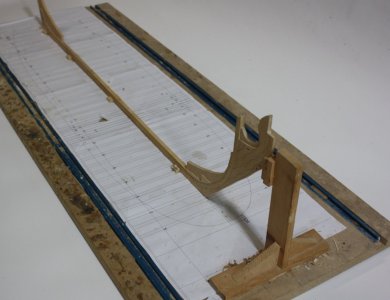
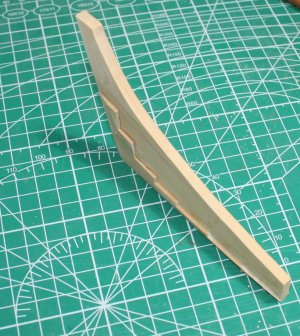
Making up the deadwood is pretty easy except for cutting the steps for the half frames. The aft deadwood on the model has fewer steps than would have been on the ship as the model will only be fully framed and unplanked in the dead flat area. The rest will have fewer frames so fewer steps as they will be planked over, never to be seen again. Still, the steps and deadwood are needed to have a solid construction. The stepped portion was actually made for the model as separate pieces, one port, one starboard rather than milling out or carving the steps. Once glued in place the initial taper was sanded towards the post and toward the keel. It is easier to make these with a bearding line, but even though it will be covered, the steps are more appropriate for the era than a bearding line which came into use much later. I am not sure exactl;y when the bearding line came into use instead of the steps. The latest contemporary drawing showing steps on an English ship that I could find is Rattlesnake and Hound 1790. The earliest showing a bearding line that I could find is Pallas, Stag, et al, 1793. Not sure the year(s) the change took place, but I feel safe that Fowey had steps, not bearding lines on the fore and aft deadwood.
Allan
1782734600817.jpeg
 
The rising wood is next. Finding the dimensions was a little challenging. The 1719 Establishment gives the dimensions for a 50 gun and a 40 gun, but not a 44. But they were the same so I am comfortable that a 44 would be the same as well. There was nothing for the later Establishments so it probably did not change. In this case it gives a depth of 8 inches and the breath that allows it to overhang the keel by 3 inches on each side (if can be had) This will require an angular trim to match the run of the frames later on.

The Shipbuilder's Repository 1788 gives a thickness of 6 inches and Steel gives a thickness of 8" for a 44. The breadth over hangs the keel 1.75 inches on each side according to the SR. Steel has an overhang of 1.5 inches on each side, half the amount in the Establishment.

The contract for a 44 of 1774 gives a thickness of 6 inches and a breadth that has an over hang of 1.75" on each side

I am comfortable with the 1719 Establishment figures but curious what other folks would do to come up with the dimensions for the rising wood for this ship.

Allan
 
Last edited:
The Shipbuilder's Repository 1788 gives a thickness of 6 inches and Steel gives a thickness of 8" for a 44.
Fowey was rated as a 44. But it was not anything like a frigate. It was a ship-of-the-line. It had two full gundecks.
SR may have been published in 1788, but it had probably existed as a manuscript for maybe 10 years before it was published.
The 44 in it was a ship-of-the-line.
It was a fat runt when compared to a frigate. That is it was too high sided and too short.

How I read the subject:

The French probably launched the first 44 gun frigate in 1794 - Forte. Even if they said it was a 50.
I do not believe in coincidence. Humphries' design for President, Constitution, United States class is very close to having the same lines. I smell some spycraft being involved.
The ink on the Steele manuscript for 1805 was probably still wet because from 1800 on - a 44 was a frigate.
Long - sleek - one full gundeck with a lot of useless junk arty on the Qdeck and foredeck. The scantlings were close to those of a 74. The 44 gun frigates were essentially a 74 with one less full gundeck.

If they had armed them with long barrel 42 or 48lb cannon a 44 probably could have shot a first or second rate to pieces and stayed out of range of the target. The total number of guns would have been lower because of the weight. A ship armed with carronade might as well surrender before the first shot.
 
Thanks Dean,
Which of the sources would you feel most comfortable with for the rising wood dimensions on Fowey 1744?
Allan
 
Last edited:
I am guessing that your choices are column 50 or 40? Keel +3"?
There is not much difference but I would go with 50. The dressing and finish will probably reduce it to spot-on.
1719 or 1745? There is a lot of 'no data' for '45 so '19 was it. Otherwise '45.
A lot comes across as "you just have to already know" jargon to me.

Being where it is there is no way to tell if it is wrong.
 
You will not do it this way
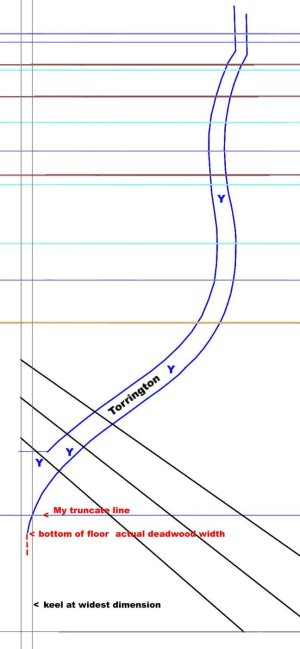
Anyway - I set the seat of my frames at the point where the outside shape intersects with the keel width line.
I set a vertical line at the keel width at the fore deadflat. I know that the keel tapers, but I keep that same line for every frame.
I also use square frames - all the way. No cants - no way - no how. No real tree short of a Redwood could be timber that is as beveled as the ends are. But for a model this is no problem.
The knife cross section even for a cant makes for thin fragile wood if it is not truncated higher up.

Fowey demo.jpg

I also became really tired of chiseling a deep "V" for the keelson. I make a wide land for the keelson. The transition from steep angle molded to horizontal is much easier to do.

Stylized framing has advantages besides looking more artful.
 
Need to take some updated photos but in the meantime the following video on the wreck site may be interesting to many of you. There are a couple comments, especially about the Tudor rose and crown cypher that I questioned after seeing this video at the museum, but it is interesting none the less and helps explain parts of the wreck site. https://vimeo.com/72920037?__cf_chl...1-NzY_LEFI4WqjeOsk27pcmzZXjmAAO7OhONEFNJm_a1U
Allan
 
Fowey was rated as a 44. But it was not anything like a frigate. It was a ship-of-the-line. It had two full gundecks.
SR may have been published in 1788, but it had probably existed as a manuscript for maybe 10 years before it was published.
The 44 in it was a ship-of-the-line.
It was a fat runt when compared to a frigate. That is it was too high sided and too short.

How I read the subject:

The French probably launched the first 44 gun frigate in 1794 - Forte. Even if they said it was a 50.
I do not believe in coincidence. Humphries' design for President, Constitution, United States class is very close to having the same lines. I smell some spycraft being involved.
The ink on the Steele manuscript for 1805 was probably still wet because from 1800 on - a 44 was a frigate.
Long - sleek - one full gundeck with a lot of useless junk arty on the Qdeck and foredeck. The scantlings were close to those of a 74. The 44 gun frigates were essentially a 74 with one less full gundeck.

If they had armed them with long barrel 42 or 48lb cannon a 44 probably could have shot a first or second rate to pieces and stayed out of range of the target. The total number of guns would have been lower because of the weight. A ship armed with carronade might as well surrender before the first shot.
So many clever deductions in just a few lines. Thanks Allan!
 
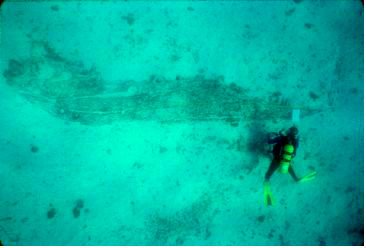
Ownership. I was asked about this and how it came to be under the control of the United States National Park Service. It is a long story, but the following is a very short version beginning with the discovery by local diver Gerald Klein in 1979. There were court battles for several years over ownership. In the end the legal disputes surrounding the wreck were resolved through international cooperation. In August 2013, the United States National Park Service (NPS) and the United Kingdom signed a Memorandum of Understanding (MOU) recognizing British title to the wreck while affirming the NPS's role in its stewardship and protection within Biscayne National Park.

The below attachment is a video from one of the dives on the wreck that is shown at the museum theatre. The narration is somewhat simplified as the average visitor has no knowledge of ships of that era or wreck sites in general. Still, the views are worth watching and the details that have been found. There are a few things that are irksome in the narration, especially regarding her cannon which I will go into later.


Allan
 
Last edited:
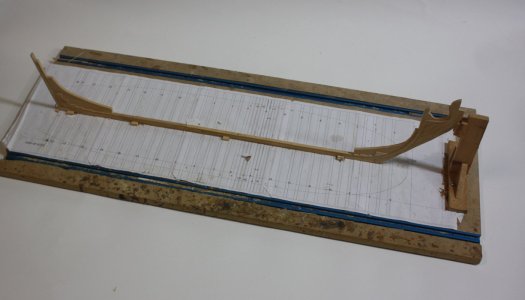
In my own experience I have found it easier to make and attach the knee of the head to the stem before moving on to framing and planking. The pics below show the keel, false keels, stem, head, deadwood with steps for the frames, and post. There are too few steps compared to the actual ship as mentioned previously, but I saw no reason to make all of them as there will be far fewer frames fore and aft of the area of the dead flat. The hog or rising is not glued in place as I have not cut the notches and cannot do that as I am waiting on the final decision from the dive team as to the framing disposition. There are three or four choices and the wreck SEEMS to indicate one in particular but I need to wait on this. In the meantime, I started making frames to keep moving along. Step by step pics of making the frames to follow.
Allan
1783427047415.jpeg

1783427074592.jpeg
 
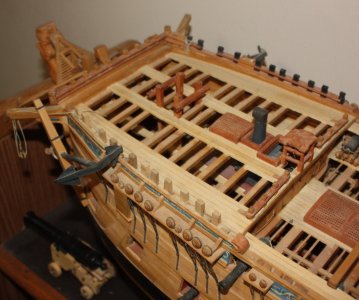
Thanks Richard. I am using Castello throughout the build. I may go with Castello for the oak deck planking and with holly for the Prussian Deal deck planks but not sure yet. Items that might have been painted red as we often see will either be Swiss pear, cherry, or paint. I received some negative comments on using holly, but it has never failed me in the past. The decks were supposedly holy stoned to be very light in color and there should be a definite contrast with the hull planking and structural members. I need to dig further into the deck planking for each deck though to see if the actual ship had oak, elm or Deal. Deal and elm came into use in the 1740's for several reasons including dwindling supplies of oak, according to Peter Goodwin on page 58 in The Construction and Fitting of the English Man of War. If oak was used I will use Castello for those strakes. The photo below shows the contrast of the holly deck planking, hull planking, and deck items that I used on a project many years ago.

I looked at some contracts but I have none for a British ship of about 1730-1750. The contract for a 44 of 1774 gives the following:

Orlop - 1.5" Oak, except Deal aft
Lower gun deck Four strakes next the waterways to be 4" oak, the rest East Country Crown (high quality pine) planking mainly from Poland and the Baltic states.
Upper gun deck Oak for two strakes next the waterways and two strakes on either side of the coamings, the rest Deal
QD Waterways and one strake next to it is oak, the rest Prussian Deal
FC Waterways and one strake next to it is oak, the rest Prussian Deal

The above is very similar to the Establishments so I am comfortable using the contract information. I have never used two different types of wood for the deck planks so this should be a different look and hopefully a nice change and conversation item.

I am wide open to suggestions.
Allan

1783438096818.jpeg
 
For White Oak = Hard Maple being picky about the grain.

For Deal - Having never come across the name as a species of present day commercial lumber - I did a search. What comes back is Scots Pine. It is a red and blonde color.
Holy stoning is just sanding to the raw fresh cut lumber color.
Marquetry white Holly will not match anything used on a full size ship. It could be used in stern carving as a background.
European Holly is yellow - = Oak
American yellow Holly = Oak
American infected Holly - a mistreated Sun bleached deck - the silver color.
Getting a model scale lumber species that is red and blonde is not easy. I would use Birch or Beech if I could get it.
 
Thanks Dean! Looks like it will be Castello, Swiss pear, and whatever represent Scots pine which is mentioned in at least one of my books.
Allan
 
Back
Top