Roger has the best answer above. The primary fastener material for ship's timbers in the eighteenth and nineteenth century (and for quite a while longer) was wrought iron, which is not excessively prone to rusting (unlike the far more expensive to make steel.) (Bronze and monel metal keelbolts fastening lead keels was a later innovation in "yacht quality" construction.) Copper was expensive and relatively soft compared to iron and so not used at all. The iron rods which were to hold against axial tension (parallel to their length) were often secured at one or both ends by hammering over an iron rove placed on the iron rod. The iron rods, called "drifts" were often driven in pairs, or larger multiples, at opposing angles to each other. Two drifts driven close together at, say, 30 degree angles to each other in opposite directions would create a fastening that would hold two timbers together far more securely than one drift driven straight down. For example, floor timbers would be secured with pairs of drifts driven at angles forming a "V" in line athwartships. The protruding tops of these drifts would then be peened over roves. This would create a very much stronger connection between the floor and top of a keel timber than a single drift driven straight down into the keel in axial tension.
For fastening timbers such as futtocks, where the tension on the fastening would be in shear (perpendicular to the joint,) the strength of the fastening would be relative to the diameter of the fastener, so the roves would probably have been omitted. The relatively rough edges of hand-wrought iron bar stock would be driven into tightly fitting holes, so where the fastening would be in shear tension, the fastening's pulling out was highly unlikely, if not categorically impossible.
Driving drifts was somewhat of a highly skilled shipwright's specialty because the hole that was bored for the drift had to be tight enough to hold the drift tightly, but not so tight that it could not be driven to the desired depth. It was not entirely uncommon to have a auger bit "freeze" in a deep bore hole and have to be "abandoned" by cutting off shank, filling the open spaces of the bore with molten tar, and plugged and another bore made. Because a drift properly driven into a timber was virtually impossible to withdraw, there was no need to thread the rod to place a nut on the end of it (which would only make sense if later disassembly of the joined parts was contemplated.)
While wooden ships were commonly "recycled" for their spars and rigging, etc., after stripping by the breakers of all accessible recyclable parts, they were usually "burned for their fastenings" to reclaim the heavy iron drifts used to fasten the framing timbers that were impossible to disassemble.
I learned these bits of trivia from an old master shipwright who took pity upon me while was trying to salvage a lead keel from the keel an old wooden boat in the knacker's yard when I was just a young kid.





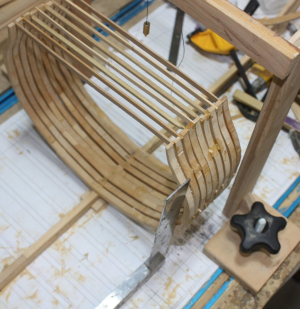
 I have more than half the frames made. I did try the Hahn method 20 years ago. I doubt I would ever use it again. Unnecessary waste of materials IMHO