• Ships of Scale has incorportated an extra level of security when you log In. Please follow on-screen prompts to acknowledge that you are not a robot via a "Check Box" or a "Pictorial Check Box Puzzle". This is needed due to higher level of AI Activity Security.
  • SUBSCRIBE TO SHIPS IN SCALE TODAY!

    The beloved Ships in Scale Magazine is back and charting a new course for 2026!
    Discover new skills, new techniques, and new inspirations in every issue.

    NOTE THAT OUR NEXT ISSUE WILL BE July/August 2026
  • Win a Free Custom Engraved Brass Coin!!!
    As a way to introduce our brass coins to the community, we will raffle off a free coin during the month of August. Follow link ABOVE for instructions for entering.

A Dutch Fluyt in shell first, reconstructing the "Ghost ship" scale 1:36

Finally a small update, not too much time for the hobby lately.
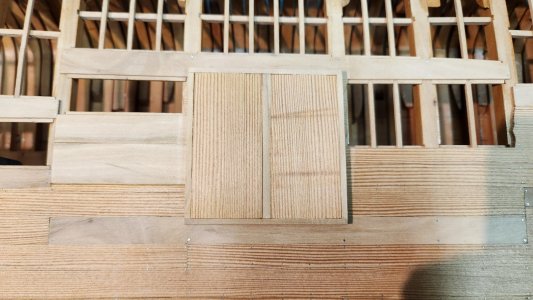
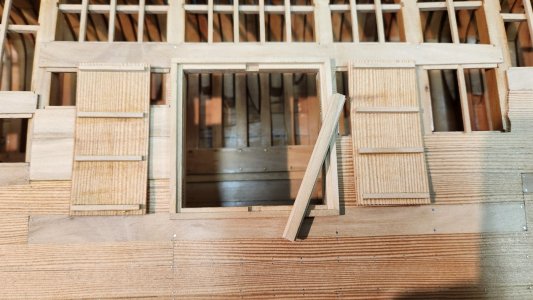
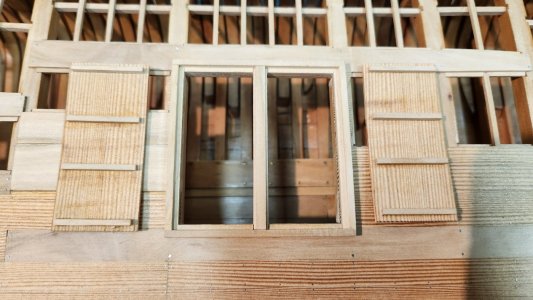
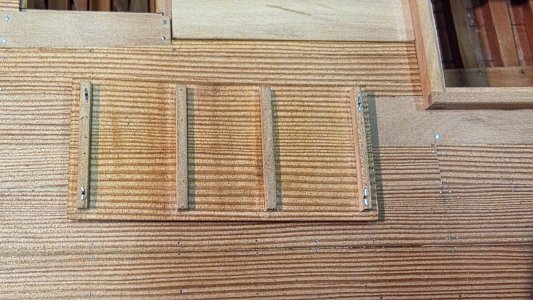
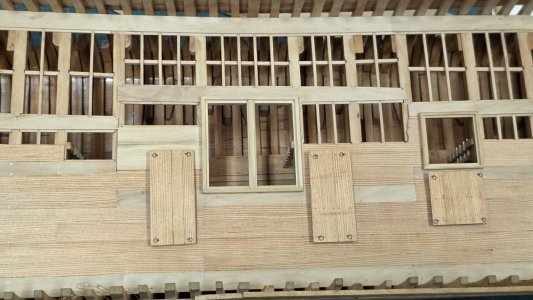
For the orlop coaming I made closed hatches.
The main hatch I splitted in two with a removable ledge in the middle to support the covers.
20260710_161345.jpg20260710_161428.jpg20260710_161448.jpg

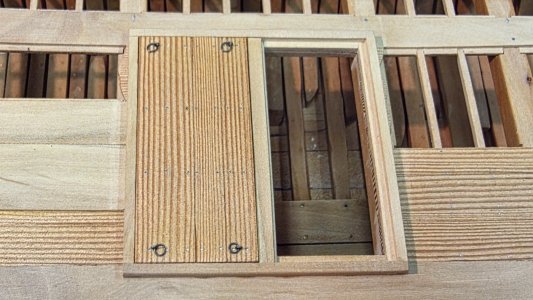
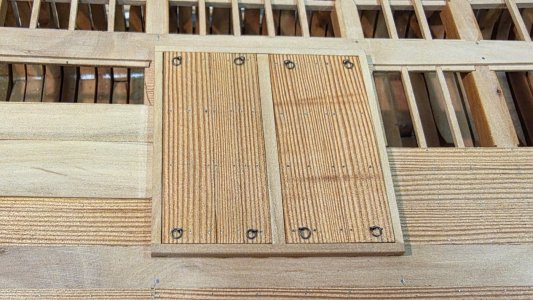
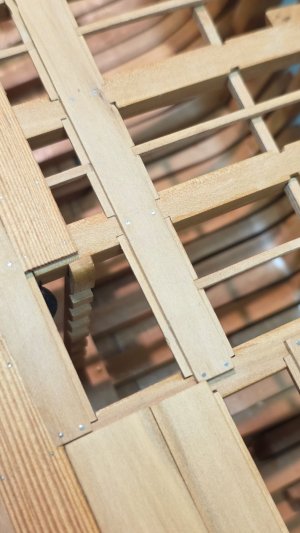
Next is the nailing of the planks and adding the rings to lift them.
20260716_200350.jpg
20260716_200736.jpg
20260717_145202.jpg

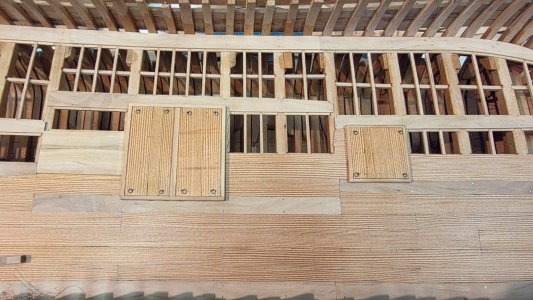
The fwd hatch cover is a single piece.
20260720_200034.jpg

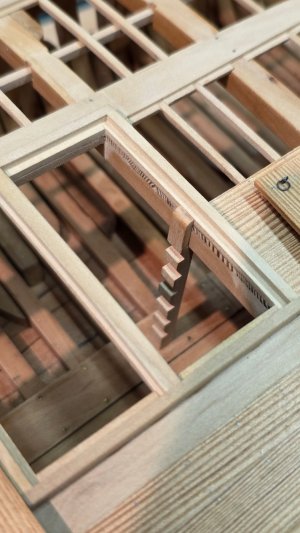
Now working on the ladders in the holds.
20260720_215330.jpg
20260720_215338.jpg

And a brief overview.
20260720_215613.jpg
 
Finally a small update, not too much time for the hobby lately.
For the orlop coaming I made closed hatches.
The main hatch I splitted in two with a removable ledge in the middle to support the covers.
View attachment 620525View attachment 620526View attachment 620527

Next is the nailing of the planks and adding the rings to lift them.
View attachment 620528
View attachment 620529
View attachment 620530

The fwd hatch cover is a single piece.
View attachment 620531

Now working on the ladders in the holds.
View attachment 620532
View attachment 620533

And a brief overview.
View attachment 620534
Nice hatches with nice details, Maarten.
Regards, Peter
 
I'm late again—wasn't yesterday your birthday? Well, belated happy birthday, and I hope you had a wonderful day.
 
Hi Paul,

Yes this I did with my small proxxon mill. I use a plank with a small pin in it.
Position the pin partly under the mill so if I put the plank under it it just cuts away the 1,3 mm width I need.
Then I adjust the mill at the proper height. Turn on the mill and push the planks underneath it.
All your slots are the same, even in curved planks. This methode works very fast.
Dear Maarten,

I ready your articels today for the secend time and I do have got a typical beginners' question for Durch shipbuilding:
Are these rules the same in use for the build of a warship? Or is the change frome pine to oak a complete gamechanger?

Thanks a lot, Chris
 
Hi Maarten,

I am new to this forum and to model ship building but when I found your thread I just plowed through all 62 pages in 2 days. There is a little story behind me finding the thread and I wish to share it.

Around 16 years ago, I played a small part in a project in the Baltic sea. At the time, I was reasonably new in my profession and it has come to mean quite a lot for me. As I was starting to think about re-modeling our sitting room at home, I decided I wanted a model ship in there as marine archaeology is a bit of a passion even though I did not go down that path professionally. Because of that small project I took part of 16 years ago, I decided that the obvious ship to have was a Fluyt and I started looking for models when I stumbled on your build. The attention to detail is absolutely amazing and I love that you make all the frame members different sizes and shapes, just as I have seen on virtually every wreck I have visited.
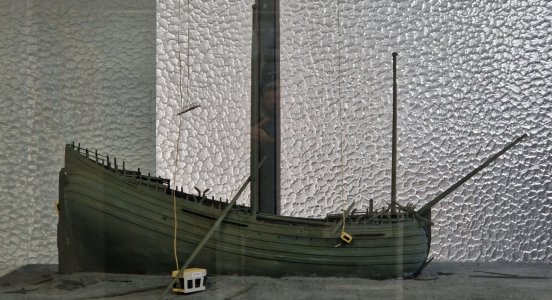
I don't know if you are aware but there are two models of the Swan or "Ghostship" in existence already but they are both in her present state. After that little project in the Baltic was completed, two models of the wreck were commissioned. One was placed in a Swedish university and the other sat as a display at the company I worked for back then. Fast forward a bunch of years and the model disappeared, the company was sold and I subsequently switched employer. At my new place of work, the other model turned up and I am now looking into restoring it and creating a better looking display case for it. This is currently the only picture I have but I am sure you recognize her :)
20260326_160052.jpg

I do not know how accurately she is build in terms of ship construction but as the wreck sits, she is very accurate. If you wish, I can snap som more detailed pictures in the upcoming weeks when I have time to go over to the workshop.
I now work quite a lot with marine archaeology and there are quite a few of these around in similar or better state of preserve. We have an upcoming long term project to bring these to the surface with photogrammetry so hopefully there will be a lot more data available within the upcoming years.

Regarding my Fluyt model, I realised that I can't just start there so I have just placed an order from Occre for my first two simpler models and maybe in a few years time I will have my Fluyt :)
Thank You for this gem of a build. I will follow it until completion

Kind Regards,
Erik
 
Hi Erik,
Thank you for your visit and I am delighted by your story and the picture you show above.
I wasn't aware there was a model made of the wreck, but she looks very realistic at a first glance.
I know that the wreck was sonar scanned so there must be a 3D model of her, so maybe the model is based on the sonar data.

All I have I shared in my blog but any additional data there is is extremely welcome and very interesting to see.
While doing research as a hobbyist you sometimes find closed doors but from time to time a new one opens and the above model is certainly one. The pictures of this model will be very valuable for my build.

Welcome to the hobby and starting with a kit makes very good sence. For you as an archeologist I am convinced you will have a lot of fun to build a model of a flute from scratch in the near future. Building one will need your attention and research to every part present in the real ship which is great fun and here are always people willing to help.

New wreck data is also very helpfull, as you have seen I use a lot of wreck data of other wrecks in different stages of decay to interpret internal construction details. So not only these magnificent complete ships are valuable but sometimes also wreck of just a small part of remaining hull sections.

Many thanks again and looking forward to the pictures.
 
Hi Erik,
Thank you for your visit and I am delighted by your story and the picture you show above.
I wasn't aware there was a model made of the wreck, but she looks very realistic at a first glance.
I know that the wreck was sonar scanned so there must be a 3D model of her, so maybe the model is based on the sonar data.

All I have I shared in my blog but any additional data there is is extremely welcome and very interesting to see.
While doing research as a hobbyist you sometimes find closed doors but from time to time a new one opens and the above model is certainly one. The pictures of this model will be very valuable for my build.

Welcome to the hobby and starting with a kit makes very good sence. For you as an archeologist I am convinced you will have a lot of fun to build a model of a flute from scratch in the near future. Building one will need your attention and research to every part present in the real ship which is great fun and here are always people willing to help.

New wreck data is also very helpfull, as you have seen I use a lot of wreck data of other wrecks in different stages of decay to interpret internal construction details. So not only these magnificent complete ships are valuable but sometimes also wreck of just a small part of remaining hull sections.

Many thanks again and looking forward to the pictures.

Hi,
During the project we surveyed the wreck with ROV mounted multibeam and quite a few hours of video material. This was however quite some time ago and the technology was not quite where it is today. The sonar was mounted below the Sub-Atlantic Mohican that i have seen in some of the pictures you shared. We also mounted a smaller 20 x 20 cm ROV on another vehicle to try and penetrate the wreck but that was only rated to 75 m and water ingress killed it before we could use it.
I believe the sonar data is forever lost but there may be things in the old archives. I will dig around and see if we can open that door a little bit further. :)
I will head to the workshop latest next week and should then be able to snap some more pictures for you.

I don't know if this is allowed and I don't do this as an advertisement, but I really recommend our book Ghost Ships of the Baltic Sea by Jonas Dahm and Carl Douglas. Lots of very well composed pictures of wrecks in different states from all around the baltic from the 16th century and onwards. It only contains one picture from a fluyt though and it is a detail from a carving in the stern. I am not writing this to sell books, I just think it is a fantastic book :cool:
 
Back
Top