• Win a Free Custom Engraved Brass Coin!!!
    As a way to introduce our brass coins to the community, we will raffle off a free coin during the month of August. Follow link ABOVE for instructions for entering.
  • SUBSCRIBE TO SHIPS IN SCALE TODAY!

    The beloved Ships in Scale Magazine is back and charting a new course for 2026!
    Discover new skills, new techniques, and new inspirations in every issue.

    NOTE THAT OUR NEXT ISSUE WILL BE MARCH/APRIL 2026

School for Shipmodel Building School for model ship building

There is a lot that goes into building a model ship. After looking at your new page, I quickly went and had a look at the Decking on the Bounty in John McKay's book, and he shows 4mm wide boards for 1:48 scale. I noticed you have silver maple 1/8 x .080, and are those for the deck?

yes that is the decking

i took a look at John McKay's book and counted 37 deck planks and the Bounty is overall 24 feet 4 inches breadth deck is around 20ish feet wide so each plank is about 6 1/2 to 7 inches wide on the drawing. The 1/8 wide planking is a bit wider making the deck planks 6 1/2 wide well within acceptable scale.
 
Very interesting discussion. This entire series is quite informative and useful on scratch-building.

On this model the width of the deck planking is about 18 inches wide
I'm curious where you get that the deck planking on that model (which I think is of the cutter HMS Sherbourne) is 18 inches wide. I count 22 planks across the deck. The real Sherbourne had a beam of 19 feet, per wikipedia. Subtracting a foot to roughly take into account the thickness of the gunwales etc, and dividing by 22 planks, that corresponds to planks scaling to roughly 9.8 inches wide on the model.

It's interesting that the contract you show states that the deck planks were to be 5 inches wide. How typical was this? I was under the impression that deck planking was usually wider on earlier vessels, and narrower later. Chapelle says that fishing schooners usually had 5-7 inch wide decking pre-1845, and narrower in later years. For warships, my impression is that they were generally wider, although also became relatively narrower with time.
 
you correct the 18 inch is wrong so i went back and changed it

i counted 20 planks could be 22 but i went with 20 planks X 11 inches wide planks =220 inches divide that by 12 and you get 18.3 feet across the deck. Still out of scale IF the average deck plank is 5 to 7 inch max.

VM169 blue.jpg
 
It's interesting that the contract you show states that the deck planks were to be 5 inches wide. How typical was this?

that i cannot answer i went with what i saw on actual ships and the deck planking were 4 1/2 to 5 inch wide. it is rare to find the width of the plank the thickness is always listed

deking thick.JPG

I was under the impression that deck planking was usually wider on earlier vessels, and narrower later. Chapelle says that fishing schooners usually had 5-7 inch wide decking pre-1845, and narrower in later years. For warships, my impression is that they were generally wider, although also became relatively narrower with time.

that is something perhaps someone can shed some light on. I heard the deck planking was wider because wider planks were available and as lumber became harder to get the planking became narrower but i do not think that is right. I think narrow planking was a structural thing and had nothing to do with available lumber.
What i heard was the rule deck planks were twice as wide as they were thick. Which seems right a 2 1/2 thick plank would be 5 inches wide. When you look at the scantlings a 4 inch thick deck plank would be 9 inches wide give or take a half inch.
 
There is a lot that goes into building a model ship. After looking at your new page, I quickly went and had a look at the Decking on the Bounty in John McKay's book, and he shows 4mm wide boards for 1:48 scale. I noticed you have silver maple 1/8 x .080, and are those for the deck?

yes that is the decking

i took a look at John McKay's book and counted 37 deck planks and the Bounty is overall 24 feet 4 inches breadth deck is around 20ish feet wide so each plank is about 6 1/2 to 7 inches wide on the drawing. The 1/8 wide planking is a bit wider making the deck planks 6 1/2 wide well within acceptable scale.
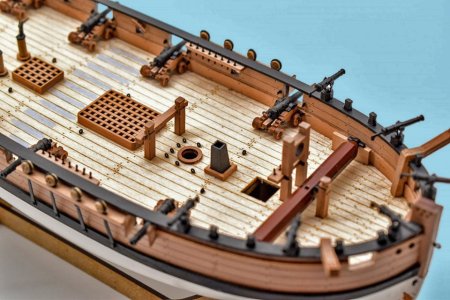
Thanks for that Dave. So, making the planking would be a hellish job for you to do. I actually was given teak from off a ship deck, and it was about 5.5 " wide and 3" thick. The tar had impregnated into the teak and when I machined it up for a small shelf I made, the teak looked wonderful in the colour contrast between the teak and the embedded tar.
However, what I gained out of your information on the width of wood used, and remembering the measurements of that piece of decking, nothing has changed over the centuries.
 
I agree with Donnie's comments of March 3, 2025. To simply say that anything other than a totally scratch-built model is not worthy of admiration, etc., discounts the very fine work by many of the modelers in the forum.

To me this creates the question, why isn't there room, appreciation, admiration for models having been built using a combination of both methods? Having recently finished the Corel version of the HMS VICTORY cross section (a totally poor representation of the actual ship which starts with the model's photo on the box) I had to do a lot (underscore "a lot") of scratch-building to get a finished model that looks very much like my full model of the ship and one of which I am proud to show. I am restarting my build of the Vasa (Corel version) and have already begun to scratch build parts of the hull, main deck, etc., that are not "included" in the kit with help from various sources including Fred Hocker. I expect to have to do much more before I finish it.

What I learn from this forum, seeing what others have done, is all part of my, or, I would suggest, anyone's growth in this hobby. I vote for both approaches.
 
I agree with Donnie's comments of March 3, 2025. To simply say that anything other than a totally scratch-built model is not worthy of admiration, etc., discounts the very fine work by many of the modelers in the forum.

To me this creates the question, why isn't there room, appreciation, admiration for models having been built using a combination of both methods? Having recently finished the Corel version of the HMS VICTORY cross section (a totally poor representation of the actual ship which starts with the model's photo on the box) I had to do a lot (underscore "a lot") of scratch-building to get a finished model that looks very much like my full model of the ship and one of which I am proud to show. I am restarting my build of the Vasa (Corel version) and have already begun to scratch build parts of the hull, main deck, etc., that are not "included" in the kit with help from various sources including Fred Hocker. I expect to have to do much more before I finish it.

What I learn from this forum, seeing what others have done, is all part of my, or, I would suggest, anyone's growth in this hobby. I vote for both approaches.

and what this have to do with deck planking?
 
From HASN - appendix
Warren & Falmouth
General Instructions for building a Sloop of War (Corvette)
660 tons
1826

Berth deck Plank

of heart pine free from sap, shakes, or large knots
& not more than 10" in width.
2.5 inches thickness
Average length to be 40'
To be fastened into the beams with 6" spikes
into the ledges with 5" spikes
which are to be punched down so as to admit above the heads a heart pine plug - 3/4" in thickness -to be put in dipped in white lead

Gun deck Plank

of this deck to be heart pine free of sap
3.5" thick
and not more than 10" wide
average length 40'
beams 8" iron spikes
ledges 7" spikes
To be managed as those on the berth deck
The plank to be planed on both sides

Poop and Forecastle deck
2" thick
heart pine free from sap
fastened with 5" iron spikes plugged and planed on both sides

Nothing on Spar deck

Also interesting:
Port cills
live oak
6" thick
Take care that these cills make a fair sheer & the decks kept at their proper distance from them

Which means that models with horizontal port cills are historically pure BS.


My take home from this is that the outer limit
for deck plank width is 10"
length 40'

I do not imagine that the east side of the Atlantic had ready access to virgin growth tall ramrod straight Tidewater pine that could produce 40' length and 10" width.
 
Sorry Dave, I gotta say it. I will remove if asked.


To simply say that anything other than a totally scratch-built model is not worthy of admiration, etc., discounts the very fine work by many of the modelers in the forum.
This depends on who the audience is. Fellow kit builders is one thing. Dedicated scratch builders are quite another. Kits are to be admired for what they really are. The pretensions about any similarity to the goals and ideals of scratch are totally misplaced fantasies - as is the advertising copy of kits. The product has to be sifted down to a common denominator to produce something that the target customers will afford. Then you are supposed to disregard the ton of compromises and pretend they were never made?

Having recently finished the Corel version of the HMS VICTORY cross section (a totally poor representation of the actual ship which starts with the model's photo on the box) I had to do a lot (underscore "a lot") of scratch-building to get a finished model that looks very much like my full model of the ship and one of which I am proud to show. I am restarting my build of the Vasa (Corel version) and have already begun to scratch build parts of the hull, main deck, etc., that are not "included" in the kit with help from various sources including Fred Hocker. I expect to have to do much more before I finish it.
In your place I would save the money spent on the kits. ( you are not using much of it anyway so why bother?). Instead buy Victory design plans and the best museum plans for Vasa. Do a total scratch build. You can do any scale that way. Put in the lofting work and part fabrication. Use the actual known scantlings. Use quality wood with proper grain and tightness and color and hardness. When you have done that then see if you still view kits in the same light.

Here is an idea:
Instead of doing another Xerox of subjects already done to death and a kit by definition is a Xerox:
why not chose a vessel that may have never been modeled? (as far as can be known - most serious scratch builders do not advertise)
 
Last edited:
Sorry Dave, I gotta say it. I will remove if asked.

that is welcome information so we can say decking can be from 5 to 10 inch wide. Why the builders of the Niagara at Erie PA used 4 1/2 wide planks is a "i do not know" but it is said She is a faithful reconstruction of Oliver Hazard Perry’s relief flagship so did the actual Niagara have narrow decking?
seems the deeper we go the more it looks like each ship was a one off build and no two were exactly the same.
 
and what this have to do with deck planking

and what this have to do with deck planking?
Why not? You may have the tools, i.e., mini band saws, laser CNC cutters, etc. that you can use to cut your own planks. I do not therefore I have to use what comes in a kit or purchase planking materials from another source such as Model Expo or Cornwall. I still may have to do something with those planks, taper, sand the edges, for whatever purpose they are called for. Where does scratch-building start and strictly kit-building start or vice versa?
 
Where does scratch-building start and strictly kit-building start or vice versa?

Easy answer: A scratch build starts when the modeler decides which subject he wishes to model picked from an unlimited selection of subjects, the majority of which have very rarely, if ever, been modeled before, thereby making his model a unique expression of his own artistry. The scratch modeler then engineers the construction of his model and drafts the necessary lines to scale. Every detail is researched to ensure the highest level of accuracy possible, preferably beginning with copies of the original builder's plans where available, supplemented generally from the scratch-modeler's own research library. The scratch modeler then builds his model of appropriate quality materials having the highest archival properties possible using construction methods which are chosen for their reversibility in anticipation of necessary conservation and repairs over the desired life of the model.

An experienced scratch-modeler will not infrequently spend more time researching, engineering, and drafting the plans for a scratch-built model than it takes to actually build the model and will find such research and planning to be as enjoyable, if not more so, that the actual building itself.

The experienced serious scratch-modeler does these things secure in the knowledge that there is virtually no ship model kit available which can yield a model having as high a level of originality and quality as is possible for him to achieve through his own devices, limited only by his own skill level and not by the restrictions on quality imposed by mercantile economics.

There are modelers who will significantly improve the results possible from a "raw" ship model kit in a variety of ways, often by substituting better quality materials and adding additional details to what the kit provides. Some will even go so far as to deviate from the kit-supplied plans to correct the often-seen historical errors and anachronisms seen in many, if not most, ship model kit plans. This is not at all scratch-building. Neither is it "semi-scratch" building, a category that actually doesn't exist. An improved kit model is classified as a "modified kit model."

Notwithstanding improvements, kit modelers remain constrained by the remaining shortcomings of the kit and, regardless of how well it may be executed, the result will always a kit and one of hundreds of copies, rather than the modeler's original work. In fact, the skills necessary to upgrade a kit product to a ship model worthy of admiration based upon the quality of its build are equivalent to those required to build a comparable model from scratch, so when such well-done kit-builds are encountered, experienced scratch builders find themselves at a loss to understand why a modeler with the skills exhibited would have bothered to assemble a kit rather than build from scratch, especially when the prices of kits are so high.

Official answers:

In international ship modeling competitions, NAVIGA has an entirely separate sub-class for kit models. In the United States, the generally recognized ship model competition classes are those promulgated by The Mariners Museum, Model Ship Craftsman Competition, and Mystic Seaport:

CATEGORIES OF SHIP MODELS

CLASS A - SCRATCH-BUILT MODEL:
Model built entirely from scratch materials by the builder with no commercially fabricated parts except cordage, chain and belaying pins.

CLASS B - SPECIAL MODIFIED SCRATCH-BUILT MODEL: Model built from scratch but supplemented by the use of some commercially fabricated accessories.

CLASS C - MODIFIED KIT MODEL: Model built from materials provided in commercial kit, supplemented by other commercially fabricated parts or by scratch-built parts.

CLASS D - KIT MODEL: Model built entirely from materials provided in commercial kits.

SUBCATEGORIES: Model built and/or displayed in any of the following methods: Antique Waterline Cross Section Cut-away Exposed Interior Sailing Half Hull Power Rare Materials Diorama Mechanized Builder’s Extreme Miniature Ship in a Bottle Shadowbox Americana Folk Art Decorative Production Pond Model Other
 
Last edited:
Back
Top