
• SUBSCRIBE TO SHIPS IN SCALE TODAY!

    The beloved Ships in Scale Magazine is back and charting a new course for 2026!
    Discover new skills, new techniques, and new inspirations in every issue.

    NOTE THAT OUR NEXT ISSUE WILL BE July/August 2026
  • Win a Free Custom Engraved Brass Coin!!!
    As a way to introduce our brass coins to the community, we will raffle off a free coin during the month of August. Follow link ABOVE for instructions for entering.

Mini Hobby 80502 1/350 Scale USS Enterprise CVN-65 Early

Mini Hobby 80502 1/350 Scale USS Enterprise CVN-65 Early

Part 17 Working on the under deck structure Part 1

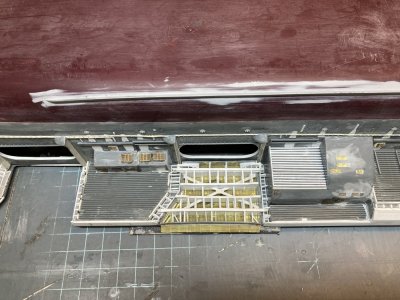
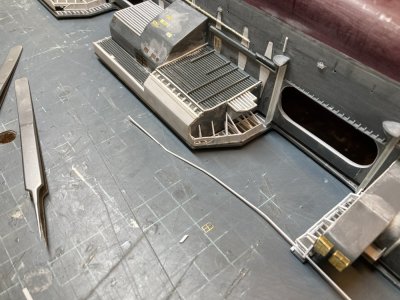
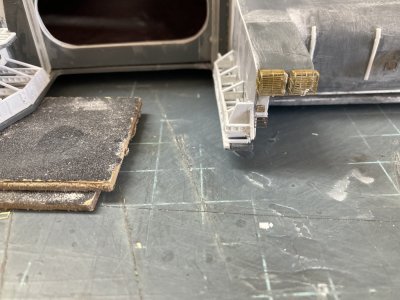
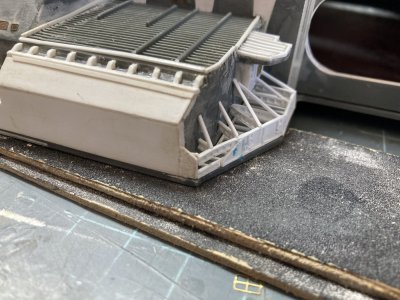
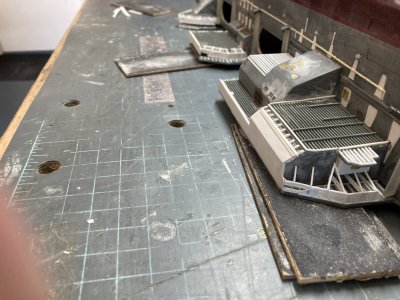
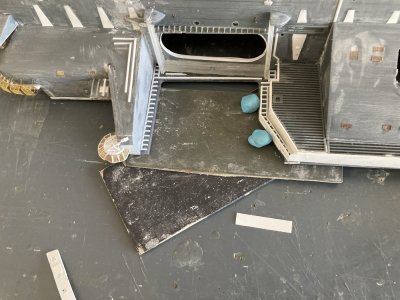
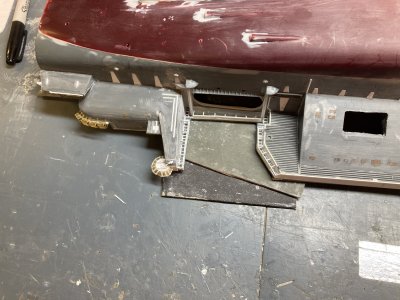
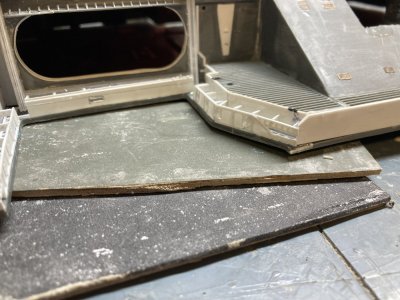
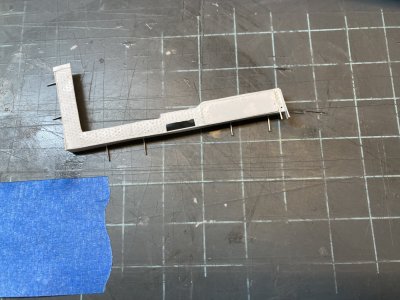
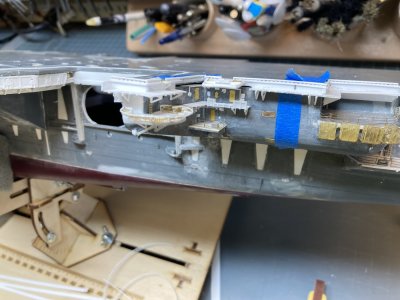
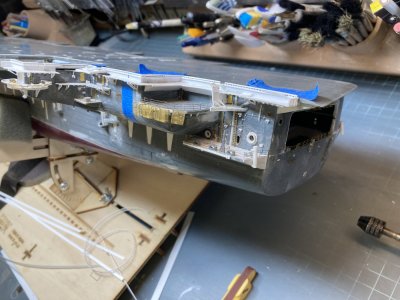
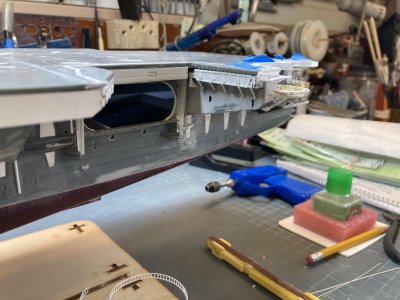
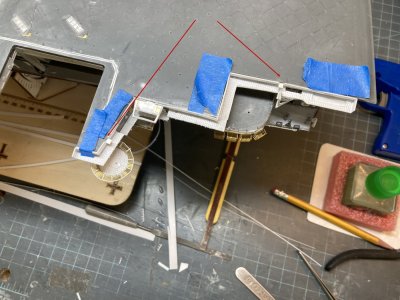
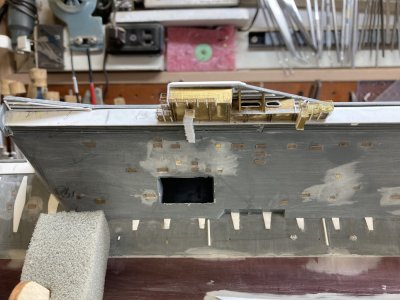
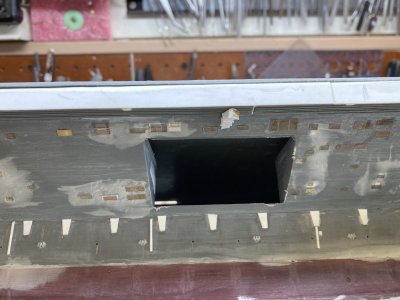
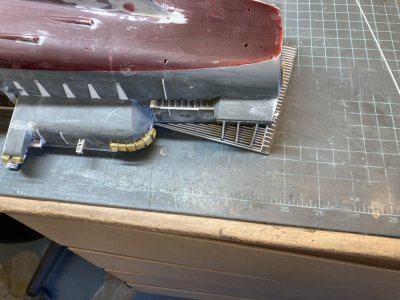
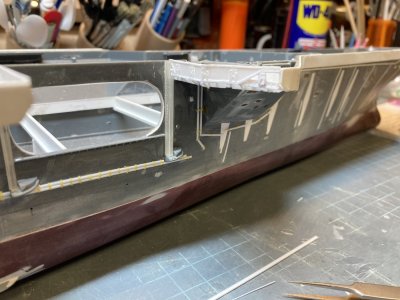
Back when I removed the catwalks from the flight deck I also removed all of the underside detail that was there originally. It was interfering with the flight deck fitting to the hull so I sanded it all away. There wasn’t any in the area around the elevators anyways. The flight deck has pins now that ensure it always is positively located. When I was working on Sponsons 8 and 9 I started adding the girders to the aft end of the flight deck under the ramp. Now I began filling in the area under the starboard side going forward. There is a pretty good sized overhang in this area and I filled it in with .030” square strip. There are 3 angled gussets that run more or less perpendicular to the girders. I placed the girders the full length of the overhang and when they had dried cut away spaces for the gussets to fit into. The locating slots for the gussets made sure they were positioned correctly.
Flight Deck Second Round (22).JPG

I have completed the girders on the overhang on the starboard side. Note the 3 gussets. The forward one is not correct and I removed it later. On the forward end of sponson10 I noticed that the extension I added had no gusset and I added one there.


I glued the 3 gussets in place and while I was trying to get a clearer photo of the detail on the gussets I came to realize that only 2 were needed. I can’t find any photos that show 3. I removed the smallest one and put a piece of flat strip in its place. This will be directly over the 03 level landing so it will be difficult to see anyways. It is possible that the gusset was under there but I am going without it. Each gusset was wrapped on the exterior edge with a section of .010” X .060” strip then vertical .010” X .030” strips were added to each the faces.
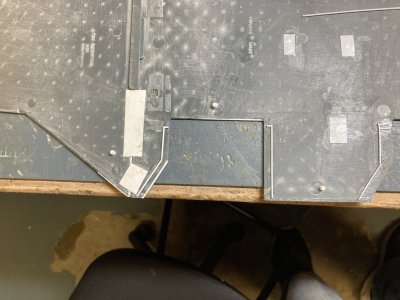
Flight Deck Second Round (28).JPG

This is how I outlined the area where girders need to be added.
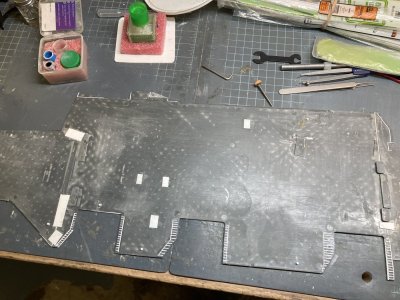
Flight Deck Second Round (31).JPG

The work on the starboard side is done.
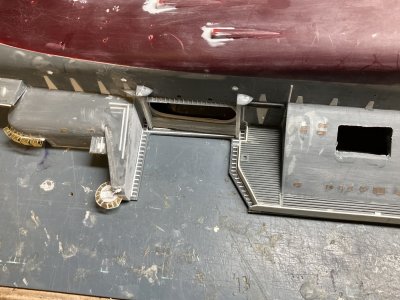
Flight Deck Second Round (38).JPG

This is the area around Elevator 4.


I flipped the hull with the flight deck over and drew the outline on the rest of the overhanging deck to see exactly where the girders will be needed. This will be primarily around each elevator and under the angle deck to some extent. While the hull was upside down and still sitting on the flight deck I went a step further and cut and fitted .030” square strip to outline the features in the elevator wells and the overhang at the angle deck. This may not be accurate but it ensures there won’t be any gaps in the support structure.
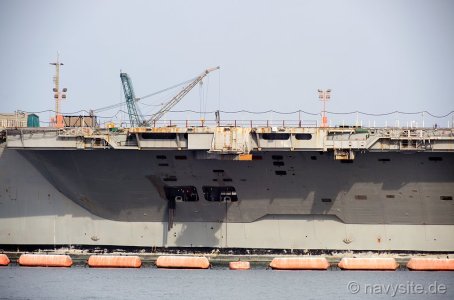
cvn65nn8.jpg

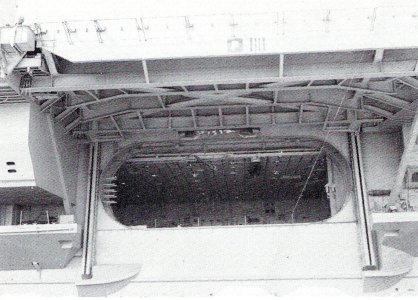
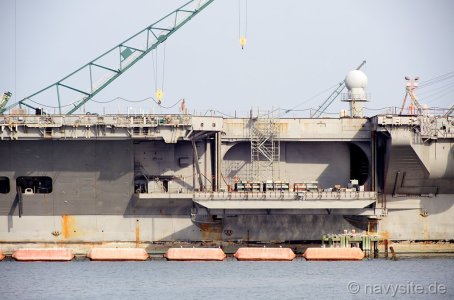
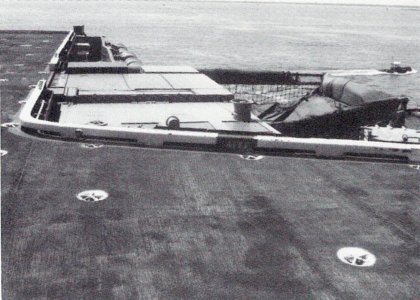
This photo shows the landing which provides several entrances to the 03 level, also called the Gallery Deck. This was taken after they have started stripping the ship..
Hull 112.jpg6

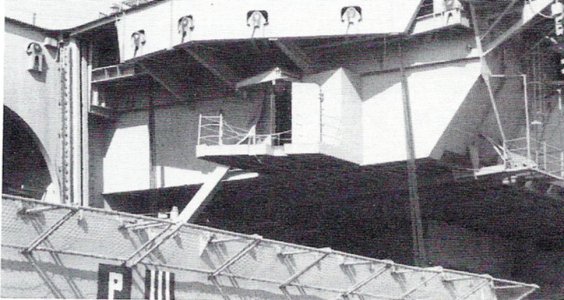
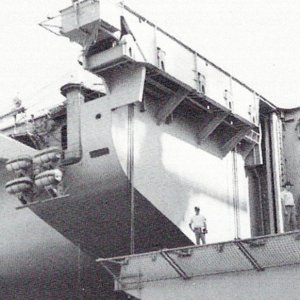
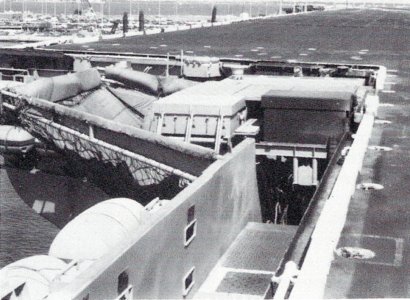
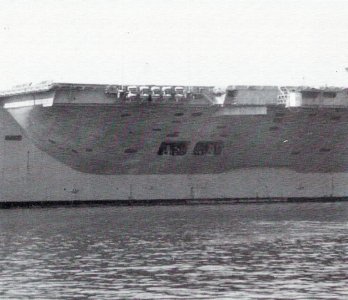
This grainy photo from the early 80’s shows this area as it also was in 1978.
7879695306_3b3fe70700_o.jpg

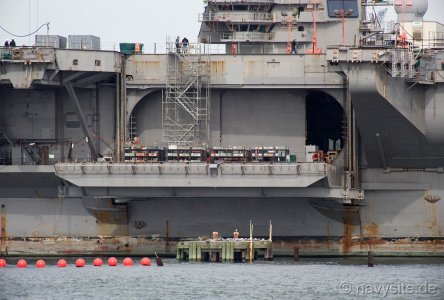
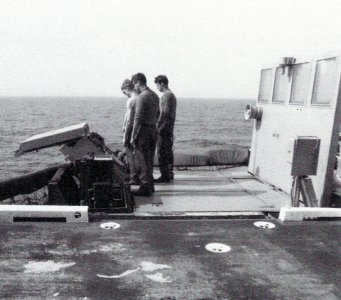
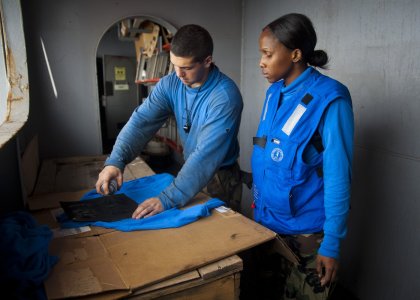
This is a photo of the interior of that landing area. The 2 blue shirts are stenciling flight deck jerseys.


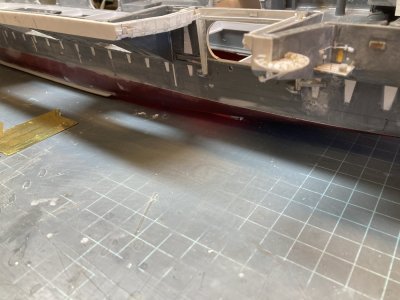
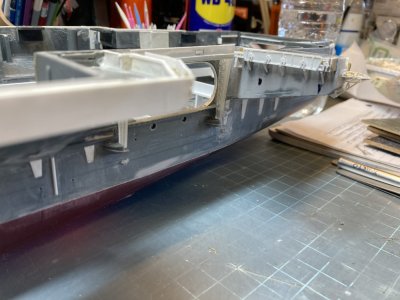
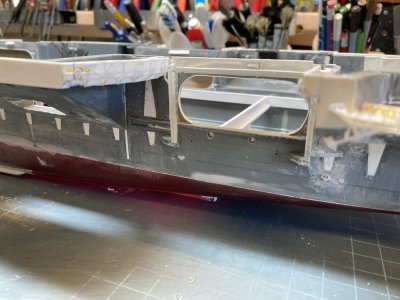
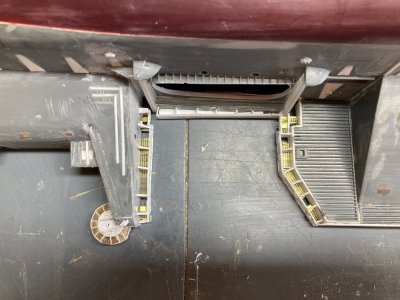
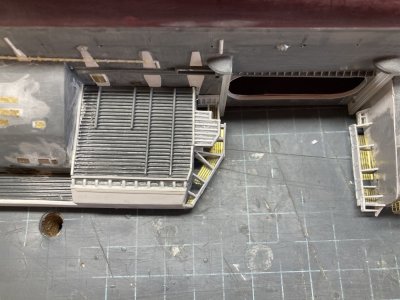
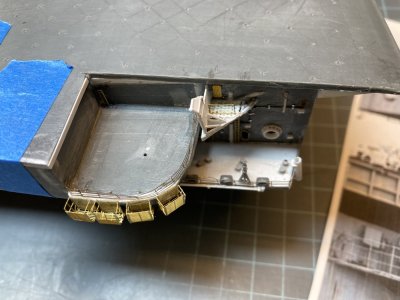
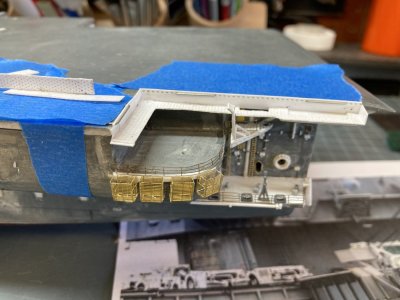
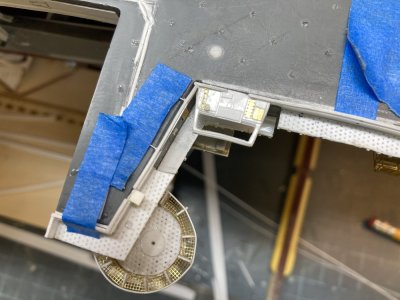
Under the aft section of angle deck there is an enclosed landing to the 03 level which is not represented in the model kit. The Eduard set part 5 has this piece pretty much as it was on the exterior in 1978. This is a large piece of brass and rather than gluing it together, after it was folded, I soldered it. I did not add the details yet I just wanted the basic assembly. I needed this piece in place to lay out the girders under the angle. This landing was the flight deck entrance which led to my shop. I remember knee knockers at the forward and aft entrances and a couple more inside. There were originally 4 oval openings to the exterior when the ship was built but by 1978 the forward pair was covered by an equipment room extension for the port ECM antenna. During the 1976 deployment there were still 3 openings.
Catwalks (1).JPG

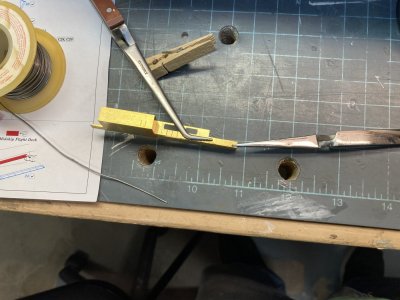
I have just about finished soldering the part.
Flight Deck Second Round (40).JPG

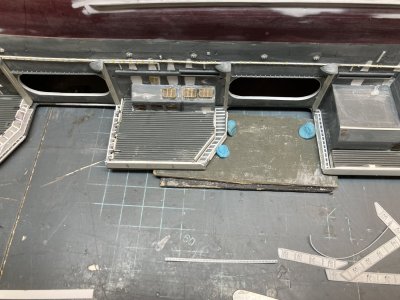
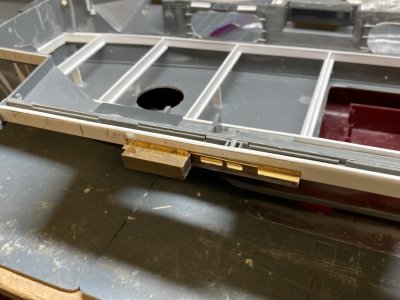
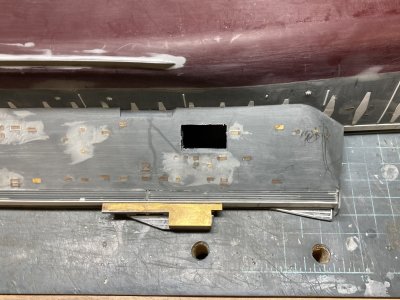
This is the Eduard part glued to the model. There is quite a bit missing from the interior and the catwalks.
Flight Deck Second Round (39).JPG

I am in process of adding the girders around the exterior.


We actually used to sit in the openings when we were in port. There was a 6 inch sill which went around the oval and made a convenient seat. I remember being in port in the Philippines during the 1976 cruise I was in the Duty Section and was required to remain aboard. The ship had to pull out into the bay and anchor for a couple of days because of a storm. It wasn’t a big storm but because of wind gusts and the waves in the bay the ship wanted to play it safe. The airplanes were all ashore at Cubi Point and there wasn’t much work to do on board. I was able to relax aboard for the most part. I couldn’t get ashore but most of my supervisors couldn’t get aboard either. It was generally nice and cool in that passageway and the design caused a breeze to flow through it. It was a great place to read when we weren’t operating.

The Eduard piece is simplified as it does not have the various knee knockers or the outboard bulkhead that covered the openings. The room is open to the passageway. I will add those parts with plastic when I get to detailing this area. You won’t see much in there but it will have some value to me. There were 2 or 3 passageways off this landing to shops under the flight deck. I know there was one aft of ours and I am pretty sure there was a third. We explored them to see if there was a better way into the main interior passageways but all the exits were the same, go down to the main deck, go inboard and climb back up to the 03 level.
Flight Deck Second Round (42).JPG

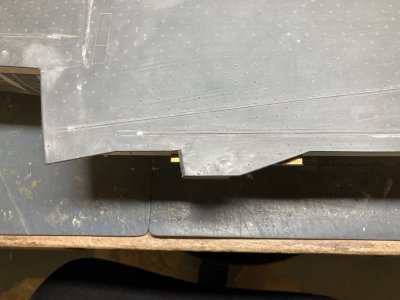
The assembled landing was positioned so that it extended past the angle precisely. This allows the inclined ladders from the catwalks to reach the landing. Once I was happy with the position I glued it to the hull with medium superglue and flipped the ship right side up. With the flight deck removed I made sure that the landing was correctly adjusted. Then it was hit with accelerator. I also let thin CA run into the joint making a good strong connection. I turned the model over again and laid out the outline of girders around the landing.
4813855912_dfe1cfe2a4_z.jpg

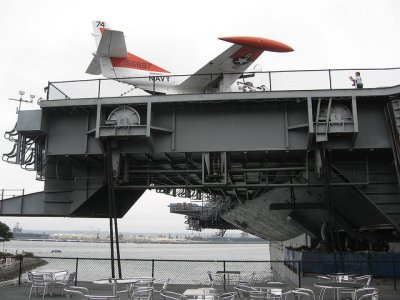
This is a photo from a museum ship I am not sure which one but this is generally what would be behind the elevator skirts.


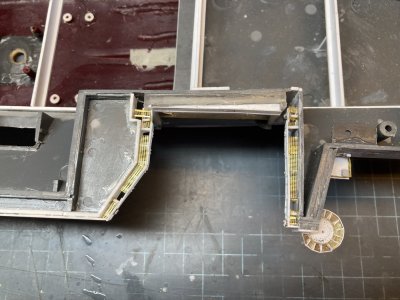
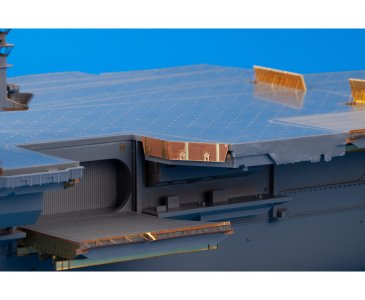
When all the basic layout work was done the ship was set upright and the flight deck removed. I could then work on the underside of the flight deck itself to finish the girder detail. This involved a lot of very small pieces of strip. Around the elevator fore and aft edges I left about a .020” space to accommodate the elevator skirts (I am sure there is a proper name for these facings to the elevator wells but I don’t know what it is). These skirts have the up locks and cover the cable reels. The model does not provide any of this structure. The Eduard set part Number 4 has the skirts, up locks and supporting structure for the Elevator 2 and 3 skirts. These are the elevators which they instruct you to lower. There are some struts but no skirts for Elevator 4 and nothing for the area around Elevator 1 since it is molded to the deck in the Tamiya kit.
002.jpg

This is the Eduard photo etch at Elevator 2, notice how it is attached to the edge of the flight deck. This is from Eduard’s page in their digital catalog.


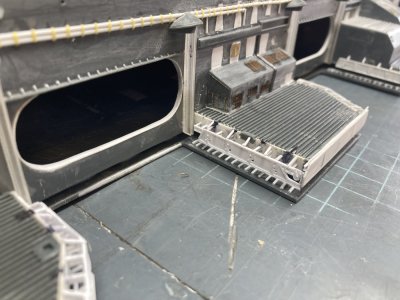
Between Elevator 2 and 3 at Sponson 1 Eduard has you add a framework piece to the forward side of the big vent box. I have to confess that I never saw that in any photo until I got this Eduard set. I went back to my photos and then found it in several. I added about 15 fore and aft girders to the overhead of Sponson 3 from .030” square strip. This area was blank and it has a lot of overhang out in the open.
Flight Deck Second Round (54).JPG

This shows the framework piece from the Eduard set on the edge of the vent box. I am pretty far along with the skirts in this photo. Unfortunately the flight deck has dropped away from the hull spoiling the effect.


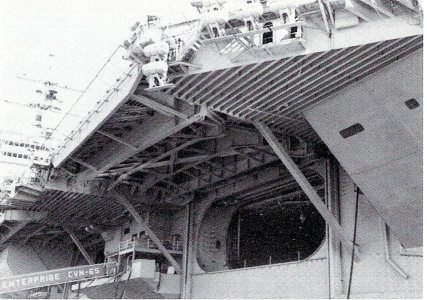
The Eduard parts for Elevators 2 and 3 are supposed to be glued to the edges of the elevator openings. They add just enough thickness to the opening that the elevators won’t fit if they are in place. Cutting them shorter to sit on the flight deck would be difficult and I did not want to sand the edges of the previously assembled elevators. Neither of the two sets will be useful on the starboard side so I will make my own. I looked into the possibility of using one or the other of these 2 sets at Elevator 4 but the detail would have to be on the inside since this elevator is a mirror image of the others. The parts would have the plain side out and none of the struts fit. There was one brass support for the structure at Elevator 2 which I would have used but after I folded it I dropped it on the floor and then rolled my chair over it. It was broken at all the fold lines and I never found one piece. The idea was pretty easy to duplicate in plastic. There is another of these struts at elevator 4.

All 3 of these elevators are very close to each other in size in the kit but in real life they were each unique. It simplifies the cut program because I can make all the skirts the same. I can make them slightly longer than I need and cut them shorter to fit each well. I will make enough parts to do all the remaining sets of elevator skirts in plastic and several extras. I designed them to be built up in layers for a 3 dimensional appearance.
Elevator 02.jpg

This is the area around Elevator 1.

Flight Deck Second Round (33).JPG

These are the parts that were produced for the second try on the skirts for El 1. I was especially pleased with the fine detail on these items.


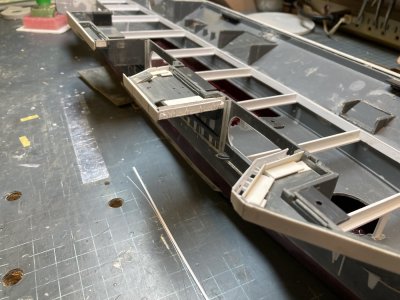
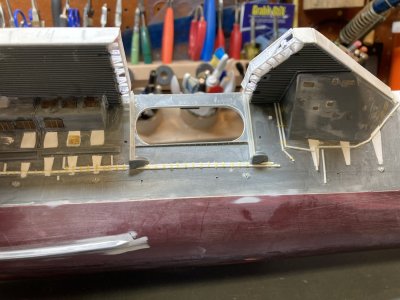
I first made a Cameo cut program just for the skirts around Elevator 1. I did this to save cutting time and material in case of mistakes. It allowed me to make corrections before proceeding to the parts for the rest of the elevators. On my second try the results were really good. I was even able to make individual up locks. This design was carried over when I made the remaining sets. To install the Elevator 1 skirts the model was placed upside down on the flight deck once again. I assembled the parts and glued the aft (straight) skirt to the hull only at the outboard edge. I worked my way inboard adding supports until the piece was about as solid as it would ever be without the flight deck glued in place. The forward skirt has an angle and it was a bit trickier to do until I hit on the idea of holding the skirts in place with blue tack until all the horizontal braces were in place.
Flight Deck Second Round (43).JPG

The aft skirt on Elevator 1 finished.
Flight Deck Second Round (45).JPG

The view from below.


This is the end of part 1 of this post.
 
Mini Hobby 80502 1/350 Scale USS Enterprise CVN-65 Early

Part 17 Working on the under deck structure Part 2

Flight Deck Second Round (46).JPG

The forward skirt in position.


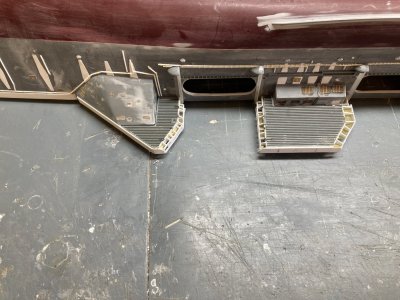
Once you get some horizontal supports attached this skirt assembly gets pretty solid. There are also angled struts that run from the lower edge of each skirt to the next lower level (upside down it is the next higher level) of structure under the deck or the 02 level. These were added at this point too. I periodically checked the fit of the raised elevator in its well to make sure that I hadn’t obstructed it. Since I had success with the Elevator 1 skirts I went ahead and incorporated changes I thought would be helpful and cut parts for the rest of the elevators. When I got all the skirts in position I turned the model back to upright and started adding catwalks. I only added physical reels to Elevator 4 because they simply won’t be visible on 1-3. They are barely visible at El 4.

Flight Deck Second Round (47).JPG

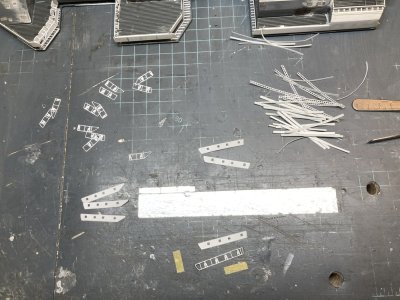
This is the pile of parts from the cut program for Elevators 2 – 4.


Elevator 01.jpg

This the bottom of Elevator 2.

Elevator 07.jpg4

This is he forward skirt on Elevator 3.

Hull 107.jpg

This is a nice view of the aft skirt area.


There are some unique features on Elevator 3. I studied my reference photos to get the details correct. Then I moved to the other side to do elevator 4. The problem with elevator 4 is the lack of actual photos of this area. I have some of the ship with the elevator up but with it lowered I only found 2 photos at all of the elevator lowered. These are from Enterprise being stripped and they were recent, very clear and showing good detail.

cvn65nn4.jpg

This is the first photo of Elevator 4 lowered.

cvn65nn21.jpg

This is the second from a slightly different angle. Note the one up lock forward, the plated over opening and the strip over the lock area.

Flight Deck Second Round (48).JPG

I am holding the skirts at Elevator 2 in position with Blue Tack they have be glue at the outboard edge and I will start adding horizontal struts next.

Flight Deck Second Round (49).JPG

All the struts have been added and I am testing the fit of Elevator 2. Note that the girders have been completed on the overhead of Sponson 5.

Flight Deck Second Round (55).JPG

Both skirts around Elevator 3 are in position.


El 4 has an additional skirt on the inboard side. This is different from all the others. It is because Elevator 4 travels the most horizontally when it is raised or lowered. On the other 3 elevators the inboard up locks are on the hull. The skirt houses the only inboard up lock which is on the forward corner of El 4. All the others elevators have 2 in this area. To make this cover I cut a piece of strip the right height, made 2 cut outs and added a strip to the lower edge which partially covers the single up lock. On the back side of the cut out I placed one of the up locks from the extra parts I made and the other opening is backed up with some flat plate.

Flight Deck Second Round (58).JPG

This is the aft skirt at Elevator 3.

Flight Deck Second Round (60).JPG

The forward skirt at the same elevator.

Flight Deck Second Round (61).JPG

Looking forward on the starboard side (pardon my finger).


This skirt is positioned at the inner edge of the elevator opening between the elevator guides. The skirt can be glued to the forward guide but it stands away from the aft. Not knowing exactly how it was supported I added horizontal struts from the skirt to the center of the guide. This is a 3D resin part from Shapeways so I could tack the plastic parts to it with Microweld and after it was all firmed up I hit each joint with thin CA for good measure. Because this was still very fragile relative to the other skirts which were glued plastic to plastic I added a heavier horizontal piece above the detail parts. This provided additional gluing surface for the skirt and it is solid now. You will not be able to see this support from below.

Flight Deck Second Round (62).JPG

I have made a start on Elevator 4.

Flight Deck Second Round (64).JPG

All three skirts in place.

Flight Deck Second Round (65).JPG

A closer look forward.

Flight Deck Second Round (66).JPG

Elevator 4 looking aft


I added additional detail at each up lock on Elevator 4 since they will be on display here. I used some of the photo etched up locks from Eduard on both of the outboard positions. I had the Cameo up locks and I glued one of these at each position on the fore and aft sides. This gives a 3 dimensional appearance to the locks. The one on the inner skirt is more or less covered so I did nothing more there.

Flight Deck Second Round (68).JPG

Looking aft at Elevator 4 with the platform lowered.

Flight Deck Second Round (69).JPG

The forward view.


This is the end of part 2 of this post.
 
Mini Hobby 80502 1/350 Scale USS Enterprise CVN-65 Early

Part 17 Working on the under deck structure Part 3

Flight Deck Second Round (71).JPG

The gratings and cable reels are all completed on the aft side of Elevator 4. I have the cable reels on the forward side.

Flight Deck Second Round (73).JPG

Looking through the openings on the in board and outboard ends of the forward skirt you can just make out a touch of brass which is the cable reel.


I used some generic USN cable reels from Tom’s Modelworks. I folded up 4 and located them in the frames so they would be visible in the right places. Next I fitted some appropriate sized round rod for drums. I made the catwalks out of the deck grating from the extra elevator decks. I cut the pieces to size, dropped them into position from above with the flight deck removed and then secured each with extra thin CA. I left openings in the catwalk for the 4 sets of cables to run. After the ship is painted I will glue EZ line to Elevator 4, then glue the elevator to the hull and run the lines to the cable reels. This will be done before the flight deck is glued to the hull so I can still access the reels. So far that is the plan.

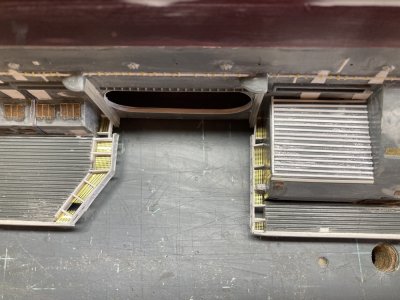
After all the final detail was applied to Elevator 4 I went back to the starboard side and finished all the frame work on the inboard ends of each elevator. By the time I had finished all three the first had dried sufficiently for me to cut the catwalk grates and get them glued in place. I took a lot of photos for this section and I am posting a lot of them here.

Flight Deck Second Round (74).JPG

This is the final round of detailing on the Elevator 4 aft skirt.

Flight Deck Second Round (76).JPG

The finished forward skirt.

Flight Deck Second Round (75).JPG

The catwalks from spare elevator deck material I tried to avoid pad eyes as much as possible but I wasn’t too worried if one or two were visible. I have added the elevator cable reels in this photo too.

Flight Deck Second Round (77).JPG

This is the view of the elevator 4 well from below.

Flight Deck Second Round (80).JPG

The finished Elevator 1 well from below.

Flight Deck Second Round (83).JPG

Elevator 2.

Flight Deck Second Round (88).JPG

And Elevator 3.


That will finish up this section of the post. I will move on to some of the 03 level landings and when they are done I will go back to the sponsons. I hope you found this post helpful. Take care and happy modeling.
 
Mini Hobby 80502 1/350 Scale USS Enterprise CVN-65 Early

Part 17 installing the catwalk landings Part 1. There will be 4 posts to cover the port side.

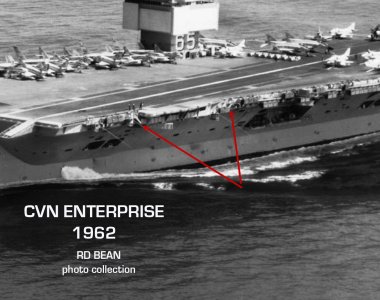
65 CVN ENTER 1962 PORT BOW AERIAL a.jpg

This view of 1962 Enterprise shows the Gallery Deck area with none of the appendages she sported later. The red arrows point to the fore and aft exits.

CVAN 65 1978 PORT CLOSEUP SFB.jpg2 CVAN 65 1978 PORT CLOSEUP SFB

This photo from 1978 shows the additions. Note in both photos there is a whip antenna under the aft entrance and there are 2 life raft baskets.


So I will begin this section on various 03 level landings by going back and detailing the landing under the angle. I am only dealing with some of the larger of these features. As it was from Eduard you would be able to look into the forward opening and see the section that should be closed off by an outboard passageway bulkhead. This was my first correction. I cut a strip of .010” sheet to the height of the structure. Once I had a piece that would go from the start of the open area to the front of this catwalk. I cut my strip off there. In real life this bulkhead was straight. Mine wanders over at an angle. I already checked and with the flight deck in place you can’t tell. If I had closed off the forward entrance first with its knee knocker then run the passageway bulkhead next I would have been able to get a straight wall. This was just one of those things that I did not want to go back and fix.

Catwalks Landings (1).JPG

In this photo the outer passageway bulkhead has been installed. You can see where it continues to the forward catwalk and becomes the catwalk splinter shield.

The next correction is the forward outboard rail. Eduard provides railing here which is correct for the era of their set. However from launch and commissioning into the 80’s this was a solid steel splinter shield. Later and I am not sure when it was changed, it became an open rail with an exit to the exterior catwalk to access the ECM antenna. When I was aboard there were ladder rungs for technicians to climb over the splinter shield and get access to the catwalk. I imagine they did not want to make this area too inviting to unauthorized personnel. I drew a pencil line for the edge of the catwalk on my new wall and then another the same height as the aft entrance splinter shield. I cut away this corner of my part and glued it in position so my bulkhead becomes a splinter shield where it exits the gallery.

Catwalks Landings (2).JPG

I am in the process of making 4 knee knocker panels.


Now I needed to make 4 knee knocker openings to section off the interior of the catwalk. There was at least one more but it will be buried in the interior and not visible. You will be able to see the entrances and the other 2 through the side ports. I used a Trimaster template to make 4 oval openings on a scrap of .010” strip. These were cut out and fitted to the places where they would be installed. One at each end, one between the 2 ports and one forward of the most forward port. Before they were glued in place each received an oval photoetched doorway opening for the coaming around each door. The one between the 2 ports had an oval on each face.

Catwalks Landings (3).JPG

In this photo from aft I have placed all 4 knee knockers, installed the coamings around the doors, and added 2 QAWTD’s and the large view port sills.


I found a couple of QAWTD’s and installed them on the inboard bulkheads where they can be seen through the ports. There is virtually nothing else on the inboard bulkhead so no further detailing needs to be done to it. There would be some stanchions on the outboard side of the interior but nobody will be able to stick their head through the view ports and see that there aren’t any. To represent the sills in the 2 ports I cut a very thin strip of .005” plastic and took short sections formed them into a loop. The loop received some Tamiya extra thin around the outside. They were placed in the openings and formed into the contours of each opening. The overlap melts together since the plastic is so thin. I left a bit hanging over the edge on the inside and outside. Then I secured each loop with thin CA.

Catwalks Landings (4).JPG

The same area from the side …

Catwalks Landings (5).JPG

… and from the bow.


I made another test fit of the flight deck and corrected a couple of fit discrepancies from the new parts. After looking at photos of the real thing I added some strip to the flight deck to fix some over sanding on the bullnose and extended the port side deck edge by about .060”. After this was blended I made a new forward end piece for the gallery which is also an angled gusset out to the deck edge.

Catwalks Landings (6).JPG

This photo shows all the above work from forward …

Catwalks Landings (7).JPG

… and the aft.


Eduard did a pretty fair job with the exterior details for this gallery. There are 7 support girders which are folded and glued to the underside and two gussets for the outboard side supporting the flight deck. There are 4 long girders and 3 short ones. Each flat piece is folded twice into a U channel. Eduard shows the correct locations in their instructions but I noticed in their digital catalog the photos showing this etch in place have the 3 short ones incorrectly positioned. None of the girders should be under the outer catwalk. To position the two gussets I had to cut a notch through my plastic girders under the flight deck. I marked the positions then used a razor saw to cut the notch for the gusset to fit in. The gussets have a single fold each. The long edge of each gusset is then glued to the side of the gallery with medium CA. When this had hardened I removed the flight deck and glued each gusset with thin CA to get a solid connection.

Catwalks Landings (10).JPG

This photo shows me working with the long channels. I used the folding jig because I wanted to ensure it was all straight. These are very small and difficult to bend with tweezers or even my fine Tamiya bending pliers.

Catwalks Landings (12).JPG

The layout of the exterior catwalk supports.


There is a catwalk around the exterior of the gallery which Eduard supplies as a single part. The rails fold up, are bent as needed and are then glued to the catwalk. Their railings are super fine and this metal is scale thin. The fold lines will break apart if they are even just flexed a bit too much. I managed to break the railings apart and had to fix them but it got done. Eduard forgot to provide a section of railing to block off the forward end of the catwalk. By their instructions the ladder from the upper catwalk comes down and rests there but this is wrong. The ladder from the catwalk comes down into the brass forward entrance to the gallery. I used an extra piece of railing from one of the unused forward sponsons to fix this. There is a small piece of railing which is to be used to close off any gaps from around the forward ladder but I found this piece to be unnecessary so it could be used to block the forward end if you are using the forward sponsons instead.

Catwalks Landings (14).JPG

The view from aft…

Catwalks Landings (15).JPG

… and forward.


The catwalk is nicely detailed and actually has some gluing tabs to hold it to the bottom of the gallery. They are small and I did not trust them to hold the catwalk until the model was completed. (Mostly because I would clumsily bump it and surely knock it off while mangling that fine detail. All of the Enterprise catwalks with splinter shields have stanchions on the exterior sides only. These are joined with a support across the bottom. Since I was going to add these supports to the catwalks along the flight deck I also reinforced this access catwalk too. This way if I knock it off I will really destroy it.

Catwalks Landings (16).JPG
With the Flight Deck removed looking down from forward…

Catwalks Landings (18).JPG

…and from aft.

Flight Deck 44.jpg

This is the AN/SLQ-17 Port side antenna from the flight deck.


There were 3 final details to be made, the life raft baskets, the whip antenna with its mount and the AN/SLQ -17 ECM antenna. The kit does have whip antennas but they are big and way out of scale. There should be 25 movable antennas around the catwalks and 2 more fixed ones on the island in 1978. There are only 20 in the kit. Not enough for my era so in order for them to all look the same (also much better) they will have to be scratch built. The whips are either transmitting or receiving antennas. Visually you can determine which is which by the color of the insulator at the base. Red is a transmitter and blue is a receiver. All the receiver whips but one are on the bow and all the transmitters are amidships ending forward of Elevators 3 and 4. These locations are different in every era, for example there are some whips aft of elevators 3 and 4 in 1968 but none are there in 1978 and there is the layout portrayed in the kit all of which are different. Prior to entering port all the whips were raised upright and at sea they were kept lowered unless we were going alongside another vessel. Then they would be raised on the affected side.

Catwalk 019.jpg

Receiving antennas on the bow. Note the insulators and counterweight handles.

FB_IMG_1660571933227.jpg

Transmitting antennas on the port side. Note that the aft 2 do not have the catwalk below but the forward one does.


The mounts were pretty much the same, a flat base supported by a pair of gussets, a pivot with a counterweighted handle and the antenna itself. The mounts were different lengths to account for the width of the catwalks where they were installed which the kit parts do portray. Some of the transmitting mounts had a catwalk suspended underneath the mount. There was one transmitting whip with a suspended catwalk on the aft gallery entrance. There were also 2 life raft baskets aft of that.

This is the end of Part 1
 
Last edited:
Mini Hobby 80502 1/350 Scale USS Enterprise CVN-65 Early

Part 17 installing the catwalk landings Part 2

Catwalks Landings (25).JPG

The basic parts for the whip antenna have been assembled.


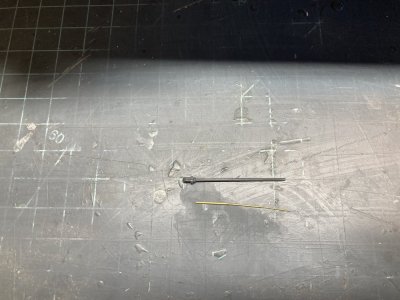
I found a likely mount pivot from a set of White Ensign RN cable reels. I had enough to do all the whips if I didn’t send too many into the maw of the garage monster. I folded the reel up and glued it to the end of a piece of .015” X .080” strip. I used a piece of thick strip to make the base of the antenna and glued it between the reel uprights as if the antenna was lowered. I punched a disc from the same material and glued it to the face. I drilled the face out to take a 1 mm O/S diameter tube (antenna socket) from an Albion Alloy brass tube set (P/N SFT-1, consisting of .4, .6, .8 and 1 mm telescoping brass tubing). The 3 smaller sizes will make up the antenna with the largest acting as a mount socket and the base of the antenna.

Catwalks Landings (38).JPG

The brass antenna and the kit part for comparison.


With the socket glued to the mount I punched and drilled a thin disc to slide over it for the insulator. Next I made 2 angled gussets and added them to the underside of the mount. At the inboard end I glued another piece of strip to support the catwalk slung below the mount. From a White Ensign set of railings and walkways I cut a piece of catwalk with railings on both sides, folded it and glued it to the bottom. This set had some additional railing which I could use for the outboard end of the cage. I should have placed an access ladder on the inboard inside end but I forgot. I did not want to try and take it apart to get one installed. Hopefully nobody will read this and it will be difficult to actually see it.

I put a small disc on the forward side of the pivot to act as a standoff for the counterweighted handle. The White Ensign Enterprise set has 20 of these handles but there won’t be enough to do all 25 antennas so I will use a modified fuel hose reel on some of them. Some of these mounts have a pair of handrails between the catwalk and the antenna but I couldn’t discern any on this one. I glued this mount in the wrong position at first photographed it and then I spent some tense moments prying it off, cleaning everything up and gluing it in the right place, so much for studying the configurations in the photos. I didn’t mangle my prototype which made my day. The antenna itself was made up of 3 sections of tubing laid alongside the kit piece to get the length right. I imparted some sag into the piece and tried it out before stowing it away. In real life these antennas were very flexible and bounced around all the time. I found an article which said they could be made of fiberglass or aluminum. I went back to the front entrance and added some ladder rungs and at the rear entrance placed a small oval hatch over the whip mount like an access hatch.

Catwalks Landings (37).JPG

I am trying out my antenna. Both of the life raft baskets have been added.

Catwalks Landings (41).JPG

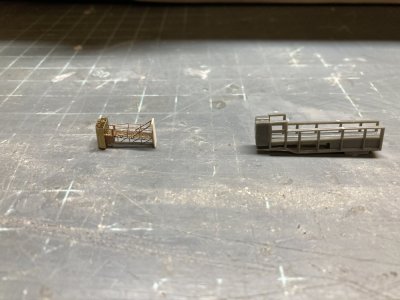
The assembled kit parts on the right with the Eduard assembly on the left. My only modification to the Eduard assembly is the plastic back piece to make it easier to glue the assembly to the side when the time comes.


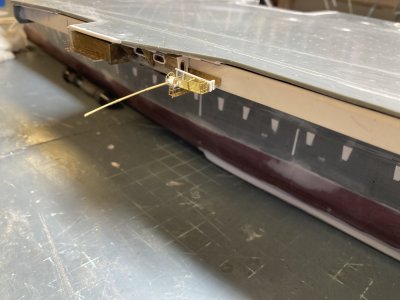
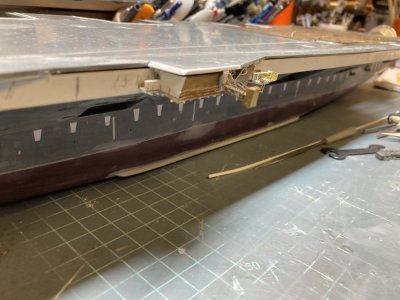
The final piece of this gallery is the AN/SLQ-17 ECM antenna which sticks straight out from the port side. I got the 2 kit parts out and assembled them and then compared them to the parts in the Eduard set Part 5. They provide 5 very fine little pieces that assemble into a very nice replica. I did add a strip of plastic at the inboard end to make attaching it to the gallery easier. With these pieces I was finally able to assemble the Eduard parts; I lost nothing and did not break anything putting it together. The White Ensign Set also has parts to replace the 2 kit parts but Gold Medal does not. The Eduard set portrayed the antennas the best so that’s the one that I used. I did not want this delicate little bit hanging off the side of the ship where I could break it so it was not attached yet but stowed with the whip antenna. I did stick it in place with some Blue Tack to take some pictures.

Catwalks Landings (39).JPG

The antenna attached with some Blue Tack to hold it in place temporarily.

cvn-65-uss-enterprise-017.jpg

This is a side view of what I will call the missile blast shield landing, notice how the shield attaches to the splinter shields on the catwalk.


cvn65_49a.jpg

This is a fairly good view of this landing. I also found Silver Shadow’s photos at The Ship Model Forum which are just fantastic. Unfortunately he stopped posting in 2013. I don’t want to post any of his work here without permission but you can go to the link below to see them. He did a great job on the on everything he built or modified for his Tamiya model.

https://www.shipmodels.info/mws_forum/viewtopic.php?f=59&t=210966

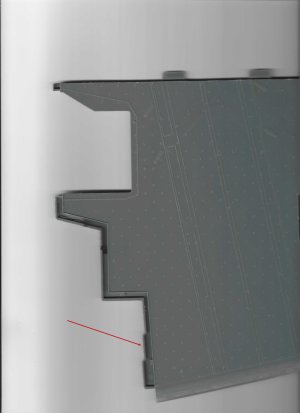
Now I moved all the way aft on the port side to install the missile launch blast shield landing (I’m sure that is not what it was called). This was a regular landing for the port aft catwalk but after the BPMDS launcher was installed shielding from missile launches was desired. They secured that landing and the aft catwalk for any planned launches when I was aboard but all the smoke and debris would have a detrimental effect on the area. The bottoms of the catwalks were even fitted with angled plates to keep the missile exhaust from coming up through the perforated catwalk deck and direct debris away from the flight deck. You won’t get anything for this landing or the shielding from any of the aftermarket sets. The kit doesn’t even have a hole in the catwalk for an inclined ladder at this position which is probably why none of them offered a landing.

Aft Flight Deck Part 2a.jpg

This is a scan I made of the aft flight deck when I was getting ready to remove the kit catwalks. The red arrow points to where the ladder opening should be.


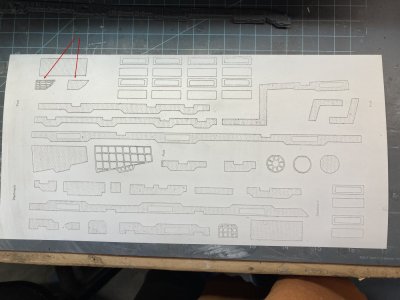
I had made a landing platform and support web when I cut all the catwalk parts. Mine wasn’t right but it was easily modified to correct it. When I made the cut diagrams I did not have the clear photo above. I could have left this until I started adding catwalks but this way it will be glued securely, plastic to plastic. The original landing was like all the other catwalk landings around the ship. But it appears to have had the hefty girder system around it dating from before the first missile launcher was installed. My first supposition was that it was like that to mount the forward blast shield. But it was built like that prior to 1967 so I don’t know why this particular landing needed all the extra support. At any rate by the time I was aboard on the forward end supports a reinforced steel blast shield that came up to the catwalk and then passed it on the outside. At the top the shield leaned forward and joined to the outside splinter shield of the catwalk around the missile sponson which also leaned out but only on the fore and aft section.

Catwalks (6a).JPG

The red arrows point to the 2 parts for the missile shield landing. They will have to be modified to be usable.


I cut off the front of the framework that I had made. Then I trimmed up the perforated deck material until it was just a rectangle like a regular landing and glued the 2 parts together. I glued some of the girders that I made for the elevator skirts to make up the beefy triangular girders. The front girder extends past the forward outboard edge of the support web. At the outside end I glued a second girder to make a triangle around the landing. To fit the shield though I would need at least a portion of the aft catwalk to determine what the height of the shield should be and exactly where it should go.

Catwalks Landings (43).JPG

I am gluing the catwalks up


I got the aft catwalk section and a section of the thin deck edge coaming that I had made previously. I was going to drill out all the perforations in the deck but I realized I could just punch them out with a needle in a pin vise. No more broken micro bits! The coaming was glued to the deck at a right angle on a magnet board to keep all the parts true. I assembled one of the tubs for the fuel stations and I glued it under the catwalk. The catwalk turns 90 degrees and goes outboard. This section also needed its coaming added. Once the catwalks had dried I took some ordinary staples and inserted them through the holes in the coamings facing inboard. These were laid on the flight deck and taped in place. This will be the actual height of the catwalk once it is glued in place. There was another section of catwalk attached to this one which would have continued forward. But it did not fit the deck edge right and I cut it into 2 sections until I could reposition it and glue it back together.

Catwalks Landings (47).JPG

The Landing has been assembled and is glued in position. The door is in place but not the rail.


I could temporarily fix the landing under the catwalk and the make a shield to fit. I detailed the shield with some reinforcement strips. I removed the landing and glued the shield to the front. I had some right angle gussets left from the MK-115 platform and used a couple to add further detail to the landing and shield. The landing was now glued permanently in position. I tested that the catwalk could be dropped in position and allowed it to dry overnight. I used an Eduard pre-painted scale figure to test the depth of the catwalk. The average man would just have his head and neck above the coaming, taller fellows head and shoulders.

Catwalks Landings (46).JPG

This is how it all fits together.


With all the glue joints firmed up I continued detailing this area by adding a door and railing where the ladder will rest. I couldn’t resist continuing to work with the catwalk around the stern quarter. Building it up a bit. So there was a bit of digression from my original purpose at this point. The first thing needed was the gusset under the flight deck which will be used to support the aft end of the catwalk. I made a triangular gusset by calibrated eyeball and added it to the end of the hull. There was a pair of gussets at the end of the catwalk which attached to the gusset under the flight deck. The aft most one is actually the end cap of the catwalk. These two parts had to be cut and test fitted until I arrived at the final product.

Catwalks Landings (45).JPG

The gusset has been added here.

Catwalks Landings (53).JPG

The two end gussets are in place at the end of the catwalk aft of the fuel station tub.

Catwalks Landings (50).JPG

This is the finished blast shield platform with the gussets and railing in placed.

Catwalks Landings (49).JPG

The catwalk is in position held up by stables and tape. Note the tab at the outboard end.


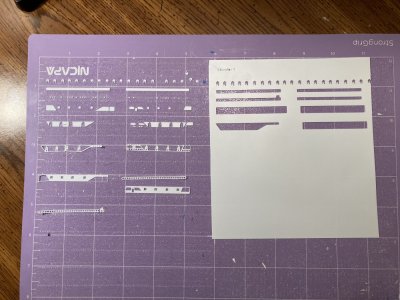
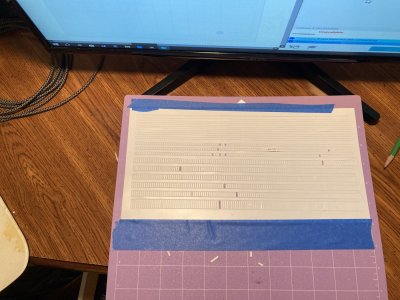
Each section of the catwalk had a support web underneath. These extend out past the edge of the deck and stanchions were welded vertically which in turn supported the outer the solid splinter shields. The splinter shield did not run the full length of the catwalks. Open railing was used in multiple locations. I needed to make parts for the outer splinter shields, the stanchions and the support web. I made some new drawings that go along with the flight deck coamings to make these additional parts. After a morning making the drawings and an afternoon cutting them on the Cameo machine I had a good supply and if more are required I can easily do another cut job now.

Catwalks Landings (55).JPG

This is a photo of the sheet of catwalk parts ready for use. I try to cut complicated shapes like this until the chads start popping out as this makes it very easy to peel the parts off the mat.

Catwalks Landings (52).JPG

These are the remaining 3 deck sections of the aft catwalk. The coaming is already glued to one of the sections, the middle piece is the actual landing and the final L shaped part goes around the deck edge at the Mk-115 platform.


This is the end of Part 2.
 
Last edited:
Mini Hobby 80502 1/350 Scale USS Enterprise CVN-65 Early

Part 17 installing the catwalk landings Part 3

I made the support web in 2 sizes to cover the various widths of the catwalk. Additionally I made the vertical stanchions in a third smaller web. The pattern was the same so the stanchions and supports match exactly. I began by adding the supports to the underside of the fuel station first. I made the web so that it can overhang the catwalk. It can be glued on, allowed to dry and then it can be trimmed off. I worked my way along the bottom of each section of catwalk and the LSO 03 level landing. When I made the coaming sections I included numerous underside support gussets as well. On the aft section of catwalk there is a final open gusset just aft of the inclined ladder opening on the fuel tub. This particular gusset is different than all the others that I had made. This one was cut and fitted to its spot the old fashioned way and I had to manually cut out the opening. I managed to do it but it brought home just how handy the Silhouette Cameo is.

Catwalks Landings (57).JPG

This is the bottom of the LSO landing where I have added the 4 support gussets.

Catwalks Landings (65).JPG

This is the aft section of catwalk glued together with all the support gussets installed. Aft of the ladder opening ( to the right of it) is the gusset I had to cut by hand.

Catwalks Landings (58).JPG

This is where I discovered that my MK-115 platform would be covered by the catwalk.

Catwalks Landings (67).JPG

Here I am preparing a strip of catwalk support gussets. I even saved the chads to use as solid gussets somewhere else.


I used several of the machine cut catwalk gussets to represent the support of all the catwalk sections. I popped out the chads, detached them from the sheet and glued them in place. I needed 4 to get the LSO landing ready for permanent attachment. I used the hanger deck height gage to determine where the 03 level was. I drew lines to mark the position and then glued the LSO landing in place. I glued flight deck coamings to the remaining catwalk sections and I got them fitted to the deck edge. When I positioned the outermost section I immediately realized that my MK-115 director platform was too small. The catwalk nearly covered it up. I had to remove and replace it. It was destroyed it in the process. It wouldn’t have had any use even if I could have salvaged it but it was painful all the same.

Catwalks Landings (60).JPG

The old MK-115 platform that I just grabbed with pliers and ripped off.

Catwalks Landings (64).JPG

The new enlarged one in process.

Catwalks Landings (68).JPG

The finished part.


I was also going to need a LSO platform. I would have thought that the kit or one of the 3 Enterprise detail sets would have furnished this item but there is nothing in any of them. The molded catwalk correctly drops down to what I have been calling the LSO landing so they really could have added some parts to make the platform. 3-D Wild has a printed set with the platform stowed or open for $12.50 for the pair. While I was at the drawing board for the MK-115 platform I designed my own LSO platform. The LSO platform was stowed until the beginning of the recovery cycle. As soon as the last aircraft was launched the platform was rigged. It was not open if we were launching aircraft. There were exceptions to that rule, for instance during carrier qualifications, aircraft would trap and then go forward to the bow to be launched again. So the platform was open during launches too. If there was maintenance that needed to be performed it could be opened up also. Below is a link to the 3-D wild LSO set. They also make a set that covers the gallery.

https://3d-wild.com/collections/cvn-65-enterprise-conversion-kits/products/big-e-1982-17-lso

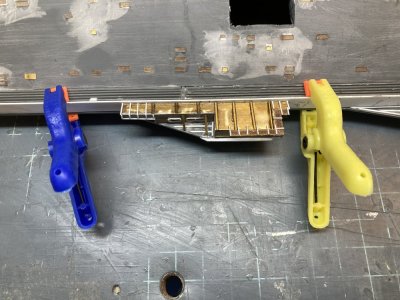
With all the parts cut I was ready to continue on with the catwalks. I positioned the most aft section, cemented a small tab underneath where the cut off section needed to mate with it. Then I positioned the catwalk that will run forward with staples and tape on the flight deck to hold it in place. I applied a small amount of Testor’s Liquid Cement at the tab and joined the sections again. I also added a piece of angle where the 2 flight deck coamings come together as an additional reinforcement. The next day the entire aft catwalk was a solid single piece.

Underneath the catwalk where it goes around Sponson 8 there were a number of support gussets. These support the angled blast shield under the catwalk. The last gussets were made solid to cap off the ends. I cut and fit panels to fit these 2 locations and glued them in place. I cut out a small section in the corner for the access ladder to the catwalk from the sponson. The later versions of Enterprise had a door to get into this area. I left them to dry solid. At the inner ends where the angle meets the deck I covered the joint with a thin piece of strip. I left the assembly to dry solid before I did any more work on it.

Catwalks Landings (69).JPG

The Mk-115 upside down. When I install the part I will first cut off the long side of the outer mount and make a new strut from strip,


While I waited I assembled my new MK-115 and LSO platforms. I made all the parts on my Cameo in several layers. The MK-115 had to be resized to be a larger diameter and the LSO platform is just the basic framework with a center deck. The touchiest part of assembling the MK-115 platform is forming The half rail to support the net gussets, then gluing it and gluing the multiple little angle gussets to that. These will form the frames for the nets. Now the MK-115 platform had to dry thoroughly so I glued the LSO platform to the flight deck coaming section, allowed it to dry and removed a section of the coaming for the entrance. While that was drying I went back to the MK-115 platform and added safety nets 1 section at a time. Having made this assembly twice before I was able to do the nets and even impart some sag between the supports. Finally I glued some .010” strip around the rim. This one is cleaner and better made at least.

Catwalks Landings (61).JPG

The LSO platform attached to the flight deck coaming. This is the bare frame along the deck edge you can make out the cut away coaming for the entrance.


I allowed the MK-115 platform to fully dry and then drilled out the locater hole for the MK-115 director. Next I cut off the long side of the outer support gusset. I positioned the platform on the end of the finger and glued it in place. I cut a section of .030” square strip and glued it to the platform and the H beam stub. I used one of the open angle gussets to detail it and added a smaller sect of .020” strip for the second brace. There the platform was replaced! I verified that the catwalk would not cover the director any more, and with the catwalk in place I penciled some locator marks, folded and glued a ladder in place on the aft face of the finger to the platform. This is just under an engraved access hatch in the catwalk.

Catwalks Landings (75).JPG

The new platform will have plenty of room for the director.


On the outer section of catwalk on the finger I made an end cap for it and detailed it with stanchions and a cap rail. I won’t be adding any of the outer splinter shields until all the detail on the catwalk inner wall is detailed. One of these details is the top of the coaming and the scuppers. I used .010” strip along the top of the coaming and then another just below the drain holes. Then I placed a strip of .010” X .020” on the lower strip to form a channel. This is the scupper and along with the coaming runs around about 95% of the deck edge. There is a short ladder to the flight deck on the aft side of the finger in this outer section. I cut out the opening in the flight deck coaming, glued a tab from strip and a support underneath it. I won’t add the ladders until much later. The flight deck coaming was shortened to just the thickness of the flight deck inboard of the end of the outer catwalk. I’ll finish detailing the catwalks after all the basic construction and fitting is completed on all the other catwalks.

Catwalks Landings (77).JPG

The completed outer catwalk section. The additional parts for the coaming and the scupper have been added. You can see the inside of the endcap.

Flight Deck 46.jpg

This is the stowed LSO platform from forward looking aft.

Flight Deck 45.jpg13

From aft looking forward.

Flight Deck 48.jpg14

From the side opened up


I made the LSO platform stowed for my model. I cut plastic strip to build up the level of the middle section where the LSO team would be standing. I then made the wind break which folds back on the forward section. To represent the windows on the break I used some 1/700 scale photoetch ladder material, I added a loudspeaker and glued it down. The aft section is where all the equipment folds down. To represent this I used plastic and photoetch to represent the various cases.

Catwalks Landings (81).JPG

This is my take on the stowed LSO platform


I detailed the hull around the LSO landing, I added the doors and a small door these were all the photoetch needed for now. There is a loudspeaker and some panels and lights. These were connected up with .010” round rod for wiring. The section of landing facing out board has a modified splinter shield. It is full height at both ends but drops down in the middle for the safety net and pad to be anchored.

Catwalks Landings (78).JPG

The hull around the LSO landing has been detailed and a splinter shield created and installed.

Catwalks Landings (79).JPG

This is the overall view of all the detail that has been added from aft looking forward. There are two catwalk to flight ladder locations added, all the coaming, scupper and support detail is complete.

Catwalks Landings (82).JPG

From forward looking aft.

Catwalks Landings (80a).JPG

This is the view from above. The red arrows point out the flight deck entrances. There will be a short inclined ladder at each location.


This is the end of Part 3.
 
Last edited:
Mini Hobby 80502 1/350 Scale USS Enterprise CVN-65 Early

Part 17 installing the catwalk landings Part 4

65 CVAN LSO PIT AND PHANTOM  UNDATED.jpg

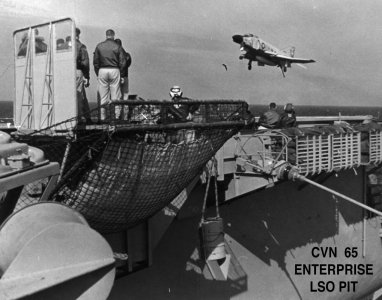
This is the one good photo that I found of the LSO net from the exterior. It is prior to my time aboard but is probably very close to the same.


If there is an imminent risk of a crash like an aircraft impacting the ramp then the safety net is the egress for all the LSO team. There were 2 - 3 officers and an enlisted man at the minimum in the team. To clear the area quickly enough for them to survive they jump off the platform to outboard. There is a net formed by cable and covered by a thick pad. The pad is anchored to the frame at the top, sides and the catwalk at the bottom. The doors on this landing were left open so the crew could get inside to safety. I confess that I tested the net myself a few times on the USS Abraham Lincoln CVN-72 because the door for the LSO landing was just around the corner from my squadron’s Maintenance Control Office.

Catwalks Landings (84).JPG

Here the frame parts are glued together and I am waiting for them to firm up.

Catwalks Landings (83).JPG

Now I have added the net. Notice the wing on the right side.


I made the upper frame as part of the platform there are 2 angled braces to the catwalk and a couple more for the sides. I measured each section of the frame with dividers and cut 4 pieces from .020” square plastic strip. I made a 4 sided trapezoid and fitted it to the landing and the LSO platform. Once I had a good frame I used photoetch grating for the net. I placed the frame on the grating and marked the dimensions on the grate. I cut it out leaving 2 triangular wings on each side. I connected the net to the frame with tiny amounts of thin CA, fit and trimmed again. I used more square stock to frame the wings on the net. I added some tabs to the inside of the net to make it easier to put in place. For the pad I used some textured metal foil from a scalpel blade wrapper. This assembly was made to be a separate part until after painting. I will need access to the inside of the net to be able to paint the hull and deck around the landing.

Catwalks Landings (87).JPG

All the framing is done and the tabs are in place on the top and bottom.

Catwalks Landings (91).JPG

My rendition of the pad.

Catwalks Landings (93).JPG

Here it is just set in place under the LSO platform.


I looked through my reference photos to see if there was anything else that I wanted to add now before I called this part of the project finished. There are 2 large square ducts under the port overhang that seemed to be something simple that I could do now. I went through the kit instructions and there are no plastic parts for these ducts. That is odd because on the starboard side the furnish some. These ducts would have been there when they were making the original kit at Tamiya. Well Eduard provides brass replacements on the starboard so surely they made some for the port side. No they did not. So the simple addition became just one more scratch built part.

Hull 111.jpg

This is the larger of the 2 ducts.

FB_IMG_1660571944818.jpg

The second is pretty clear here.


There is a fairly long duct under the gallery and a smaller one just about in the middle of the boathouse overhang. I used some .125” square rod for the body of the ducts. I first cut an angle that matched up to the sloped part of the hull. Both of them are raked aft and I cut and glued each duct to model that. I fitted until I was happy with the two parts. I cut .020” square strip to make junctions or hangers on 3 sides of both parts. On the longer one some were also added to the top near the outlet end. I used some scrap grating from making the net to make 2 grills and glued them to the ends. I also found some square coaming and place that over the grills. I glued them in place on the hull and called it good.

Catwalks Landings (94).JPG

The long duct.

Catwalks Landings (95).JPG10 Catwalks Landings (95)

And the short one. Both of these ducts are visible in photos of E beginning the scrapper’s process so I would guess that they were there from the beginning to the end. Certainly from 1976 to 2017.


This will be the end of this post. In the next I will be bringing the starboard side up to this level of detail. When the catwalks are all assembled I will be revisiting them to detail the interiors, deal with the splinter shields and installing them on the fight deck. Till the next part I wish you fair winds and following seas. Enjoy your modeling.
 
Last edited:
Back
Top