


- Joined
- May 8, 2021
- Messages
- 109
- Points
- 78
Mini Hobby 80502 1/350 Scale USS Enterprise CVN-65 Early
Part 17 Working on the under deck structure Part 1
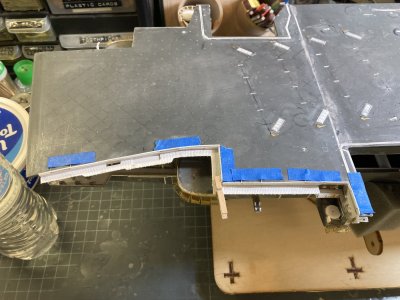
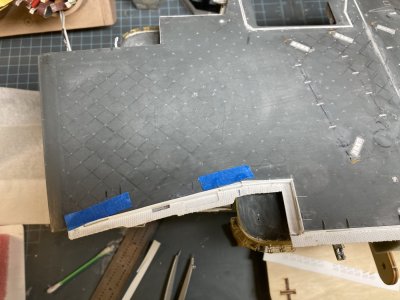
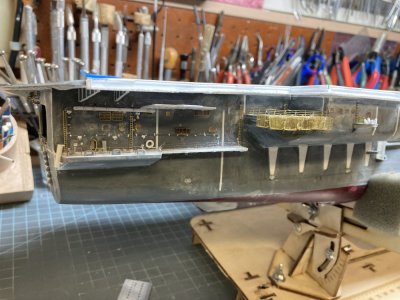
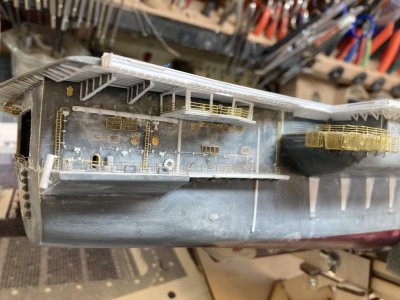
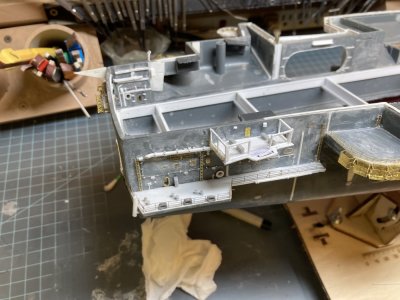
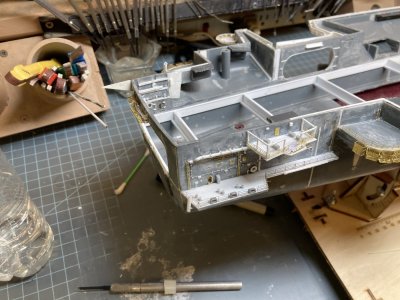
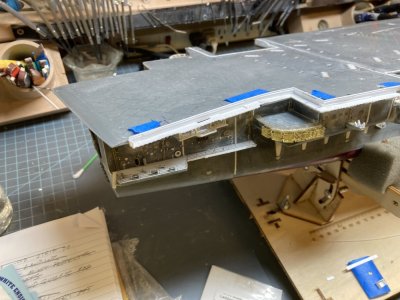
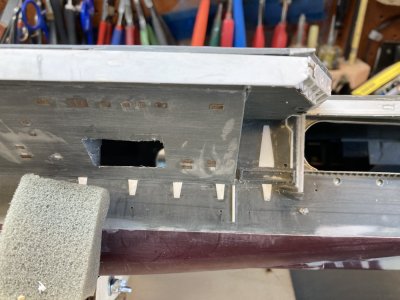
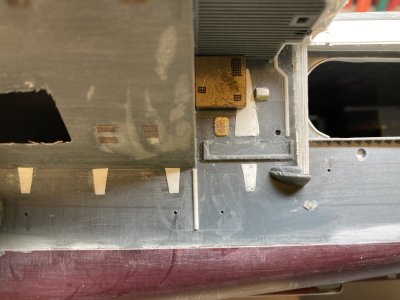
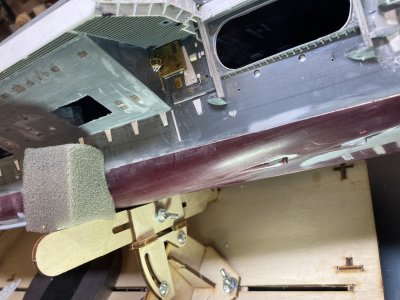
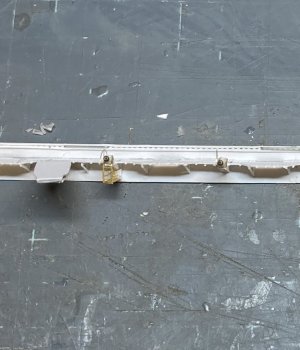
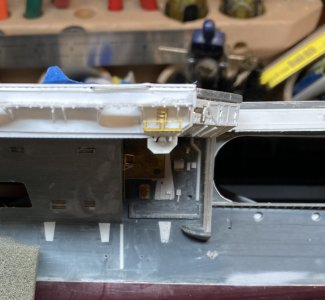
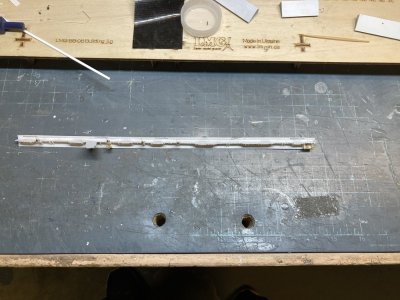
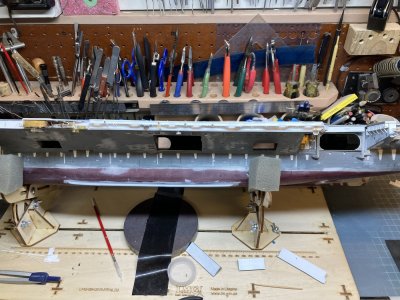
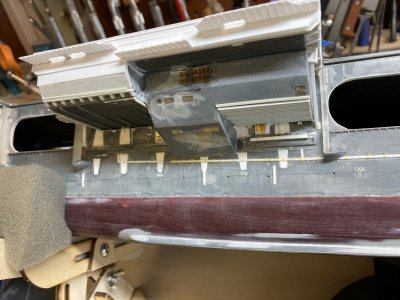
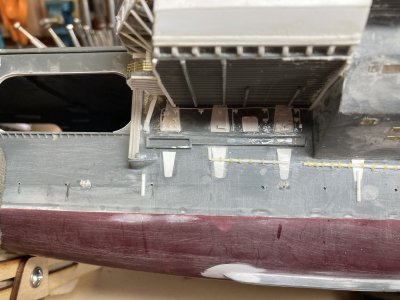
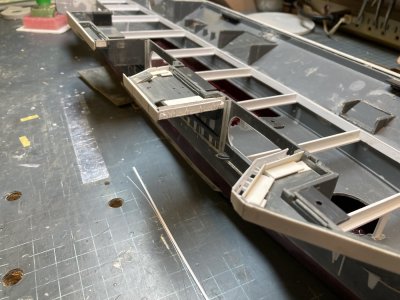
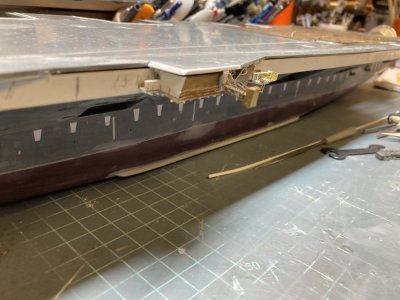
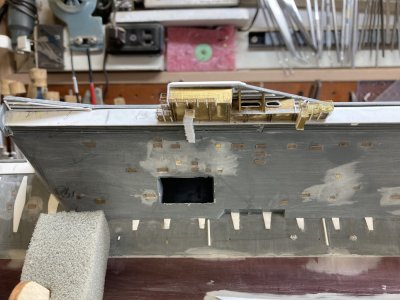
Back when I removed the catwalks from the flight deck I also removed all of the underside detail that was there originally. It was interfering with the flight deck fitting to the hull so I sanded it all away. There wasn’t any in the area around the elevators anyways. The flight deck has pins now that ensure it always is positively located. When I was working on Sponsons 8 and 9 I started adding the girders to the aft end of the flight deck under the ramp. Now I began filling in the area under the starboard side going forward. There is a pretty good sized overhang in this area and I filled it in with .030” square strip. There are 3 angled gussets that run more or less perpendicular to the girders. I placed the girders the full length of the overhang and when they had dried cut away spaces for the gussets to fit into. The locating slots for the gussets made sure they were positioned correctly.
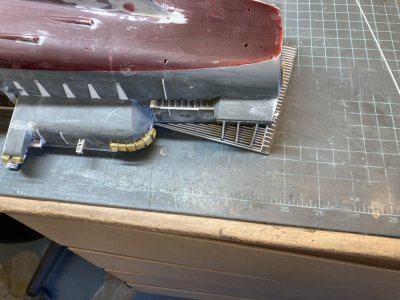
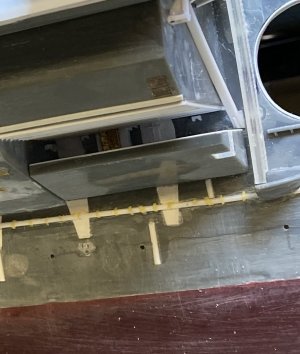
I have completed the girders on the overhang on the starboard side. Note the 3 gussets. The forward one is not correct and I removed it later. On the forward end of sponson10 I noticed that the extension I added had no gusset and I added one there.
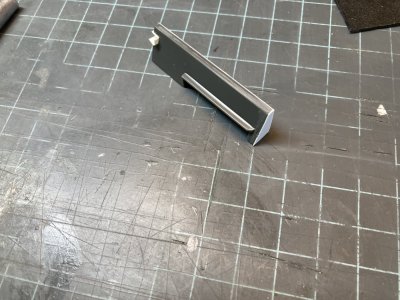
I glued the 3 gussets in place and while I was trying to get a clearer photo of the detail on the gussets I came to realize that only 2 were needed. I can’t find any photos that show 3. I removed the smallest one and put a piece of flat strip in its place. This will be directly over the 03 level landing so it will be difficult to see anyways. It is possible that the gusset was under there but I am going without it. Each gusset was wrapped on the exterior edge with a section of .010” X .060” strip then vertical .010” X .030” strips were added to each the faces.
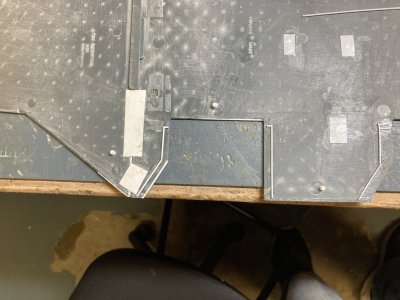
This is how I outlined the area where girders need to be added.
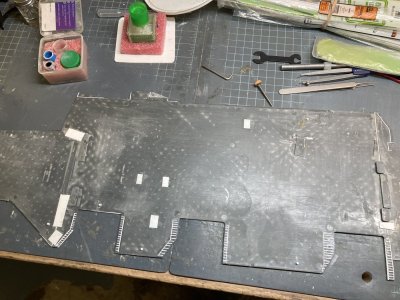
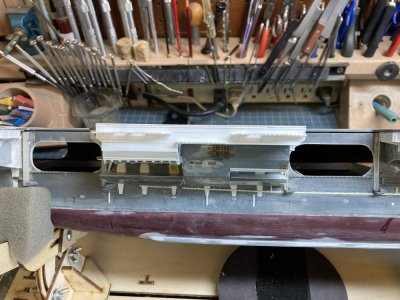
The work on the starboard side is done.
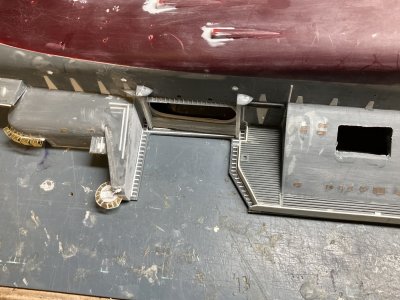
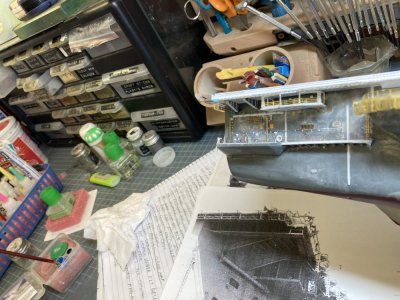
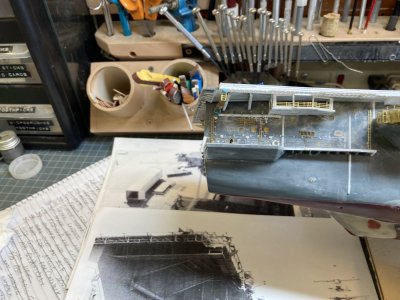
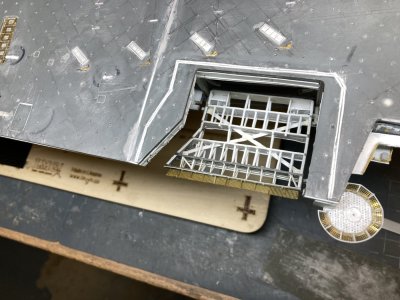
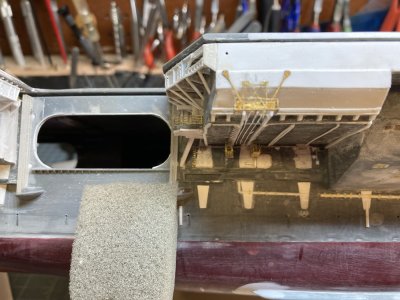
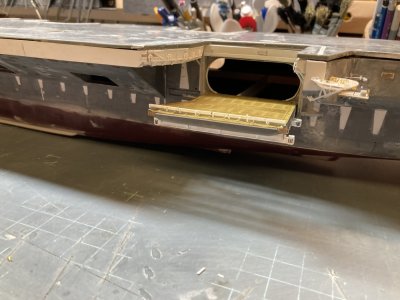
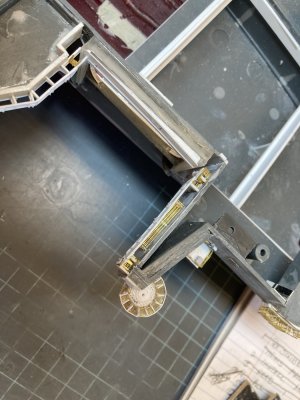
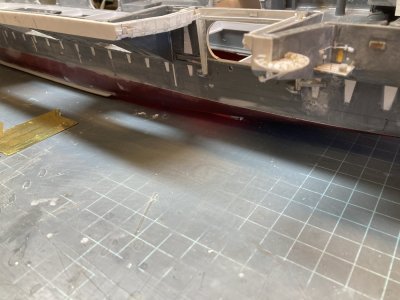
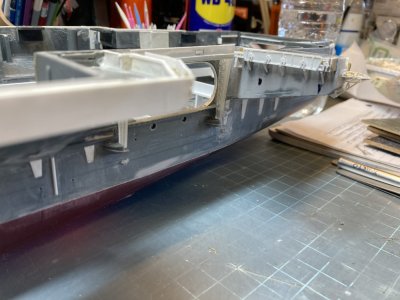
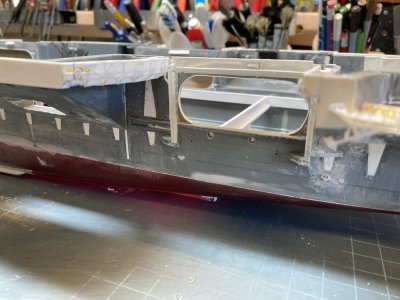
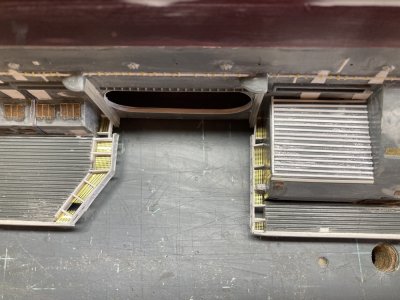
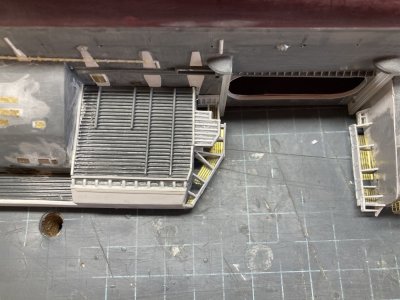
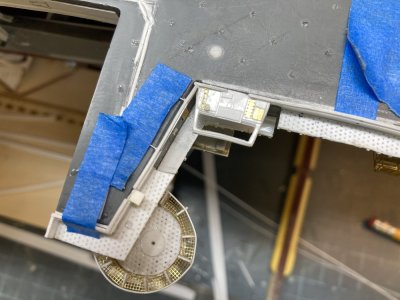
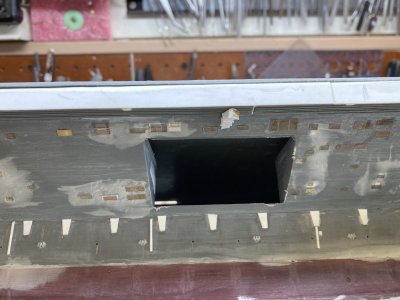
This is the area around Elevator 4.
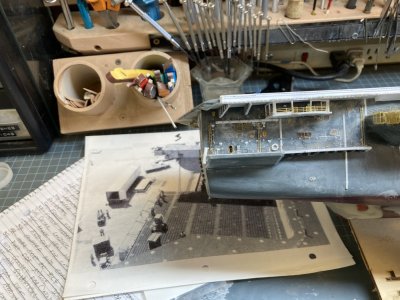
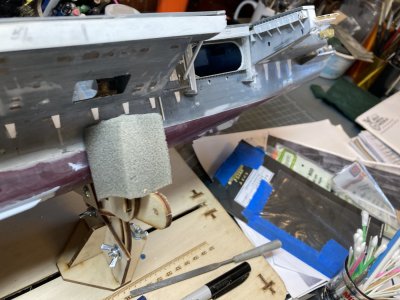
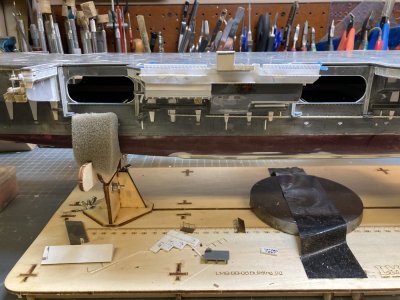
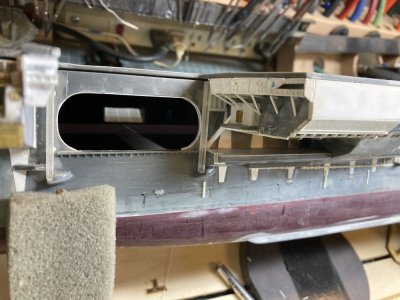
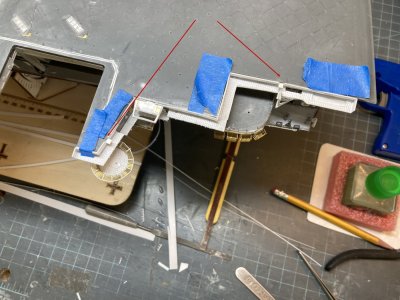
I flipped the hull with the flight deck over and drew the outline on the rest of the overhanging deck to see exactly where the girders will be needed. This will be primarily around each elevator and under the angle deck to some extent. While the hull was upside down and still sitting on the flight deck I went a step further and cut and fitted .030” square strip to outline the features in the elevator wells and the overhang at the angle deck. This may not be accurate but it ensures there won’t be any gaps in the support structure.
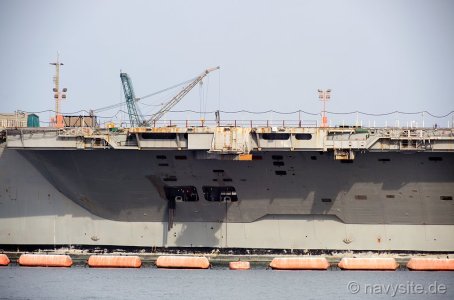
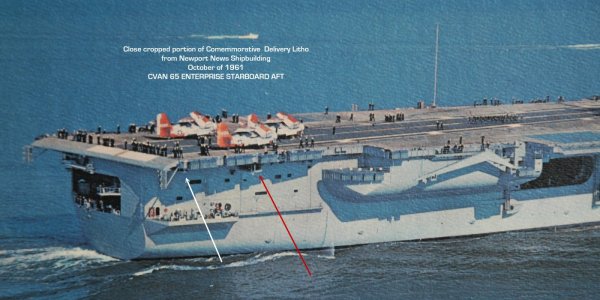
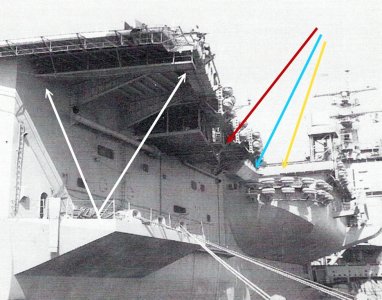
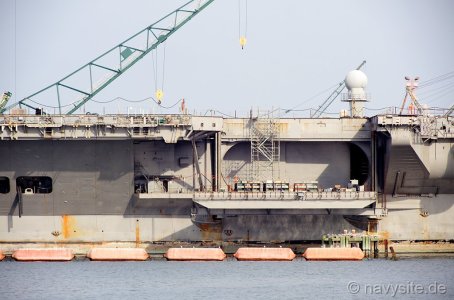
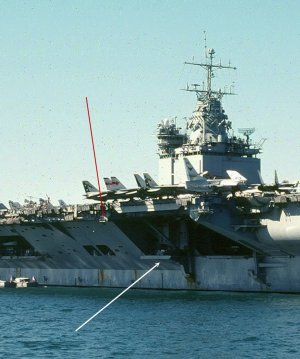
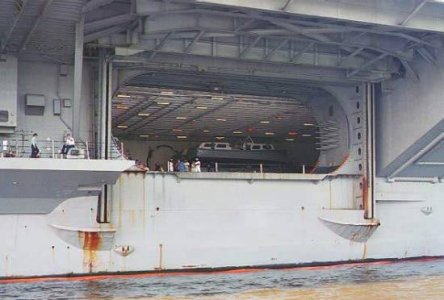
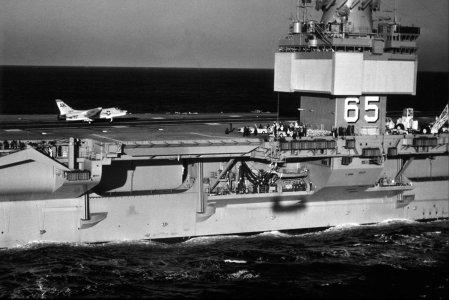
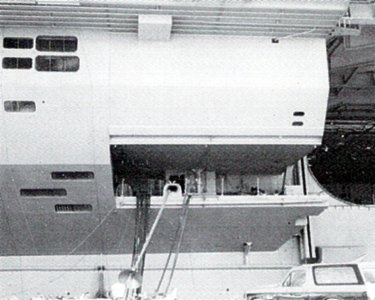
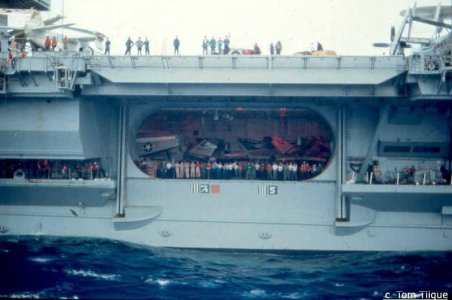
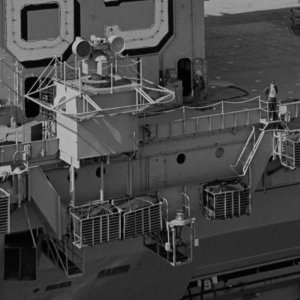
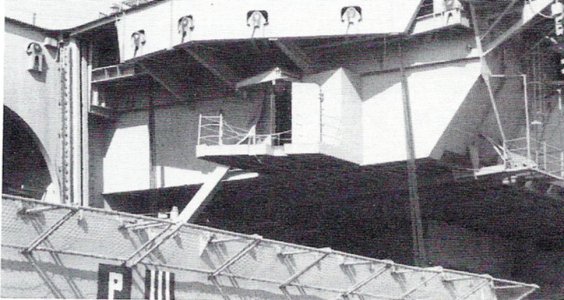
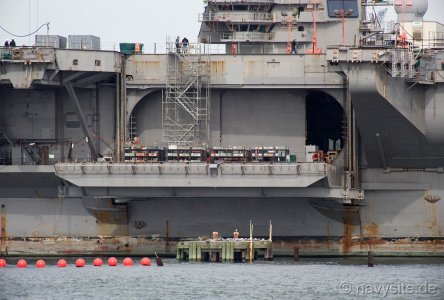
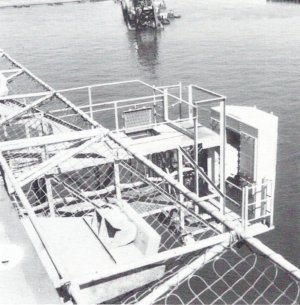
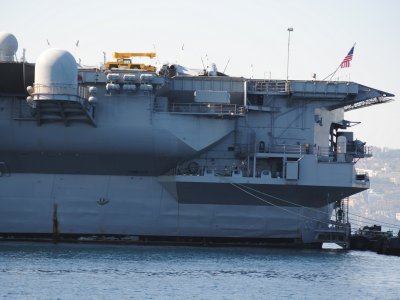
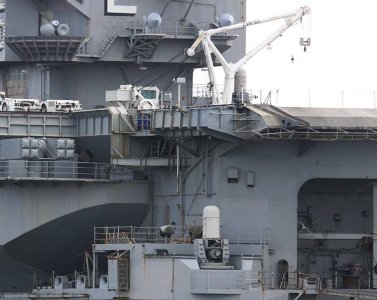
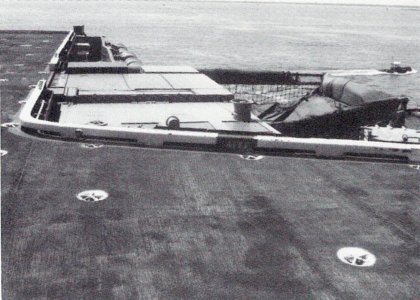
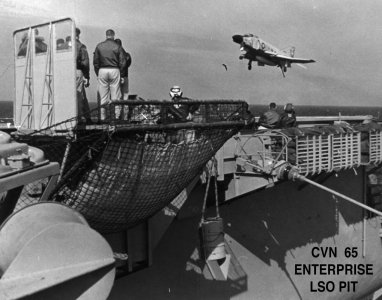
This photo shows the landing which provides several entrances to the 03 level, also called the Gallery Deck. This was taken after they have started stripping the ship..
 6
6
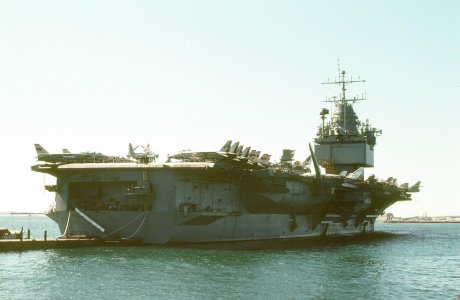
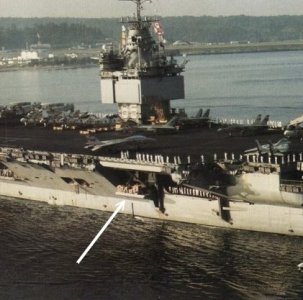
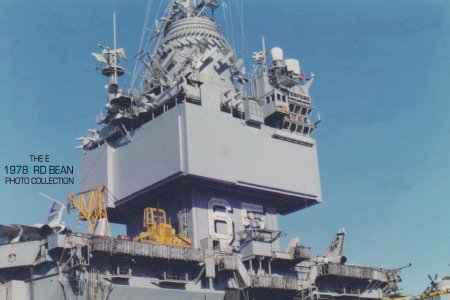
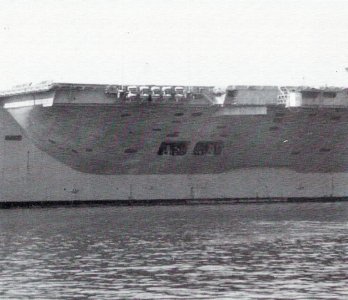
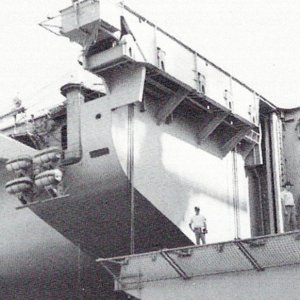
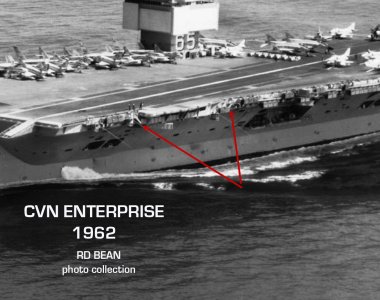
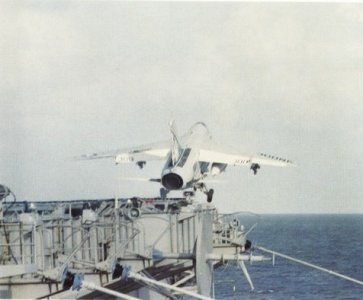
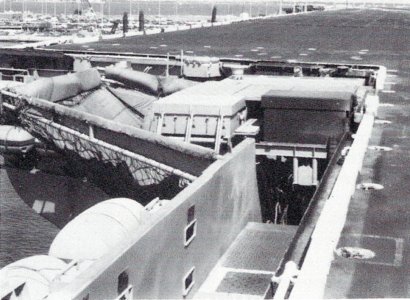
This grainy photo from the early 80’s shows this area as it also was in 1978.
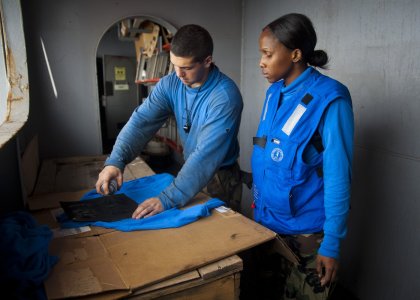
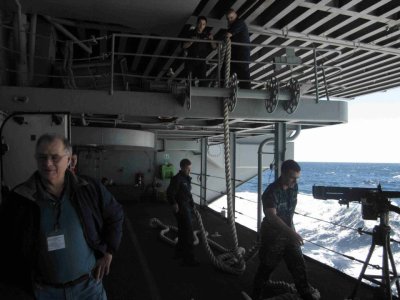
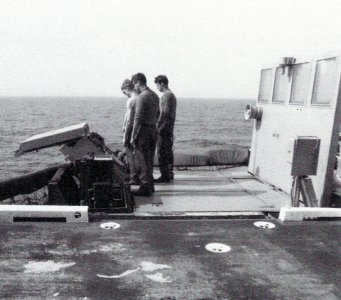
This is a photo of the interior of that landing area. The 2 blue shirts are stenciling flight deck jerseys.
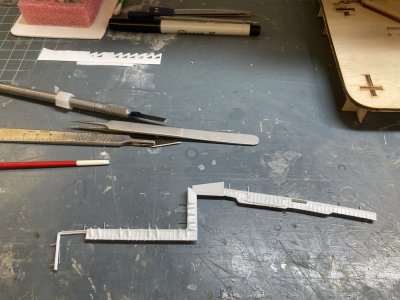
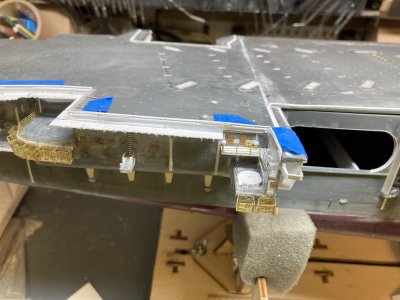
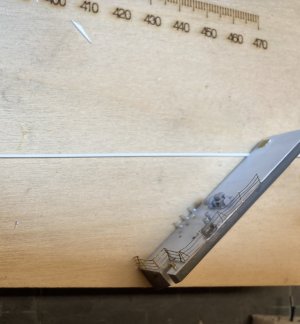
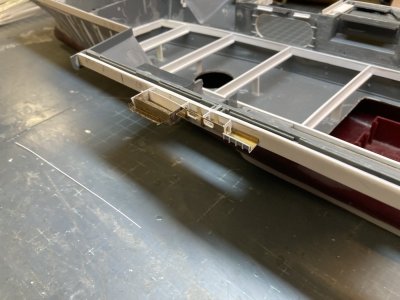
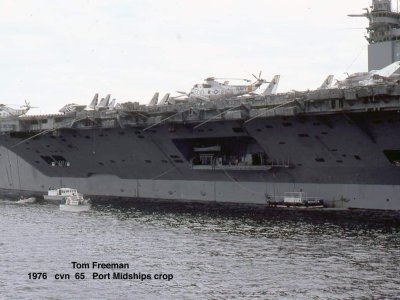
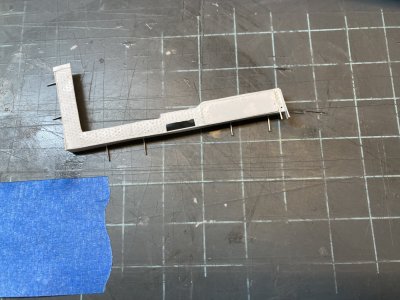
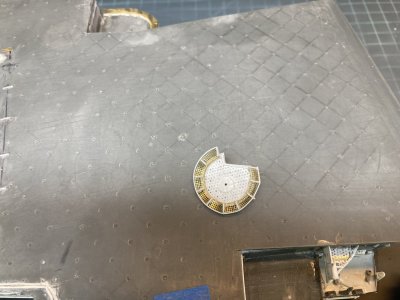
Under the aft section of angle deck there is an enclosed landing to the 03 level which is not represented in the model kit. The Eduard set part 5 has this piece pretty much as it was on the exterior in 1978. This is a large piece of brass and rather than gluing it together, after it was folded, I soldered it. I did not add the details yet I just wanted the basic assembly. I needed this piece in place to lay out the girders under the angle. This landing was the flight deck entrance which led to my shop. I remember knee knockers at the forward and aft entrances and a couple more inside. There were originally 4 oval openings to the exterior when the ship was built but by 1978 the forward pair was covered by an equipment room extension for the port ECM antenna. During the 1976 deployment there were still 3 openings.
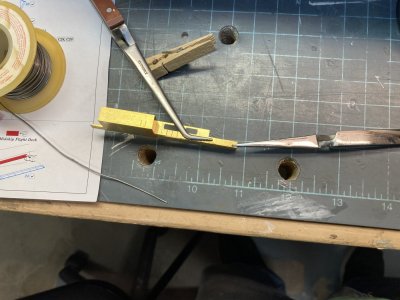
I have just about finished soldering the part.
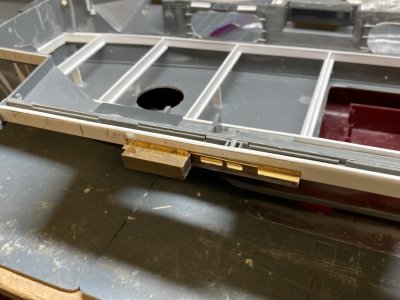
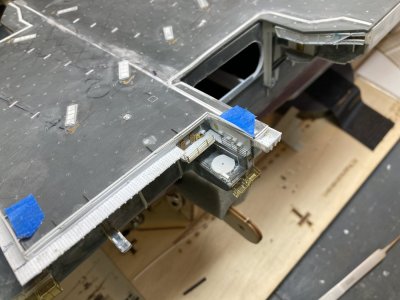
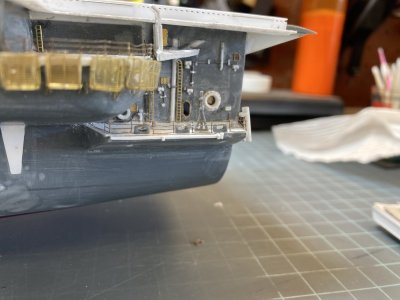
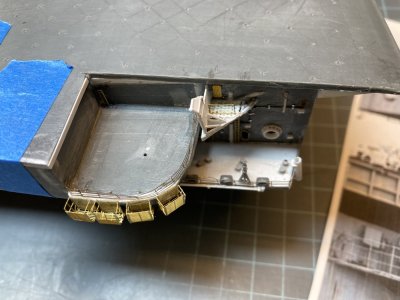
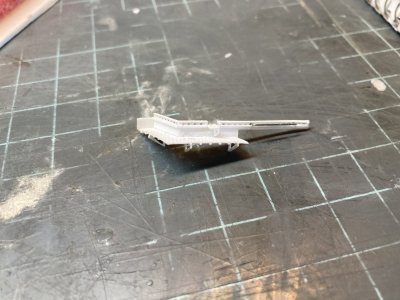
This is the Eduard part glued to the model. There is quite a bit missing from the interior and the catwalks.
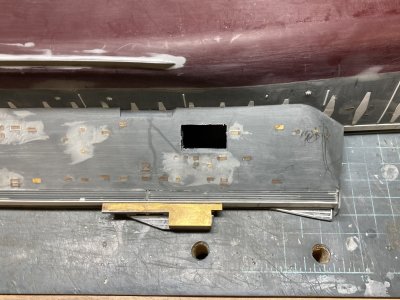
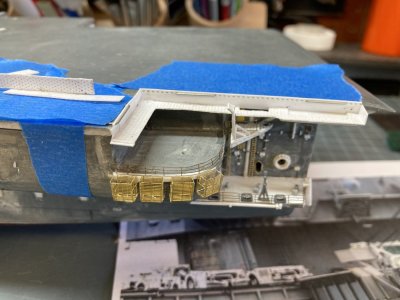
I am in process of adding the girders around the exterior.
We actually used to sit in the openings when we were in port. There was a 6 inch sill which went around the oval and made a convenient seat. I remember being in port in the Philippines during the 1976 cruise I was in the Duty Section and was required to remain aboard. The ship had to pull out into the bay and anchor for a couple of days because of a storm. It wasn’t a big storm but because of wind gusts and the waves in the bay the ship wanted to play it safe. The airplanes were all ashore at Cubi Point and there wasn’t much work to do on board. I was able to relax aboard for the most part. I couldn’t get ashore but most of my supervisors couldn’t get aboard either. It was generally nice and cool in that passageway and the design caused a breeze to flow through it. It was a great place to read when we weren’t operating.
The Eduard piece is simplified as it does not have the various knee knockers or the outboard bulkhead that covered the openings. The room is open to the passageway. I will add those parts with plastic when I get to detailing this area. You won’t see much in there but it will have some value to me. There were 2 or 3 passageways off this landing to shops under the flight deck. I know there was one aft of ours and I am pretty sure there was a third. We explored them to see if there was a better way into the main interior passageways but all the exits were the same, go down to the main deck, go inboard and climb back up to the 03 level.
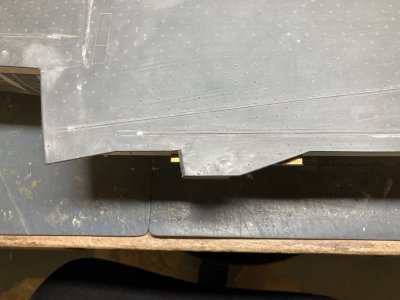
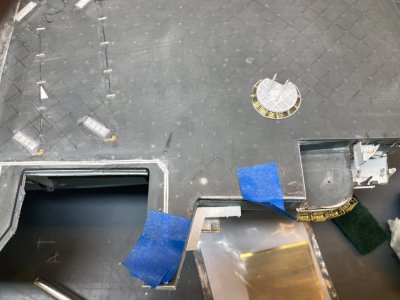
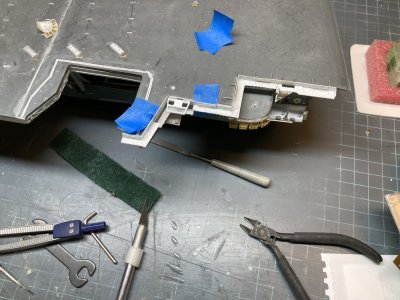
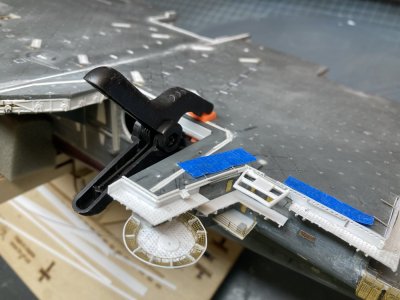
The assembled landing was positioned so that it extended past the angle precisely. This allows the inclined ladders from the catwalks to reach the landing. Once I was happy with the position I glued it to the hull with medium superglue and flipped the ship right side up. With the flight deck removed I made sure that the landing was correctly adjusted. Then it was hit with accelerator. I also let thin CA run into the joint making a good strong connection. I turned the model over again and laid out the outline of girders around the landing.
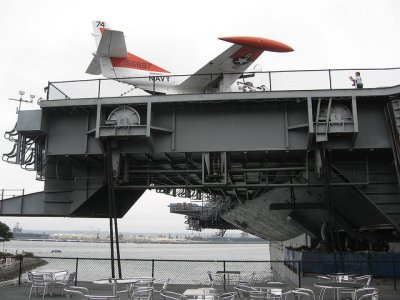
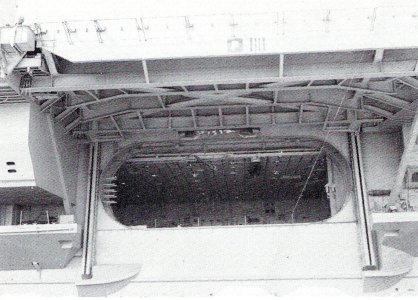
This is a photo from a museum ship I am not sure which one but this is generally what would be behind the elevator skirts.
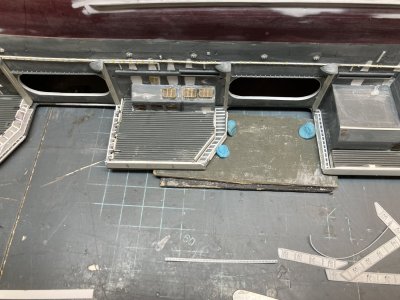
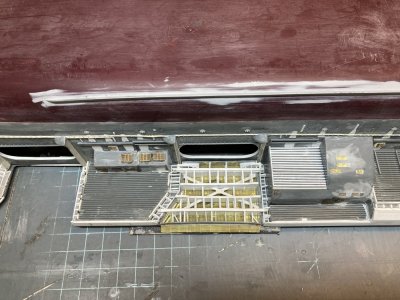
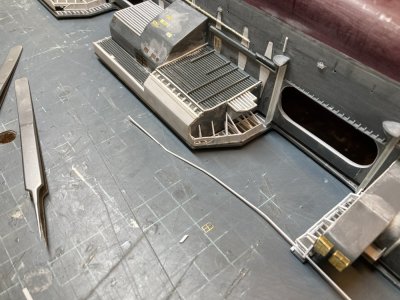
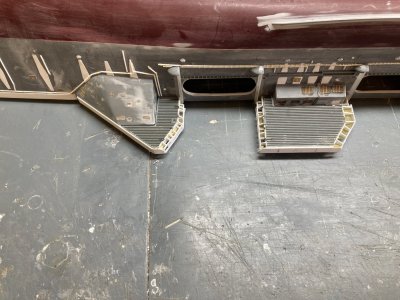
When all the basic layout work was done the ship was set upright and the flight deck removed. I could then work on the underside of the flight deck itself to finish the girder detail. This involved a lot of very small pieces of strip. Around the elevator fore and aft edges I left about a .020” space to accommodate the elevator skirts (I am sure there is a proper name for these facings to the elevator wells but I don’t know what it is). These skirts have the up locks and cover the cable reels. The model does not provide any of this structure. The Eduard set part Number 4 has the skirts, up locks and supporting structure for the Elevator 2 and 3 skirts. These are the elevators which they instruct you to lower. There are some struts but no skirts for Elevator 4 and nothing for the area around Elevator 1 since it is molded to the deck in the Tamiya kit.
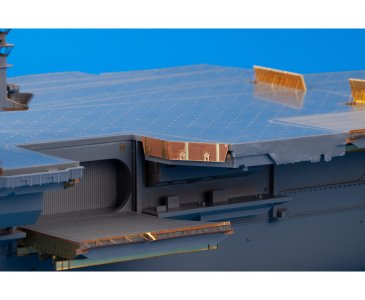
This is the Eduard photo etch at Elevator 2, notice how it is attached to the edge of the flight deck. This is from Eduard’s page in their digital catalog.
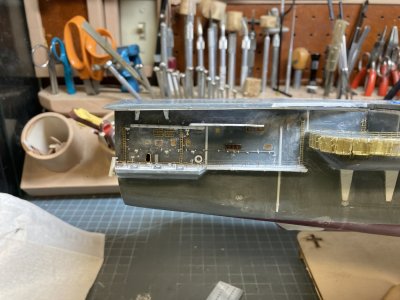
Between Elevator 2 and 3 at Sponson 1 Eduard has you add a framework piece to the forward side of the big vent box. I have to confess that I never saw that in any photo until I got this Eduard set. I went back to my photos and then found it in several. I added about 15 fore and aft girders to the overhead of Sponson 3 from .030” square strip. This area was blank and it has a lot of overhang out in the open.
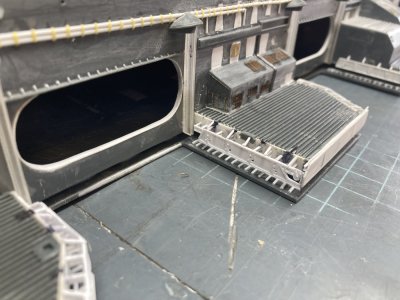
This shows the framework piece from the Eduard set on the edge of the vent box. I am pretty far along with the skirts in this photo. Unfortunately the flight deck has dropped away from the hull spoiling the effect.
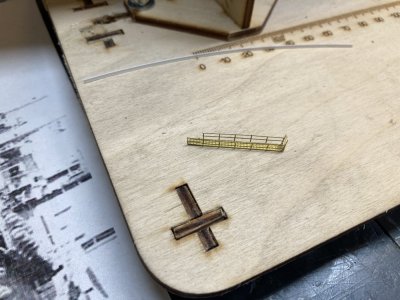
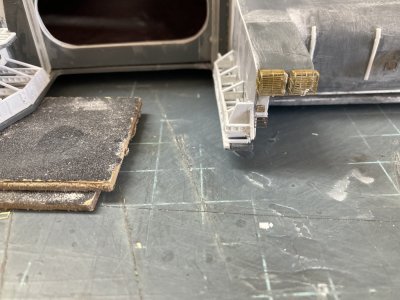
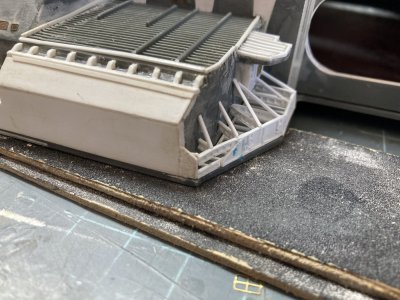
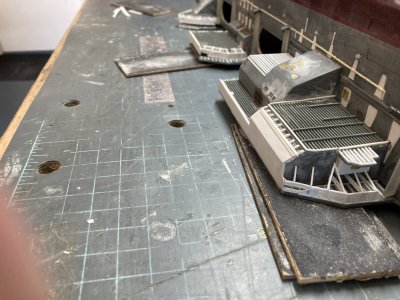
The Eduard parts for Elevators 2 and 3 are supposed to be glued to the edges of the elevator openings. They add just enough thickness to the opening that the elevators won’t fit if they are in place. Cutting them shorter to sit on the flight deck would be difficult and I did not want to sand the edges of the previously assembled elevators. Neither of the two sets will be useful on the starboard side so I will make my own. I looked into the possibility of using one or the other of these 2 sets at Elevator 4 but the detail would have to be on the inside since this elevator is a mirror image of the others. The parts would have the plain side out and none of the struts fit. There was one brass support for the structure at Elevator 2 which I would have used but after I folded it I dropped it on the floor and then rolled my chair over it. It was broken at all the fold lines and I never found one piece. The idea was pretty easy to duplicate in plastic. There is another of these struts at elevator 4.
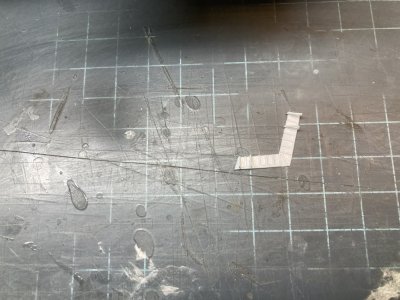
All 3 of these elevators are very close to each other in size in the kit but in real life they were each unique. It simplifies the cut program because I can make all the skirts the same. I can make them slightly longer than I need and cut them shorter to fit each well. I will make enough parts to do all the remaining sets of elevator skirts in plastic and several extras. I designed them to be built up in layers for a 3 dimensional appearance.
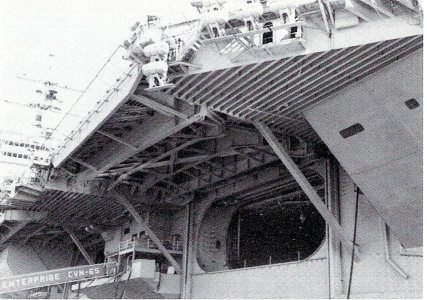
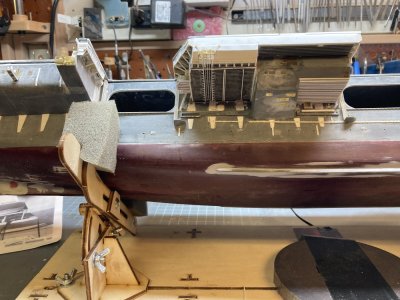
This is the area around Elevator 1.
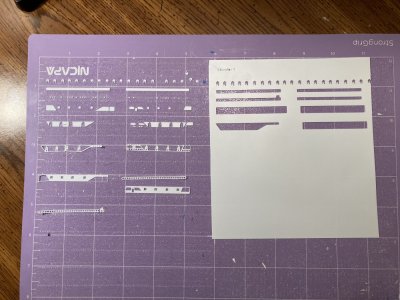
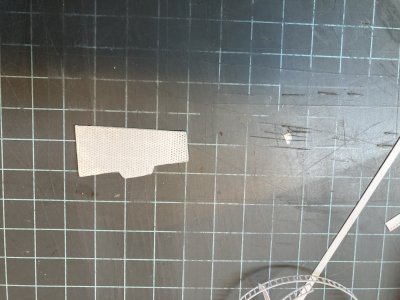
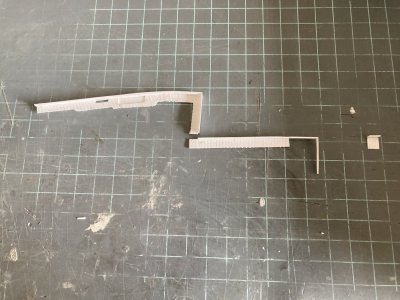
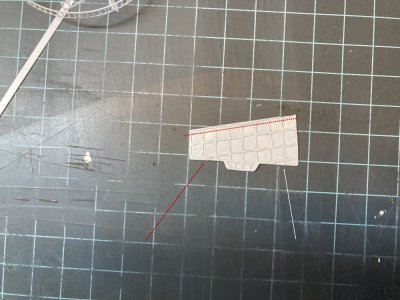
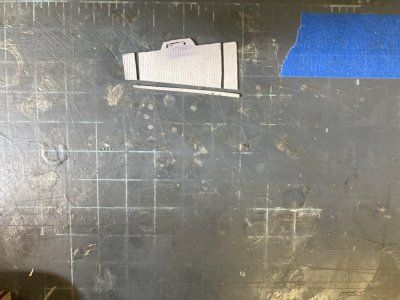
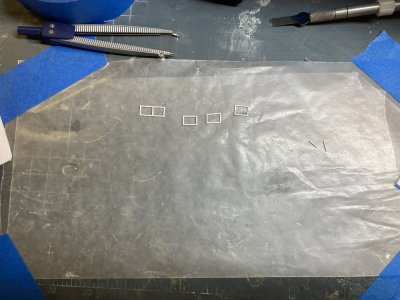
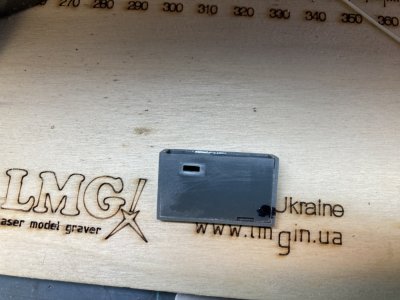
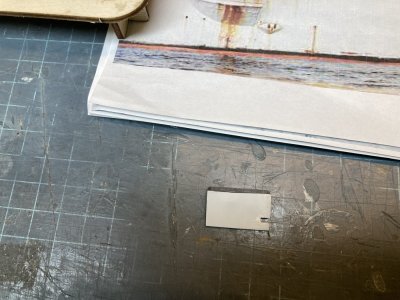
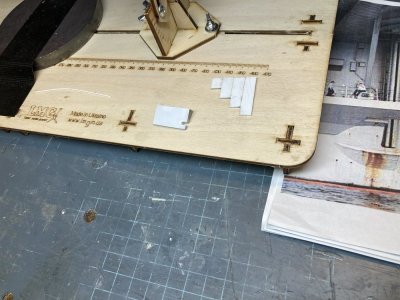
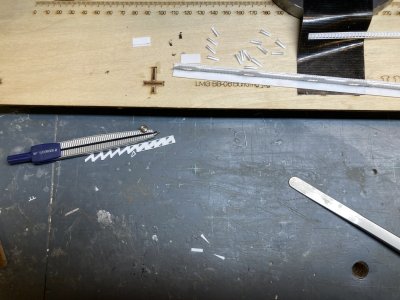
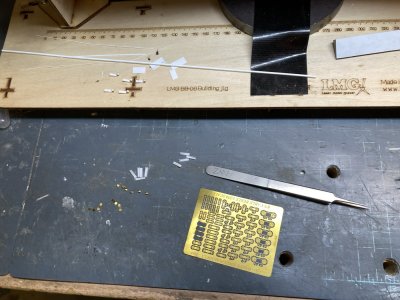
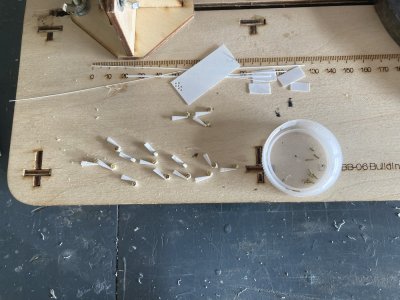
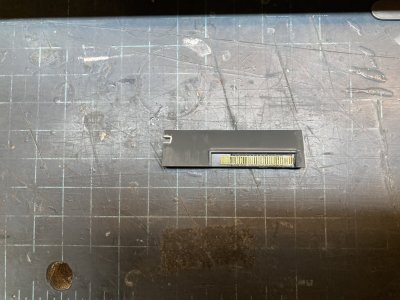
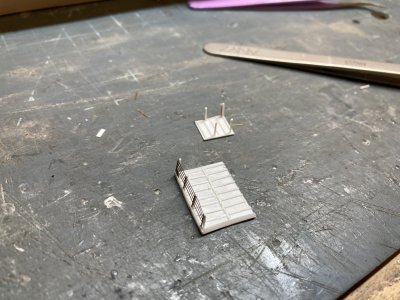
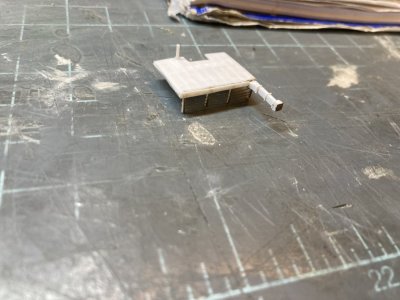
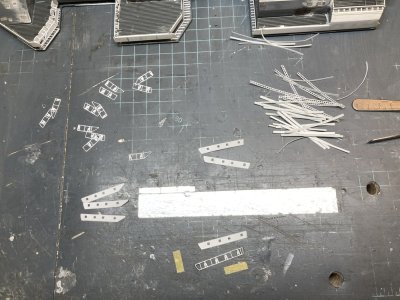
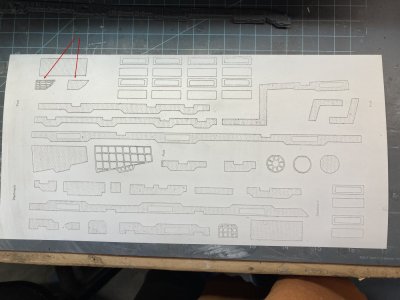
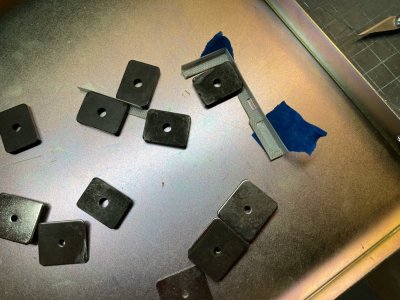
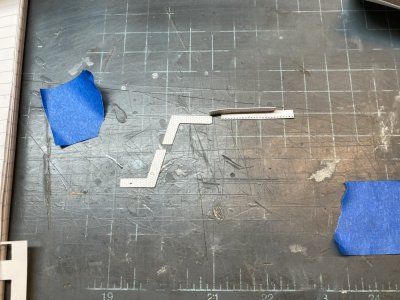
These are the parts that were produced for the second try on the skirts for El 1. I was especially pleased with the fine detail on these items.
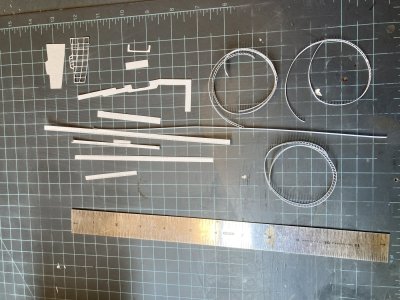
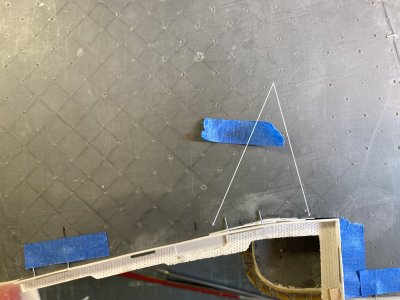
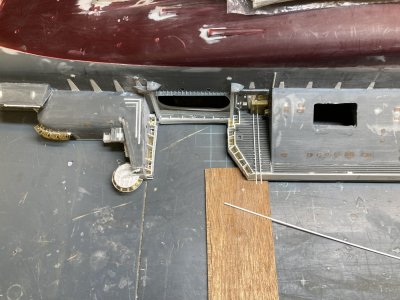
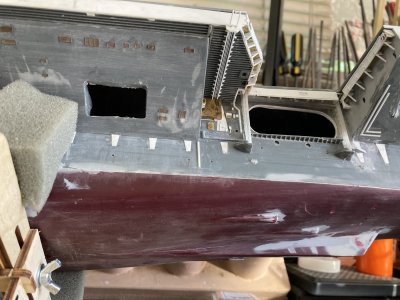
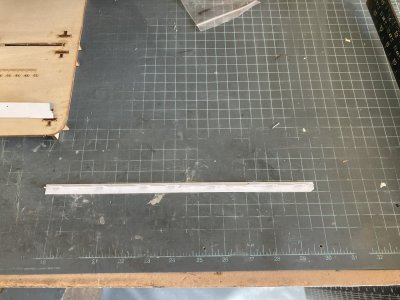
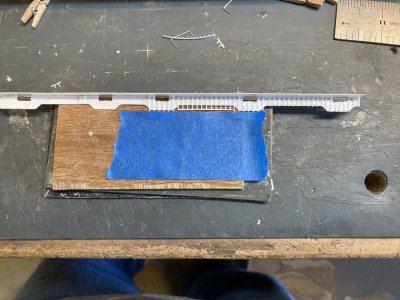
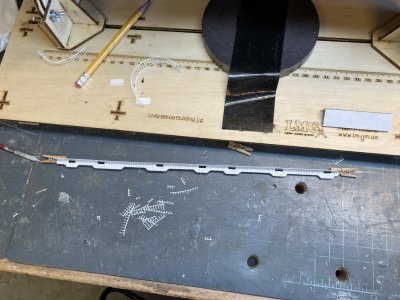
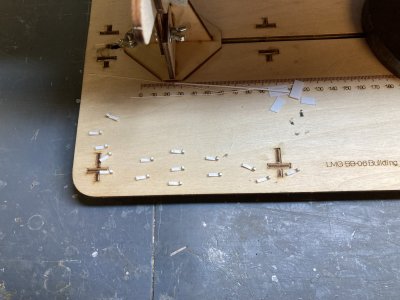
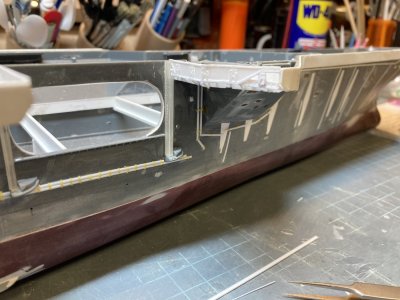
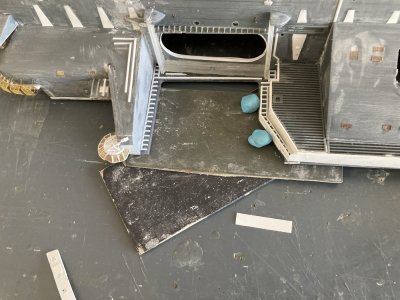
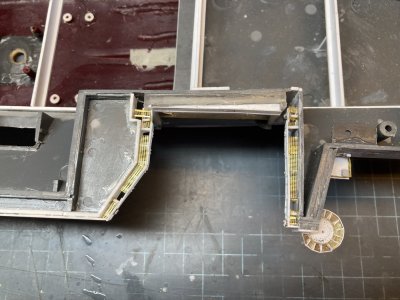
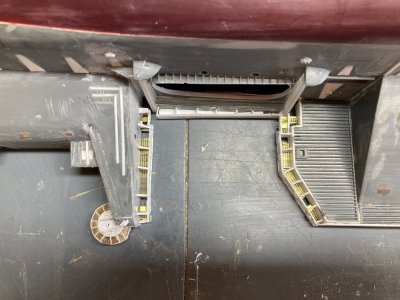
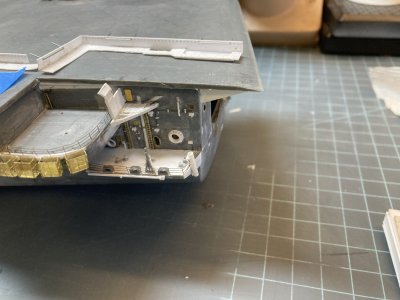
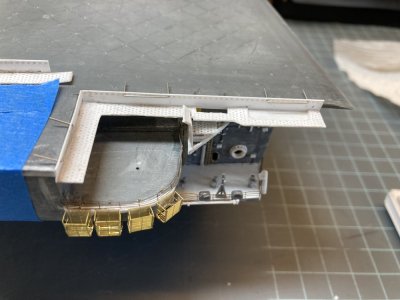
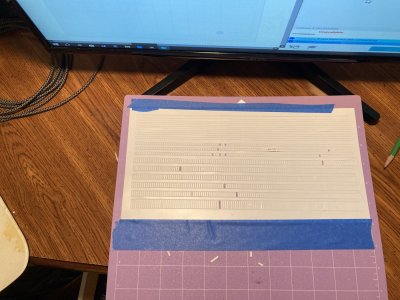
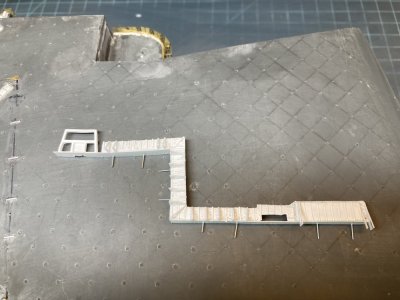
I first made a Cameo cut program just for the skirts around Elevator 1. I did this to save cutting time and material in case of mistakes. It allowed me to make corrections before proceeding to the parts for the rest of the elevators. On my second try the results were really good. I was even able to make individual up locks. This design was carried over when I made the remaining sets. To install the Elevator 1 skirts the model was placed upside down on the flight deck once again. I assembled the parts and glued the aft (straight) skirt to the hull only at the outboard edge. I worked my way inboard adding supports until the piece was about as solid as it would ever be without the flight deck glued in place. The forward skirt has an angle and it was a bit trickier to do until I hit on the idea of holding the skirts in place with blue tack until all the horizontal braces were in place.
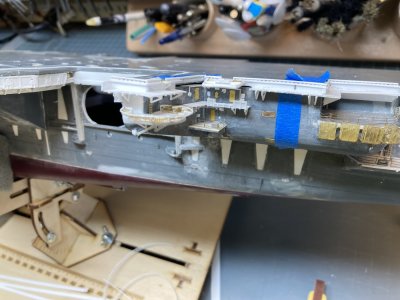
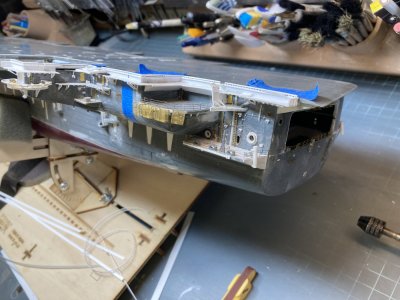
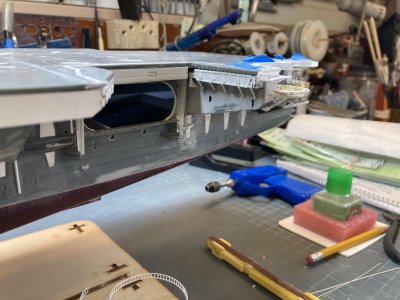
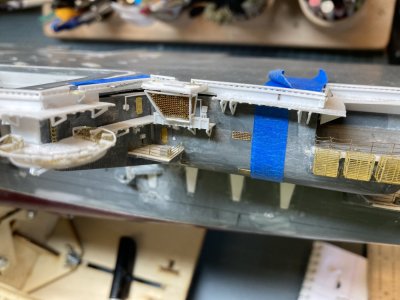
The aft skirt on Elevator 1 finished.
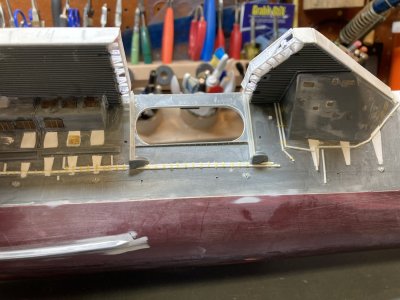
The view from below.
This is the end of part 1 of this post.
Part 17 Working on the under deck structure Part 1
Back when I removed the catwalks from the flight deck I also removed all of the underside detail that was there originally. It was interfering with the flight deck fitting to the hull so I sanded it all away. There wasn’t any in the area around the elevators anyways. The flight deck has pins now that ensure it always is positively located. When I was working on Sponsons 8 and 9 I started adding the girders to the aft end of the flight deck under the ramp. Now I began filling in the area under the starboard side going forward. There is a pretty good sized overhang in this area and I filled it in with .030” square strip. There are 3 angled gussets that run more or less perpendicular to the girders. I placed the girders the full length of the overhang and when they had dried cut away spaces for the gussets to fit into. The locating slots for the gussets made sure they were positioned correctly.
I have completed the girders on the overhang on the starboard side. Note the 3 gussets. The forward one is not correct and I removed it later. On the forward end of sponson10 I noticed that the extension I added had no gusset and I added one there.
I glued the 3 gussets in place and while I was trying to get a clearer photo of the detail on the gussets I came to realize that only 2 were needed. I can’t find any photos that show 3. I removed the smallest one and put a piece of flat strip in its place. This will be directly over the 03 level landing so it will be difficult to see anyways. It is possible that the gusset was under there but I am going without it. Each gusset was wrapped on the exterior edge with a section of .010” X .060” strip then vertical .010” X .030” strips were added to each the faces.
This is how I outlined the area where girders need to be added.
The work on the starboard side is done.
This is the area around Elevator 4.
I flipped the hull with the flight deck over and drew the outline on the rest of the overhanging deck to see exactly where the girders will be needed. This will be primarily around each elevator and under the angle deck to some extent. While the hull was upside down and still sitting on the flight deck I went a step further and cut and fitted .030” square strip to outline the features in the elevator wells and the overhang at the angle deck. This may not be accurate but it ensures there won’t be any gaps in the support structure.
This photo shows the landing which provides several entrances to the 03 level, also called the Gallery Deck. This was taken after they have started stripping the ship..
6 This grainy photo from the early 80’s shows this area as it also was in 1978.
This is a photo of the interior of that landing area. The 2 blue shirts are stenciling flight deck jerseys.
Under the aft section of angle deck there is an enclosed landing to the 03 level which is not represented in the model kit. The Eduard set part 5 has this piece pretty much as it was on the exterior in 1978. This is a large piece of brass and rather than gluing it together, after it was folded, I soldered it. I did not add the details yet I just wanted the basic assembly. I needed this piece in place to lay out the girders under the angle. This landing was the flight deck entrance which led to my shop. I remember knee knockers at the forward and aft entrances and a couple more inside. There were originally 4 oval openings to the exterior when the ship was built but by 1978 the forward pair was covered by an equipment room extension for the port ECM antenna. During the 1976 deployment there were still 3 openings.
I have just about finished soldering the part.
This is the Eduard part glued to the model. There is quite a bit missing from the interior and the catwalks.
I am in process of adding the girders around the exterior.
We actually used to sit in the openings when we were in port. There was a 6 inch sill which went around the oval and made a convenient seat. I remember being in port in the Philippines during the 1976 cruise I was in the Duty Section and was required to remain aboard. The ship had to pull out into the bay and anchor for a couple of days because of a storm. It wasn’t a big storm but because of wind gusts and the waves in the bay the ship wanted to play it safe. The airplanes were all ashore at Cubi Point and there wasn’t much work to do on board. I was able to relax aboard for the most part. I couldn’t get ashore but most of my supervisors couldn’t get aboard either. It was generally nice and cool in that passageway and the design caused a breeze to flow through it. It was a great place to read when we weren’t operating.
The Eduard piece is simplified as it does not have the various knee knockers or the outboard bulkhead that covered the openings. The room is open to the passageway. I will add those parts with plastic when I get to detailing this area. You won’t see much in there but it will have some value to me. There were 2 or 3 passageways off this landing to shops under the flight deck. I know there was one aft of ours and I am pretty sure there was a third. We explored them to see if there was a better way into the main interior passageways but all the exits were the same, go down to the main deck, go inboard and climb back up to the 03 level.
The assembled landing was positioned so that it extended past the angle precisely. This allows the inclined ladders from the catwalks to reach the landing. Once I was happy with the position I glued it to the hull with medium superglue and flipped the ship right side up. With the flight deck removed I made sure that the landing was correctly adjusted. Then it was hit with accelerator. I also let thin CA run into the joint making a good strong connection. I turned the model over again and laid out the outline of girders around the landing.
This is a photo from a museum ship I am not sure which one but this is generally what would be behind the elevator skirts.
When all the basic layout work was done the ship was set upright and the flight deck removed. I could then work on the underside of the flight deck itself to finish the girder detail. This involved a lot of very small pieces of strip. Around the elevator fore and aft edges I left about a .020” space to accommodate the elevator skirts (I am sure there is a proper name for these facings to the elevator wells but I don’t know what it is). These skirts have the up locks and cover the cable reels. The model does not provide any of this structure. The Eduard set part Number 4 has the skirts, up locks and supporting structure for the Elevator 2 and 3 skirts. These are the elevators which they instruct you to lower. There are some struts but no skirts for Elevator 4 and nothing for the area around Elevator 1 since it is molded to the deck in the Tamiya kit.
This is the Eduard photo etch at Elevator 2, notice how it is attached to the edge of the flight deck. This is from Eduard’s page in their digital catalog.
Between Elevator 2 and 3 at Sponson 1 Eduard has you add a framework piece to the forward side of the big vent box. I have to confess that I never saw that in any photo until I got this Eduard set. I went back to my photos and then found it in several. I added about 15 fore and aft girders to the overhead of Sponson 3 from .030” square strip. This area was blank and it has a lot of overhang out in the open.
This shows the framework piece from the Eduard set on the edge of the vent box. I am pretty far along with the skirts in this photo. Unfortunately the flight deck has dropped away from the hull spoiling the effect.
The Eduard parts for Elevators 2 and 3 are supposed to be glued to the edges of the elevator openings. They add just enough thickness to the opening that the elevators won’t fit if they are in place. Cutting them shorter to sit on the flight deck would be difficult and I did not want to sand the edges of the previously assembled elevators. Neither of the two sets will be useful on the starboard side so I will make my own. I looked into the possibility of using one or the other of these 2 sets at Elevator 4 but the detail would have to be on the inside since this elevator is a mirror image of the others. The parts would have the plain side out and none of the struts fit. There was one brass support for the structure at Elevator 2 which I would have used but after I folded it I dropped it on the floor and then rolled my chair over it. It was broken at all the fold lines and I never found one piece. The idea was pretty easy to duplicate in plastic. There is another of these struts at elevator 4.
All 3 of these elevators are very close to each other in size in the kit but in real life they were each unique. It simplifies the cut program because I can make all the skirts the same. I can make them slightly longer than I need and cut them shorter to fit each well. I will make enough parts to do all the remaining sets of elevator skirts in plastic and several extras. I designed them to be built up in layers for a 3 dimensional appearance.
This is the area around Elevator 1.
These are the parts that were produced for the second try on the skirts for El 1. I was especially pleased with the fine detail on these items.
I first made a Cameo cut program just for the skirts around Elevator 1. I did this to save cutting time and material in case of mistakes. It allowed me to make corrections before proceeding to the parts for the rest of the elevators. On my second try the results were really good. I was even able to make individual up locks. This design was carried over when I made the remaining sets. To install the Elevator 1 skirts the model was placed upside down on the flight deck once again. I assembled the parts and glued the aft (straight) skirt to the hull only at the outboard edge. I worked my way inboard adding supports until the piece was about as solid as it would ever be without the flight deck glued in place. The forward skirt has an angle and it was a bit trickier to do until I hit on the idea of holding the skirts in place with blue tack until all the horizontal braces were in place.
The aft skirt on Elevator 1 finished.
The view from below.
This is the end of part 1 of this post.
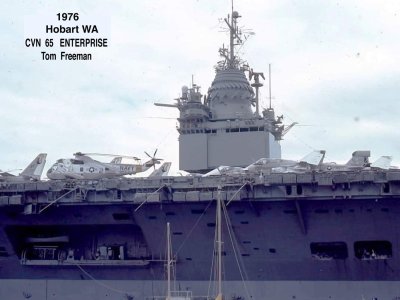
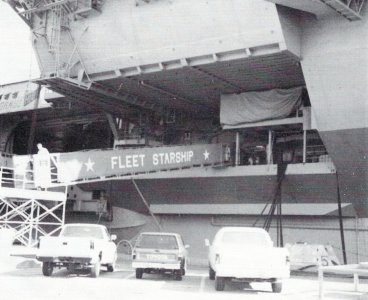
 ) but I remember as a kid catching a ferry in Hobart to go out and have a look at this great ship. Caused quite a stir in Tassie