





- Joined
- Jul 27, 2021
- Messages
- 702
- Points
- 403

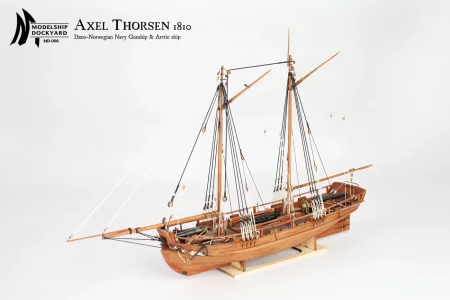
Axel Thorsen 1810 Dane - Norwegian Schooner 1:72 by Modelship Dockyard
Download Instruction Manual - Axel Thorsen 1810
Size:
Length: 400mm
Width: 80mm
Height: 250mm
Time for something new.
I have a special relationship with smaller, more unusual ships and kits, and I wanted to build something "simple" without having to think too much. Spoiler alert: the plan didn't work out at all :-D
In my stash, I still had this small, inexpensive 1:72 kit with a printed hull from Modelship Dockyard. The design seemed interesting and the finished hull promised easy construction...
History:
The Axel Thorsen was constructed in 1810 as a Naval gun-schooner for the Royal Danish/Norwegian Navy. Built from pine, the vessel measured approximately 56 Norwegian feet (approx. 19 meters) in length with a displacement of 74 tons. It was armed with two 24-pdr swivel guns and typically crewed by 45 sailors. This class of schooner was designed to counter the British blockade of the Norwegian coastline during the Napoleonic Wars, primarily tasked with escorting merchant ships from the White Sea to Norway. In its early service, the Axel Thorsen participated in multiple convoy missions and harbor defense operations.
Following the Napoleonic Wars, the ship continued to serve for decades in diverse roles, including coastal surveying, Arctic scientific expeditions, and marine resource harvesting. Its final chapter came in 1872 during an Arctic exploration when it was trapped by ice and abandoned in Tsjesjekaja Bay near Cape Kanin.
Axel Thorsen epitomized 19th-century maritime endeavors—from wartime defense and sovereignty assertion to Arctic exploration and resource exploitation. Its dual roles reflect the era’s complexities
The Kit:
At first glance, the kit makes a good impression. I prefer pear wood, but cherry is also a good wood. Turned brass gun barrels, high-quality blocks, photo-etched parts and some resin parts (3D printed) round off the picture. A 1:1 side view of the model is included as the only plan. The instructions can be downloaded from drydockmodelsandparts.com, for example.
Unfortunately, it becomes clear as early as step 3 of the instructions that something is seriously wrong. The instructions – as will become increasingly clear – are unfortunately a disaster. Parts are not mentioned, not named, look completely different from the laser-cut parts, are supposed to be installed in a way that is not possible, and are sometimes listed in an "unfortunate" order.
Unfortunately, this seems to be a fundamental problem with lots, not all, Chinese kits. Which is a shame. Wonderful little kits are designed, but it seems that no one is willing to go through a couple of beta build iterations to test whether, for example, the instructions are correct and what can and, above all, must be optimized. It's a great pity.
Anyway, challenge accepted.
The inner planking should be made with 1 mm cherry veneer. There's no way to get all the bends with these short parts – the wood is simply too thick! Other manufacturers rightly use 0.5 mm veneer for this. I switched to this and made the parts with 0.5 mm pear veneer.
Another issue was the waterway. According to the instructions, it should be glued to the deck, which is nonsense, if only because of the fishing that has been done. With a 3D-printed hull, you would expect everything to fit perfectly, but that is not the case. The waterway had to be laboriously adapted to the shape of the printed case.
The keels false keel is not mentioned in the instructions and no part number is shown, great (I mean I don't care ... haha).
It was a very frustrating start, and I was undecided whether to start a build log because there was a possibility that I would abandon the project. So much for simple and relaxing... :-D


Cheers Dirk
Download Instruction Manual - Axel Thorsen 1810
Size:
Length: 400mm
Width: 80mm
Height: 250mm
Time for something new.
I have a special relationship with smaller, more unusual ships and kits, and I wanted to build something "simple" without having to think too much. Spoiler alert: the plan didn't work out at all :-D
In my stash, I still had this small, inexpensive 1:72 kit with a printed hull from Modelship Dockyard. The design seemed interesting and the finished hull promised easy construction...
History:
The Axel Thorsen was constructed in 1810 as a Naval gun-schooner for the Royal Danish/Norwegian Navy. Built from pine, the vessel measured approximately 56 Norwegian feet (approx. 19 meters) in length with a displacement of 74 tons. It was armed with two 24-pdr swivel guns and typically crewed by 45 sailors. This class of schooner was designed to counter the British blockade of the Norwegian coastline during the Napoleonic Wars, primarily tasked with escorting merchant ships from the White Sea to Norway. In its early service, the Axel Thorsen participated in multiple convoy missions and harbor defense operations.
Following the Napoleonic Wars, the ship continued to serve for decades in diverse roles, including coastal surveying, Arctic scientific expeditions, and marine resource harvesting. Its final chapter came in 1872 during an Arctic exploration when it was trapped by ice and abandoned in Tsjesjekaja Bay near Cape Kanin.
Axel Thorsen epitomized 19th-century maritime endeavors—from wartime defense and sovereignty assertion to Arctic exploration and resource exploitation. Its dual roles reflect the era’s complexities
The Kit:
At first glance, the kit makes a good impression. I prefer pear wood, but cherry is also a good wood. Turned brass gun barrels, high-quality blocks, photo-etched parts and some resin parts (3D printed) round off the picture. A 1:1 side view of the model is included as the only plan. The instructions can be downloaded from drydockmodelsandparts.com, for example.
Unfortunately, it becomes clear as early as step 3 of the instructions that something is seriously wrong. The instructions – as will become increasingly clear – are unfortunately a disaster. Parts are not mentioned, not named, look completely different from the laser-cut parts, are supposed to be installed in a way that is not possible, and are sometimes listed in an "unfortunate" order.
Unfortunately, this seems to be a fundamental problem with lots, not all, Chinese kits. Which is a shame. Wonderful little kits are designed, but it seems that no one is willing to go through a couple of beta build iterations to test whether, for example, the instructions are correct and what can and, above all, must be optimized. It's a great pity.
Anyway, challenge accepted.
The inner planking should be made with 1 mm cherry veneer. There's no way to get all the bends with these short parts – the wood is simply too thick! Other manufacturers rightly use 0.5 mm veneer for this. I switched to this and made the parts with 0.5 mm pear veneer.
Another issue was the waterway. According to the instructions, it should be glued to the deck, which is nonsense, if only because of the fishing that has been done. With a 3D-printed hull, you would expect everything to fit perfectly, but that is not the case. The waterway had to be laboriously adapted to the shape of the printed case.
The keels false keel is not mentioned in the instructions and no part number is shown, great (I mean I don't care ... haha).
It was a very frustrating start, and I was undecided whether to start a build log because there was a possibility that I would abandon the project. So much for simple and relaxing... :-D
Cheers Dirk
Last edited:






 !
!


