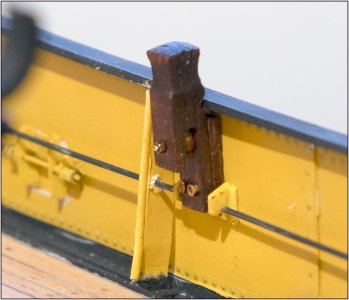
After installing the chainplates and deadeyes for the mizzen mast, I built this mizzen mast.
The chainplates with deadeyes also need to be installed for the main mast.
However, while setting them out and then lowering the main mast, I ran into a problem. I'll try to explain it step by step.
The Amsterdam restoration book neatly describes on page 54 that these were installed in a special way on the Balder:
"
A mistake was initially made when installing the new rigging fittings. The mast socket was tilted about two degrees to port because the mast was lowered during fishing and had to be positioned next to the mizzen mast. Because the standing rigging was positioned as perpendicular as possible to the mast socket to ensure uninterrupted lowering and raising of the mast, the fittings were positioned perpendicular to the sides of the mast socket. Therefore, the starboard fittings were positioned about 10 centimeters aft of the port fittings. Initially, the port and starboard sides were made the same; this error was later corrected."
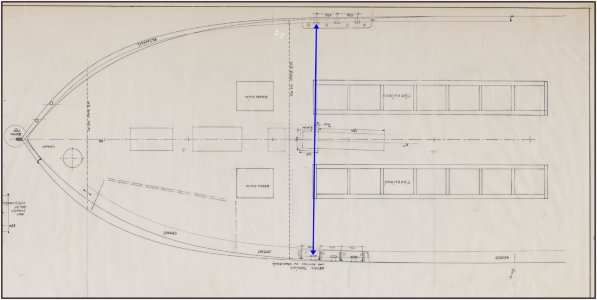
There was a drawing in the archive from which I extracted this section:
View attachment 583982
The blue line points between the two forward chainplates. The line is rotated about 1 degree clockwise and both chainplates are just covered by the aft side of the mast.
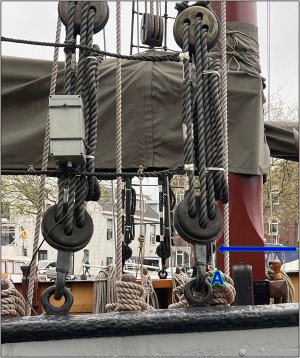
On the Balder, the forward shrouds are positioned just aft of the mast:
View attachment 583983
The arrow points to the barely visible port deadeye. So, the forward shrouds are just behind the mast.
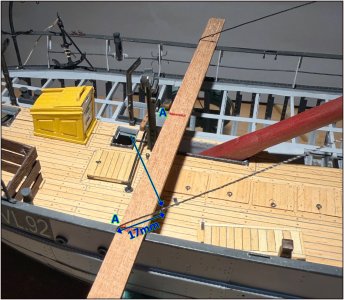
The letter A indicates the location where the forward shroud will hinge with the hook of the lower deadeye when the mast is lowered.
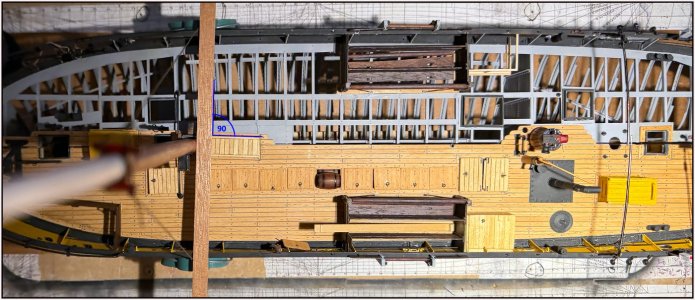
I've placed two test lines on my model to determine the position of the two forward shrouds.
View attachment 583984
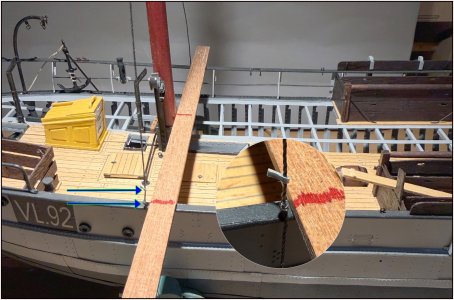
Behind the mast is the box that closes the 'kossing'. Behind the mast, I've placed a batten perpendicular to the 'kossing'. The starboard side is therefore slightly aft than the port side.
Viewed from the side:
View attachment 583985
When the mast is lowered, the forward shrouds hinge around the front of the batten. I've drawn a red line there, as well as the center of the aft side of the mast. Just above the bulwark, I tied a knot in the line, marking the position of the hinge hook of the lower deadeye block. I placed a piece of tape 5 mm above it to make the knot easy to find.
The hinge point of the main mast, however, lies deep within the hull. On the original Balder it's 1.75 meters below the top of the bulwark, which is the hinge point of the forward shrouds.
View attachment 583986
Initially, I had clamped both shrouds to the bulwark. I could then only tilt the mast slightly aft. The shrouds became taut and prevented further lowering.
If the mast is lowered now... the forward shrouds will need to be extended! In this case: the lanyards between the deadeye will have to be released.
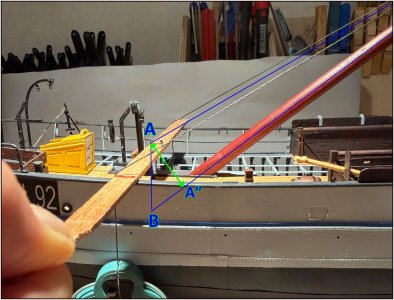
On my model, the knot was pulled 17 mm from hinge point A. For the explanation in the next photo, I also projected point A onto the strip at the red line behind the mast.
With a little math, all of this can be explained:
View attachment 583987
-From point A, I drew the hinge (blue) line of the shroud rope diagonally upwards to the attachment point on the mast.
-Starting from B, vertically below A, I drew the hinged (blue) line from the pivot point of the mainmast.
-I projected point A with the green line perpendicular to the mast line as point A".
-Then the length between B and A" is (almost) equal to the distance between the hinged line behind the slat to the knot.
Conclusion:
For sure, to lower the mainmast, the lanyards of shroud ropes between the two deadeyes will have to be released.
Not just the forward ones, but the other two as well.
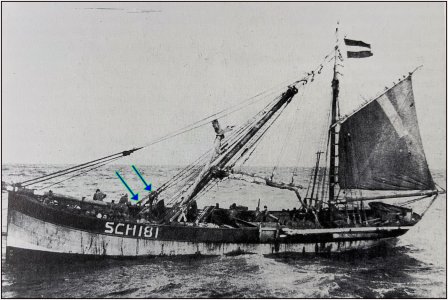
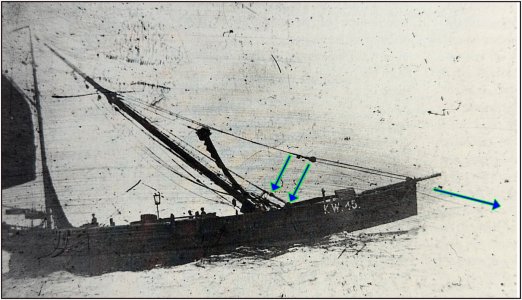
If I look more closely at these two old photos:
View attachment 583988
View attachment 583989
Then the shrouds are clearly forward of the lowered mast, and it looks like the two deadeyes are far apart. So, a released lanyard.
PS: On the 2nd picture you can see te 'reep' of the fishnet in front of the bow. On the 1st picture also slightly visible.
It is nice that at the various steps in the build of the model you discover more and more in the old specifications and old photos.
Today I also visited the original Balder and discussed this with some technical people. They were unaware of this because the Balder's mast was never lowered after its restoration. They found it incredibly interesting and felt even more awe for the crew who had to do all this at sea with a ship rolling and pitching.
I already knew it would be a challenge to build my model with a lowered mast. To get the rigging on the foremast in shape properly, I'll have to make it with the mast standing. Then I'll lower the mast and figure out how to release the tally strips and keep the rigging in shape. The spreader bar above the uppermost deadeyes should be helpful.
Then the rigging at the port top should also be detachable, as both halves can be taken apart.
First, I'll get to work on the chainplates. 'Eating the elephant one bite at a time' ..........


Regards, Peter












 .
.
 …..sounds like my shipbuilding