

• Win a Free Custom Engraved Brass Coin!!!
    As a way to introduce our brass coins to the community, we will raffle off a free coin during the month of August. Follow link ABOVE for instructions for entering.
  • PRE-ORDER SHIPS IN SCALE TODAY!

    The beloved Ships in Scale Magazine is back and charting a new course for 2026!
    Discover new skills, new techniques, and new inspirations in every issue.

    NOTE THAT OUR FIRST ISSUE WILL BE JAN/FEB 2026

BALDER, Vlaardingen Herring Lugger from 1912, scratch build scale 1:50 Plate-On-Frame

Thank you very much, Dean. Much appreciated!
Then you have a scoop in this reply: since last week I have been an official member of the maintenance team of the original Balder and therefore also a crew member. This is very convenient now that I am working on the rigging of my Balder.
Last Thursday with some other volunteers, including the skipper, we went through some specific lines of the Balder that are slightly different than described in the old specifications that I am working out.
So, here you have a very proud person.:)
Regards, Peter
That’s great! Congratulations!
 
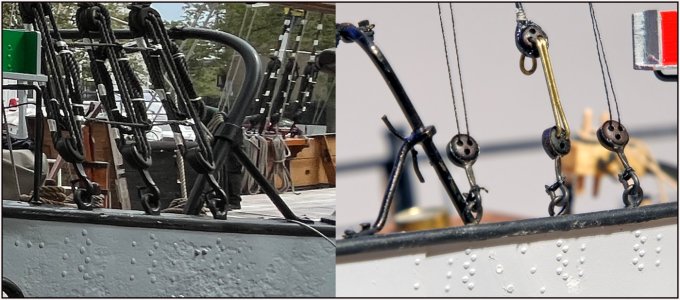
I concluded that the eyes on the bulwark were too thin and the hooks too large.
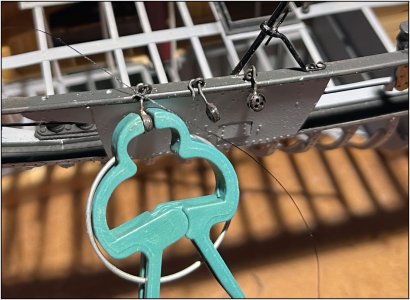
I made 6 new ones and were ready to attach them to the model:
0986 Size.jpg
When they were on the model with the chain plates glued in place, I found the arms between the hook and the deadeye still too long.
I cut the ties around the hook opening, removed them, and made 6 new ones. So, hook and band around the deadeye.
That's the situation on the photo. Then I had to attach the slings over the hook opening fitted on the model. It was a matter of patience, working with tweezers and a small clamp.

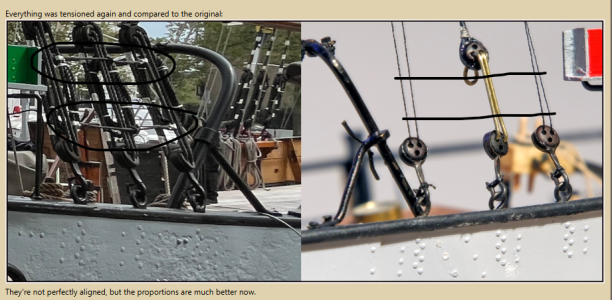
Everything was tensioned again and compared to the original:
0987 Size.jpg
They're not perfectly aligned, but the proportions are much better now.

Now I'm going to fit all the bands and blocks to the mizzen mast.
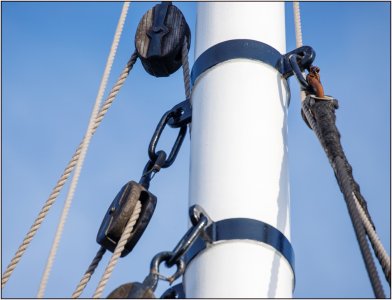
That will be another challenge because the blocks all have external fittings.
0988 Blokken.jpg
There are a lot of drawing of different blocks, the dimensions are known. Well, bring it back to 1:50..... ;)
Regards, Peter
 
Last edited:
Then you have a scoop in this reply: since last week I have been an official member of the maintenance team of the original Balder and therefore also a crew member. This is very convenient now that I am working on the rigging of my Balder.
Conratulation. mon ami! Well deserved, now we can call you: One of the Balders!
 
Way to go Peter. Officially a crew member of the ship you are building is very cool. Cheers Grant

Thanks, Grant. During my visits over the past two and a half years, I increasingly felt like "one of them." Studying the old drawings and specifications allowed me to participate in detailed discussions. And showing them my progress of my build also provided input for various discussions.
But I'm convinced that others here on the forum wouldn't be out of place as members on "their original." Such as the builders of the H.M.S. Victory, Cutty Sark, USS Constitution, Gorch Fock, etc. etc. etc.
Regards, Peter
 
By the meeting last Thursday I was also presented with an old 'skipper's cap' that had been worn by a member who passed away last year.
View attachment 573098
After some investigation by my Admiral and a cousin of mine whom I spoke to this afternoon, both with an interest in genealogy, this man turned out to be my mother's cousin. There is no such thing as coincidence!
Regards, Peter
what an honor well-earned and deserved!
 
what an honor well-earned and deserved!
Thanks, Pete. It's indeed a honor and I feel privileged to.
Somestimes I have to look twice to se idntify the model and the original ship. It's absolute outstanding.
One question: is the rigging of the original ship original or is it more modern to facilitate todays's needs?
You also thanks, Christian. The Balder crew looks at it in much the same way, but then: 'Is it right with our Balder?'
As far as what I have seen for now, the sail settings and rigging is original. To comply with current regulations, adjustments are in the areas of navigation, communication, rescue equipment and the engine.
Regards, Peter
 
Fantastic work on the eyes...
View attachment 573666
I think you have the opportunity to adjust the alignment some with these horizontal lines?
Thanks, Dean. For the compliments and for thinking with me. That they were not good aligned was a footnote for the temporary alignment on that picture.
When the shrouds with upper deadeye were installed and everything on tension with the lanyards, for sure the sheer poles and ratlines will adjust them in the right position.
Regards, Peter
 
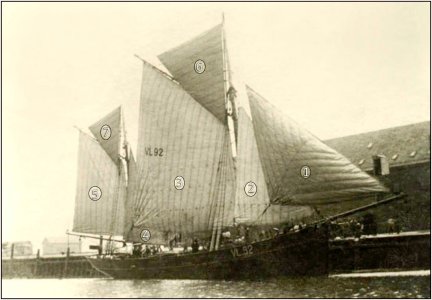
Before I go into the details of the rigging, I'll first show the Balder's sails:
0988 Aap.jpg
I assumed there were only 6 sails, but it turns out there's a 7th. With their partly old names:
1: Jib (kluiver)
2: Stay sail (fok)
3: Main sail (without boom)
4: 'Aap', Monkey or mizzen staysail
5: Mizzen sail (with boom)
6: Main gaff topsail
7: Mizzen gaff topsail
A total of 288.30 square meters of cloth.

I wasn't familiar with the ‘Aap’ / Monkey mentioned under '4'. I did come across the 'Aapval' / 'Monkey halyard' in the old specifications. It became clear to me during my last visit to the Balder. Although it's also called a mizzen staysail, it's not led along a stay. This is because the mizzen mast doesn't have a stay in the middle. The tack is attached to an eyelet located in the center of the deck at the stern of the crowbars. I didn't know the function of that eyelet either. Now I do... The sheet is secured to the bulwark on either the port or starboard side, depending on which side the hull guard is on.

I'll describe the course of all the lines of the standing and running rigging and show them later when I apply the relevant lines to the model.
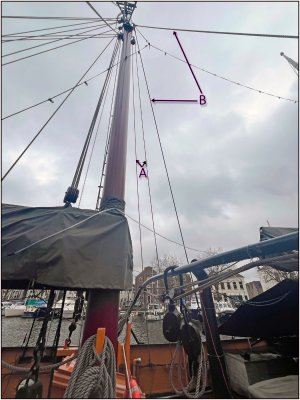
Because they are special and relate to the description above, I'll include these two:
0990 Aap.jpg
A: ‘Aap’/Ape halyard
B: ‘Bakstag/Backstays (to the front ...... ;))
What was immediately pointed out to me: the presence of the two 'backstays' on the front of the mizzen mast, which aren't mentioned in the old specifications. I don't think the term 'bakstag' comes from 'back-stay' but rather because they are attached to the ‘bak’ , the bulwark on either side.
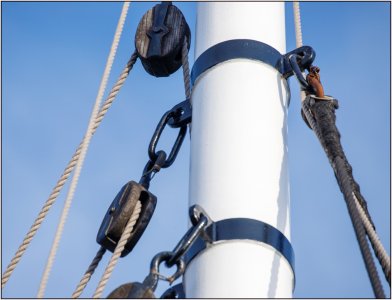
These are attached to the link in the eye at the front of the middle band with both eye splices and a shackle:
0991 Blokken.jpg
A notable feature is that, for example, the blocks of the peak halyard to the left of the mast were inserted in the links "from outside/top to inside/bottom" and then "tied off."
While the old specifications describe:
"the single-sheave hook blocks (hook perpendicular to the nail) were hooked from bottom to top so that the hook opening pointed aft."
On my next visit to the Balder, I'll ask why on the Balder ...?
Regards, Peter
 
Last edited:
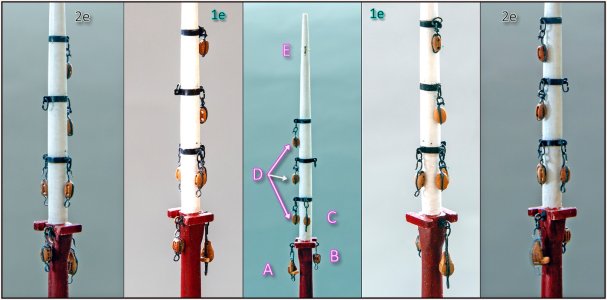
I've been busy assembling the mizzen mast.
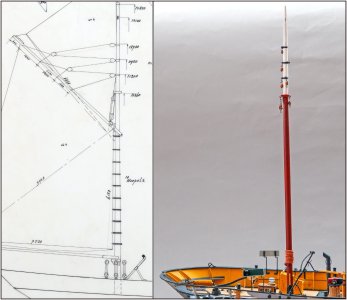
First, a general overview:
0992 Mast.jpg
There was also a drawing with all the dimensions, which saved a lot of climbing to measure.

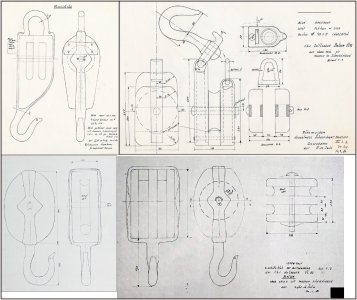
Also, several drawings with the dimensions of the blocks:
0993 Blokken.jpg
Top left is an interesting one. In Dutch, it's called the 'Klauwval blok' / block for the claw halyard /throat halyard.

Here's a collection pictures to make a long story short:
0994 Blokken.jpg
The two photos labeled '1st' are my first attempt at making the fittings for the blocks. I did it the same way as with my Bluenose.
In the general overview of the top of the mast in the middle photo:
A: at the rear: a 2-sheave hook block of 6 mm with a becket for the inner halyard/claw halyard.
*by means of a link on an eyebolt, at the top of the hommer, between the two cushions;
*hook parallel to the axis of the athwartship sheaves;
*hooked from bottom to top.
B: At the front: 2-sheave hook block of 3.5 mm with a eye for the "Aapval" (Ape halyard).
*attached to an eyebolt at the top of the hommer, between both cushions;
*hook perpendicular to the axis of the athwartship sheaves;
*hooked from starboard to port so that the hook opening points towards port.
C: On both starboard and port sides, a 4 mm 1-sheave hook block for the "Crane lines" to the end of the mizzen boom (Topping lift).
*by means of a link to an eye on the lower strap;
*hook parallel to the axis of the athwartship sheave;
*hooked from bottom to top.
D: At the aft, three 1-sheave hook blocks of 4 mm for the peak halyard.
*by means of a shackle attached to the eyes of all 3 slings;
*the hook is perpendicular to the axis of the fore-and-aft sheaves;
*hooked from bottom to top.
E: At the top of the mizzen mast, a transversely rotating sheave for the mizzen topsail halyard.
*the fore-and-aft axis.

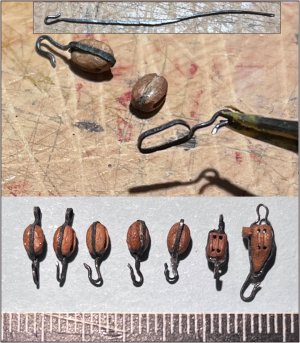
However, once photographed, I wasn't satisfied with the round wire. I removed all the blocks and made new fittings. Hence the outer two photos marked '2nd'.
0995 Banden.jpg
The Dry-Dock blocks are a bit egg-shaped. That's why I filed down the sidewalls a bit. This way, the bands fit a bit flatter on the blocks and look more like the Balder's. Drilling little holes and fitting the shafts ........ that was a bit too far ....... ;)
I started with the hook using the 0.4 mm round metal wire. After making the hook, I flattened the wire in my small vice. And then wrapped the rest of the sling around the blocks.

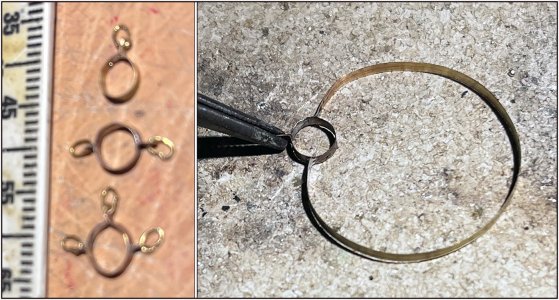
Soldering the 3 slings with 1, 2, and 3 ears was improvised.
0996 Banden.jpg
The band with the 3 eyes were particularly challenging, because when soldering one eye, another, already soldered, came loose.
*First, the band was cut to size and a tab was bent for the eyes on each side. These were soldered together.
*The tab was placed in a clamping pin set;
*The brass strip was bent into a large curve and clamped under tension on each side in the position of the other two eyes.
*On each side, a clamp and a piece of solder were placed against the connections and both connections were soldered in one go;
*Bolted both sides to size and drilled holes for the eyes in all three tabs.

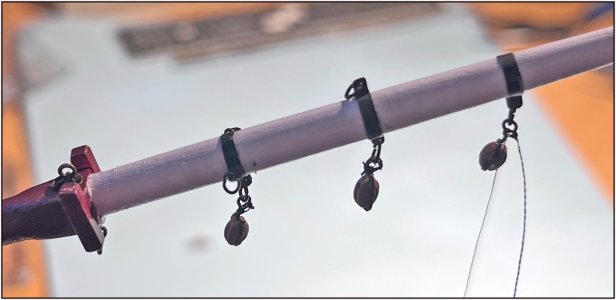
Then, the three blocks for the peak halyard were hooked in again:
0997 Bindselen.jpg
Ones hooked, the opening was closed again with a piece of Serafil thread.

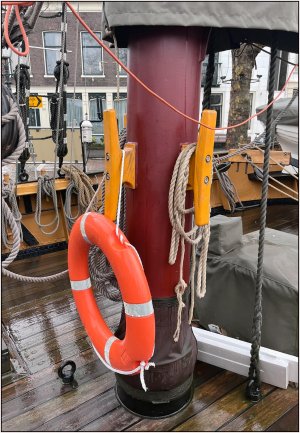
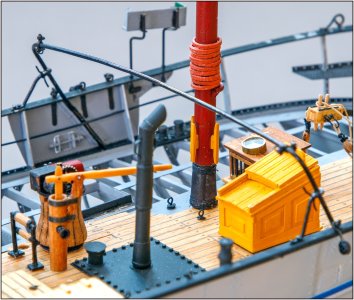
Next, it was the mast foot's turn:
0998 Mastvoet.jpg
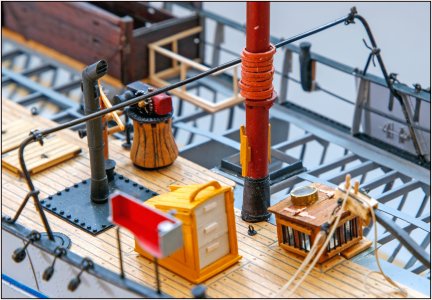
The connection to the deck was tied off with a piece of canvas to prevent water ingress. Above that, three large cleats on the front and both sides.

As it appears on the model.
0999 Mastvoet.jpg
I still have to imitate both bolds of the 3 cleats …..
1000 Mastvoet.jpg
Above the three cleats is the table where the gaff boom claw will rests.
And the 10 hoops to which the mizzen gaff sail is attached.
Regards, Peter
 
Last edited:
Back
Top