




• Win a Free Custom Engraved Brass Coin!!!
    As a way to introduce our brass coins to the community, we will raffle off a free coin during the month of August. Follow link ABOVE for instructions for entering.
  • SUBSCRIBE TO SHIPS IN SCALE TODAY!

    The beloved Ships in Scale Magazine is back and charting a new course for 2026!
    Discover new skills, new techniques, and new inspirations in every issue.

    NOTE THAT OUR NEXT ISSUE WILL BE MARCH/APRIL 2026

Bellona POF scratch build

Thank you Allan
I have that drawing but have, to date, not seen a reason to study it. This brings up a question. How do you discover the changes between documents? Are you looking for an answer to a question or do you study and compare drawings? I spent some time yesterday looking at the two drawings. From station 2 aft and station A forward I see no changes. With the lack of detail on the inboard profile plan I cannot see that much has changed other than moving the midship mark. Seems like I should just keep moving until I have to make the midship frames/bends.
warren

 
Are you looking for an answer to a question or do you study and compare drawings?
I do not mean to be indirect, but it depends on what is available. When doing a scratch build of an English ship in the age of sail, the following is my order of preference for dimensional information, if they are available.
As-built drawings for the specific ship
Contract for the specific ship or a sister ship
Design drawings for a specific ship or a sister ship
Establishments from 1719 to 1750 and for some years beyond
The Shipbuilder's Repository 1788
David Steel's Elements and practice of Naval Architecture.

I cannot think of any part that would be made or installed without looking at the most appropriate plans and scantlings list.

Even if all the above are available, a good book on how these things were installed is invaluable. Small fittings such as bolts are not on drawings but they are often specified in contracts, or lacking a contract, the scantling sources mentioned above. For Bellona I would compare scantlings from the contract for the closest ships I could find which is for, Culloden 1776 along with The Shipbuilder's Repository and the plans. Interesting aside about the Culloden contract. There are red ink changes that were used for the Thunderer 1783

Sorry for a long drawn out answer, but I hope it makes some sort of sense.

Allan
 
Last edited:
I do not mean to be indirect, but it depends on what is available. When doing a scratch build of an English ship in the age of sail, the following is my order of preference for dimensional information, if they are available.
As-built drawings for the specific ship
Contract for the specific ship or a sister ship
Design drawings for a specific ship or a sister ship
Establishments from 1719 to 1750 and for some years beyond
The Shipbuilder's Repository 1788
David Steel's Elements and practice of Naval Architecture.

I cannot think of any part that would be madeor installed without looking at the most appropriate plans and scantlings list.

Even if all the above are available, a good book on how these things were installed is invaluable. Small fittings such as bolts are not on drawings but they are often specified in contracts, or lacking a contract, the scantling sources mentioned above. For Bellona I would compare scantlings from the contract for the closest ships I could find which is for, Culloden 1776 along with The Shipbuilder's Repository and the plans. Interesting aside about the Culloden contract. There are red ink changes that were used for the Thunderer 1783

Sorry for a long drawn out answer, but I hope it makes some sort of sense.

Allan
This is not drawn out at all. You have actually answered my question and anticipated the next. Thank you.
warren
 
It has been a while, but I am back. Having taken a break I took a fresh look at my lofting problem. Upon very close examination of the body plan I discovered it was rotated 0.17 degrees counter clockwise. After correcting this my stern and bow lofting lines finally worked together and my spline lines were all very smooth. Time to revisit cant frames and get going.
 
I discovered it was rotated 0.17 degrees counter clockwise.
I have not inserted one RMG drawing, be it from their website, purchased from RMG, or a downloaded copy ot the high res drawings from RMG on the Wiki website that did not need to be rotated slightly. Same thing for drawings from any archives. I load the drawing onto a new page in CAD then the first thing is to make sure it is full scale 1:1, then draw a straight line along the keel or center line (for decks and such) as appropriate. Deck drawings are the worst for symmetry so a straight horizontal line on the center line then draw half, port or starboard. After the half is done mirror image and done. Drafting perfectly symmetrical halves by hand wasn't easy when done by hand.

Allan
 
Repeating myself = Of over 200 plans that I have experience with, not one had identical 0 (midship) station shapes on the right Fore and left Aft with the Body plan.
I just usually use the Fore shape.
The vast majority of NMM plans have tears with taped repair and or stretch or shift or contraction along the Sheer/Profile plans.

My advantage with the Profile is that a single 1 pixel vertical line of data at each station is all that I need.
For my purposes, spending half a year recreating a 3D hull in CAD is totally unnecessary.
 
For my purposes, spending half a year recreating a 3D hull in CAD is totally unnecessary.
Similar thoughts here Dean. 3D appears to be a big plus and if I was twenty years younger I would take a course or two in learning it. (Still something to consider :)) But 2D has worked in my own builds which has covered 5 centuries from 17th century 5th rates to a 21st century schooner and I've had no complaints so far.:)
Allan
 
Allan and Dean. Thank you for your comments. I have learned two things from this part of my effort. 1. Small errors do matter. 2. Digital spline tools blow up when they run into a discontinuity. The error that was disturbing me was an "oscillation" where I was trying to join the fore and aft plots.
 
Digital spline tools
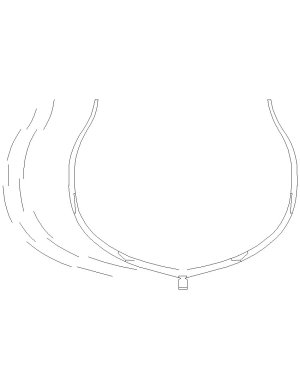
Where are you using splines? I use them to draw in carvings and such but for curves on just about everything else, arcs work really well. I did read somewhere many moons ago that the draftsmen of old used arcs a lot. Below I copied/separated the segments that I used for the frame on the left to show what I mean. Hope it makes some sort of sense.

Allan

Arcs.JPG
 
I used splines to create the half breadth water lines. I had previously re-done the body drawing tracings using curves. I was able to use several of the sweep (?) markings as curve centers
 
At least we are not doing them with pen and ink by hand
Imagine doing it on a large table - bending over all the time - stressing your back and getting in your light - using a goose quill with a limited ink volume and needing constant trimming - using bread as an eraser - on an animal hide.
 
magine doing it on a large table - bending over all the time - stressing your back and getting in your light - using a goose quill with a limited ink volume and needing constant trimming - using bread as an eraser - on an animal hide.
Imagine? Heck, it sounds like our drafting class at school, except for the bread........ and quill (substitute adustable tool like the one below) ... When we were cadets during sea year we had to do drawings as part of the school curriculum. No drafting tables but the chart table on the bridge was a decent substitute. Thankfully they changed to a sketch book instead so just lay in the rack and sketch away!!!
Allan

1777229984488.png
 
Back
Top