
-

Win a Free Custom Engraved Brass Coin!!!
As a way to introduce our brass coins to the community, we will raffle off a free coin during the month of August. Follow link ABOVE for instructions for entering. -
PRE-ORDER SHIPS IN SCALE TODAY!
The beloved Ships in Scale Magazine is back and charting a new course for 2026!
Discover new skills, new techniques, and new inspirations in every issue.
NOTE THAT OUR FIRST ISSUE WILL BE JAN/FEB 2026
You are using an out of date browser. It may not display this or other websites correctly.
You should upgrade or use an alternative browser.
You should upgrade or use an alternative browser.
CAF Granado 1/48 PoF Bomb Vessel by Signet




Before planking the main deck, I needed to install the lower bulkhead separating the main deck from the quarterdeck and the captain and officers' cabins. Near as I can tell, it goes atop the officers' deck planking, so that's where I installed it:

I believe the aft portion of my main deck may be a bit lower than it should be, as the slots in this partition and the slots in the aftmost deck beam do not line up vertically:

That may also/instead mean my aft deck installed is too high, but to maintain the correct partition height in that area, I'm leaving it alone. I don't think the resulting quarterdeck will be too high, so I don't see any measure problems at this point (probably due to my lack of insight, rather than no problems actually existing).
The port waterway goes on first. I had to reshape the outer plank (waterway) a bit to fit the bow, probably due to my less-than-perfect shaping there.
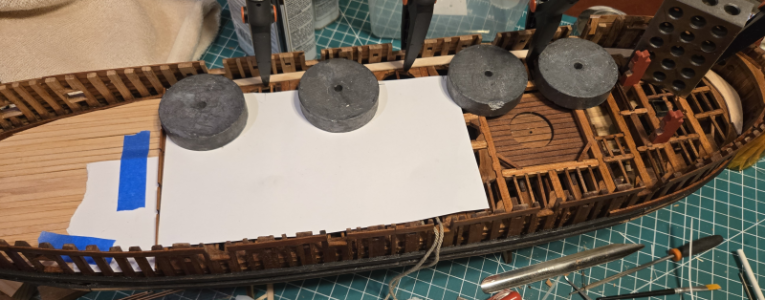
When doing this, I actually forgot about it being a waterway, and just looked at it as another plank. My intention had been to raise it up a bit with shims, to simulate a thicker waterway with a slope to the deck. I didn't remember this until several planks were installed, so too late. I may try to do something about it later.
If you're wondering about the heavy paper taped in place, I've already dropped a couple small pieces down into the hold, and was lucky enough to get them back out. I'm trying to prevent that in the future; I don't think the model will take well to being shaken upside down!
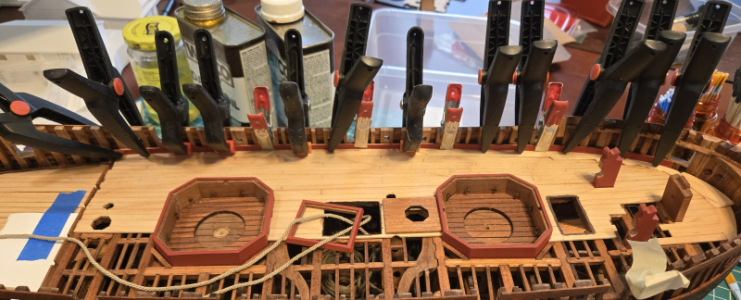
Here I'm gluing the second plank in place:

Up to a point, I could use clamps to keep the planking tight, with weights to hold them down.
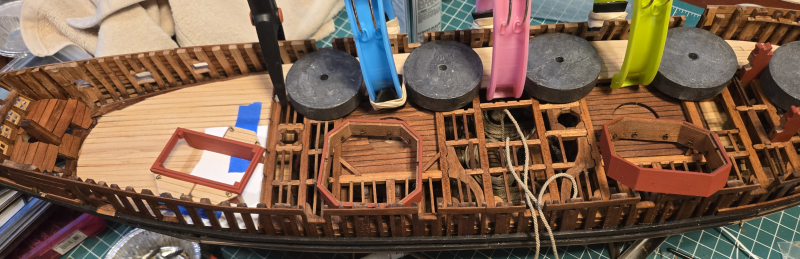
When the clamps quit working (I broke one of the black needle-nose ones), I just used weights and sometimes pieces of scrap to help hold them:

I fit the last plank that contacted the mortar surrounds to them, and glued the surrounds as well as the plank in place.
Making sure the mortar housings and surrounding planking are glued in place true and level. And secure:
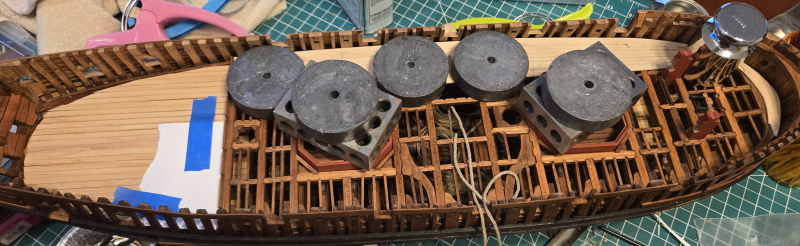
This was the last full-length plank. After this, planks will be in pieces for each section between mortars and hatches and such:
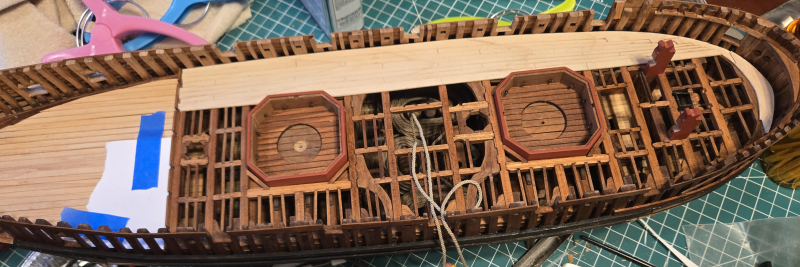
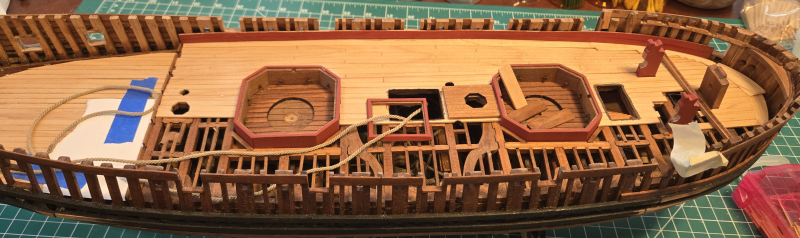
Where I am at this point:
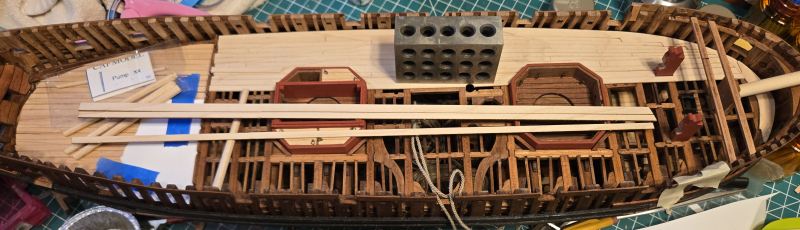
I've already located the main pumps and have a plank partially cut for it. From now on, I have to start thinking about all the required openings for pumps, hatches, etc. Looks like the Bowsprit Step must be positioned and glued to the main beams, with planking surrounding it, which I have to watch out for. I thought the step on it might go atop the planking, but looks like it doesn't. That's my interpretation, anyhow. The instructions show full planking everything, and cutting all openings later.
I didn't end up reducing the planking width as suggested on the plans to speak of, just enough to go aside the windlass mount, so am a bit surprised that the overall planking half doesn't quite make it to the centerline. No problem, though, as I won't be planking much of the starboard side of the deck.
Sounds like a good place to stop for the night; too much thinking and planning involved at this point. Good night, and thanks for watching!
I believe the aft portion of my main deck may be a bit lower than it should be, as the slots in this partition and the slots in the aftmost deck beam do not line up vertically:
That may also/instead mean my aft deck installed is too high, but to maintain the correct partition height in that area, I'm leaving it alone. I don't think the resulting quarterdeck will be too high, so I don't see any measure problems at this point (probably due to my lack of insight, rather than no problems actually existing).
The port waterway goes on first. I had to reshape the outer plank (waterway) a bit to fit the bow, probably due to my less-than-perfect shaping there.
When doing this, I actually forgot about it being a waterway, and just looked at it as another plank. My intention had been to raise it up a bit with shims, to simulate a thicker waterway with a slope to the deck. I didn't remember this until several planks were installed, so too late. I may try to do something about it later.
If you're wondering about the heavy paper taped in place, I've already dropped a couple small pieces down into the hold, and was lucky enough to get them back out. I'm trying to prevent that in the future; I don't think the model will take well to being shaken upside down!
Here I'm gluing the second plank in place:
Up to a point, I could use clamps to keep the planking tight, with weights to hold them down.
When the clamps quit working (I broke one of the black needle-nose ones), I just used weights and sometimes pieces of scrap to help hold them:
I fit the last plank that contacted the mortar surrounds to them, and glued the surrounds as well as the plank in place.
Making sure the mortar housings and surrounding planking are glued in place true and level. And secure:
This was the last full-length plank. After this, planks will be in pieces for each section between mortars and hatches and such:
Where I am at this point:
I've already located the main pumps and have a plank partially cut for it. From now on, I have to start thinking about all the required openings for pumps, hatches, etc. Looks like the Bowsprit Step must be positioned and glued to the main beams, with planking surrounding it, which I have to watch out for. I thought the step on it might go atop the planking, but looks like it doesn't. That's my interpretation, anyhow. The instructions show full planking everything, and cutting all openings later.
I didn't end up reducing the planking width as suggested on the plans to speak of, just enough to go aside the windlass mount, so am a bit surprised that the overall planking half doesn't quite make it to the centerline. No problem, though, as I won't be planking much of the starboard side of the deck.
Sounds like a good place to stop for the night; too much thinking and planning involved at this point. Good night, and thanks for watching!


Good morning. You are totally owning this POF Granado. I think your anchor cables are spot on. I doubt any crew, considering the weight of these, manages to make perfect coils. Lovely details. Cheers Grant
Continuing on with the main deck planking... As mentioned above, the bowsprit step must be mounted directly on a main deck beam, and also is held by a beam from the deck above. Since the decking must go around it, rather than below it, I mounted and glued it in place now:
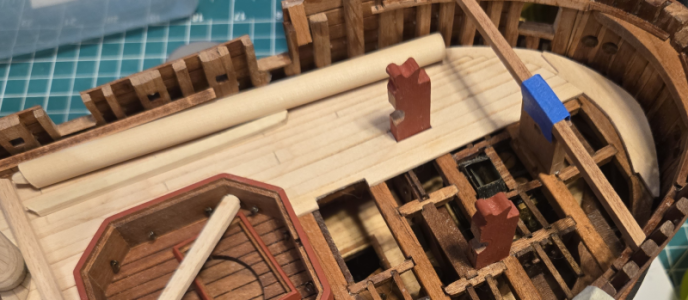
Now I will have to protect it from being broken off as construction continues.
Here, several things are going on:

The mast step is "protected" and held in place, the hatch surrounds are being checked with the openings as they are made, the elm pumps are being located and mounted and the raised area between the fore mortar and main hatch is positioned. There were a number of interferences.
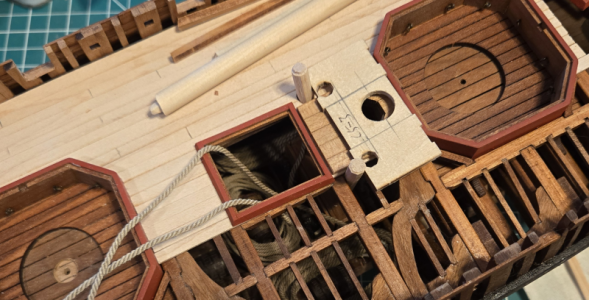
Referring to the above photo, the aft elm pumps would fit further back against the last main deck beam, as they interfered with the end of the deck below, so I moved the forward to the mast level. I marked the location of the pump on the planked size and drilled it, tearing up the plank (shown here removed). As the pumps will not fit between any of the deck members, I tried making clearance for the starboard pump, and tore up some of the structure.
Notice that the forward pumps sit outside of the raised area around the mainmast. This is further out than the template below shows, which required cutting into the mast support structure. So I had to move them outward to clear the structure:
I decided to address the fact that the waterways should have been thicker, tapered in thickness towards the deck. My original thought was to place shims under the waterway, and taper the waterway, to create this impression, but forgot to during planking. So, I took the waterway included with the kit for the starboard side, flipped it over and tapered it, to fit atop the port waterway. Here is a closeup of each side of the tapered waterway:

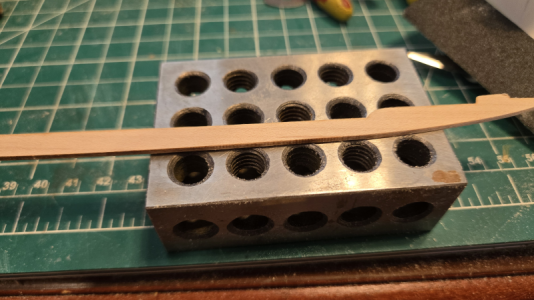
I then glued the tapered waterway in place. I also cut new planks for the aft port pump and made reconfigured support for the starboard pump. Not correct, but hopefully not too bad:
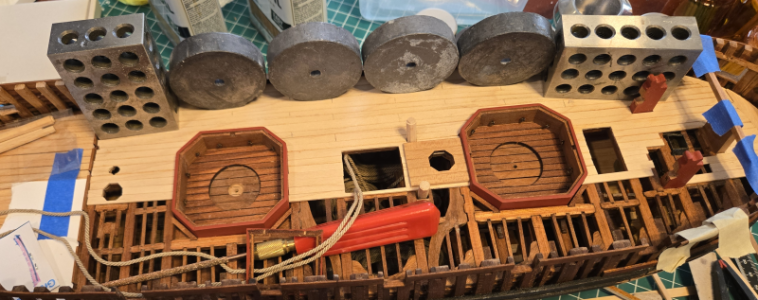
The tapered waterway looks pretty good, IMHO, but is not very noticeable:
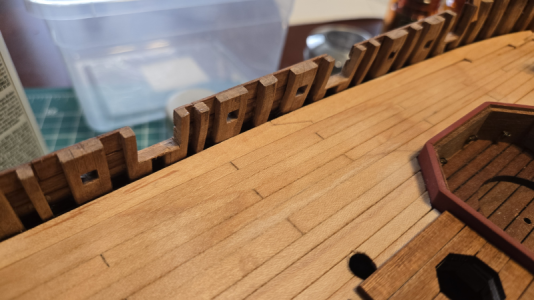
At least it looks like part of the main structure.
And that puts me here in the model construction:
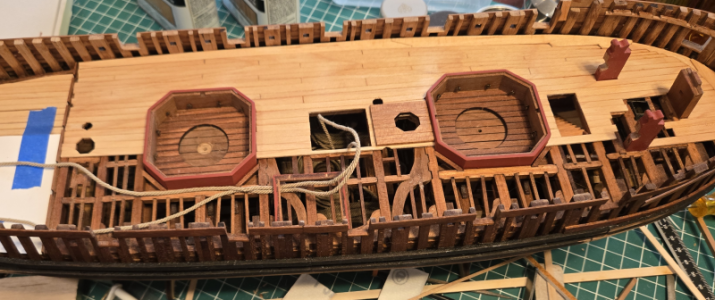
Looks like I need to do some inner bulkhead planking next.
Now I will have to protect it from being broken off as construction continues.
Here, several things are going on:
The mast step is "protected" and held in place, the hatch surrounds are being checked with the openings as they are made, the elm pumps are being located and mounted and the raised area between the fore mortar and main hatch is positioned. There were a number of interferences.
Referring to the above photo, the aft elm pumps would fit further back against the last main deck beam, as they interfered with the end of the deck below, so I moved the forward to the mast level. I marked the location of the pump on the planked size and drilled it, tearing up the plank (shown here removed). As the pumps will not fit between any of the deck members, I tried making clearance for the starboard pump, and tore up some of the structure.
Notice that the forward pumps sit outside of the raised area around the mainmast. This is further out than the template below shows, which required cutting into the mast support structure. So I had to move them outward to clear the structure:
I decided to address the fact that the waterways should have been thicker, tapered in thickness towards the deck. My original thought was to place shims under the waterway, and taper the waterway, to create this impression, but forgot to during planking. So, I took the waterway included with the kit for the starboard side, flipped it over and tapered it, to fit atop the port waterway. Here is a closeup of each side of the tapered waterway:
I then glued the tapered waterway in place. I also cut new planks for the aft port pump and made reconfigured support for the starboard pump. Not correct, but hopefully not too bad:
The tapered waterway looks pretty good, IMHO, but is not very noticeable:
At least it looks like part of the main structure.
And that puts me here in the model construction:
Looks like I need to do some inner bulkhead planking next.

Some of your best work. Way to go!
First inner plank being installed:
Since it's hard for me to paint straight edges against other materials, I've painted the plank before gluing in place. I guess this is actually called the spriketting, but the kit shows no difference between it and the lining above it, so it's all planking to me.
Second plank is placed and looks pretty good:
I've used the planks supplied at their full length, so I decided to put the splice under the forecastle at a port, where it will be less noticeable, and the other end where the curved wall to the quarterdeck goes. I won't be painting the walls within the captain's cabin area (I don't think), nor in front of the anchor manger bulkhead, so I'll put those pieces in separately. I was going to install at least the starboard manger bulkhead, to strengthen the spritsail step, but I think I better work on the hawse holes next. Plus, the bulkheads provided with the kit were a bit short, and IMHO a bit too high, considering the hawse opening position, so I made new ones (in the forward mortar bay).
I'll be trimming the inner planks as I go up, so different kind of work now. Time, I think, to red up my workspace, for this change in type of work. (FYI: Red up - or redd up - we never spelled it - is what we used to say in PA when I grew up, it means to tidy up or clean up.)
Since it's hard for me to paint straight edges against other materials, I've painted the plank before gluing in place. I guess this is actually called the spriketting, but the kit shows no difference between it and the lining above it, so it's all planking to me.
Second plank is placed and looks pretty good:
I've used the planks supplied at their full length, so I decided to put the splice under the forecastle at a port, where it will be less noticeable, and the other end where the curved wall to the quarterdeck goes. I won't be painting the walls within the captain's cabin area (I don't think), nor in front of the anchor manger bulkhead, so I'll put those pieces in separately. I was going to install at least the starboard manger bulkhead, to strengthen the spritsail step, but I think I better work on the hawse holes next. Plus, the bulkheads provided with the kit were a bit short, and IMHO a bit too high, considering the hawse opening position, so I made new ones (in the forward mortar bay).
I'll be trimming the inner planks as I go up, so different kind of work now. Time, I think, to red up my workspace, for this change in type of work. (FYI: Red up - or redd up - we never spelled it - is what we used to say in PA when I grew up, it means to tidy up or clean up.)
Last edited:
The hawses with "lead" liners were next on my list, while access to the anchor cable area was still accessible. I'd decided some time ago to use some thick wall plastic tubing I had. The OD was meant to represent the expanded and curved lead liner for the hawse, and the ID the proper size for the cable. I'd drilled the holes oversize for the tubing previously, and here you can see the orientation of the hawse tubing in place:
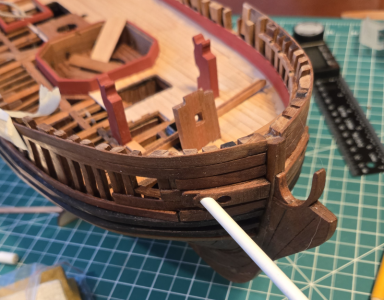
First I marked the tubing cut angle on the inside:
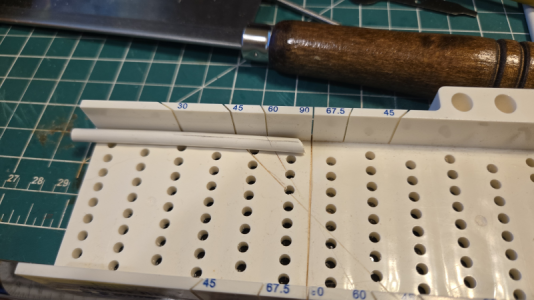
The marked angle ended up very close to 60 degrees, so I used a miter box for that:
After cutting one end, I inserted the tube and determined the correct protrusion towards the inside, for marking of the outside length:
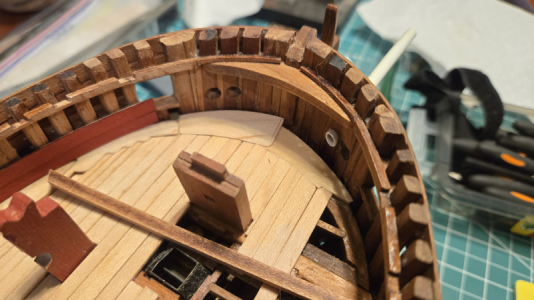
I left the starboard hawse longer, as it would go though the planking which is not installed there.
After cutting to length, I attempted to "round" the ends like hawse holes are usually made, to prevent wear of the anchor cable on the corner.
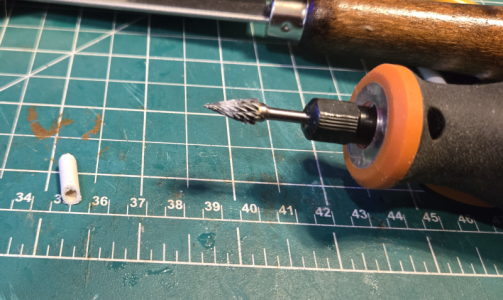
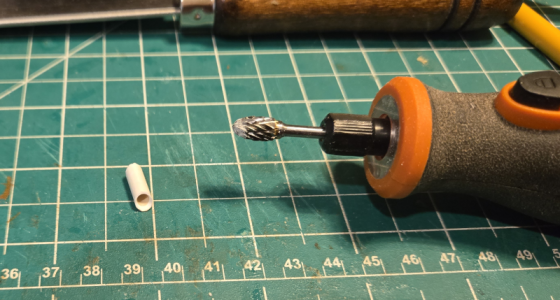
Since I don't have a concave cutter or router bit to do this, and even if I did the 60 degree angle complicates it, I used a couple burrs in progression.
The first, more pointed one takes off the burrs and tapers the hole in a ways:
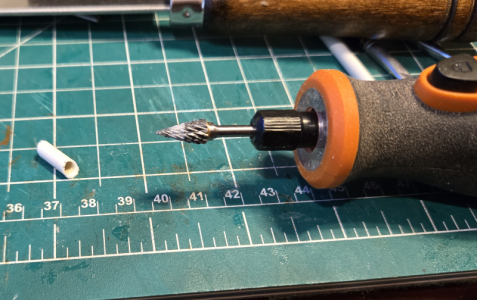
The second more round bit gives a more rounded appearance:
To paint the exposed areas, I slid each hawse liner onto a piece of brass rod.
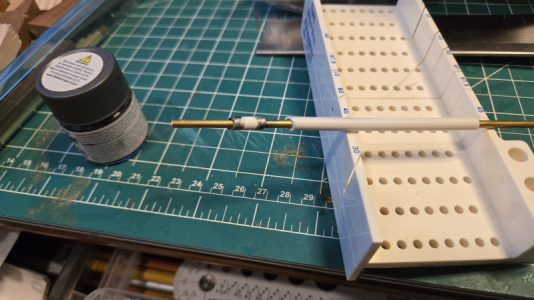
I also used the rod to insert the liner into the hole:
the liners are pushed flush with the outside, a drop of CA on the bottom prior to pushing it flush, careful to maintain the angle orientation:
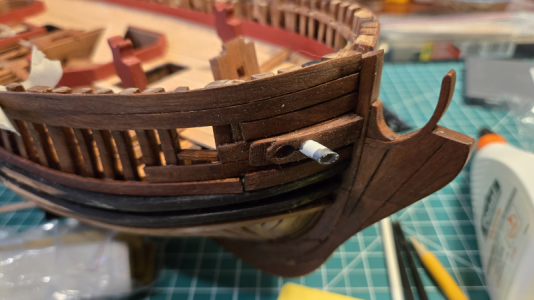
One is now in place:
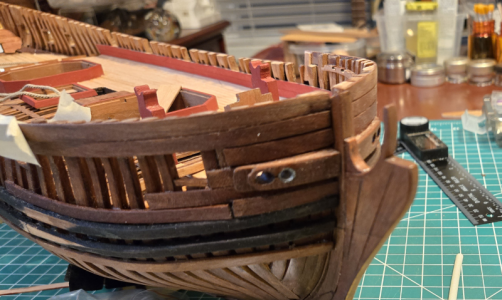
As mentioned, they extend further inside on the starboard side, as they would extend past the planking thickness:
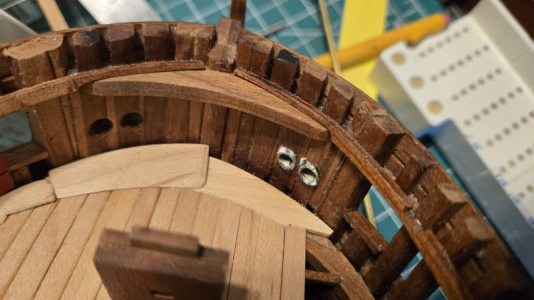
They were touched up with paint later.
I think they look pretty good when done:
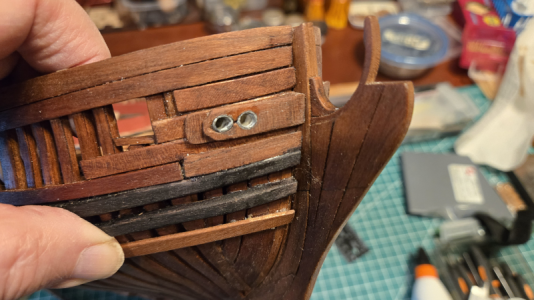
Unfortunately, these photos highlight many of my defects and dust, etc. So please remember stand on the other side of the room when viewing my photos.
I will install the port side hawses after planking is installed in that area. I did this side first as proof of concept and will repeat the process later on the other side.
I continued with the inner planking next:
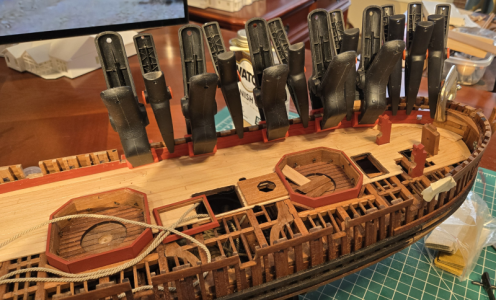
The planking at the port hawses didn't turn out well, but luckily will not be visible beneath the decking above.
The next higher planking continued through the officers quarters of the quarterdeck.
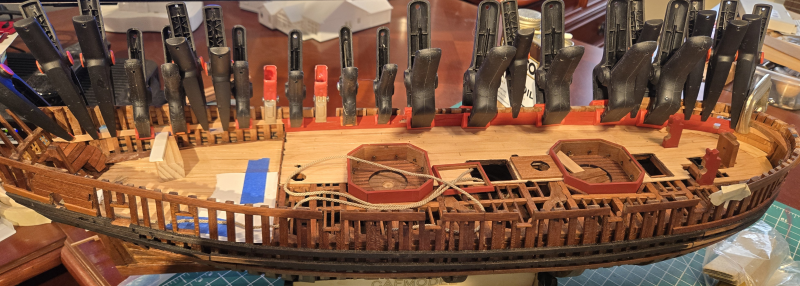
Those inner walls would not be painted red, so the paint stops at the partition:
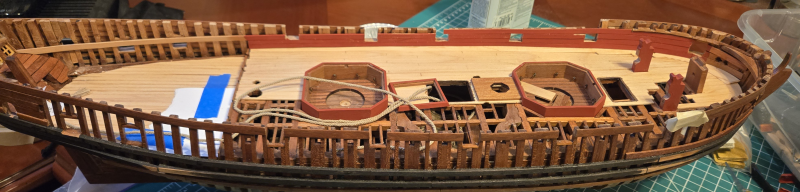
The port hawses are installed using the same method as above. I'm satisfied with their looks:
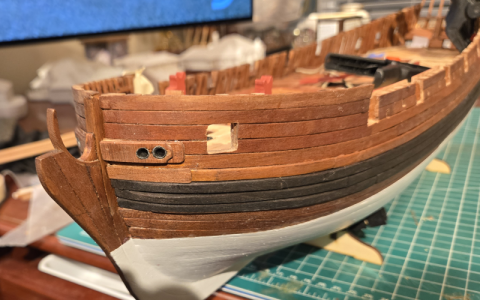
To be continued......
First I marked the tubing cut angle on the inside:
The marked angle ended up very close to 60 degrees, so I used a miter box for that:
After cutting one end, I inserted the tube and determined the correct protrusion towards the inside, for marking of the outside length:
I left the starboard hawse longer, as it would go though the planking which is not installed there.
After cutting to length, I attempted to "round" the ends like hawse holes are usually made, to prevent wear of the anchor cable on the corner.
Since I don't have a concave cutter or router bit to do this, and even if I did the 60 degree angle complicates it, I used a couple burrs in progression.
The first, more pointed one takes off the burrs and tapers the hole in a ways:
The second more round bit gives a more rounded appearance:
To paint the exposed areas, I slid each hawse liner onto a piece of brass rod.
I also used the rod to insert the liner into the hole:
the liners are pushed flush with the outside, a drop of CA on the bottom prior to pushing it flush, careful to maintain the angle orientation:
One is now in place:
As mentioned, they extend further inside on the starboard side, as they would extend past the planking thickness:
They were touched up with paint later.
I think they look pretty good when done:
Unfortunately, these photos highlight many of my defects and dust, etc. So please remember stand on the other side of the room when viewing my photos.
I will install the port side hawses after planking is installed in that area. I did this side first as proof of concept and will repeat the process later on the other side.
I continued with the inner planking next:
The planking at the port hawses didn't turn out well, but luckily will not be visible beneath the decking above.
The next higher planking continued through the officers quarters of the quarterdeck.
Those inner walls would not be painted red, so the paint stops at the partition:
The port hawses are installed using the same method as above. I'm satisfied with their looks:
To be continued......
I wanted to get the framing and decking on the forecastle soon, so needed to think about detail in that area. My first thought went to the stack for the ship oven. I felt if I left it until after the decking was done, it would be difficult or impossible to fit. And if I mount it now, I just know it would be broken off at some point. I felt I needed a way to make it removable.
So I took a small piece of wood (balsa as it turned out - probably should have used something harder, but think it will work), cut and sanded it to be a snug fit on the main stack:
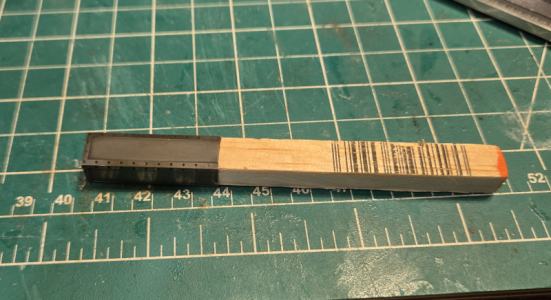
Note that the stack is composed of brass bent into 4 sides, with no tabs or extra material to maintain its integrity. I felt inserting this wood would also help shape and strengthen the stack.
I inserted the wood through both the stack and upper vent to make sure it would fit okay. Nice that it was constant size, which would make it difficult IMHO to attached without any additional parts, but should work fine this way:
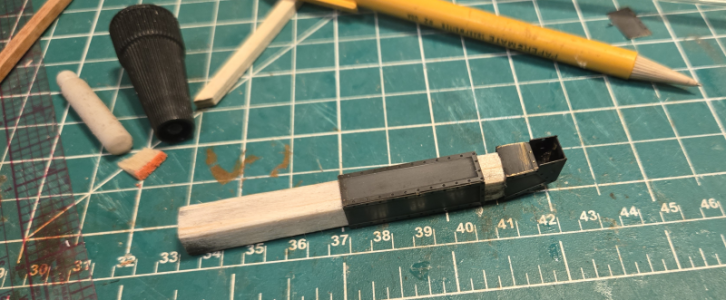
Little sanding was required to insert the end of the wood into the top of the oven:
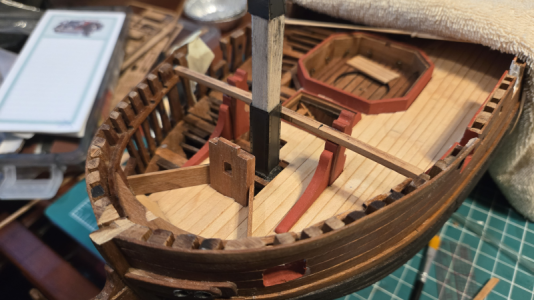
Here you can see I've added the braces to the windlass support and the manger bulkheads. For those not familiar, the manger bulkheads help contain water falling off the anchor cable while raising it, although I've never seen where it goes then. In my case, the bulkheads also support the bowsprit step, which I'm a bit surprised I haven't broken off.
I cut the balsa into 2 pieces, one to be glued into the vent and inserted into the stack. The stack then could fit separately into the oven top:
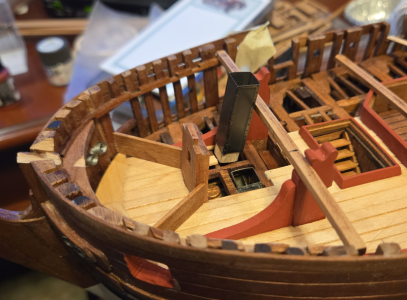
The stack fits proudly in place, confirming the method used:
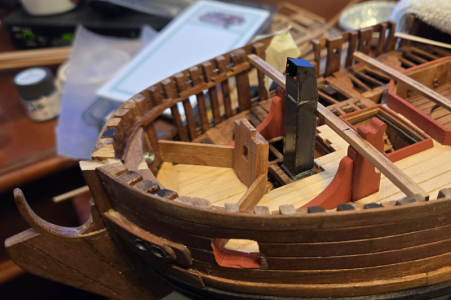
Time to install the remaining forecastle beams. Sometimes it takes me a bit of fiddling to to hold pieces in place while the glue dries:
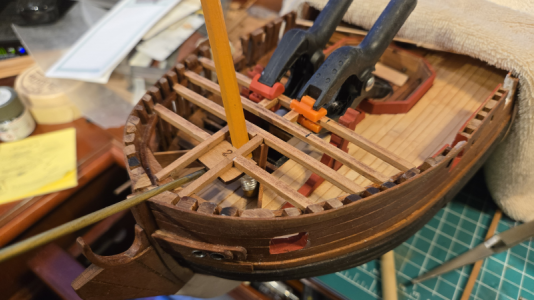
The included waterway was a rather poor fit on my model. No doubt due to mistakes I have made in shaping the bow:
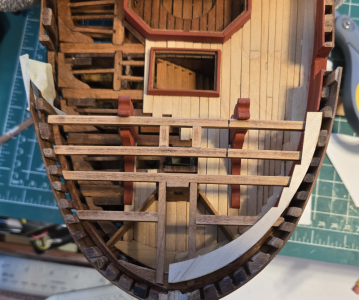
I was able to reshape it to a reasonable fit:
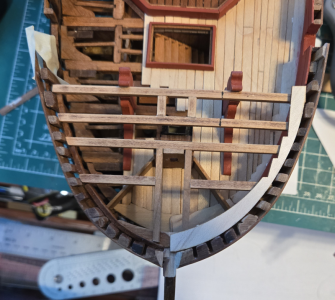
I decided not to raise the waterway on the foredeck (and quarterdeck for that matter) like I did on the main deck. On the main deck, the waterway is specifically raised, with outlet ports along the deck (not shown on any source I've seen except models), because otherwise water would accumulate on the deck. Both the foredeck and quarterdeck have enough slope to take water to the main deck, so I felt this detail was unnecessary.
Decking is progressing on the foredeck:
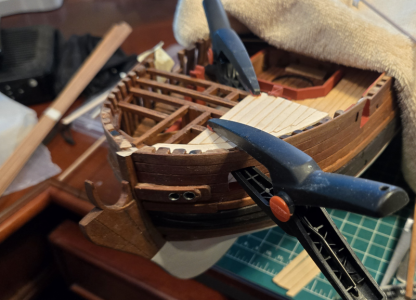
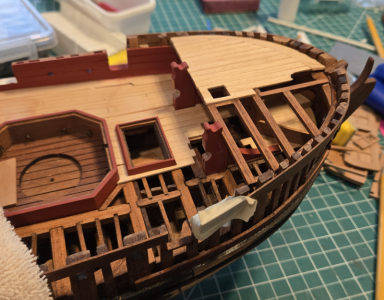
The main stack can then be placed from above:
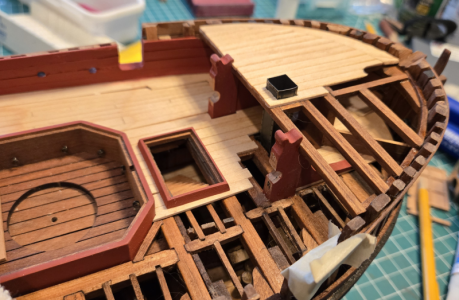
and is quite secure.
Likewise, the top stack vent can be easily added:
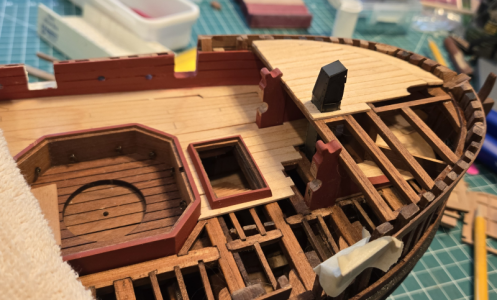
Both parts will be removed and added later, to prevent damage. Likewise, the stack vent damper and other details will be added later. I tend to whack things that protrude, causing damage to them and other parts, to prefer to add them at the end.
I planked over a bit more of the foredeck but apparently didn't photograph it. You'll see it later.
These small additions are adding so much finished detail to the model, and I'm really enjoying them.
So I took a small piece of wood (balsa as it turned out - probably should have used something harder, but think it will work), cut and sanded it to be a snug fit on the main stack:
Note that the stack is composed of brass bent into 4 sides, with no tabs or extra material to maintain its integrity. I felt inserting this wood would also help shape and strengthen the stack.
I inserted the wood through both the stack and upper vent to make sure it would fit okay. Nice that it was constant size, which would make it difficult IMHO to attached without any additional parts, but should work fine this way:
Little sanding was required to insert the end of the wood into the top of the oven:
Here you can see I've added the braces to the windlass support and the manger bulkheads. For those not familiar, the manger bulkheads help contain water falling off the anchor cable while raising it, although I've never seen where it goes then. In my case, the bulkheads also support the bowsprit step, which I'm a bit surprised I haven't broken off.
I cut the balsa into 2 pieces, one to be glued into the vent and inserted into the stack. The stack then could fit separately into the oven top:
The stack fits proudly in place, confirming the method used:
Time to install the remaining forecastle beams. Sometimes it takes me a bit of fiddling to to hold pieces in place while the glue dries:
The included waterway was a rather poor fit on my model. No doubt due to mistakes I have made in shaping the bow:
I was able to reshape it to a reasonable fit:
I decided not to raise the waterway on the foredeck (and quarterdeck for that matter) like I did on the main deck. On the main deck, the waterway is specifically raised, with outlet ports along the deck (not shown on any source I've seen except models), because otherwise water would accumulate on the deck. Both the foredeck and quarterdeck have enough slope to take water to the main deck, so I felt this detail was unnecessary.
Decking is progressing on the foredeck:
The main stack can then be placed from above:
and is quite secure.
Likewise, the top stack vent can be easily added:
Both parts will be removed and added later, to prevent damage. Likewise, the stack vent damper and other details will be added later. I tend to whack things that protrude, causing damage to them and other parts, to prefer to add them at the end.
I planked over a bit more of the foredeck but apparently didn't photograph it. You'll see it later.
These small additions are adding so much finished detail to the model, and I'm really enjoying them.
Ah, the captain's and officers quarters are next! One of the highlights of the kit IMHO. I started to assemble the wall panels, with their recessed and beveled inserts, which was very difficult for me to do. I could think of no way to automate or simplify the process, nor make it more accurate, so did what I thought was a decent job on one of the walls. Still, with the gap from the laser, the light indicator lines that were sometimes there, and sometimes not, after sanding, I wasn't that proud of it. When doing the next panel, I realized that I was happier with the plain recessed panels than I was with the ones with the added beveled panels.
Since I had intended to paint the captain's quarters walls off-white, I did this to two panels to confirm my choice:
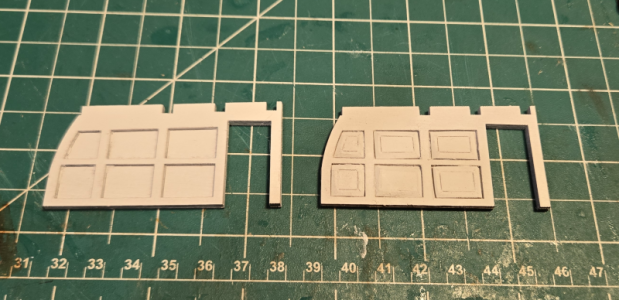
Done properly, by Uwe and others building this model, and especially when left natural wood, the inserted panels look very good. But I was not as happy with my result, so have reasoned that the poor Bomb Vessel, considered the ugly ducking of any flotilla, might not warrant this fancy woodwork. But rather the simplicity of only recessed panels. The Captain is a practical man, and agreed with this decision.
IMPORTANT: Those who include the recessed panels, that is, pretty much everyone but me, understand that they are ALL different in size and shape. Panels that look rectangular are usually not quite rectangular, and size variations one to another are TINY! It's best to keep them in their relative position when working on them, or mark the backs accordingly, to insure they go into the correct position and orientation. The center top panel is an example of this - it should have been turned 180 degrees.
In part 2 of this kit, the beam supports (2A-3) for the quarterdeck were installed:
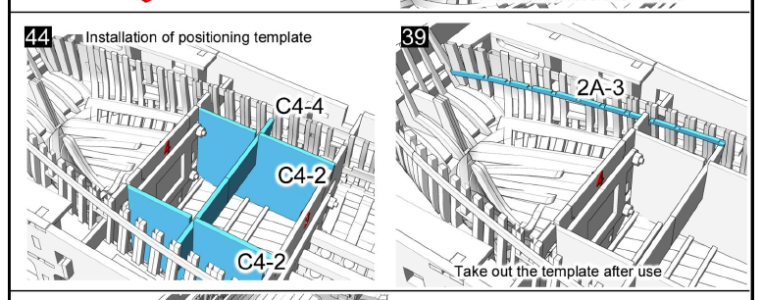
It was pretty much impossible for me to install these using the positioning template, although I did my best. The templates never fit very well for me. Some I think I've posted previously were impossible to place due to material or part interference. When I did similar work on the foredeck rooms at the oven level, nothing lined up very well, requiring a lot of trimming of wall pieces to fit. After doing those rooms, I had zero confidence in the above supports, so removed them from the model, damaging one and destroying the other. But I reasoned that I'd be better replacing them when I was able to get proper measurements from the captain's and officers' rooms. I'm very glad I did!
Since I was so concerned about 2A-3 above, the location of which is determined by both the height and location of the cross beams, which in turn must match the rooms with their notches, I started by comparing the wall panels with the drawing showing the beam locations:
Placing 2 longitudinal walls together, the notches seem to match up well:
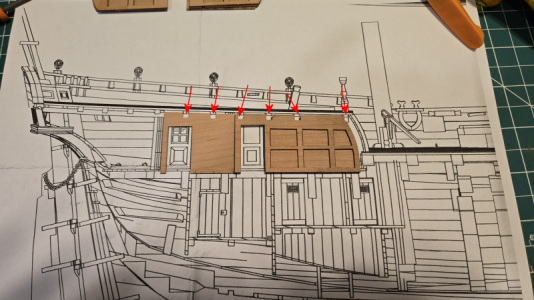
But, you know what's missing? The transverse bulkhead that has to go between the two panels!
Simulating the width of the bulkhead with 3x2mm strip (the bulkheads are comprised of three 1mm thick pieces), this shows the result with an unmodified Captain's berth cabin wall:
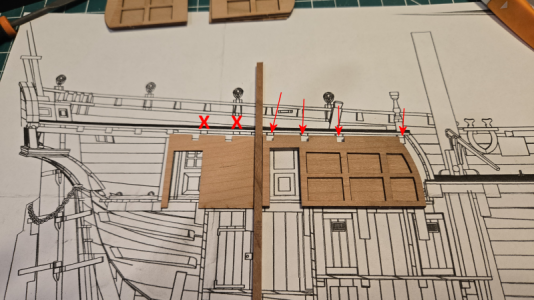
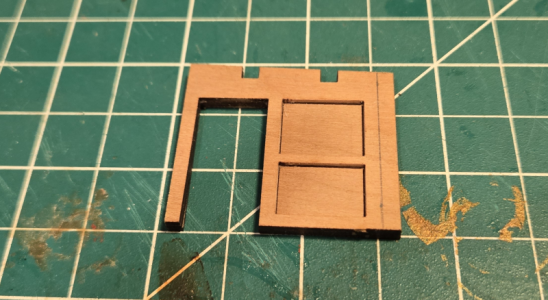
No way will this work. The wall to the left above will need to have 3mm trimmed from the fore end, as shown marked here:
BTW, comparing the wall size and location in the kit with the locations shown by Goodwin in his AoS Granado book, it comes out quite close:
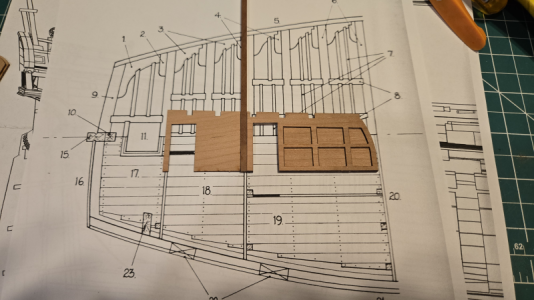
The walls are too thick, of course, but that's necessary to provide the 3D effect on them, so quite worth it.
Here are all of my final panels, without the inserts as described above:
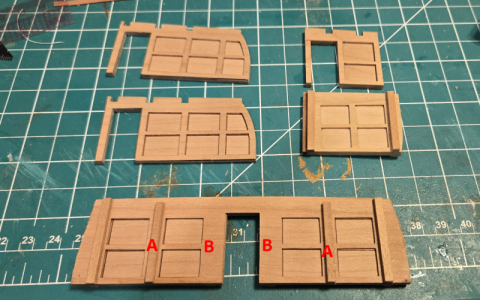
The 3x2mm strips are not accurate per Goodwin's drawings, and IMHO are way oversize, adding a scale 7.5" of thickness to an already over-thick wall, but they seemed to look good, adding detail to help with my removed panels, so I used them. The instructions show these in 6 locations on both sides of the main transverse panel above, with the attached longitudinal walls, where they connect, beside them. I felt this very unnecessary, and left them off of connection areas. So on the aft side, B was left off (one was actually added back), and on the fore side, A's were left off, as walls connect there.
With the wall panels built, I could place them temporarily in position and plan the location of the beam supports:
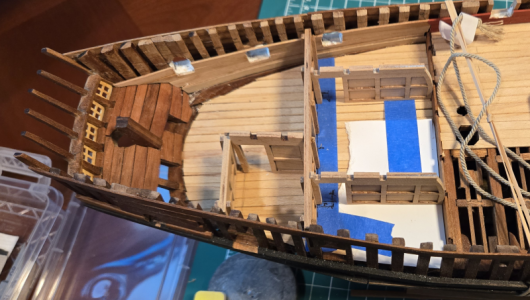
Here most of the cabin deck inner wall planking has been added.
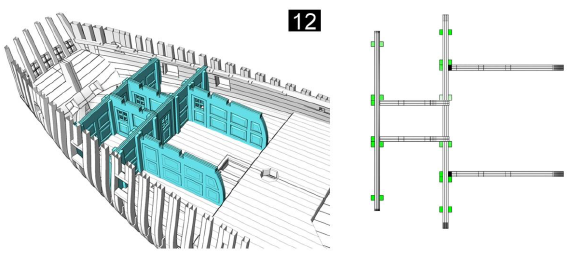
Perhaps this is a good place to discuss a difference from my model and the kit parts and instructions. The instructions show the following layout for walls under the quarterdeck:
Goodwin's drawing for this area is:
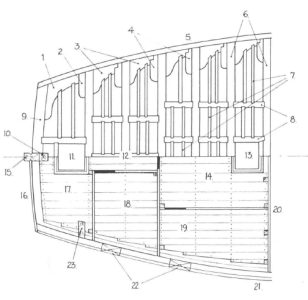
CAF and others have assumed that the wall between 17 above (Captain's Day Cabin) and 18 (Captain's ing Berth) extends the entire way from the starboard to the port side of the ship, and the wall between 18 and 12 (Captain's Dining Space) is duplicated making a corridor or hall. Accompanying text indicates 19 (Master's Cabin) has a mirrored Lieutenant's cabin on the other side. But clearly, portions of the aft wall are not shown on Goodwin's drawing, and if the arrangement were as CAF interprets it, 12 would be called a Corridor, and a note would be included to say that the Captain's Dining Space was opposite the Captain's ing Berth.
Therefore, I and others (most notably Uwe, whose excellent build thread also discusses this and comes to the same conclusion) have elected to eliminate one of the walls, and shorten the aft wall, resulting in the outline shown in red on this modified sketch:
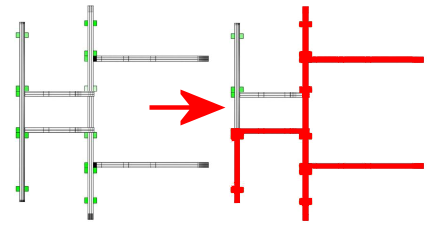
This results in a large dining area, open to the Captain's Day Cabin and IMHO agrees with both Goodwin and the layout of many larger ships, which is somewhat standardized.
Continuing...
Unlike the original 2A-3 beam supports, which were notched to fit the cross beams, I decided to leave mine flat, so I could position them to fit accurately in all the partition notches, and place them where needed, instead of being limited by the notches. Using the above setup I could accurately determine the location (height, in particular) of the support beam. Here, I've glued it in place and show the original beam laying below:
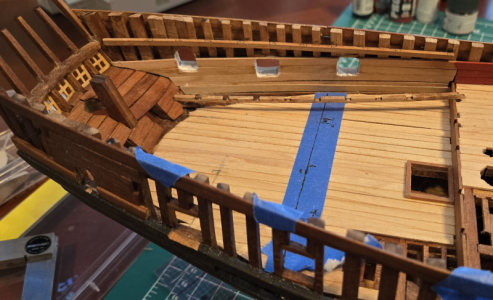
Incidentally, the original beam measured 2.5mm square, but lacking that I used one of the 2x3mm strips.
I intended to finish the captain's cabins floor and walls differently, so had to accurately find the location of it, determined by the partitions:
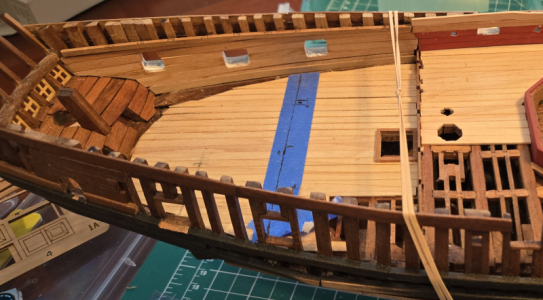
Once located, I painted the walls off-white (actually AK Silver Grey):
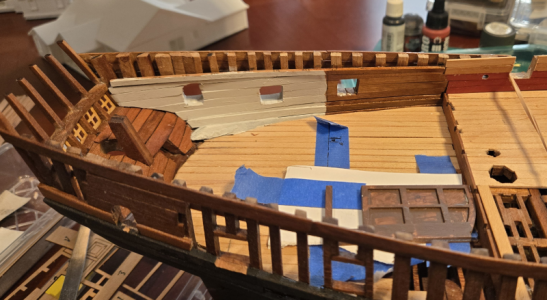
Many of the walls and partitions of captain's cabins, as well as some officers', were painted white, beige, light blue or green, or other colors, to lighten the space. This can easily be seen in photos of HMS Victory and other tall ships. While the Granado may not originally have had this done, the Captain certain had enough spare cash to buy a gallon of paint from the Ipswich Home Depot.
Also, the Captain was a bit sensitive about the fancy cabins and floor covering of larger ships. Bomb Vessels were generally considered the ugly ducklings of the flotilla, so were not always so fitted. Granado, however, had an ornate square stern in contrast to the round undecorated sterns of most bomb vessels, so perhaps she deserved a bit more flair. The Captain certainly agreed, so perhaps purchased some chequered canvas to liven up his quarters:
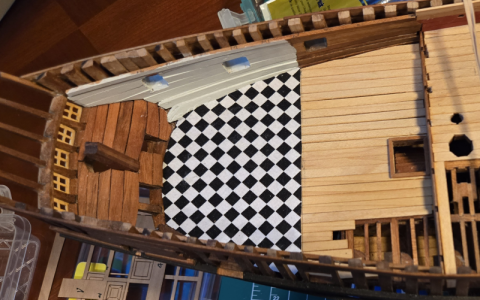
On other British ships, the flooring was not painted, but rather printed fabric was applied and probably nailed to the floor in the Captain's areas. On the model, this was simply some checkered fabric purchased on eBay and cemented in place with white glue. Most often I have seen, especially on smaller ships, that the stern wall woodwork was not painted, so I have left it natural. Not sure what, if anything, I should do to the window frames.
With a coat of off-white on the captain's area walls, and door hardware installed, the final was are ready for installation:
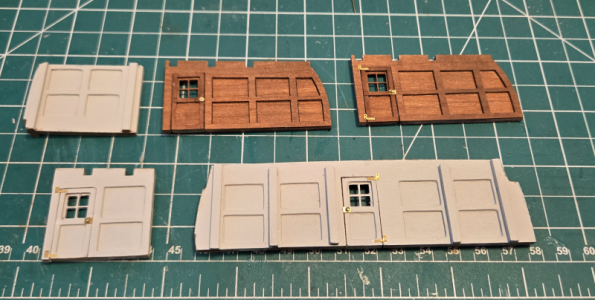
I went with the L-shaped hinges rather than the cast ones, as I saw no way of mounting those hinges, nor bending the brass strip around them, and have it come out decent. These hinges may look upside-down at the top of the doors to you. They do to me, but I reasoned that these are removable panels, and the doors should have to be unmounted quickly, so hinge pins pointing in the same direction would allow for this. The instructions showed locks with only the end of a brass nail as a "knob", but this looked undersize to me, so added the small brass circles (hope I have enough later for whatever they're to be used for). And just added these circles on the side of the door opposite the latch to simulate a knob only.
Here I've added a hatch surround simulating the hatch to the breadroom below. The Cap'n made sure fabric was added over this hatch as well, matching the floor:
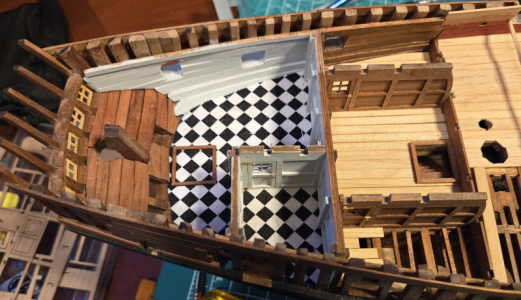
After addition of a couple rings on the breadroom hatch, and a two of the quarterdeck cross beams which help to locate and retain the walls, we have:
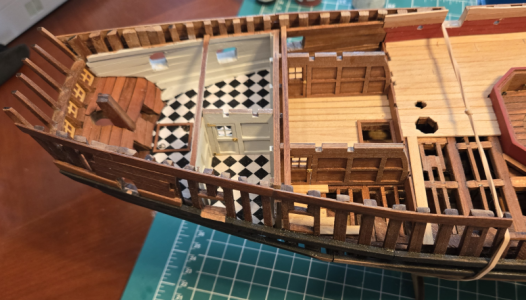
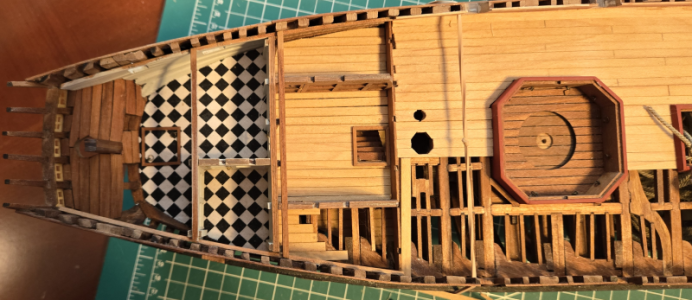
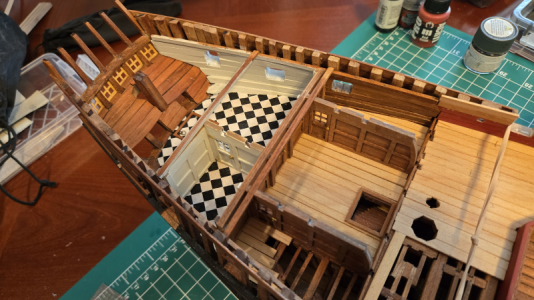
Now I'd like to add just a little detail to the cabins, perhaps a table or desk. Just a few items, I think, to generally indicate the purpose and arrangement of each room. If I do too much more than that, readers will think I'm trying to compete with those fancy rooms like on the Royal Caroline, with inlaid tables, silverware and photos on the wall, which of course are well beyond my capabilities. No, I want you to think I could do those if I wanted to, but decided to construct a minimalistic approach to the area instead!
Since I had intended to paint the captain's quarters walls off-white, I did this to two panels to confirm my choice:
Done properly, by Uwe and others building this model, and especially when left natural wood, the inserted panels look very good. But I was not as happy with my result, so have reasoned that the poor Bomb Vessel, considered the ugly ducking of any flotilla, might not warrant this fancy woodwork. But rather the simplicity of only recessed panels. The Captain is a practical man, and agreed with this decision.
IMPORTANT: Those who include the recessed panels, that is, pretty much everyone but me, understand that they are ALL different in size and shape. Panels that look rectangular are usually not quite rectangular, and size variations one to another are TINY! It's best to keep them in their relative position when working on them, or mark the backs accordingly, to insure they go into the correct position and orientation. The center top panel is an example of this - it should have been turned 180 degrees.
In part 2 of this kit, the beam supports (2A-3) for the quarterdeck were installed:
It was pretty much impossible for me to install these using the positioning template, although I did my best. The templates never fit very well for me. Some I think I've posted previously were impossible to place due to material or part interference. When I did similar work on the foredeck rooms at the oven level, nothing lined up very well, requiring a lot of trimming of wall pieces to fit. After doing those rooms, I had zero confidence in the above supports, so removed them from the model, damaging one and destroying the other. But I reasoned that I'd be better replacing them when I was able to get proper measurements from the captain's and officers' rooms. I'm very glad I did!
Since I was so concerned about 2A-3 above, the location of which is determined by both the height and location of the cross beams, which in turn must match the rooms with their notches, I started by comparing the wall panels with the drawing showing the beam locations:
Placing 2 longitudinal walls together, the notches seem to match up well:
But, you know what's missing? The transverse bulkhead that has to go between the two panels!
Simulating the width of the bulkhead with 3x2mm strip (the bulkheads are comprised of three 1mm thick pieces), this shows the result with an unmodified Captain's berth cabin wall:
No way will this work. The wall to the left above will need to have 3mm trimmed from the fore end, as shown marked here:
BTW, comparing the wall size and location in the kit with the locations shown by Goodwin in his AoS Granado book, it comes out quite close:
The walls are too thick, of course, but that's necessary to provide the 3D effect on them, so quite worth it.
Here are all of my final panels, without the inserts as described above:
The 3x2mm strips are not accurate per Goodwin's drawings, and IMHO are way oversize, adding a scale 7.5" of thickness to an already over-thick wall, but they seemed to look good, adding detail to help with my removed panels, so I used them. The instructions show these in 6 locations on both sides of the main transverse panel above, with the attached longitudinal walls, where they connect, beside them. I felt this very unnecessary, and left them off of connection areas. So on the aft side, B was left off (one was actually added back), and on the fore side, A's were left off, as walls connect there.
With the wall panels built, I could place them temporarily in position and plan the location of the beam supports:
Here most of the cabin deck inner wall planking has been added.
Perhaps this is a good place to discuss a difference from my model and the kit parts and instructions. The instructions show the following layout for walls under the quarterdeck:
Goodwin's drawing for this area is:
CAF and others have assumed that the wall between 17 above (Captain's Day Cabin) and 18 (Captain's
ing Berth) extends the entire way from the starboard to the port side of the ship, and the wall between 18 and 12 (Captain's Dining Space) is duplicated making a corridor or hall. Accompanying text indicates 19 (Master's Cabin) has a mirrored Lieutenant's cabin on the other side. But clearly, portions of the aft wall are not shown on Goodwin's drawing, and if the arrangement were as CAF interprets it, 12 would be called a Corridor, and a note would be included to say that the Captain's Dining Space was opposite the Captain's ing Berth.Therefore, I and others (most notably Uwe, whose excellent build thread also discusses this and comes to the same conclusion) have elected to eliminate one of the walls, and shorten the aft wall, resulting in the outline shown in red on this modified sketch:
This results in a large dining area, open to the Captain's Day Cabin and IMHO agrees with both Goodwin and the layout of many larger ships, which is somewhat standardized.
Continuing...
Unlike the original 2A-3 beam supports, which were notched to fit the cross beams, I decided to leave mine flat, so I could position them to fit accurately in all the partition notches, and place them where needed, instead of being limited by the notches. Using the above setup I could accurately determine the location (height, in particular) of the support beam. Here, I've glued it in place and show the original beam laying below:
Incidentally, the original beam measured 2.5mm square, but lacking that I used one of the 2x3mm strips.
I intended to finish the captain's cabins floor and walls differently, so had to accurately find the location of it, determined by the partitions:
Once located, I painted the walls off-white (actually AK Silver Grey):
Many of the walls and partitions of captain's cabins, as well as some officers', were painted white, beige, light blue or green, or other colors, to lighten the space. This can easily be seen in photos of HMS Victory and other tall ships. While the Granado may not originally have had this done, the Captain certain had enough spare cash to buy a gallon of paint from the Ipswich Home Depot.
Also, the Captain was a bit sensitive about the fancy cabins and floor covering of larger ships. Bomb Vessels were generally considered the ugly ducklings of the flotilla, so were not always so fitted. Granado, however, had an ornate square stern in contrast to the round undecorated sterns of most bomb vessels, so perhaps she deserved a bit more flair. The Captain certainly agreed, so perhaps purchased some chequered canvas to liven up his quarters:
On other British ships, the flooring was not painted, but rather printed fabric was applied and probably nailed to the floor in the Captain's areas. On the model, this was simply some checkered fabric purchased on eBay and cemented in place with white glue. Most often I have seen, especially on smaller ships, that the stern wall woodwork was not painted, so I have left it natural. Not sure what, if anything, I should do to the window frames.
With a coat of off-white on the captain's area walls, and door hardware installed, the final was are ready for installation:
I went with the L-shaped hinges rather than the cast ones, as I saw no way of mounting those hinges, nor bending the brass strip around them, and have it come out decent. These hinges may look upside-down at the top of the doors to you. They do to me, but I reasoned that these are removable panels, and the doors should have to be unmounted quickly, so hinge pins pointing in the same direction would allow for this. The instructions showed locks with only the end of a brass nail as a "knob", but this looked undersize to me, so added the small brass circles (hope I have enough later for whatever they're to be used for). And just added these circles on the side of the door opposite the latch to simulate a knob only.
Here I've added a hatch surround simulating the hatch to the breadroom below. The Cap'n made sure fabric was added over this hatch as well, matching the floor:
After addition of a couple rings on the breadroom hatch, and a two of the quarterdeck cross beams which help to locate and retain the walls, we have:
Now I'd like to add just a little detail to the cabins, perhaps a table or desk. Just a few items, I think, to generally indicate the purpose and arrangement of each room. If I do too much more than that, readers will think I'm trying to compete with those fancy rooms like on the Royal Caroline, with inlaid tables, silverware and photos on the wall, which of course are well beyond my capabilities. No, I want you to think I could do those if I wanted to, but decided to construct a minimalistic approach to the area instead!
I need a bit of advice here. Skipping ahead from other things I've done since the last post, I was going to add the mast coat to the mainmast. As shown by the instruction below, the main mast is a 12mm diameter dowel:
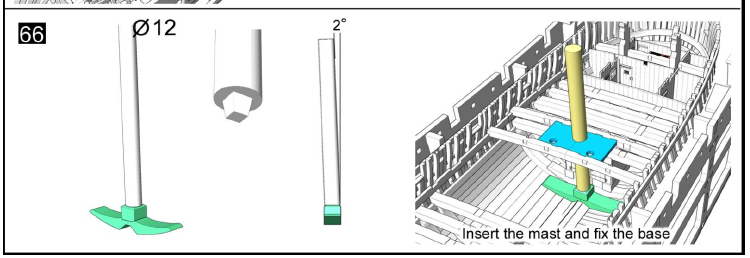
This is confirmed because it is a nice snug fit on the template shown in blue above.
I'm now trying to add the mast location shims (mast coat). This is shown in the directions:
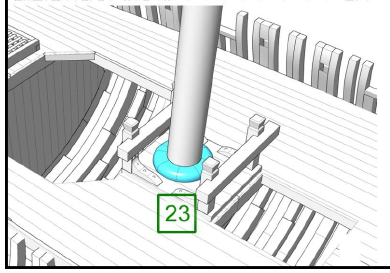
Item 2 is 8 pre-machined pieces each 45 degrees in angle, with areas below the deck that can be tapered or shimmed to locate and fit the main mast. But mine are waaay too big, and don't really fit the mainmast:
Here the octagonal hole in the deck is shown:
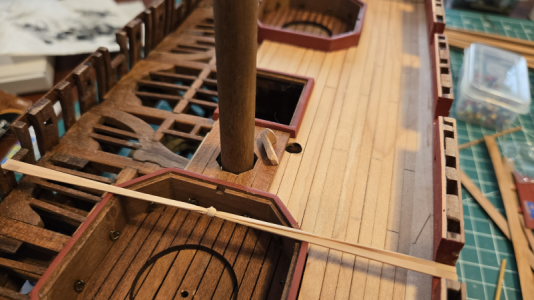
with the mainmast inserted and one of the shims beside it. The mainmast is 12mm diameter, and the opening is about 14.7 across, leaving 1.35mm space for the shims all around. But they're 2.6mm thick! And no, the octagonal hole is the correct size, as it's determined by the assembly in the lower right below:

Since thinning each shim individually to that thickness would be difficult to handle while doing it, I thought that perhaps the best way to would be to glue the shims to the mainmast at the correct height, then sand the shim assembly to fit. But guess what? The shims don't make it the whole way around the 12mm mast:
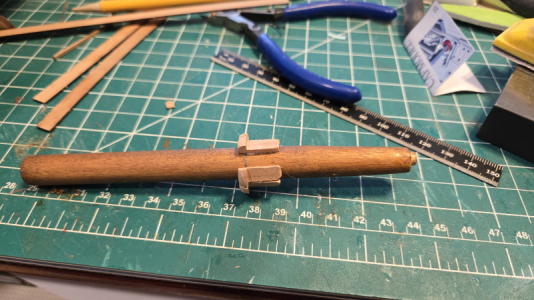
So, I thought maybe I'd assemble the shims, and try to drill out the hole, after assembly, to the correct 12mm diameter. While attempting this assembly, I found that the shims work quite well with the 10mm diameter mizzen mast. Below is shown the assembly as well as both the 12mm and 10mm masts:
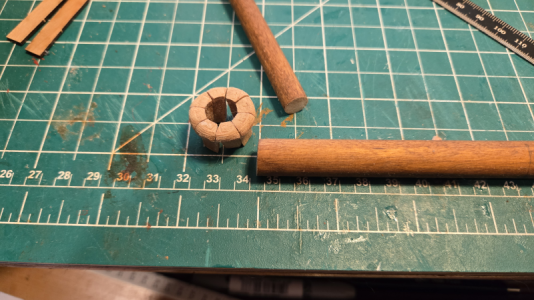
Although I don't understand why anyone else hasn't mentioned it (that I've seen), it appears that these carefully constructed (and expensive to do) shims were made completely wrong! I've confirmed with Goodwin's book that the mainmast should be very close to 12mm diameter. Is this just me??
Looking at the assembly, I'm certain I can't keep it glued together and drill out the proper size opening, at least not without a good lather, which I don't have. I considered sanding down the mainmast in the middle, where the shims go, to about 10mm diameter and mount the assembly around it, but that certainly defeats the idea of shimming to help position and level the mast. And I'm not sure it will look like the mast comes out of the shims, since it will overlap them.
About the only way I can think of is cutting the shims down in height to have only the portion shown above deck, and glue that around the mast to simulate this. But I'd love to hear other suggestions, especially by those who have completed this on their Granado.
Oh, and it looks to me like a similar problem may exist with the mizzen mast. I haven't tried fitting them yet, but there's only about 1mm thickness available for them, similar to the mainmast.
This is confirmed because it is a nice snug fit on the template shown in blue above.
I'm now trying to add the mast location shims (mast coat). This is shown in the directions:
Item 2 is 8 pre-machined pieces each 45 degrees in angle, with areas below the deck that can be tapered or shimmed to locate and fit the main mast. But mine are waaay too big, and don't really fit the mainmast:
Here the octagonal hole in the deck is shown:
with the mainmast inserted and one of the shims beside it. The mainmast is 12mm diameter, and the opening is about 14.7 across, leaving 1.35mm space for the shims all around. But they're 2.6mm thick! And no, the octagonal hole is the correct size, as it's determined by the assembly in the lower right below:
Since thinning each shim individually to that thickness would be difficult to handle while doing it, I thought that perhaps the best way to would be to glue the shims to the mainmast at the correct height, then sand the shim assembly to fit. But guess what? The shims don't make it the whole way around the 12mm mast:
So, I thought maybe I'd assemble the shims, and try to drill out the hole, after assembly, to the correct 12mm diameter. While attempting this assembly, I found that the shims work quite well with the 10mm diameter mizzen mast. Below is shown the assembly as well as both the 12mm and 10mm masts:
Although I don't understand why anyone else hasn't mentioned it (that I've seen), it appears that these carefully constructed (and expensive to do) shims were made completely wrong! I've confirmed with Goodwin's book that the mainmast should be very close to 12mm diameter. Is this just me??
Looking at the assembly, I'm certain I can't keep it glued together and drill out the proper size opening, at least not without a good lather, which I don't have. I considered sanding down the mainmast in the middle, where the shims go, to about 10mm diameter and mount the assembly around it, but that certainly defeats the idea of shimming to help position and level the mast. And I'm not sure it will look like the mast comes out of the shims, since it will overlap them.
About the only way I can think of is cutting the shims down in height to have only the portion shown above deck, and glue that around the mast to simulate this. But I'd love to hear other suggestions, especially by those who have completed this on their Granado.
Oh, and it looks to me like a similar problem may exist with the mizzen mast. I haven't tried fitting them yet, but there's only about 1mm thickness available for them, similar to the mainmast.
If you haven't, I'd scour the parts board for a second set of shims. It's that those you have are indeed for the 10mm mast. Maybe somewhere there are a mislabeled set of shims that fit the 12mm mast?
Fingers crossed you solve this one.
Fingers crossed you solve this one.
I was hoping so too, but no joy. The set of shims for the mizzenmast are smaller, but again, based on ID, will not go around the mizzenmast:If you haven't, I'd scour the parts board for a second set of shims. It's that those you have are indeed for the 10mm mast. Maybe somewhere there are a mislabeled set of shims that fit the 12mm mast?
Fingers crossed you solve this one.
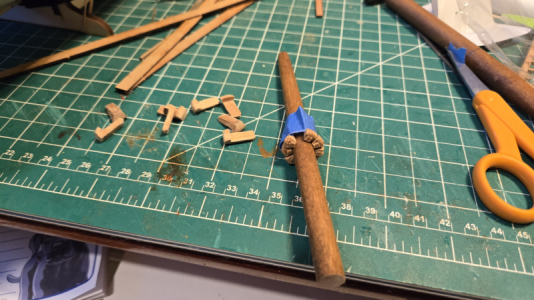
I haven't tried it, but I'm reasonably sure that the 8 shims assembled would be a close fit on the octagonal hole for the mizzenmast, pretty much like the mainmast. Looks to me that either 1) The wrong mast diameter was used with each set (10mm & 8mm rather than 12mm and 10mm), or, no, that's almost got to be it. I was going to say that stock had to be removed on the outside of the shims instead of the inside, but then they still wouldn't fit the mast. For each set of shims (assembled), the resulting "holes" are just way too small for their matching mast, which is a very difficult thing to fix, for me. Again, someone else has probably found an easy solution (or found what I have been doing wrong).
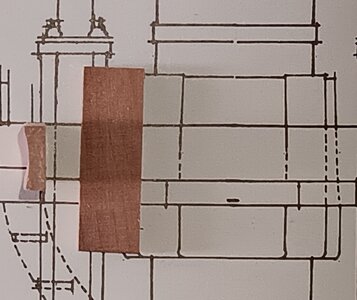
Sand the inside edges till they wrap around the mast. Here is an excerpt from my Bonhomme RIchard:
Finally have marginal cell reception after a week camping next to the Kootenay River, near Libby MT, just 30 miles south of the US/Canadian border. Lots of trout fishing and long steep bike rides but some progress was made in the shipyard. Below are the mast wedges being prepared.
I could not find any parts in the kit that were labeled, numbered or even near the correct size for these wedges. SO...I used leftover scraps and cut 12 pieces of the appropriate length and thickness.
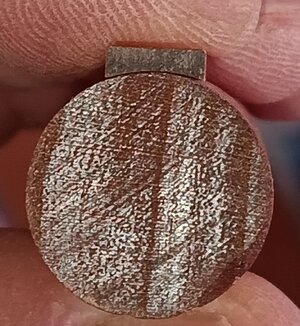
Next, I sanded the inside curvature onto each of the 12 pieces.
Finally, I test fit and continually sanded the beveled edges, until all 12 wedges fit tight.
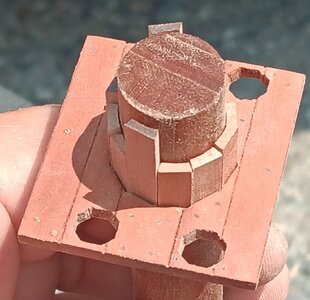
Once I glued the mast into the keel wedges and tapped these wedges into place with just a small dab of wood glue, the mast became ROCK SOLID!!
Finally have marginal cell reception after a week camping next to the Kootenay River, near Libby MT, just 30 miles south of the US/Canadian border. Lots of trout fishing and long steep bike rides but some progress was made in the shipyard. Below are the mast wedges being prepared.
I could not find any parts in the kit that were labeled, numbered or even near the correct size for these wedges. SO...I used leftover scraps and cut 12 pieces of the appropriate length and thickness.
Next, I sanded the inside curvature onto each of the 12 pieces.
Finally, I test fit and continually sanded the beveled edges, until all 12 wedges fit tight.
Once I glued the mast into the keel wedges and tapped these wedges into place with just a small dab of wood glue, the mast became ROCK SOLID!!
Yes, I did the same with my Bonhomme Richard cross section. But these parts are pre-machined, with the curvature already on the inside. The way they /should/ work is to taper the outsides against the octagonal opening as needed to right the mast. These weren't tapered, so seem to be intended to fit right in place. And the outside is very close, from what I can tell. But the inside curvature is just wrong, making for /much/ more, and more complicated, handwork to fit it. All for a realistic piece that's made incorrectly. I think.Sand the inside edges till they wrap around the mast. Here is an excerpt from my Bonhomme RIchard:

Hello ,The kit includes two fasteners for the bottom of the masts, one for the main mast and the other for the mizzen mast. If you still want to try this installation plan, I can mail you another set of these parts。
Very very nice indeed.


Very niceHello ,The kit includes two fasteners for the bottom of the masts, one for the main mast and the other for the mizzen mast. If you still want to try this installation plan, I can mail you another set of these parts。

- Joined
- Mar 1, 2022
- Messages
- 709
- Points
- 308

You are doing an outstanding job. I really like the checkered floor as well the transoms painted in white. Sincere congrats!Ah, the captain's and officers quarters are next! One of the highlights of the kit IMHO. I started to assemble the wall panels, with their recessed and beveled inserts, which was very difficult for me to do. I could think of no way to automate or simplify the process, nor make it more accurate, so did what I thought was a decent job on one of the walls. Still, with the gap from the laser, the light indicator lines that were sometimes there, and sometimes not, after sanding, I wasn't that proud of it. When doing the next panel, I realized that I was happier with the plain recessed panels than I was with the ones with the added beveled panels.
Since I had intended to paint the captain's quarters walls off-white, I did this to two panels to confirm my choice:
View attachment 565308
Done properly, by Uwe and others building this model, and especially when left natural wood, the inserted panels look very good. But I was not as happy with my result, so have reasoned that the poor Bomb Vessel, considered the ugly ducking of any flotilla, might not warrant this fancy woodwork. But rather the simplicity of only recessed panels. The Captain is a practical man, and agreed with this decision.
IMPORTANT: Those who include the recessed panels, that is, pretty much everyone but me, understand that they are ALL different in size and shape. Panels that look rectangular are usually not quite rectangular, and size variations one to another are TINY! It's best to keep them in their relative position when working on them, or mark the backs accordingly, to insure they go into the correct position and orientation. The center top panel is an example of this - it should have been turned 180 degrees.
In part 2 of this kit, the beam supports (2A-3) for the quarterdeck were installed:
View attachment 565310
It was pretty much impossible for me to install these using the positioning template, although I did my best. The templates never fit very well for me. Some I think I've posted previously were impossible to place due to material or part interference. When I did similar work on the foredeck rooms at the oven level, nothing lined up very well, requiring a lot of trimming of wall pieces to fit. After doing those rooms, I had zero confidence in the above supports, so removed them from the model, damaging one and destroying the other. But I reasoned that I'd be better replacing them when I was able to get proper measurements from the captain's and officers' rooms. I'm very glad I did!
Since I was so concerned about 2A-3 above, the location of which is determined by both the height and location of the cross beams, which in turn must match the rooms with their notches, I started by comparing the wall panels with the drawing showing the beam locations:
Placing 2 longitudinal walls together, the notches seem to match up well:
View attachment 565323
But, you know what's missing? The transverse bulkhead that has to go between the two panels!
Simulating the width of the bulkhead with 3x2mm strip (the bulkheads are comprised of three 1mm thick pieces), this shows the result with an unmodified Captain's berth cabin wall:
View attachment 565326
No way will this work. The wall to the left above will need to have 3mm trimmed from the fore end, as shown marked here:
View attachment 565330
BTW, comparing the wall size and location in the kit with the locations shown by Goodwin in his AoS Granado book, it comes out quite close:
View attachment 565328
The walls are too thick, of course, but that's necessary to provide the 3D effect on them, so quite worth it.
Here are all of my final panels, without the inserts as described above:
View attachment 565332
The 3x2mm strips are not accurate per Goodwin's drawings, and IMHO are way oversize, adding a scale 7.5" of thickness to an already over-thick wall, but they seemed to look good, adding detail to help with my removed panels, so I used them. The instructions show these in 6 locations on both sides of the main transverse panel above, with the attached longitudinal walls, where they connect, beside them. I felt this very unnecessary, and left them off of connection areas. So on the aft side, B was left off (one was actually added back), and on the fore side, A's were left off, as walls connect there.
With the wall panels built, I could place them temporarily in position and plan the location of the beam supports:
View attachment 565333
Here most of the cabin deck inner wall planking has been added.
Perhaps this is a good place to discuss a difference from my model and the kit parts and instructions. The instructions show the following layout for walls under the quarterdeck:
View attachment 565348
Goodwin's drawing for this area is:
View attachment 565349
CAF and others have assumed that the wall between 17 above (Captain's Day Cabin) and 18 (Captain's
Therefore, I and others (most notably Uwe, whose excellent build thread also discusses this and comes to the same conclusion) have elected to eliminate one of the walls, and shorten the aft wall, resulting in the outline shown in red on this modified sketch:
View attachment 565356
This results in a large dining area, open to the Captain's Day Cabin and IMHO agrees with both Goodwin and the layout of many larger ships, which is somewhat standardized.
Continuing...
Unlike the original 2A-3 beam supports, which were notched to fit the cross beams, I decided to leave mine flat, so I could position them to fit accurately in all the partition notches, and place them where needed, instead of being limited by the notches. Using the above setup I could accurately determine the location (height, in particular) of the support beam. Here, I've glued it in place and show the original beam laying below:
View attachment 565336
Incidentally, the original beam measured 2.5mm square, but lacking that I used one of the 2x3mm strips.
I intended to finish the captain's cabins floor and walls differently, so had to accurately find the location of it, determined by the partitions:
View attachment 565337
Once located, I painted the walls off-white (actually AK Silver Grey):
View attachment 565338
Many of the walls and partitions of captain's cabins, as well as some officers', were painted white, beige, light blue or green, or other colors, to lighten the space. This can easily be seen in photos of HMS Victory and other tall ships. While the Granado may not originally have had this done, the Captain certain had enough spare cash to buy a gallon of paint from the Ipswich Home Depot.
Also, the Captain was a bit sensitive about the fancy cabins and floor covering of larger ships. Bomb Vessels were generally considered the ugly ducklings of the flotilla, so were not always so fitted. Granado, however, had an ornate square stern in contrast to the round undecorated sterns of most bomb vessels, so perhaps she deserved a bit more flair. The Captain certainly agreed, so perhaps purchased some chequered canvas to liven up his quarters:
View attachment 565339
On other British ships, the flooring was not painted, but rather printed fabric was applied and probably nailed to the floor in the Captain's areas. On the model, this was simply some checkered fabric purchased on eBay and cemented in place with white glue. Most often I have seen, especially on smaller ships, that the stern wall woodwork was not painted, so I have left it natural. Not sure what, if anything, I should do to the window frames.
With a coat of off-white on the captain's area walls, and door hardware installed, the final was are ready for installation:
View attachment 565340
I went with the L-shaped hinges rather than the cast ones, as I saw no way of mounting those hinges, nor bending the brass strip around them, and have it come out decent. These hinges may look upside-down at the top of the doors to you. They do to me, but I reasoned that these are removable panels, and the doors should have to be unmounted quickly, so hinge pins pointing in the same direction would allow for this. The instructions showed locks with only the end of a brass nail as a "knob", but this looked undersize to me, so added the small brass circles (hope I have enough later for whatever they're to be used for). And just added these circles on the side of the door opposite the latch to simulate a knob only.
Here I've added a hatch surround simulating the hatch to the breadroom below. The Cap'n made sure fabric was added over this hatch as well, matching the floor:
View attachment 565343
After addition of a couple rings on the breadroom hatch, and a two of the quarterdeck cross beams which help to locate and retain the walls, we have:
View attachment 565342
View attachment 565344
View attachment 565345
Now I'd like to add just a little detail to the cabins, perhaps a table or desk. Just a few items, I think, to generally indicate the purpose and arrangement of each room. If I do too much more than that, readers will think I'm trying to compete with those fancy rooms like on the Royal Caroline, with inlaid tables, silverware and photos on the wall, which of course are well beyond my capabilities. No, I want you to think I could do those if I wanted to, but decided to construct a minimalistic approach to the area instead!
Tom at CAF said he'd have a solution for me in a bit, so I'm going to continue with the rest of the build in the meantime.
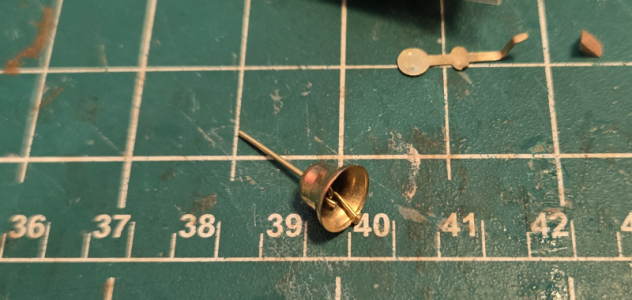
I decided to work on the Belfry. The small brass bell included is nice, but the piece included for the ringer (?), uh, isn't. It didn't really work as a ringer, or support, or anything, really, so I used a ring and nail instead:
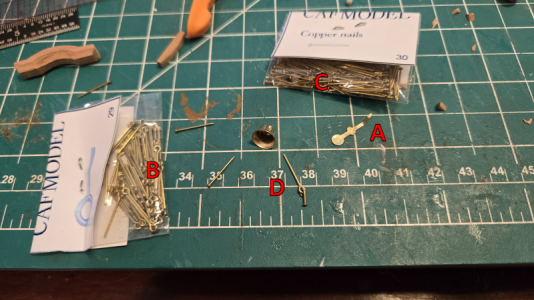
A is the included "ringer". B are the rings and C are the nails, put together to make a ringer and bell support D.
The result is much better, and looks pretty good from the side, where you can't see the ring:
I then mounted the bell onto the bell pivot (the extension of the ring acts as a lever), and assembled it with the top:
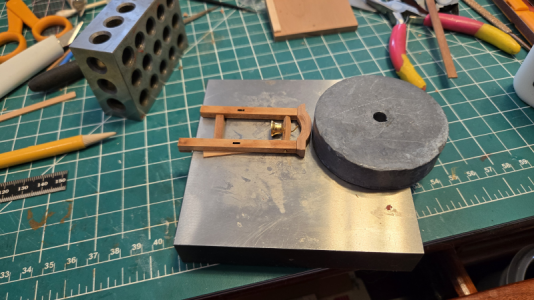
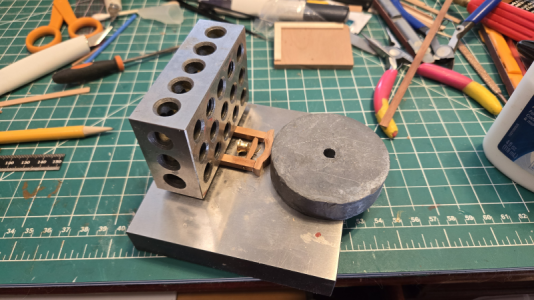
The bell pivot actually "rings", using small nails as a pivot. I used a temporary spacer at the bottom to keep the vertical arms parallel. I also placed shims under each arm to center the top piece , which is wider, then weighted it while glue dried. BTW, the two vertical arms are different length because one side will sit on the main deck, while the other will extend through the deck structure to the beam below.
I was concerned it would be too flimsy, but ended up fairly strong, if not manhandled. I dropped it a couple times, of course, but it survived.
I then checked the fit in the required location, and found a problem:
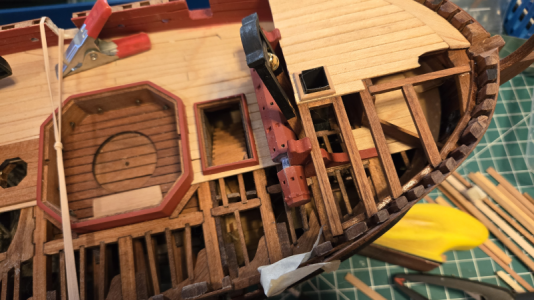
There isn't room for the belfry to fit between the foredeck and the windlass shaft. , what have I done wrong now? I knew from doing the foredeck planking that it was a bit long, compared to the plans, but it was all based on the windlass support, so still should have been okay for the belfry.
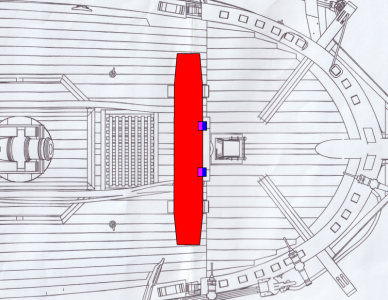
Taking the plans, I determined that they do indeed indicate an problem interference at this location:

In blue is the belfry uprights, red is the windlass shaft (rotated to its maximum width) and magenta is the interference. Same in below:
So, I checked out Goodwin's side cross section:
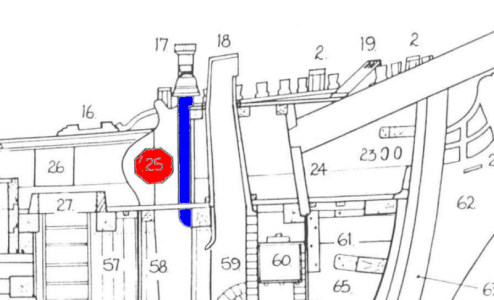
It appears that the windlass should have been further aft, or the foredeck further forward, creating clearance rather than interference.
I decided to fix the problem by moving the belfry forward into the foredeck by notching the uprights to clear the foredeck cross beam and deck:

This isn't realistic, of course, because this would severely weaken the uprights, and we wouldn't want to cut into the crossbeam. But it should look okay, and be far preferred to rebuilding everything.
After mounting the belfry as well as the windlass assembly, we have:
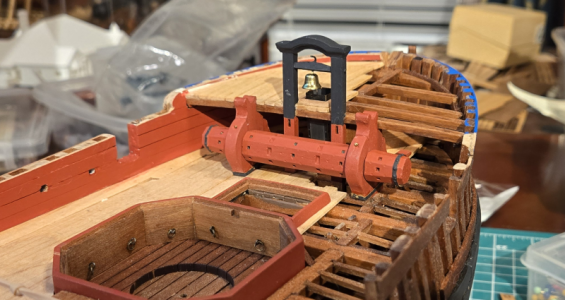
And while there is very little clearance between the windlass shaft and the belfry uprights, there is at least some:


I'll end this chapter here, and begin a new post.
I decided to work on the Belfry. The small brass bell included is nice, but the piece included for the ringer (?), uh, isn't. It didn't really work as a ringer, or support, or anything, really, so I used a ring and nail instead:
A is the included "ringer". B are the rings and C are the nails, put together to make a ringer and bell support D.
The result is much better, and looks pretty good from the side, where you can't see the ring:
I then mounted the bell onto the bell pivot (the extension of the ring acts as a lever), and assembled it with the top:
The bell pivot actually "rings", using small nails as a pivot. I used a temporary spacer at the bottom to keep the vertical arms parallel. I also placed shims under each arm to center the top piece , which is wider, then weighted it while glue dried. BTW, the two vertical arms are different length because one side will sit on the main deck, while the other will extend through the deck structure to the beam below.
I was concerned it would be too flimsy, but ended up fairly strong, if not manhandled. I dropped it a couple times, of course, but it survived.
I then checked the fit in the required location, and found a problem:
There isn't room for the belfry to fit between the foredeck and the windlass shaft.
, what have I done wrong now? I knew from doing the foredeck planking that it was a bit long, compared to the plans, but it was all based on the windlass support, so still should have been okay for the belfry.Taking the plans, I determined that they do indeed indicate an problem interference at this location:
In blue is the belfry uprights, red is the windlass shaft (rotated to its maximum width) and magenta is the interference. Same in below:
So, I checked out Goodwin's side cross section:
It appears that the windlass should have been further aft, or the foredeck further forward, creating clearance rather than interference.
I decided to fix the problem by moving the belfry forward into the foredeck by notching the uprights to clear the foredeck cross beam and deck:
This isn't realistic, of course, because this would severely weaken the uprights, and we wouldn't want to cut into the crossbeam. But it should look okay, and be far preferred to rebuilding everything.
After mounting the belfry as well as the windlass assembly, we have:
And while there is very little clearance between the windlass shaft and the belfry uprights, there is at least some:
I'll end this chapter here, and begin a new post.
Continuing, I added a piece of inner planking to the forecastle, which will help support the planksheer at the forecastle.
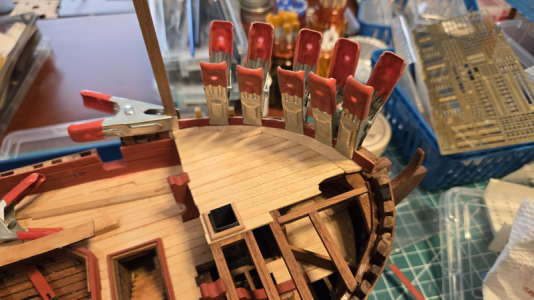
It will taper from little to almost nothing - I think my decks in general are a bit too high - but it will be seen somewhat.
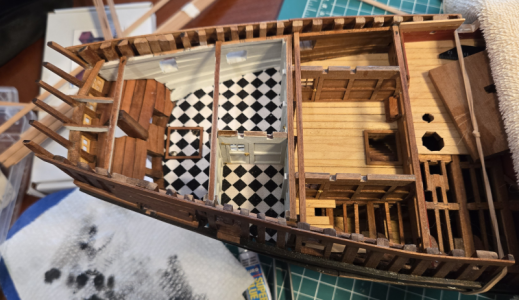
Here I've started adding crossbeams for the quarterdeck, add included a couple carlings around the rudder head and tiller housing.
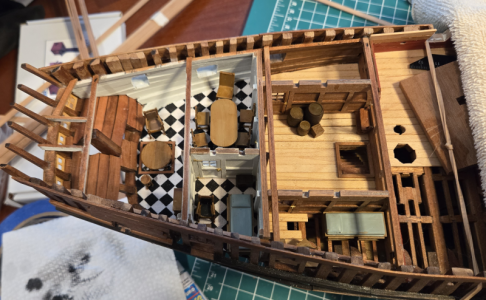
I decided to add a minimum of furniture to the cabins: a chair, writing desk and bunk in the Captain's berth and Master's cabin, table and chairs in the Captain's Day Cabin and dining table and chairs in the Dining Room. I'm attempting to hit that in-between level of detail, where I care enough to include the bare minimum of furniture, but don't attempt to compete wih far nicer builds that include charts and silverware. You know: "He cares about detail, but isn't that great at it."
My intent was to include hammocks somewhere, and even spent months developing some good looking ones, but realized there aren't really any place to hang them except in the 3 larger cabins big enough for bunks. The small forward cabins don't even have room for them. I am amazed that a crew of 60 men could be accommodated when sailed as a bomb vessel (double or so as a ketch). Where would they sleep? Probably curled up into corners, nooks and crannies, wherever they could find room, using other crew members for warmth. What a life!
With the minimal furniture in place, the remaining forecastle deck beams were added:

Those in the Captain's area were painted white along with the ceiling and walls to lighten the area.
Next would come quarterdeck decking. The included decking material ended up too short for my ship:
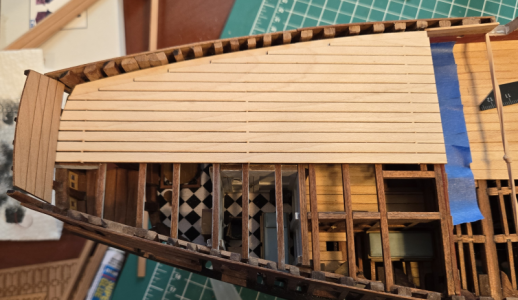
The outboard planks would not reach the after corner of the quarterdeck. Neither would the waterway.
I decided to add a small "waterway" made of scrap at the stern, thus allowing for shorter planking, then began planking:
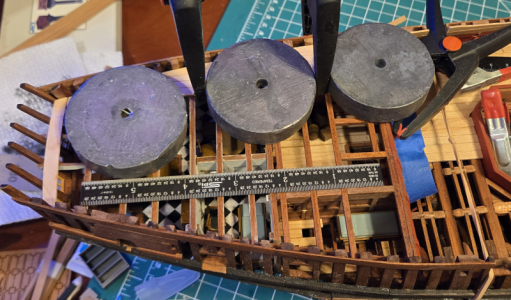
Here all planking desired has been added, with openings for the rudder head and hatchway:
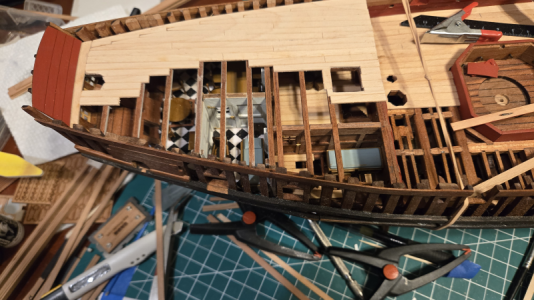
I wanted to show as much deck as possible consistent with still giving of the aft quarters and furniture.
Oh, and while I /love/ the waterway being included, it would really be easier, less time-consuming and better (IHMO) to just use strips for all planking. But they end up looking different, and don't work well if mixed.
More to come....
It will taper from little to almost nothing - I think my decks in general are a bit too high - but it will be seen somewhat.
Here I've started adding crossbeams for the quarterdeck, add included a couple carlings around the rudder head and tiller housing.
I decided to add a minimum of furniture to the cabins: a chair, writing desk and bunk in the Captain's berth and Master's cabin, table and chairs in the Captain's Day Cabin and dining table and chairs in the Dining Room. I'm attempting to hit that in-between level of detail, where I care enough to include the bare minimum of furniture, but don't attempt to compete wih far nicer builds that include charts and silverware. You know: "He cares about detail, but isn't that great at it."
My intent was to include hammocks somewhere, and even spent months developing some good looking ones, but realized there aren't really any place to hang them except in the 3 larger cabins big enough for bunks. The small forward cabins don't even have room for them. I am amazed that a crew of 60 men could be accommodated when sailed as a bomb vessel (double or so as a ketch). Where would they sleep? Probably curled up into corners, nooks and crannies, wherever they could find room, using other crew members for warmth. What a life!
With the minimal furniture in place, the remaining forecastle deck beams were added:
Those in the Captain's area were painted white along with the ceiling and walls to lighten the area.
Next would come quarterdeck decking. The included decking material ended up too short for my ship:
The outboard planks would not reach the after corner of the quarterdeck. Neither would the waterway.
I decided to add a small "waterway" made of scrap at the stern, thus allowing for shorter planking, then began planking:
Here all planking desired has been added, with openings for the rudder head and hatchway:
I wanted to show as much deck as possible consistent with still giving of the aft quarters and furniture.
Oh, and while I /love/ the waterway being included, it would really be easier, less time-consuming and better (IHMO) to just use strips for all planking. But they end up looking different, and don't work well if mixed.
More to come....