• Win a Free Custom Engraved Brass Coin!!!
    As a way to introduce our brass coins to the community, we will raffle off a free coin during the month of August. Follow link ABOVE for instructions for entering.
  • SUBSCRIBE TO SHIPS IN SCALE TODAY!

    The beloved Ships in Scale Magazine is back and charting a new course for 2026!
    Discover new skills, new techniques, and new inspirations in every issue.

    NOTE THAT OUR NEXT ISSUE WILL BE MARCH/APRIL 2026

D805 Piet Hein, ex HMS Serapis, WW2 S class destroyer

Joined
Jul 18, 2024
Messages
486
Points
323

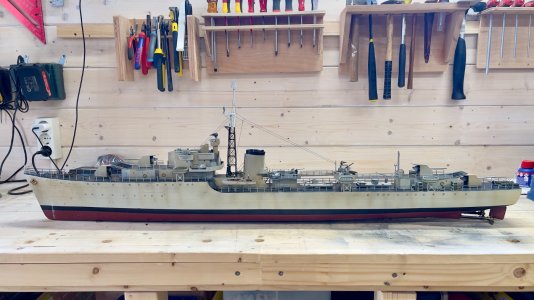
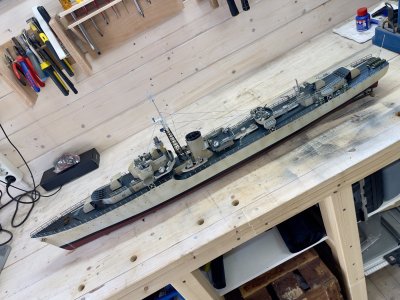
I’m still plenty busy with my current build, but I like to start some preparations for the next one. And this is a special one, as I already built it and after ripped it up again. Why? Because I made a big mistake with 3D resin printed parts. Enclosed spaces. End result: exploding parts and the whole ship in sticky goo. Only one way to go: can it.

D805 was HMS Serapis, an S class emergency destroyer, until being handed over to the Dutch navy end of WW2. She served well into the fifties.

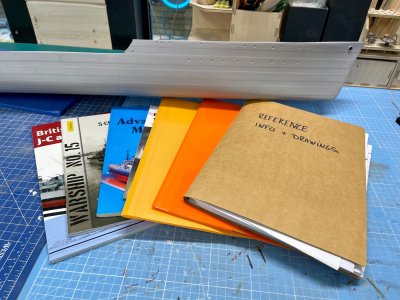
I have a set of drawings, a book and lots of images of similar ships. And I have build her once. So what can go wrong a second time around? We’ll see.

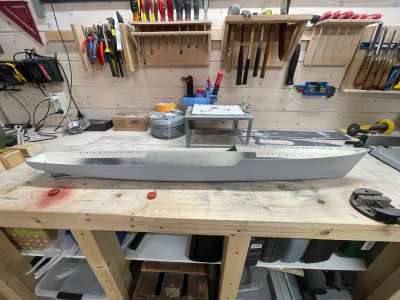
Here are two images of the original build and a last one I took today. Bare hull in grey primer. And I didn’t hesitate.

Looking forward to it.
1728853735182.jpeg

IMG_4826.jpeg

IMG_5508.jpeg
 
That’s great. What scale is it ?
Missed this one somehow: 1:96 scale, so will be just under four foot. Biggish. The hull is ex Deans Marine HMS Verulam. I didn’t like the rest of the build, so right away started doing my own thing. It was quite an experience, learning my first steps in 3D, scratch building a ship. But I’m not sorry to have had to rip it apart. It was sub par. So the resin leakage was convenient.
 
Last edited:
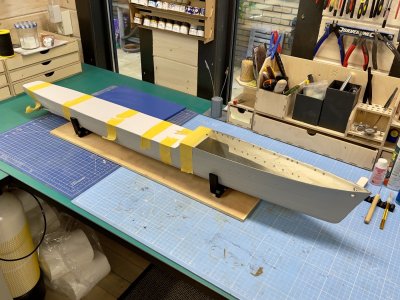
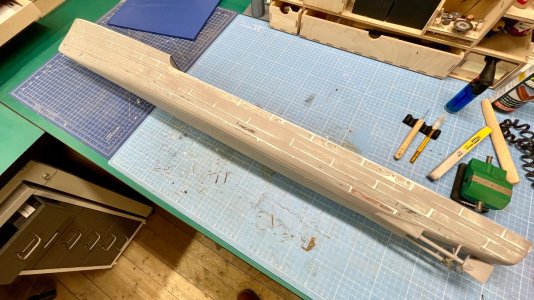
I had a hard look at that hull: it needs lots of closing old portholes, opening new ones. And quite some sanding to tone down the really rough ‘welding’ DM thought was good enough.

Hmmm. Half a mind to even scrap this and design and print a new one … Let’s see. I’ve glued in the first deck, filled the gaps and will let it dry 24h. If that works, I may proceed. If I’m not happy: bin.

Exciting times.

1730996414845.jpeg
 
Fun time! Revisiting drawings, articles and books to prepare for D805 version 2. And I will have to do some repairs on the drawings, as they were folded and refolded time after time creating version 1. I’m sure they would not survive another project without some sticky tape on the back.

I have accepted working with this hull, although it will require lots of attention to get it where I want it to be.

Step by step.

IMG_5835.jpeg
 
Arghhhh ... Three days looking at that hull and thinking ... mwah ... really?

I suddenly realised I had forgotten about "cost forgone" and was throwing time and effort in something "just because otherwise it would go to waste". And some laziness creeping in, as setting up a new hull in 3D is not easy. And perhaps I could use some parts of the original 3D design. But those require redesign anyway.

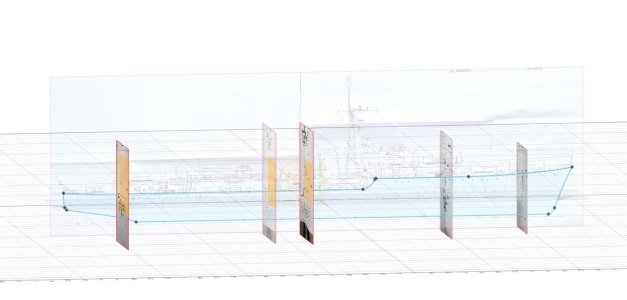
Basta! I will put that hum ho hull on the high shelf and start over. And now I can actually do what I wanted to in the first place: build a humongous model in 1:72 scale, which means it will be slightly over 150 cm / 5 foot long.

Oh boy.

Screenshot 2024-11-17 at 14.28.24.jpg
 
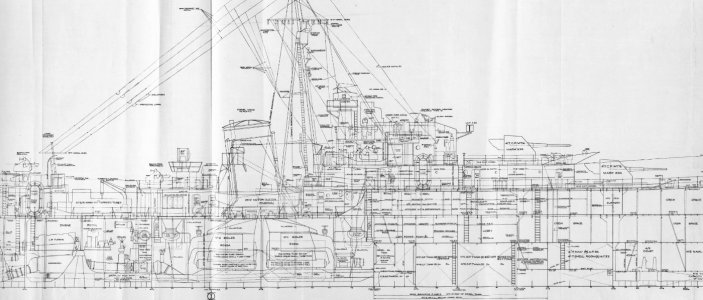
I received some good support from a local modeller, Jantinus Mulder, who also writes books about ships. I already bought his book regarding D805 Piet Hein, ex HMS Serapis, but he pointed me to some great archived ship plans of HMS Savage and HMS Scorpion, sister ships. And I found another drawing set for D805 online, which I bought right away.

Things are coming together nicely.

Screenshot 2024-11-18 at 11.05.38.jpg
 
I received some good support from a local modeller, Jantinus Mulder, who also writes books about ships. I already bought his book regarding D805 Piet Hein, ex HMS Serapis, but he pointed me to some great archived ship plans of HMS Savage and HMS Scorpion, sister ships. And I found another drawing set for D805 online, which I bought right away.

Things are coming together nicely.

View attachment 484990
The nice thing about a ship model, is you don't have to worry about all those internal parts, walls, doors and ladders shown in the drawing.
 
Regarding your post #6 above. If this ship was built in a British Yard before or during WWII she provided had a riveted hull.

Roger
Interesting point, didn’t really think about this. But … after I had a little chat (I know, always double check what ChatGPT is stating) I found out that HMS Serapis actually had a fully welded hull. Predecessors often had riveted midship hull and welded bow and stern.

I will dive deeper into this to make absolutely sure.

But a very good point! Appreciated.
 
Ah. The difference … HMS Daring was the first destroyer to be designed with a fully welded hull, whereas HMS Serapis still had some rivets in her construction. Things were moving fast in the last year of WW2.

HMS Cavalier was built half welds half rivets. HMS Daring was laid down September 1945 and welding was the new standard. I guess (and will build accordingly) HMS Serapis was ‘as build’ with (visible) welds only.

Call it artistic freedom.
 
Wow you sure like a challenge Marco, I am looking forward to seeing this project develop. Just took a look at a couple of pics. of Serapis on the IWM site and confirm that her exposed hull looks like it was all welded.

Cheers JJ..
 
Five years earlier, (1940) the British Government built 60 -10,000 ton merchant ships in the USA. These Ocean Class ships were based on English designs, but modified from riveted to welded construction to meet the very aggressive delivery schedule. Further modified, the design became the more famous all welded Liberty Ships.

During the war, these and other US built ships experienced hull failures that was blamed on their welded construction. While subsequent research has determined that there were other contributing factors; metallurgy of the steel and stress risers in the deck structure, all welded construction got a bad name.

Realizing that hull cracks did not propagate across a riveted seam, Naval Architects began using riveted seams at high stress points in the hull as “crack stoppers.” Here on the Great Lakes, plating at the turn of the bilge and the deck angle continued to be riveted while the rest of the hull plating was welded. This practice continued throughout the 1950’s.

As modern historians like to say, Context.

Roger
 
Five years earlier, (1940) the British Government built 60 -10,000 ton merchant ships in the USA. These Ocean Class ships were based on English designs, but modified from riveted to welded construction to meet the very aggressive delivery schedule. Further modified, the design became the more famous all welded Liberty Ships.

During the war, these and other US built ships experienced hull failures that was blamed on their welded construction. While subsequent research has determined that there were other contributing factors; metallurgy of the steel and stress risers in the deck structure, all welded construction got a bad name.

Realizing that hull cracks did not propagate across a riveted seam, Naval Architects began using riveted seams at high stress points in the hull as “crack stoppers.” Here on the Great Lakes, plating at the turn of the bilge and the deck angle continued to be riveted while the rest of the hull plating was welded. This practice continued throughout the 1950’s.

As modern historians like to say, Context.

Roger
This is exactly why I like being on this forum. Chances of understanding these little historical facts are pretty low without somebody pointing in the right direction.

Interestingly I just read about the liberty ships as part of a really good book, the war in the west by James Holland about WW2 and how industrialisation and welding made things possible.

I have some experience with welding, as I worked at Rheinmetall and saw many a hull being welded and blast tested. That kind of welding is the domain of top level welding engineers.

On with the 3D ship. If someone can point out were rivets would be visible AND I would be able to get it into the design, I will happily incorporate it in the hull.
 
A while ago, I read a book by a British Author; Assault From the Sea, about the development of World War II landing craft. I was more than a little surprised to find credit given to Dravo Corporation, a relatively unknown American Company for developing specialized welding techniques that made high volume production of these essential ships (LST’s), and others possible. These production methods made use of large subassemblies that could be turned upside down to minimize overhead welding. As progress on the welded hull progressed it was walked across the shipyard until it could be side launched into the Ohio River, near Pittsburgh, PA.

Dravo’s production techniques were then copied by several “cornfield shipyards” rapidly built along the Ohio and Mississippi Rivers to produce LST’s. Winston Churchill supposedly grumbled about wartime strategy being dictated about unknown ships called LST’s. Probably untrue as he was involved in the original idea of a Tank Landing Ship.

This story is personal, as I worked for Dravo for 20 years, but long after WWII and not at their shipyard. The division that I worked for produced prefabricated high pressure piping assemblies for nuclear and fossil power plants. Mostly TIG and Submerged Arc welding. Sadly Dravo did not survive the American heavy industry depression of the 1980’s.

Fortunately, a Dravo built LST has survived. LST 325 was found in Greece, laid up by the Greek Navy. A group of retired sailors in their 60’s and 70’s traveled to Greece, put her back into operating condition, and sailed her to the USA. She is now moored on the Ohio River at Evansville, Indiana, near the site of one of the Cornfield Shipyards. She is well cared for and travels to other Ohio River communities during the summer months. Google LST 325

Marco, After high jacking yout thread, Back to the subject: At any
modeling scale rivets would be invisible. The heavy Pan Head of the rivet would be on the inside of the hull and the hammered point on the outside of the hull would only protrude a few mm. What would show is the plating. With a welded hull the plating is butt welded. Back during WW II probably backed up with backing strips on the hull inside. So the plating is flush. The riveted seams, however, would probably overlap, or for high quality work butt joints again using backing strips on the inside were possible. The heavy in and out strakes shown on the hull in post #7 are indicative of a riveted not a welded hull.

Roger
 
Last edited:
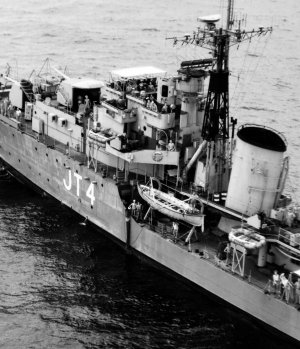
I found an excellent photo of Piet Hein, albeit before she was designated D805. This was right after WW2, operating as JT4. You can see the separate hull plates. Enough to create something in 3D. The old 1:96 scale hull was flawed in this respect, probably as a result of the way it was made: fibre glass. Way too overdone. I will go for subtle scratch lines where the plates meet.

I hope the final drawing set comes in today, as the ones I already have, are missing body plans.

IMG_4100.jpeg
 
Back
Top