• Win a Free Custom Engraved Brass Coin!!!
    As a way to introduce our brass coins to the community, we will raffle off a free coin during the month of August. Follow link ABOVE for instructions for entering.
  • PRE-ORDER SHIPS IN SCALE TODAY!

    The beloved Ships in Scale Magazine is back and charting a new course for 2026!
    Discover new skills, new techniques, and new inspirations in every issue.

    NOTE THAT OUR FIRST ISSUE WILL BE JAN/FEB 2026

De Zeven Provincien 1665 - 1.100, Fa. Seahorse (Tomasz Weremko)

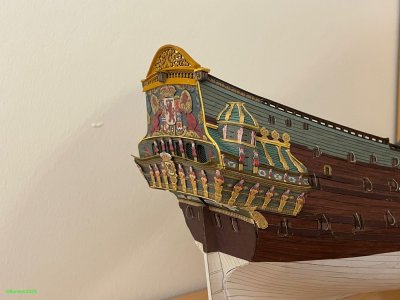
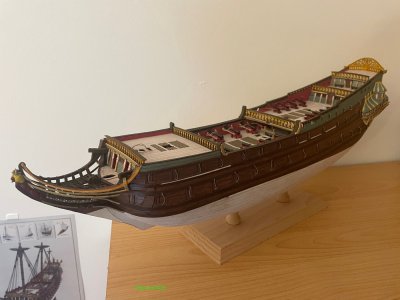
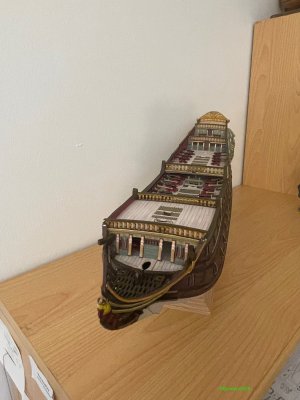
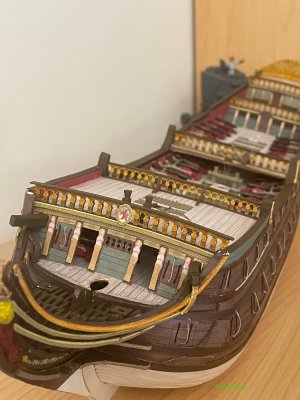
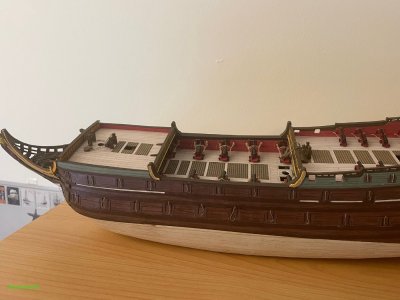
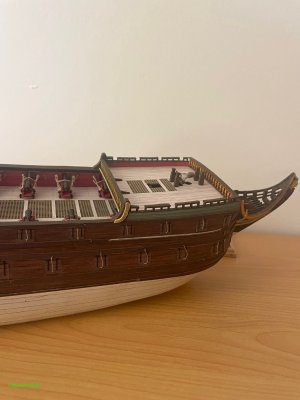
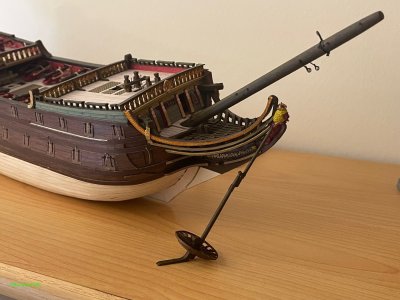
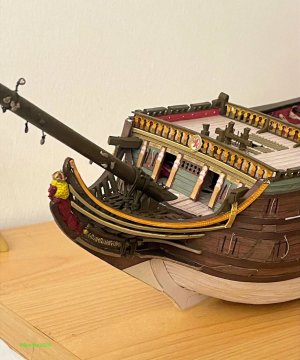
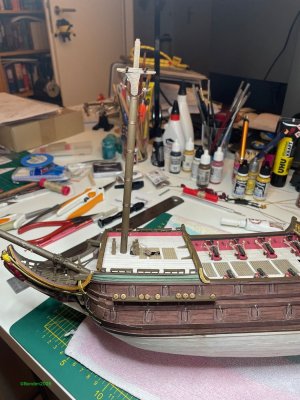
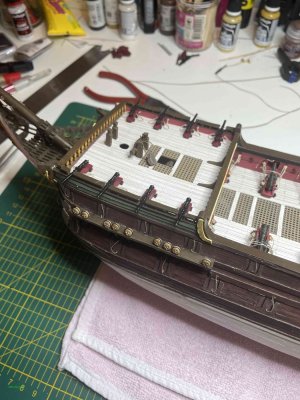
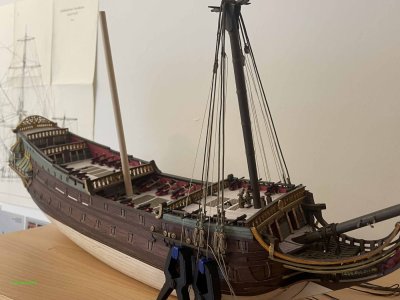
The cat heads are now in place, as are the railings on all decks.
ZP156.jpgZP157.jpg

I am very pleased with what I have achieved so far and am currently having a lot of fun continuing to build the model. So look forward to more posts from me in this thread. :cool:
 
@0Seahorse
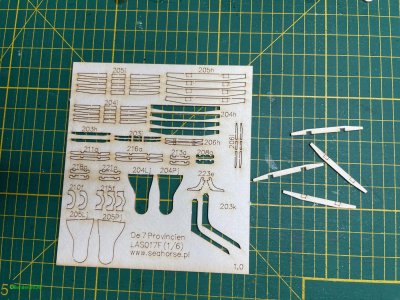
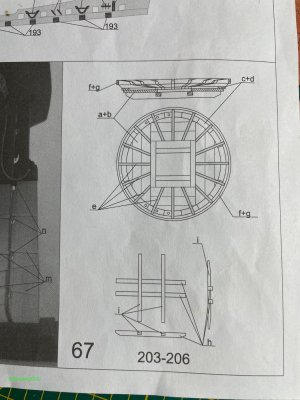
I have another question: How do you attach the spreaders for the upper spars to the masts? I can't find anywhere in the assembly instructions how to assemble parts 208 a-c, 211 a-c, etc. The assembly instructions only show this for the lower areas, No. 67 – but that doesn't work here because there is no platform up there.

Thanks in advance for your help.
 
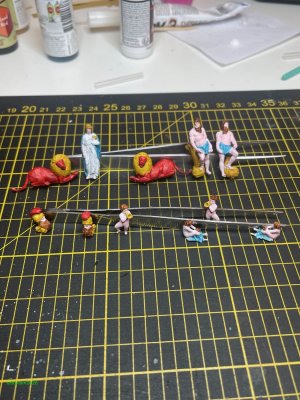
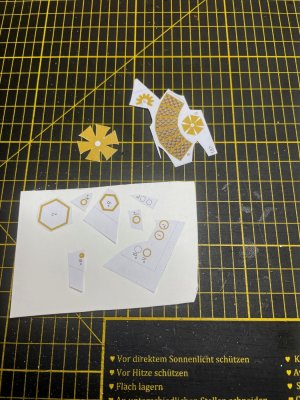
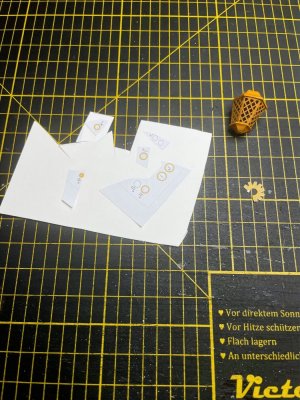
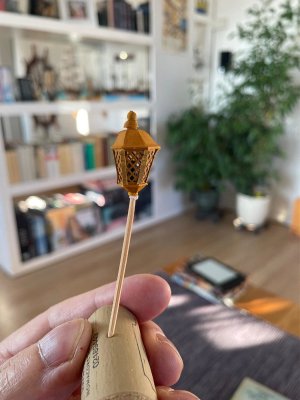
I always need a bit of variety when building, so I like to tackle a part that won't be fitted until much later in the process. The stern will be adorned with five lanterns; I finished the first – and largest – one today.
ZP163.JPGZP164.JPGZP165.JPG
And anyone who thinks that looks crooked is right. But that's how it has to be – since the stern also slopes slightly aft, it ends up looking symmetrical again.
 
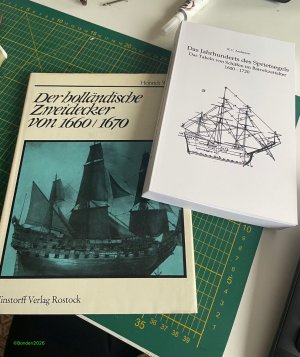
To get started, I took two great books off the shelf in my well-stocked library. The Anderson book is also available in English, of course, but I'm not sure about the Winter book. It's called “Der holländische Zweidecker von 160/1670” (The Dutch Biplane of 160/1670). Around 1930, the author extensively photographed and described an old ship model in Berlin; the book also includes construction plans. And it is almost identical to the Zeven Provincien. A treasure trove for me!

Unfortunately, the model itself was destroyed during the war.

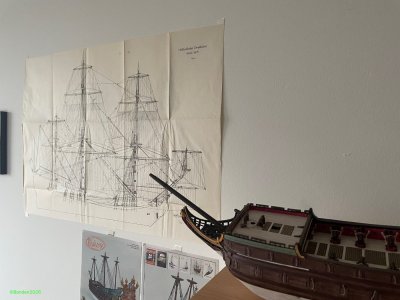
I immediately hung some of the construction plans on the wall.
ZP176.jpgZP177.jpg
 
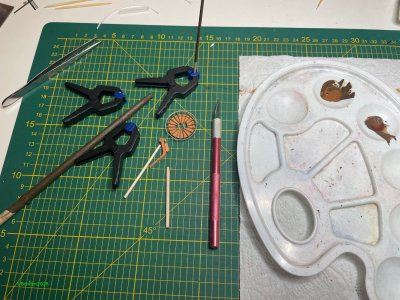
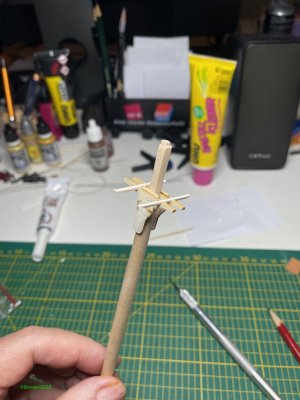
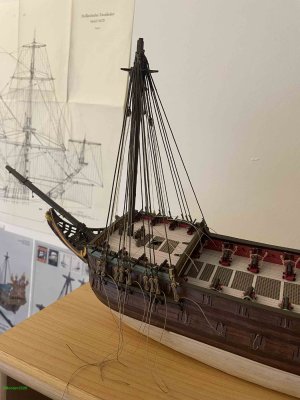
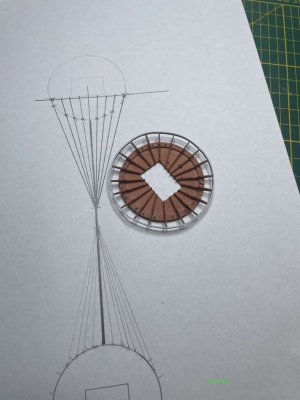
Next, I prepared to rig the foremast. According to the building instructions, the spreader and platform are made in one piece and then attached to the mast. No, that's not my way of doing things; it just makes everything unnecessarily complicated. I build the spreader separately and attach the platform much later, only when all the shrouds and stays are in place. The longitudinal parts of the spreader are included in the kit as one piece, but the transverse parts are divided into three. Hmm, okay, for whatever reason, I cut the transverse parts myself. And then I quartered a toothpick lengthwise and used it to make the calves. ZP182.jpgZP183.jpgZP184.jpg
 
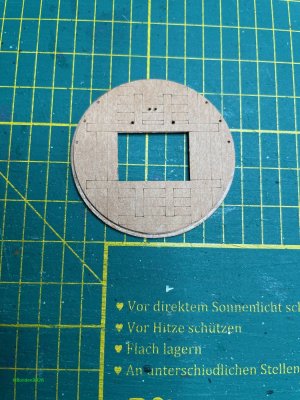
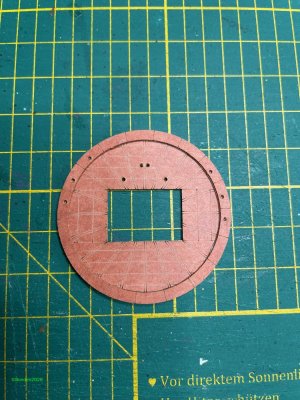
For the Mars platform, various parts that are available as laser cuts need to be glued together. And this is where a mistake seems to have crept in, dear @0Seahorse . The holes for the mounting brackets are incorrect on one side, as you can see in the photos. I will have to drill new holes and then generously cover the “invalid” ones with paint.
ZP185.jpgZP186.jpg
 
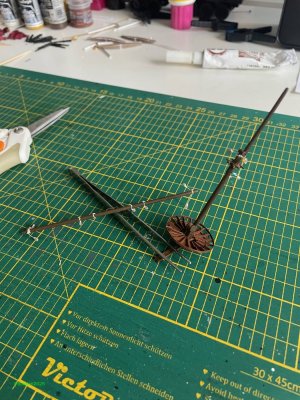
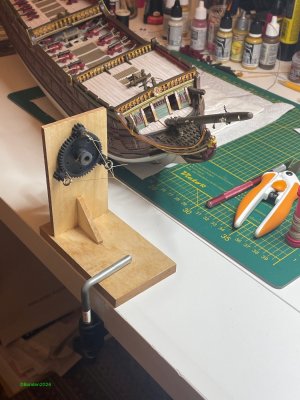
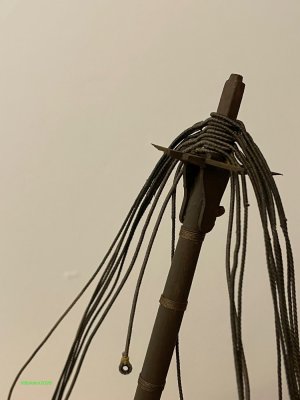
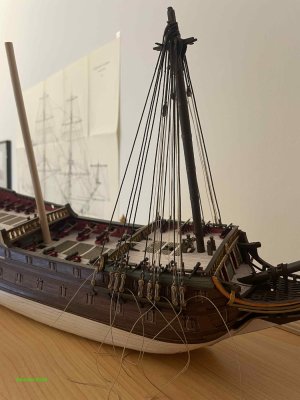
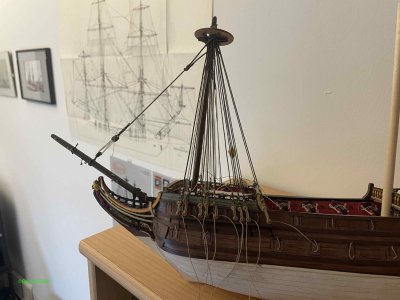
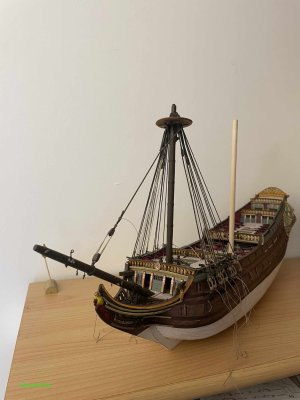
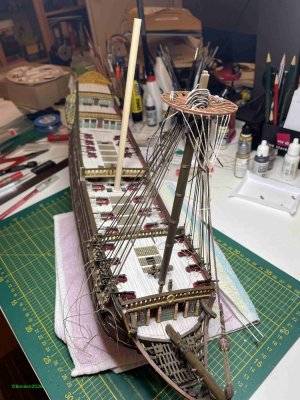
Several ropes have been made here recently. Then I put my fine-line wrapping machine to work. I made all the shroud pairs for the foremast as they should be and laid them all around the mast top to see how they looked. It looks good, doesn't it?
ZP198.jpg

So, now you're up to date again. We'll continue here soon—I feel like I'm in the flow at the moment... :cool:
 
I was able to attach the shrouds quickly. Today, I also built and attached the stay.

Incidentally, I only use light-coloured yarn for all ropes, including those I make myself, and then dye them dark with wood stain. The tar back then was not pure black, but dark to light brown, depending on its consistency. I try to show this in my model as well.
ZP206.jpgZP207.jpgZP208.jpgZP209.jpgZP210.jpgZP211.jpg
 
I asked the AI what the exact terms for two parts of the rigging are. If you enter “Hahnepoten” and “Spinnenkoben” into DeepL, you get what you see in this sentence – the programme doesn't know what to do with it. DeepL should go to sea...
So, let me solve the riddle: Hahnepoten are crowfoot. And now it makes sense to me too: the feet of a crow – and Hahnepoten apparently comes from a German dialect – the feet of a cock. Funny.
Now to the spider webs: euphroe. I can't find a derivation for that, but I hope everyone knows what it means now.

What a long preamble! But the next pictures show why I wrote it.

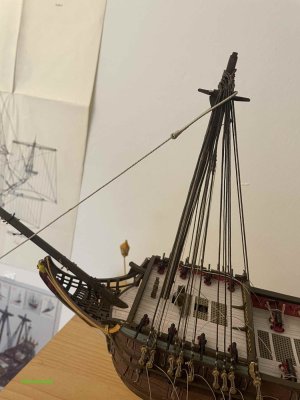
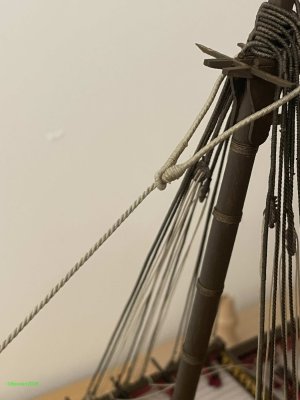
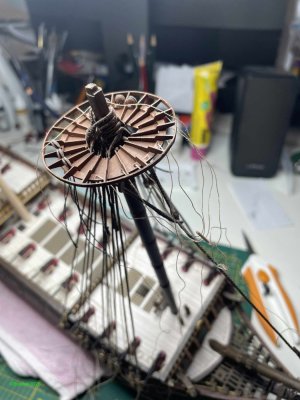
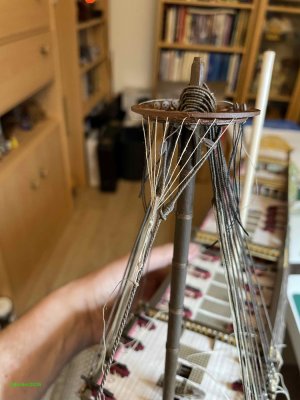
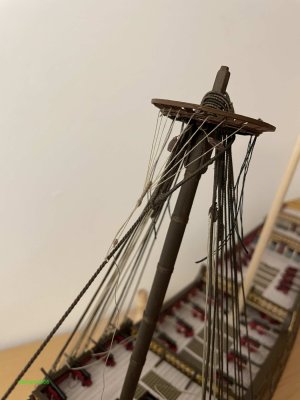
Unfortunately, the Mars platform does not have pre-drilled holes for the crowfoots. In the pictures of the reference model, I can see that Tomasz has attached these ropes to the platform railing. However, all my books tell me that this is not correct, so I drilled the corresponding holes into the platform myself.
Setting the crowfoots is quite fiddly work, but it's also fun because you end up with such a great result. And the euphroe, which you get as a 3D print in the kit, are really great.
I really like the result of a long day at the shipyard – what do you think?
ZP223.jpgZP225.jpgZP226.jpgZP227.jpgZP228.jpgZP229.jpg
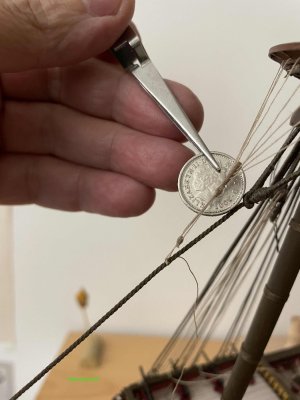
The 5-pence coin to show the size. And the rope will be made even darker – after all, the crowfoots are part of the standing rigging.


Translated with DeepL.com (free version)
 
Back
Top