• Win a Free Custom Engraved Brass Coin!!!
    As a way to introduce our brass coins to the community, we will raffle off a free coin during the month of August. Follow link ABOVE for instructions for entering.

Deck planking procedure

I have to disagree on several statements here, base on my years of being a Luthier.
1. For the purposes of building wooden model ships, any pva glue will work, no point in spending extra money. Your prerogative.
2. PVA glue bonds on a molecular level. Here is a brief excerpt of a write up I did a few years back.

"one needs to understand that glue bonds on a molecular level, that is to say that the molecules of glue, link to the molecules of wood. Thus, anything that gets between the surface molecules to be bonded, like dirt or oils from you fingers will hinder the bond. You often hear, "roughen up the surface first before gluing" with many people thinking that the glue will make little hooks into the roughened surface and bond better. This is false, glue alone has very little strength. What roughening up the surface does is expose a clean surface and increase the dimensions of the gluing area. So, the best glue bond one can make will be one that is perfectly mated together (I generally test my joints with a 1 to 2/1000th inch feeler gage), is absolutely clean (I wipe with denatured alcohol or acetone depending on the wood species) and is not starved for glue. So with that in mind, a strong build will be one that has proper glue bonds".

3. A spit coat of shellac is an excellent conditioning for wood, especially when applying oil based stains on "known" blotchy wood species.
I didn't realize it was on a molecular basis.
 
Every boat I have built followed the same laying and finishing procedure. Firstly the sub deck (plywood in most cases) is flooded with 50% watered down PVA and the planks stuck down and then heavily "stroked" with the end of a steel ruler held vertically, until they are tight to one another and secure. The glue will ooze out and look a right mess. After a few hours the steel ruler is used again, at a shallower angle this time, to scrape the surface of the deck until all planks present a clean fresh appearance. Then apply a finish if necessary, clear varnish on a smart motor yacht or nothing at all on a warship. Job's a good 'un.
 
have to disagree on several statements here, base on my years of being a Luthier.


I see no disagreement in what we both have written.

This is an edited version of what the GOOGLE AI glomed

Initial state: PVA glue is a liquid polymer where the polyvinyl alcohol chains can easily slip and slide past one another, allowing it to flow. When applied to form a bond as the water evaporates the acetic acid component increases in concentration and breaks ester bonds and introduces acetyl groups, which promotes cross-linking. The cross-linking creates a much stronger bond by forming a more rigid, 3D polymer structure within the glue and between the glue and the surfaces it is bonding. The bond between wood and polymer is a van der Waals bond. A van der Waals bond is a weak intermolecular force of attraction that exists between atoms or molecules due to temporary fluctuations in their electron distributions. These fluctuations create temporary, or instantaneous dipoles (magnet), which can then induce dipoles in neighboring atoms or molecules, resulting in a weak attraction between them. Think of it as being similar to the bond between two magnets.

To push the logic - with a van der Waals bond, the greater is the surface area, the stronger is the bond. Wood with deeper scratches has more surface area. Wood whose pores have no sawdust filling them has more surface area. The farther apart are the two wood surfaces, the more is the volume of the bond a semi rigid plastic that can flex under a sheer force.

This means that a liquid that gets between the molecules can push them far enough apart to break the weak molecular bond. For PVA an effective liquid is isopropyl alcohol.


"any pva glue will work, no point in spending extra money. Your prerogative."
Some of us are more neurotic or compulsive than others. Going an extra step is a need.
Plus, here, even inside, Summer: a sauna - Winter: Death Valley

It would probably be near impossible to find a better primer coat than Shellac. Shellac is a superb finish coat, unless it will be subject to water spills or a glass with water condensation sitting on it. However, if Shellac is applied before a PVA bond, the bond will be PVA to Shellac and Shellac to wood. This is not something that I want.

Applying PVA to a painted surface (a stain is actually a paint) or a varnished surface (usually a polymerized plant oil = Linseed, Tung, Walnut, etc. - or a polymerized synthetic plastic = polyurethane, polycrylic - or lacquer = nitrocellulose) puts a third and intermediating layer that blocks PVA from wood. Not much of a bond with this. It is a better bond than one with finger print oil, way oil, grease, sawdust, wax, etc. involved.

** "Wood whose pores have no sawdust filling them has more surface area." Sanding the surface fills the pores with sawdust. Scraping the surface with a sharp steel or glass edge does not.

 
Mr. Robinson...
This thread seems to be getting rather diluted with lots of misc comments, etc. I'm just now checking in and having a hard time figuring out just where things currently stand. Please re-post your original or most current question and concerns... and let's see if we can steer this thing back towards a more fruitful direction.
 
Original post repostedm

I don't know what wood is used for the ZHL San Felipe kit. It is extremely porous.
When testing stain colors and building a deck planking sample i found the stain bleeds through to the underside of the plank. When building the deck planking sample I found that both the PVA and CA glues bleed through to the surface.
I don't want the shiny surface created by the CA bleedthrough. I'm afraid of the splotchy finish created by the PVA bleedthrough.
I'm also afraid to prefinish the deck planks prior to installation because I won't be able to glue subsequent deck furniture.
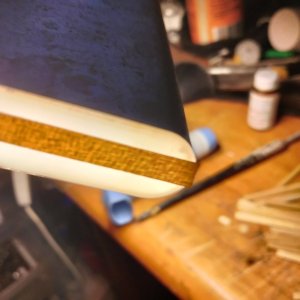
See prestained deck plank below. It was stained with Minwax Golden Pecan oil based.
Any advice is sincerely appreciated.
Ted
 
I see no disagreement in what we both have written.

This is an edited version of what the GOOGLE AI glomed

Initial state: PVA glue is a liquid polymer where the polyvinyl alcohol chains can easily slip and slide past one another, allowing it to flow. When applied to form a bond as the water evaporates the acetic acid component increases in concentration and breaks ester bonds and introduces acetyl groups, which promotes cross-linking. The cross-linking creates a much stronger bond by forming a more rigid, 3D polymer structure within the glue and between the glue and the surfaces it is bonding. The bond between wood and polymer is a van der Waals bond. A van der Waals bond is a weak intermolecular force of attraction that exists between atoms or molecules due to temporary fluctuations in their electron distributions. These fluctuations create temporary, or instantaneous dipoles (magnet), which can then induce dipoles in neighboring atoms or molecules, resulting in a weak attraction between them. Think of it as being similar to the bond between two magnets.

To push the logic - with a van der Waals bond, the greater is the surface area, the stronger is the bond. Wood with deeper scratches has more surface area. Wood whose pores have no sawdust filling them has more surface area. The farther apart are the two wood surfaces, the more is the volume of the bond a semi rigid plastic that can flex under a sheer force.

This means that a liquid that gets between the molecules can push them far enough apart to break the weak molecular bond. For PVA an effective liquid is isopropyl alcohol.


"any pva glue will work, no point in spending extra money. Your prerogative."
Some of us are more neurotic or compulsive than others. Going an extra step is a need.
Plus, here, even inside, Summer: a sauna - Winter: Death Valley

It would probably be near impossible to find a better primer coat than Shellac. Shellac is a superb finish coat, unless it will be subject to water spills or a glass with water condensation sitting on it. However, if Shellac is applied before a PVA bond, the bond will be PVA to Shellac and Shellac to wood. This is not something that I want.

Applying PVA to a painted surface (a stain is actually a paint) or a varnished surface (usually a polymerized plant oil = Linseed, Tung, Walnut, etc. - or a polymerized synthetic plastic = polyurethane, polycrylic - or lacquer = nitrocellulose) puts a third and intermediating layer that blocks PVA from wood. Not much of a bond with this. It is a better bond than one with finger print oil, way oil, grease, sawdust, wax, etc. involved.

** "Wood whose pores have no sawdust filling them has more surface area." Sanding the surface fills the pores with sawdust. Scraping the surface with a sharp steel or glass edge does not.

I want to thank everyone for their responses.
 
Original post reposted
I don't know what wood is used for the ZHL San Felipe kit. It is extremely porous and only .37mm thick

When testing stain colors and building a deck planking sample i found the stain bleeds through to the underside of the plank. When building the deck planking sample I found that both the PVA and CA glues bleed through to the surface.
I don't want the shiny surface created by the CA bleedthrough. I'm afraid of the splotchy finish created by the PVA bleedthrough.
I'm also afraid to prefinish the deck planks prior to installation because I won't be able to glue subsequent deck furniture.
See prestained deck plank below. It was stained with Minwax Golden Pecan oil based.
Any advice is sincerely appreciated.
Ted
 
There is a difference in perspective when focus is on and about kits as an end in itself and when focus is scratch build.
That said, in your specific situation a determination to use what comes in the kit is defeating your progress. For some mfg, an ethic that reflects a willingness to sacrifice profit margin to provide quality materials is lacking. Our domestic species that can serve as filter paper is Red Oak. Soap bubbles can be formed by blowing thru a Red Oak plank. The Mary Celeste had empty Red Oak barrels in her hold that began the voyage filled with ethanol (I think.)
It seems that there is a Asian tree species that is worse. You do not want to use it.

You can get an appropriate species with the needed thickness from a vendor. I was going to suggest a hardwood dealer like WoodCraft for veneer but a search does not find anything reasonable. With veneer, there must be care. Plane cut is good. Rotary cut - like pulling on a roll of paper towels will "want" to cup. It is the shape it came from after all. Maple or Birch edge banding looks promising but it comes pre-glued. The glue could maybe be removed if the proper solvent is known and available. A steel straight edge and a sharp #11 blade (strop often) gets the desired width and there is no loss to kerf. A self healing mat would probably do to work on, although I prefer a 12x18 piece of thick tempered glass with beveled edges.
 
I have to disagree on several statements here, base on my years of being a Luthier.
1. For the purposes of building wooden model ships, any pva glue will work, no point in spending extra money. Your prerogative.
2. PVA glue bonds on a molecular level. Here is a brief excerpt of a write up I did a few years back.

"one needs to understand that glue bonds on a molecular level, that is to say that the molecules of glue, link to the molecules of wood. Thus, anything that gets between the surface molecules to be bonded, like dirt or oils from you fingers will hinder the bond. You often hear, "roughen up the surface first before gluing" with many people thinking that the glue will make little hooks into the roughened surface and bond better. This is false, glue alone has very little strength. What roughening up the surface does is expose a clean surface and increase the dimensions of the gluing area. So, the best glue bond one can make will be one that is perfectly mated together (I generally test my joints with a 1 to 2/1000th inch feeler gage), is absolutely clean (I wipe with denatured alcohol or acetone depending on the wood species) and is not starved for glue. So with that in mind, a strong build will be one that has proper glue bonds".

3. A spit coat of shellac is an excellent conditioning for wood, especially when applying oil based stains on "known" blotchy wood species.
can you explain more about 3.
When i Built my Brandford (Similar Pear Constuction) I tried t0 stain it and totallu cocked it up as the glue prevented it to take the stain regularly
Similarly my AI Victory which use CA just ruined the surface
Si ive used PA (Titebond and another)
Hopefully i will clean it up OK and either lightly stain it OR apply a decent vanish or preferably a decent Wood Oil
What would you suggest Vonccarlos
THANKS

What would you suggest
 
There is a difference in perspective when focus is on and about kits as an end in itself and when focus is scratch build.
That said, in your specific situation a determination to use what comes in the kit is defeating your progress. For some mfg, an ethic that reflects a willingness to sacrifice profit margin to provide quality materials is lacking. Our domestic species that can serve as filter paper is Red Oak. Soap bubbles can be formed by blowing thru a Red Oak plank. The Mary Celeste had empty Red Oak barrels in her hold that began the voyage filled with ethanol (I think.)
It seems that there is a Asian tree species that is worse. You do not want to use it.

You can get an appropriate species with the needed thickness from a vendor. I was going to suggest a hardwood dealer like WoodCraft for veneer but a search does not find anything reasonable. With veneer, there must be care. Plane cut is good. Rotary cut - like pulling on a roll of paper towels will "want" to cup. It is the shape it came from after all. Maple or Birch edge banding looks promising but it comes pre-glued. The glue could maybe be removed if the proper solvent is known and available. A steel straight edge and a sharp #11 blade (strop often) gets the desired width and there is no loss to kerf. A self healing mat would probably do to work on, although I prefer a 12x18 piece of thick tempered glass with beveled edges.
The edge banding is a good suggestion.
 
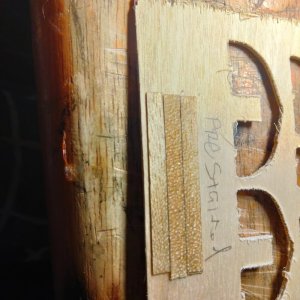
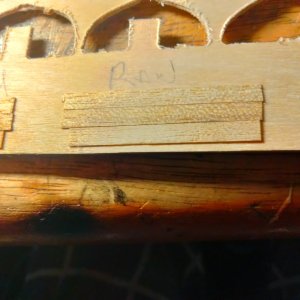
Test panels. First prestained, then glued.
Second glued, stain later. I'll give it twelve hours and check glue adhesion on the prestained side and then stain the raw wood glued for consistent finish and glue leed throughIMG20251109072521.jpgIMG20251109072527.jpg
 
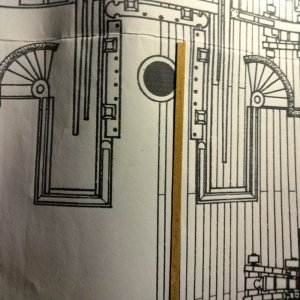
Some of the deck planks shown on the plans are longer than the materials provided. See plan plank directly above the deck plank in the photo IMG20251109075241.jpg
 
Ted, Although you like to use the woods supplied with the kit, it just might be time to stop struggling with this wood. The samples that you show in your post #53 with that mottled grain structure do not resemble any full scale materials that would be used for shipbuilding.

The ideal solution would be to buy a piece of quality wood and to then rip your own planking material. If this is not an option then visit your local craft store; Hobby Lobby, Michael’s, etc. They usually stock Basswood strip. This would be a better choice than the wood that you’re trying to use. Living in the LA area there should be many choices.

Roger
 
Ted, Although you like to use the woods supplied with the kit, it just might be time to stop struggling with this wood. The samples that you show in your post #53 with that mottled grain structure do not resemble any full scale materials that would be used for shipbuilding.

The ideal solution would be to buy a piece of quality wood and to then rip your own planking material. If this is not an option then visit your local craft store; Hobby Lobby, Michael’s, etc. They usually stock Basswood strip. This would be a better choice than the wood that you’re trying to use. Living in the LA area there should be many choices.

Roger
Thank you, I'll look around
 
I had all my questions answered and see no reason to continue this thread unless other are finding it useful.
Further posts will be on my build log
ZHL San Felipe 1690 - Ted R
 
Back
Top