• Win a Free Custom Engraved Brass Coin!!!
    As a way to introduce our brass coins to the community, we will raffle off a free coin during the month of August. Follow link ABOVE for instructions for entering.

Display cases

  • Thread starter Thread starter MDB
  • Start date Start date
  • Watchers Watchers 26
Has anyone seen this YouTube video of an excellent way of building acrylic display cases? Doesn’t use glue but double sided tape only 3mm wide and very thin. I’ve made a few myself and works very well!
Just need the cost of acrylic sheets. And maybe a table saw for cutting. No other tools required.
The tape used here is PET.....available on Amazon.com in quire a few widths....
 
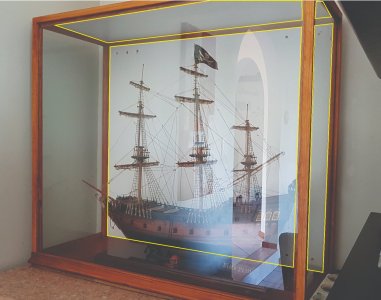
This the first boat and case I built so excuse the look.
To make the display case cheaper, I used 3mm backing board on the wall facing side and the top as highlighted in yellow in the pic. The model is not viewable from the wall or top anyway.
For the front and sides I used 3mm glass which was much cheaper than acrylic sheet.

20251013_090130.jpg
 
I have had excellent results using picture framing glass for model cases. This glass is treated with a UV shielding that protects the model in the same way it is designed to protect framed artwork. It can be purchased quite reasonably from any framing shop. I get mine from Michael's, a crafting supply store. They will cut the glass to any dimensions you require. It's about 3/16" thick and it fits in the kerf of a table saw blade. I rip frame stock on my table saw from whatever is on hand, often oak, and then assemble it using antique picture framing tools which provide perfectly cut corner alignment and joint clamping.

THE JOY OF OLD 'ARN:

As anybody who has ever tried to cut perfectly matched miters for model cases, picture frames, interior trim, or any other mitered corner knows, it's a lot harder than it looks to get a perfectly matched mitered joint without any edge chipping or tear out. Small stuff can be done successfully with a fine-toothed blade on a Byrnes saw if one takes the requisite care in setting up the angles. For anything larger, a shooting board and a sharp block plane will do the job as long as one is careful to come at it from both directions and not cut past the far end and chip the edge. Then, too, it takes some care to get the lengths matching exactly. (I always cut my case frame pieces to length after I buy the glass cut to size from the local picture framing shop.)

Full-size table saws and powered miter saws are much too rough and often not accurate enough to do the job without requiring a lot of trimming to get the angle perfect without any edges chipping. Hand saw miter jigs are a bit better, but not by a lot. There is a tool for solving the problem, save for edge chipping. That is the H.C. Marsh Miter Machine (later Stanley-Marsh #100.) I have been fortunate to have come across two of these no longer made combination miter sawing and assembly jigs over the years, amazingly with their accompanying Disston 26" and 22" backsaws, respectively. I found one in an online auction and another at a garage sale serendipitously a week apart. I bought the second one because it was too good a deal to pass up and will permit me to glue up two corners simultaneously, thereby cutting my "glue setting" time in half. One much appreciated unique feature of this miter saw and vise, which accommodates work up to 4" in width, is that it rotates 360 degrees and tilts 90 degrees which permits moving the joined corner to a convenient angle for sawing a kerf for a spline, drilling for a dowel, or nailing. I bought one of these machines and its saw for $25.00 USD, the other for $50.00 USD. They're running around $300.00 to $350.00 on the tool collectors' market, less their backsaws which can run as much as $250 and up for Disstons in good condition. Not anywhere close to being an essential for ship modeling, but very handy for building wooden framed glass model cases, picture frames, and mitered interior trim. If you come across one for cheap, buy it!

H.C. Marsh Miter Machine (photos from internet)


1756444699496.png


1756443554697.png


1756442367461.png


The Marsh Miter Machine was marketed primarily for picture framing and, back in the day, they were standard equipment in every commercial framing shop. They were accompanied by the Lion Miter Trimmer, a cast iron lever-operated shear which shaves the mitered edges of workpieces up to 4" by 6" at any angle desired between 45 degrees and 90 degrees, leaving a perfectly smooth finish with no edge chipping. Invented in the late 1800's, the Lion Miter Trimmer is still manufactured today and sold under the labels of various specialty hardware retailers such as Grizzly, Lee Valley, and Highland Hardware, being marketed not only for use in picture framing, but as a miter shaving machine for any mitered joints within its capacity. I stumbled upon one in nearly new condition at the recycling resale center at the local dumps the other day and was able to buy it for $50.00 USD. They retail for between $300.00 USD and $350.00 USD. I'm looking forward to using this beautiful hunk of cast iron and steel in the near future. It will come in handy for making ship model cases and any other miter work that comes along.

See: https://www.highlandwoodworking.com...an/miter-trimmer-woodworking-tool-review.html for demonstration of use and application details.
Lion Miter Trimmer, photo of Highland Hardware's currently produced copy of the original:


1756440288246.png

1756440461303.png

\\

1756445783941.png


1756445883245.png
 
Last edited:
I'm guessing that you mean 3/32", which is the thickness for single-strength glass and would fit into a 1/8" saw kerf. Double-strength is 1/8". 3/16" glass, especially UV shielded, would be very expensive.
You're right! My bad! ;)
 
Has anyone seen this YouTube video of an excellent way of building acrylic display cases? Doesn’t use glue but double sided tape only 3mm wide and very thin. I’ve made a few myself and works very well!
Just need the cost of acrylic sheets. And maybe a table saw for cutting. No other tools required.
Can you tell me the dimensions of the cases you made? I need one for my Victory model and it should be 1500x1000x400 mm. Would this be too big for the technique described? Thanks
 
Beautiful Job! I was wondering how to cover my cross section when done and I think you found the answer for me!

Rob
I used a floating shelf, added trim around the edge, and the wall side is open.
 
Depending on the size you need, here are a couple of options:
There are retailers out there that resell store fixtures. The fixtures may be full cases, or smaller units designed to fit on top of the cases or on shelves. They may be worth stopping, walking through their store and taking a look.
If you are willing to make your own case, another option is to use the plastic out of old frames made to hold posters. They can be found very cheaply at garage sales. Get rid of the frame and the poster and just use the plastic face.
 
Can you tell me the dimensions of the cases you made? I need one for my Victory model and it should be 1500x1000x400 mm. Would this be too big for the technique described? Thanks
Yes I think it would be a challenge to make a case such as this for a model as large as yours. I would practice de making smaller cases first and see whether it is viable or not for you.
 
Yes I think it would be a challenge to make a case such as this for a model as large as yours. I would practice de making smaller cases first and see whether it is viable or not for you.
Thank you, I'll try as you suggest
 
Back
Top