• SUBSCRIBE TO SHIPS IN SCALE TODAY!

    The beloved Ships in Scale Magazine is back and charting a new course for 2026!
    Discover new skills, new techniques, and new inspirations in every issue.

    NOTE THAT OUR NEXT ISSUE WILL BE MARCH/APRIL 2026
  • Win a Free Custom Engraved Brass Coin!!!
    As a way to introduce our brass coins to the community, we will raffle off a free coin during the month of August. Follow link ABOVE for instructions for entering.

Ever considered to scratch-build from card?

I’m afraid to work with paper because it’s susceptible to moisture and the weaker structure could get easily crumpled.
There are scratch built ship models in my collection that are over 10 years old and I never saw any sign of crumpling. What do you intend to do with them? Store them in the bath room?
What I do see in some of the kits I built (mainly planes and vehicles) is discoloring and damage by insects (silverfish). Peculiar enough they don't seem to like my ships, for which I thank them.
 
There are scratch built ship models in my collection that are over 10 years old and I never saw any sign of crumpling. What do you intend to do with them? Store them in the bath room?
Well....... maybe. It will give me something to look at while doing my business. . . :D

As for crumpling, YOU don't have CATS. I also have some silverfish in the basement level bathroom, and you thought teredo worms were a problem.
 
I’m afraid to work with paper because it’s susceptible to moisture and the weaker structure could get easily crumpled.
I did the HMS Alert, and when all was said and done the hull was as strong as a wooden hull. The spars and mast are wood. It has been in the basement for two years with no degradation, though I did paint the surface with a flat poly on the bottom and a semigloss on the superstructure, but you have no need to worry.
I have to rerig it due to a former family cat
 
Last edited:
I did the HMS Alert, and when all was said and done the hull was as strong as a wooden hull. The spars and mast are wood. It has been in the basement for two years with no degradation, though I did paint the surface with a flat poly on the bottom and a semi gloss on the superstructure, but you have no need to worry
Nice. It's good to know. Paper seems so flimsy to me.
 
It's not just paper Kurt, it is also card. You know how rigid a cardboard box can be.
The fact that everything is glued to everything makes the whole structure surprisingly sturdy. You should give it a try.
I know a very nice book that excessively details the whole proces, called 'Dutch 17th century ship models in paper' written by a very well know author. :-))
 
I will quickly chime in and note that I know a guy locally (Windsor, ON) who does historic great lakes freighters out of card stock and they look fantastic and hold up very well. He stores them in his basement and has no issues at all.

I have considered doing so at least once, but I prefer working with wood. One thing though......the card stock models are super light weight of course.

Quick aside: The local model railroad club here as a waterfront scene depicting the steel mill in Hamilton, Ontario and they have a scratch built waterline laker that was built out of automotive modeling rigid foam, with styrene and PE parts for details. This stuff is rigid like wood and super light - but.....hard to get and expensive.
 
Paper and card do not require the sanding wood does. If a wooden plank breaks, it's time for gluing and sanding. Paper can often be hardened with a dab of superglue. The lack of sanding eliminates a lot of dust, which keeps the Captain happy.
 
It's not just paper Kurt, it is also card. You know how rigid a cardboard box can be.
The fact that everything is glued to everything makes the whole structure surprisingly sturdy. You should give it a try.
I know a very nice book that excessively details the whole proces, called 'Dutch 17th century ship models in paper' written by a very well know author. :-))

Mr. Hoving (Ab) - I just purchased your "Dutch 17th Century Ship Models in Paper" book from Seawatch and I am looking forward to building the smalschip and Witsen's pinas using your card stock method and your designs.

I want to see if 2mm and 3mm chipboard sheets (cardboard used in creating book covers) would work well on my build of the smalschip (there is a good build log out there). I will also try 2mm and 3mm Foamcore sheets (Styrofoam with Kraft Paper veneer). Whichever material works better, I will use that on Witsen's pinace. I will also be using 80, 100 and 120 pound card stock for the thinner pieces.

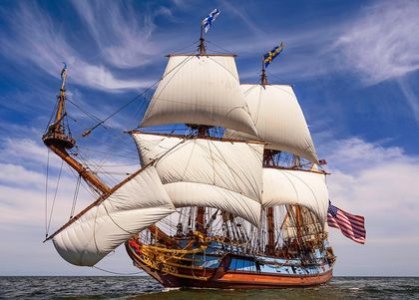
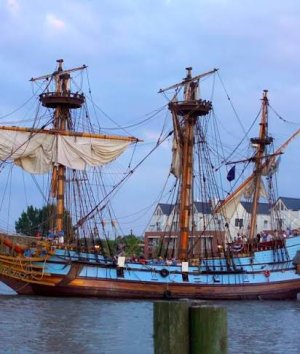
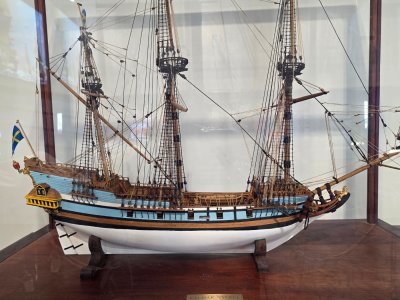
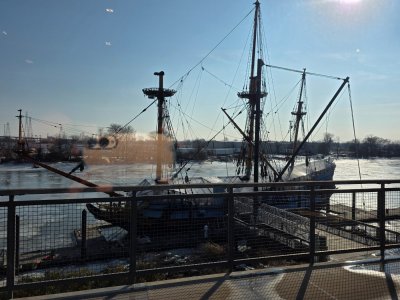
I have a special interest in the Kalmar Nyckel, a 17th century Dutch pinnace, which is berthed near where I live in Wilmington Delaware. It is the ship that brought Peter Minuit and the first Swedes to America, but it went down in the Battle of Buchan Ness against much larger British ships of the line. I usually see the Kalmar Nyckel 4 or 5 times each year...its is an amazing replica of the original.

I will also see the Kalmar Nyckel at Sail250 in Boston in July, along with other windjammers like the Star of India, the Gorch Fock, the Nippon Maru, the Juan Sebastian de Elcano, the Belem and others.

Previously, I abandoned 3 paper card builds because they were always so unforgiving...1 wrong fold or cut could ruin the finished model. I tried to build the Cyclon II ocean tugboat, the Centaur tugboat, and the Graf Goetzen armed freighter. All 3 went into the waste bin. That was when I started to make wooden ship models. I hope that using your method will help me get better results than buying a cheap paper kit on the internet.

After I build the Witsen's pinas from your excellent plans -- I plan to build the Papegojan 1624 from a Shipyard paper card kit with lasercut parts, which I'm sure I can supplement with chipboard or Foamcore and heavy paper card stock if needed.

I do not know whether the three vessels are related in any way -- Witsen's pinas, the Kalmar Nyckel and the Papegojan -- other than that they were all built by the Dutch in the first half of the 17th century. But I reckon that if I can build Witsen's pinas and the Papegojan then I might be able to scratch-build a paper cardstock model of the Kalmar Nyckel based on your Witsen's pinas plans.

Thank you for all you have done to advance the paper card modeling craft and for enlightening us all about Dutch ship building in the 17th century.

Ignatius

KN-homepage-sail-KN-callout-613x420@2x-420w.jpg

images (3) (1).jpeg

20260214_151140.jpg

20260214_151038.jpg

20260214_151155.jpg

20260214_150841.jpg
 
Last edited:
Back
Top