
• Win a Free Custom Engraved Brass Coin!!!
    As a way to introduce our brass coins to the community, we will raffle off a free coin during the month of August. Follow link ABOVE for instructions for entering.
  • SUBSCRIBE TO SHIPS IN SCALE TODAY!

    The beloved Ships in Scale Magazine is back and charting a new course for 2026!
    Discover new skills, new techniques, and new inspirations in every issue.

    NOTE THAT OUR NEXT ISSUE WILL BE MARCH/APRIL 2026

Fanny M - a simple lift model

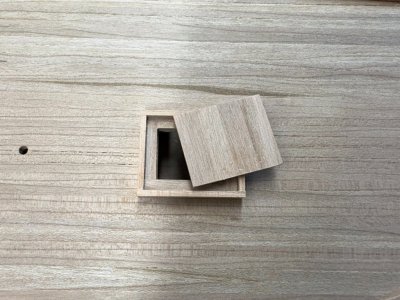
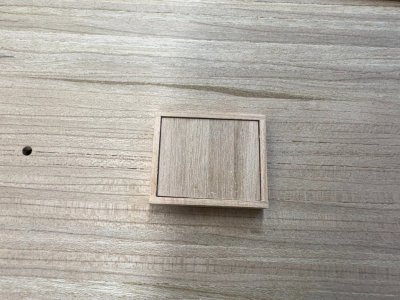
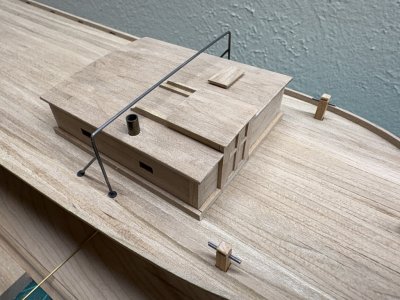
Another (small) step forward - the main front hatch was made. The model will be presented with the hatch closed as in the second picture - rings will be added later to model a means to open the hatch. The outer / visible ledge is made from 1/16" x 3/16" material. The hatch is 4 strips of 1/16" material as well. To provide support for the hatch cover, a inner ledge was made from 1/8" square material. Framing the inside and outside of the ledge in this manner seemed to be more efficient than milling L-shaped material.

Deck Hatch 1.jpgDeck Hatch 2.jpg

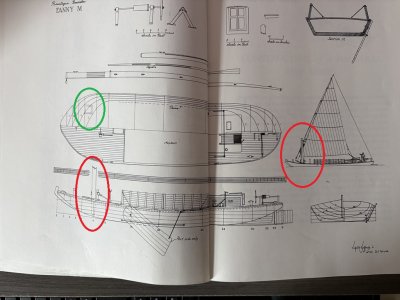
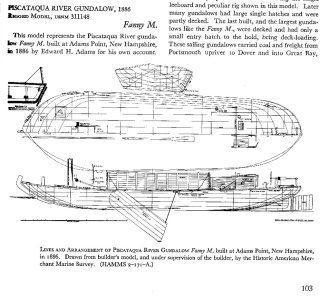
There is a second smaller hatch that is located fore on the starboard side of the deck - I'm not clear on what purpose it served. The hatch is circled in green of the the Grimwood plan for Fanny M. I also would like to note an observation I made on the Grimwood plan and a comparison to the corresponding plan from the National Watercraft Collection. It is the rake of the mast - on the Grimwood profile plan, the mast rakes back, on the sketch of the complete vessel it rakes forward. The National Watercraft image shows the profile with the mast raking forward as it should. Sometimes it is helpful to have multiple sources for the project you are working on!

1773433284610.jpeg

1773433306020.jpeg
 
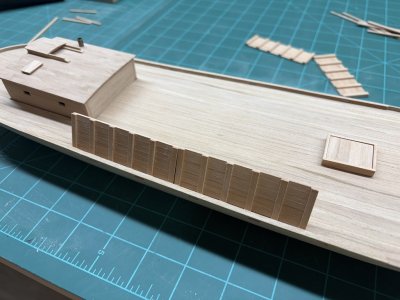
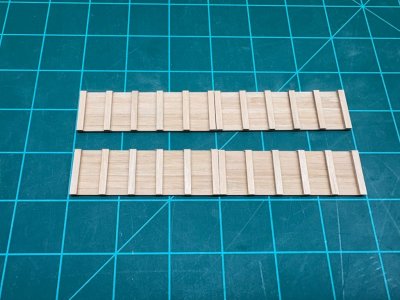
In the plans, portable walls to help secure loads can be seen traversing from main hatch to cabin. In reality they would have been 4' high and 12' long each, with a pair on both sides of the vessel. For the model, each panel is 1" high and 3" long made up of a number of horizontal strips that were supported by vertical battens. I made all of the pieces from 1/8" x 1/16" stock.

Here are pair sitting in place on the deck - later hardware to keep the panels in place will be added.

1773458978424.jpeg

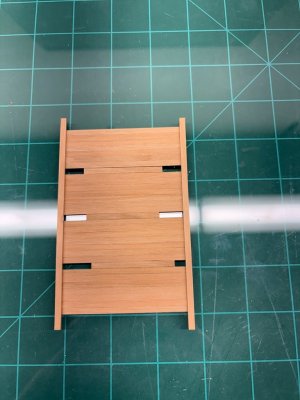
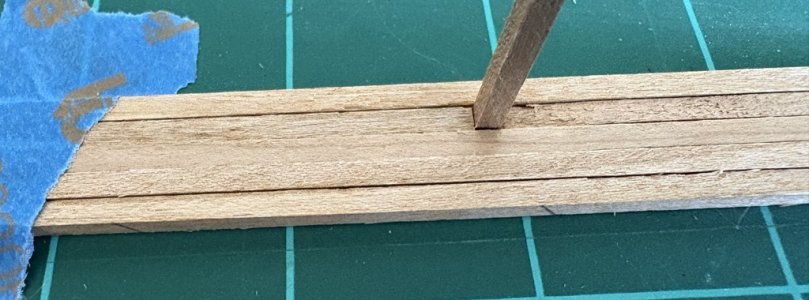
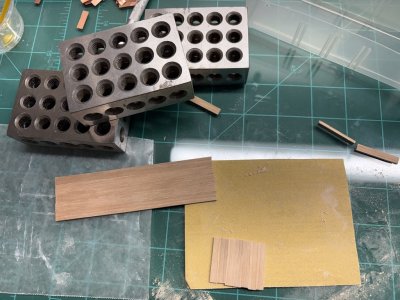
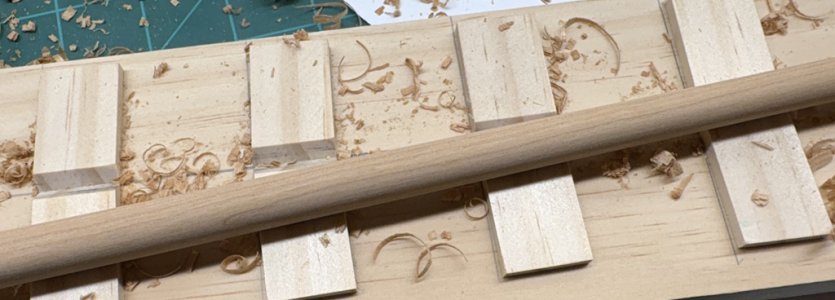
The horizontal pieces were cut longer than necessary and edge glued. Before the four panels were dry, they were placed between 2 glass sheets to keep the panels flat. Once dry, the oversized (in length) panels were trimmed to 3 inches.

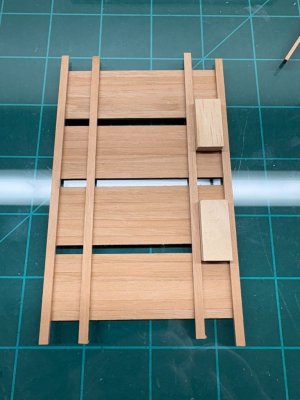
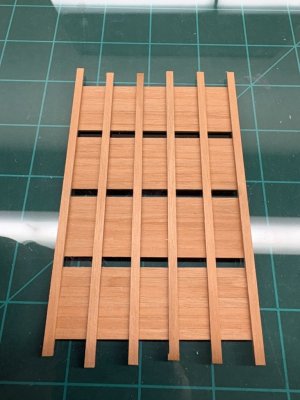
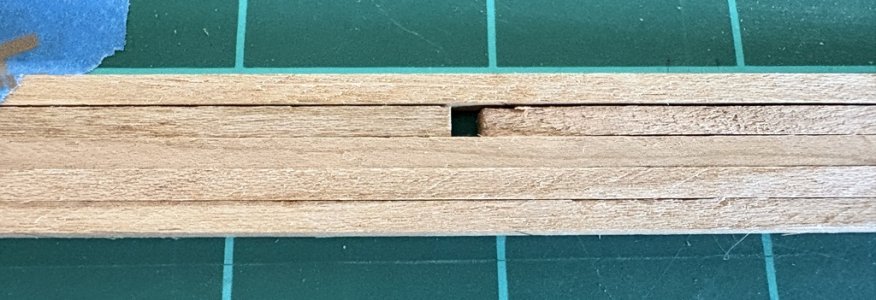
Next, I placed spacers between the four panels, lined up there edges with a straightedge and attached the two most outer battens. This assembly was set between the glass plates to dry. A pair of spacers were made to allow easy spacing / attachment of the interior battens. After a last bit of time between the glass plates, the four panels were separated.

Cargo Panel Assembly 1.jpgCargo Panel Assembly 2.jpgCargo Panel Assembly 3.jpgCargo Panels Complete.jpg
 
Greg,
Are you giving any thought to "painting" with alcohol based aniline dyes?
Using that method is easier if the wood is dyed before assembly.
I am not sure about white. A whitewash may be necessary. There is no problem with gloss.
The grain is still visible.
Shellac and how many coats determines the nature of the finish and has a completely effective reverse gear.

I have the thought of using Renaissance Wax Polish over the shellac, but a test on scrap first.
 
Greg,
Are you giving any thought to "painting" with alcohol based aniline dyes?
Using that method is easier if the wood is dyed before assembly.
I am not sure about white. A whitewash may be necessary. There is no problem with gloss.
The grain is still visible.
Shellac and how many coats determines the nature of the finish and has a completely effective reverse gear.

I have the thought of using Renaissance Wax Polish over the shellac, but a test on scrap first.

I'm very hesitant to paint and do so only when it is absolutely needed. For this model, I have been planning on treating most of the surfaces with boiled linseed oil and leaving it as that. I feel the Cherry then continues to look nicer with age and the finish is not all that fancy, which is good for a working vessel.

However, I am having some difficulty as to how I will be treating the waist of the vessel. Apparently the deck in the waist region between the panels was covered with asphalt to provide protection to the deck when coal loads were shoveled off. Since the photographs of the wrecked Fanny M do not show any asphalt I am currently conjecturing that the asphalt used was rolled asphalt from the roofing industry. This type of material had been in use since the 1890's. I'm not sure how to model that material so it has some texture and looks / matches well with the rest of the model. I have read that some people have had success using a high grit wet/dry sandpaper for this purpose...
 
I was imagining a transparent color contrast of the deck house - hatch combing - topside - portable walls from the deck.
Paint is way too much for what I am imagining. That it is Cherry still needs to come thru.
For the tar paper - might just a piece of black craft paper be worth a test?
 
Well done! I especially like your use of spacers to maintain consistency… I’m adding that little “trick” to my memory… assuming I can hold that thought! ROTF ROTFROTF
 
Well done! I especially like your use of spacers to maintain consistency… I’m adding that little “trick” to my memory… assuming I can hold that thought! ROTF ROTFROTF
Thanks, and I am interested in your Leon build - (re)building models from that time period of publications is rather fascinating!
 
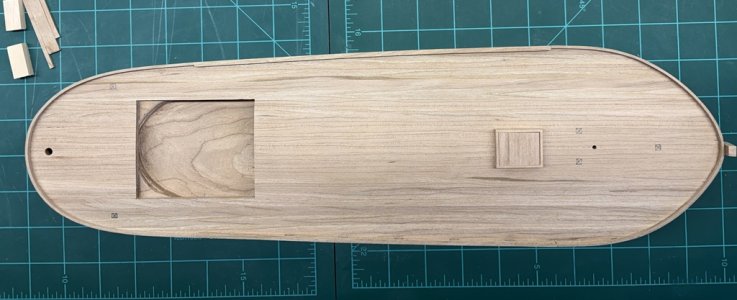
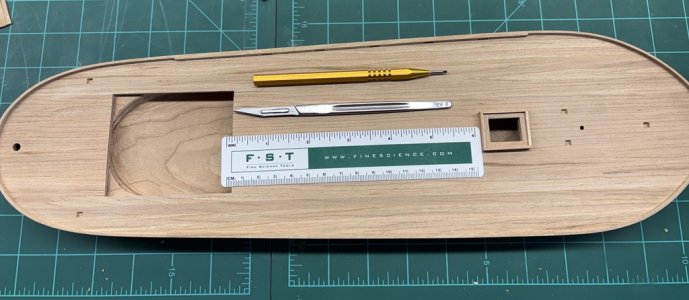
Did a little deck surgery and opened up locations that bollards and bitts will be placed. These pieces could simply be pinned and glued to the top of the deck. However, I believe that a better look, and more secure fastening can be made by cutting an opening in the deck itself. This provides the illusion of the bollards and bitts passing thru the deck.

The first step is to carefully measure and then mark their location on the deck. This is really a measure twice cut once situation as the work is invasive and a misplaced hole is really hard to remedy. Having not permanently affixed the deckhouse provided additional space to mark and then open the two bollard locations in the aft portion of Fanny. Here are the five locations marked where the deck will be pierced:

1774057868885.jpeg

To get (reasonably) square openings, I chose to cut the sides of the openings with a scalpel using a straightedge to keep the cuts straight. The interior wood was then removed using a small chisel. The work was done iteratively - cut along the edge, remove material with chisel, cut a little deeper, remove more wood, ... I went as far as the top lift and stopped. An alternate method would be to drill a hole where the opening is to be and then use a cutting tool to square the corners.

1774058102071.jpeg

The bitts and bollards will still be pinned when attached, but the finished product will have a more shipshape look to it.
 
The first step is to carefully measure and then mark their location on the deck. This is really a measure twice cut once situation as the work is invasive and a misplaced hole is really hard to remedy.
Your technique is belt and suspenders - the better option. The socket will be of help in keeping this furniture 90 degrees vertical. A Parkinson's twitch should not displace.
It is an option that I will keep on file.
About remedying a mistake: How much more difficult would it be to have made the holes in the deck planks before they were bonded? I am trying to envision which is more work: cutting the holes in the finished work or the additional work it would take to place the deck plank with the hole already there perfectly?
 
How much more difficult would it be to have made the holes in the deck planks before they were bonded?
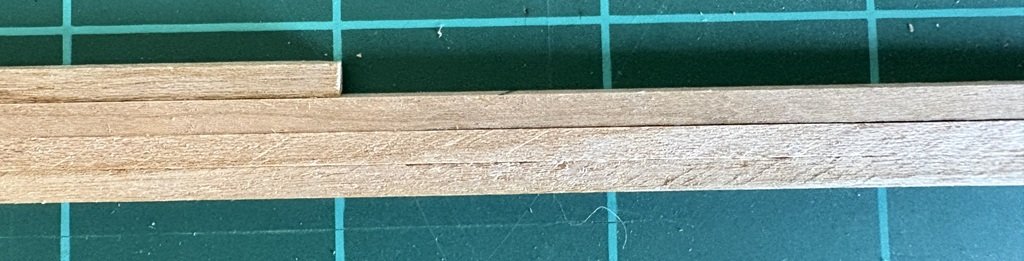
In some ways less difficult. The work could go as follows:

1. Plank up to marked edge of hole location.

1774118762900.jpeg

2. Use spacer and set continuation of strake, folllowed by next strake.

1774118824443.jpeg

3. Lift out spacer and a nice squared hole now exists.

1774118847869.jpeg

This works most easily if the hole matches the width of the planking strip - which is the case of all but the most forward opening I made in Fanny's deck. The bitt most forward cuts halfway into two deck strakes; here a pair of notches could have been cut in planks before being laid and aligned via measurement and/or a spacer.
 
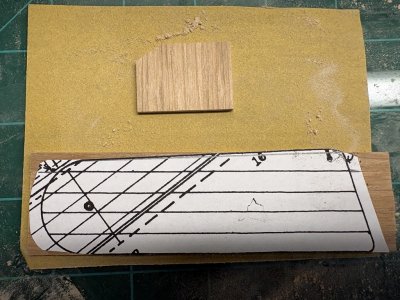
Yesterday I milled some wood for the leeboard and the rudder. The leeboard is made from 5 strips 1/4" wide and 3/32" thick. The rudder is made from 6 strips 3/16" wide and 1/16" thick. Strip, slightly longer than required were edge glued, set on a glass sheet (along with waxed paper) and weighted while they dried. Surfaces of the blanks were lightly sanded before final shaping.

1777679661832.jpeg

The exterior shape of the rudder was formed using my small table saw. The straight edges of the leeboard were also cut on the table saw, but the curved profile was formed using an oscillating sander. A disk sander would have worked well also, if power tools are being used. Otherwise hand tools could certainly be used to cut and shape the profile. In the picture below you can see that I attached a photocopy of the leeboard to its blank - this was done using rubber cement.

1777679758401.jpeg

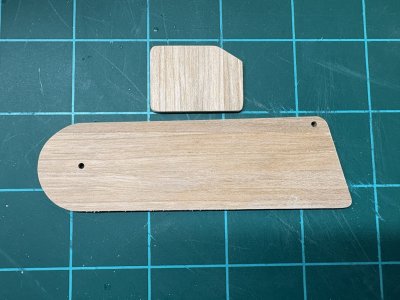
Once the leeboard was shaped, I drilled two holes - one for the pivot bolt and one for the lifting tackle. The paper template was peeled off and any remaining rubber cement was rubbed off. To finish, I lightly sanded the edges of the rudder and leeboard.

1777680079017.jpeg

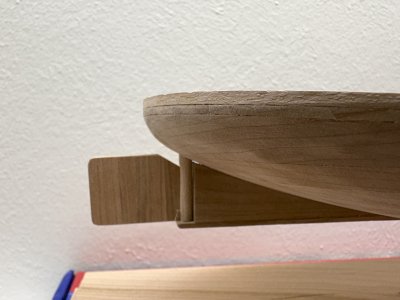
The rudder post was turned from cherry wood to match the rest of the model. It is a just a dowel with diameter slightly less than 3/16". I milled a slot in the lower portion of the rudder post to accept the rudder. Here is a picture of the rudder and rudder pos being test fit:

1777680424174.jpeg

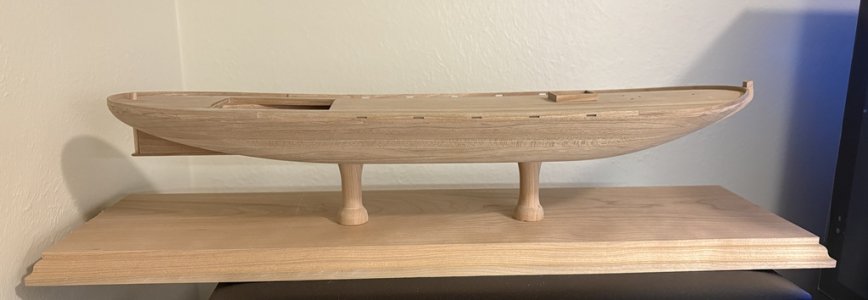
Additionally, I chose a display option for the model. It will be placed a pair of pedestals attached to a display board - these were also made of cheery wood. The pedestals are relatively high so that the leeboard can be extended downward below the hull.

1777680849252.jpeg
 
I'm not sure how to model that material so it has some texture and looks / matches well with the rest of the model. I have read that some people have had success using a high grit wet/dry sandpaper for this purpose...

i have sandpaper up to 5,000 grit and i think it goes all the way to 10,000 grit. The fine grit does look like rolled asphalt
 
Back
Top