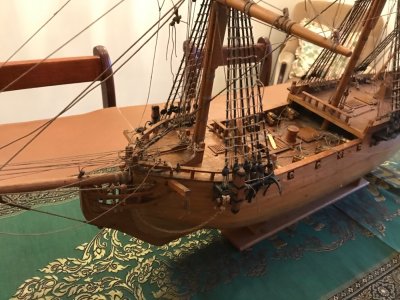
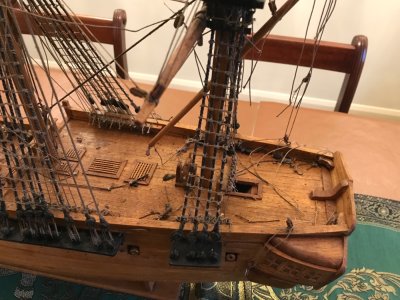
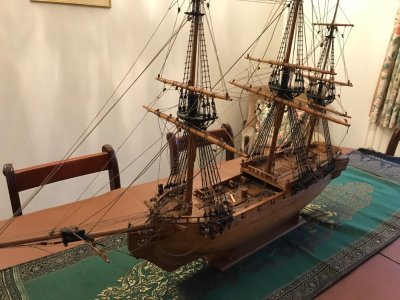
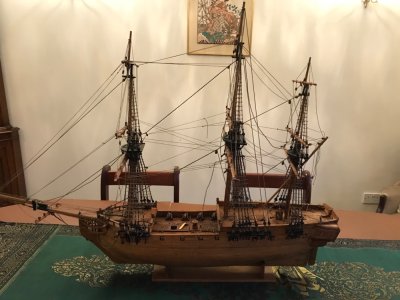
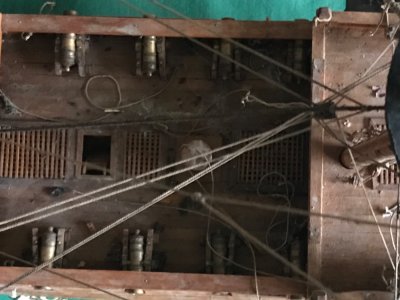
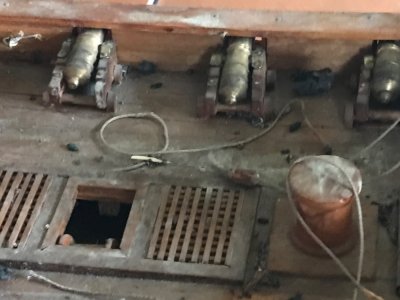
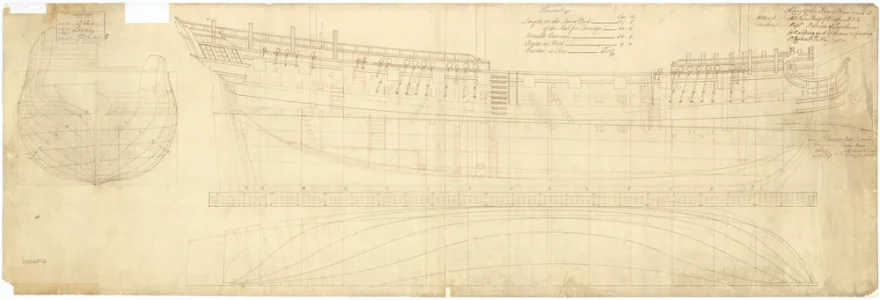
If the model in question was built by "a model builder for the museum" at Bucklers Hard, Gerald Wingrove may be spinning in his grave.

That's no reflection on either the museum or the model's builder. Sometimes museums can't gracefully refuse gifts from those with close connections to the institution. These legacy donations are often relegated to the back corners of storage facilities, only to be "rediscovered" decades later, separated from any documentation of the acquisition. The interesting thing about it is that these "barn finds" sometimes turn out to be rather interesting for one reason or another after they've had time to "age" in the warehouse.
While it may be seen as an embarrassment were it considered an exemplar of the identified model builder's skill, the modeler should not be judged on the basis of a single model. Sometimes the quality of a modeler's output varies for any number of understandable reasons. I once built a (alleged) model of Drakes
Golden Hind with my then nine-year-old daughter and her classmate for a school project. As such things go, the four-foot-long model had a hull made of plaster of Paris over an armature of wire coat hangers and metal window screen (similar to full scale ferrocement hull construction,) untapered dowel masts and yards, popsicle stick laid decks, cardboard deck furniture, old bedsheet sails, sisal twine rigging well fastened with a hot melt glue gun and all painted with liberal amounts of poster paint. Much to my surprise, the kids' school was inordinately impressed and placed it on "permanent exhibit" in the school library! It's too bad that that was before there was such a thing as social media. Had we posted it online, I'm sure it would have gotten rave reviews and a record number of "likes."

Neither can we harshly judge the museum at Buckler's Hard for considering ship models of the instant example's qualities, or lack thereof, part of its collection. The days of museums exhibiting collections of ship models and other artifacts presented for studious examination seem to be near-universally over these days. It's all become "interactive" in the museum business. Buckler's Hard, which I've never visited, appears to be an "historic theme park," much like Jamestown or Mystic Seaport in the U.S. It's an "immersive experience" in a "period village setting" where visitors can see the baker's shop, the blacksmith's shop, milliner's shop, and so on, interpreted by docents in period dress. The focus is on tableaux displays full of department store mannikins dressed in period clothes, audio recorded guide narratives, and so on. Buckler's Hard certainly looks like a place an 18th century ship model afficionado would enjoy visiting, but the ship models there clearly have to compete with the "butcher, baker, and candle stick maker" exhibits. It calls to mind the grief experienced by the staff of the San Francisco Maritime Museum when the previously private institution was "absorbed" into the Golden Gate National Recreation Area as the San Francisco Maritime National Historic Park and they found themselves having to explain the insistent ongoing maintenance requirements of a fleet of wooden ships to the new NPS curatorial management whose last job was cataloging pueblo indian pottery fragments in the arid Southwest.