
-

SUBSCRIBE TO SHIPS IN SCALE TODAY!
The beloved Ships in Scale Magazine is back and charting a new course for 2026!
Discover new skills, new techniques, and new inspirations in every issue.
NOTE THAT OUR NEXT ISSUE WILL BE July/August 2026 -

Win a Free Custom Engraved Brass Coin!!!
As a way to introduce our brass coins to the community, we will raffle off a free coin during the month of August. Follow link ABOVE for instructions for entering.


You are using an out of date browser. It may not display this or other websites correctly.
You should upgrade or use an alternative browser.
You should upgrade or use an alternative browser.
Hi All, has anyone built a model of Billings boats "Cutty Sark. I'm a little bit stuck on the planking side in terms of completing as there is a bow/c

Welcome to SoS Gary!
When you say plank on plank, do you mean the hull has two layers of planking? If it does, the first layer will obviously be covered so less to worry about. Regarding the bowing, the sheer of the hull planking was different than the sheer of the deck lines so the bowing was more obvious. Keep in mind that the breadth of the planks was reduced fore and aft from the dead flat so the frames/bulkheads need to be lined off to know the width of each plank at each frame. The planks were not the same width from stem to post. There are planking expansion drawings from RMG posted here at SoS that explain it better than words and a lot of posts on how to plank a hull properly that could be of help. Then again, if the hull is to be painted over, there is a lot more leeway on how you do it,
Allan
When you say plank on plank, do you mean the hull has two layers of planking? If it does, the first layer will obviously be covered so less to worry about. Regarding the bowing, the sheer of the hull planking was different than the sheer of the deck lines so the bowing was more obvious. Keep in mind that the breadth of the planks was reduced fore and aft from the dead flat so the frames/bulkheads need to be lined off to know the width of each plank at each frame. The planks were not the same width from stem to post. There are planking expansion drawings from RMG posted here at SoS that explain it better than words and a lot of posts on how to plank a hull properly that could be of help. Then again, if the hull is to be painted over, there is a lot more leeway on how you do it,
Allan


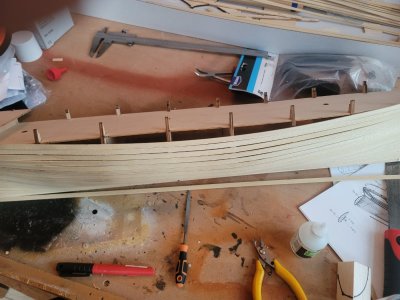
Welcome aboard from Connecticut. It is a bit difficult ro diagnose the problem with just one picture. If you include more of the hull it would be better. From what I see, I agree with Allan that the planks need to be tapered at the ends. Planking is one of the mysterious processes of ship building and much has been written. Here is one area you may want to study.
 modelshipworld.com
There are also many articles on this site and many you tube videos that help.
It also pays to bevel one edge of the length of the plank as it abuts the previous plank and curves up the hull.
As Allan stated if this is a double planked hull you are probably ok, if you do the second planking using some of the above techniques. If not you may have to take off some of the planking and refine your technique. If you used water based (PVA) glue you can soak the joins with water and it should separate. If you used CA I believe acetone or toluene may help.
If you do not want to do that you can try using wood filler (I like Elmers).
Rob
Planking Downloads and Tutorials and Videos
modelshipworld.com
There are also many articles on this site and many you tube videos that help.
It also pays to bevel one edge of the length of the plank as it abuts the previous plank and curves up the hull.
As Allan stated if this is a double planked hull you are probably ok, if you do the second planking using some of the above techniques. If not you may have to take off some of the planking and refine your technique. If you used water based (PVA) glue you can soak the joins with water and it should separate. If you used CA I believe acetone or toluene may help.
If you do not want to do that you can try using wood filler (I like Elmers).
Rob

Hello and welcome to the forum, from NY

- Joined
- Sep 23, 2021
- Messages
- 375
- Points
- 238

Apologies, forgot to introduce myself. I'm Gary and although I've built a number of model ships, this is my first plank on plank model
View attachment 587969
Hi Gary,
I'm currently building this model from a vintage kit, see my log here < Cutty Sark build > . It has become more of a kit bash now rather than following Billing's plans.
It is definitely one of the worst hulls I have had to plank!
Planking the hull was very hard because the frames are set too far apart resulting in the planks either bowing in or out. I decided to fill the frames with some modelling foam which helped enormously. It looks like you have past that option, so I suggest to bend the planks as close to the hull line as possible with a plank bending tool or plank heater and trim the plank width down at the bow and stern so that the planks snug up as much as possible. I did not nail my planks and used lots of crocodile and bulldog clips to hold the planks together and to the frames while the glue set (use lots of glue!). Even after that, I still had to spend a lot of time filling and sanding in order to refine the shape.
As I work my way through the build I am including lots of historical information and pictures from a visit to the ship at Greenwich in my log which you may find useful to refer to. There are is another build of this model on the go by Harbour Hulk < HH Billing Build > where you may also find some useful hints and tips.
Good Luck!
Dom
This is probably the video that Terry is suggesting
Rob
Rob

Hi Gary,
I built this kit many years ago (but failed to finish). I am currently completing the planking on the Billings Cutty Sark 1:75 and found a range of information as described by others on this site. What I think you may have done is placed full-size planks from the keel upwards. I followed guidelines found elsewhere on the site that entailed commencing from the keel for around 2-3 planks and then reverting to the deckline and placing 2-3 there, always placing planks on both sides to prevent warping of the keel.
Essentially, this will eventually lead to a curved gap to fill in the mid-region. However, it is necessary on all planks to shave both ends to enable the best fit to follow the natural shape of the frame ribs (albeit after fairing the fore and aft ribs to allow the planks as much material to lay flat against (due to the curve).
Hope this helps, though with the proviso that I am pretty much a novice at this stuff.
I built this kit many years ago (but failed to finish). I am currently completing the planking on the Billings Cutty Sark 1:75 and found a range of information as described by others on this site. What I think you may have done is placed full-size planks from the keel upwards. I followed guidelines found elsewhere on the site that entailed commencing from the keel for around 2-3 planks and then reverting to the deckline and placing 2-3 there, always placing planks on both sides to prevent warping of the keel.
Essentially, this will eventually lead to a curved gap to fill in the mid-region. However, it is necessary on all planks to shave both ends to enable the best fit to follow the natural shape of the frame ribs (albeit after fairing the fore and aft ribs to allow the planks as much material to lay flat against (due to the curve).
Hope this helps, though with the proviso that I am pretty much a novice at this stuff.

Welcome Gary to the forums and greetings from Texas! Magic Mike
- Joined
- Sep 23, 2021
- Messages
- 375
- Points
- 238
Hi again,Apologies, forgot to introduce myself. I'm Gary and although I've built a number of model ships, this is my first plank on plank model
View attachment 587969
I had to read my log to remind myself of what I did! If you look at Part 5 of my log you can see what I did, and what not to do. The best way is to use some paper strips laid on each frame and mark off the length from the deck level to the keel. The largest measurement will be at the centre of the hull (frame 6), divide that length by the width of the planks, that tells you exactly how many planks you need to fill the hull. You can then divide the measurements at each of the other frames by that number which gives you what the width of the planks at that frame needs to be to fit into the space. Mark off the planking strips with the frame spacing and then mark the width of the plank at each frame from the bottom edge of the strip. Draw a line joining all the marks and then trim the strip. If all is correct, the planks will fit together neatly.
Dom