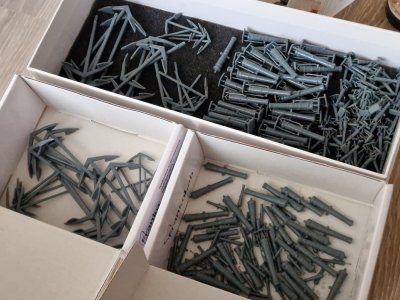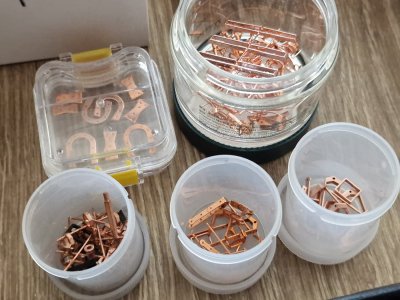


- Joined
- Jul 20, 2022
- Messages
- 81
- Points
- 143

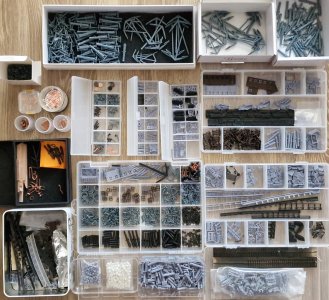
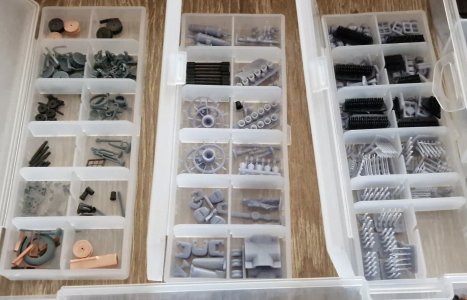
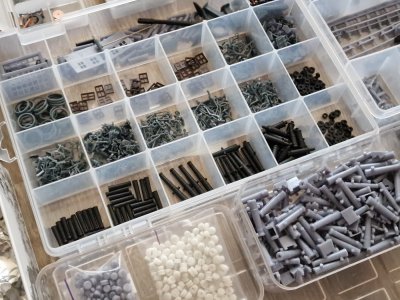
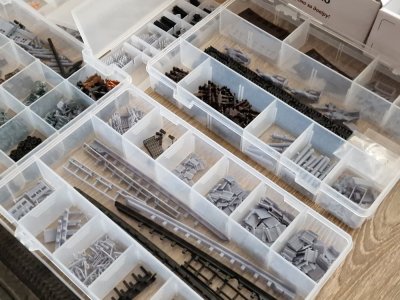
Je n'ai jamais réussi à imprimer plus finement. Au-delà, ça casse.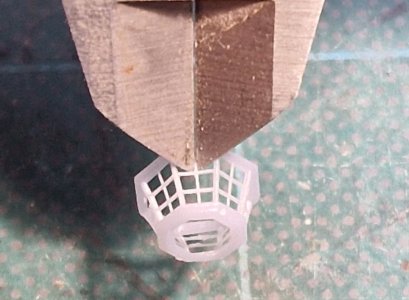
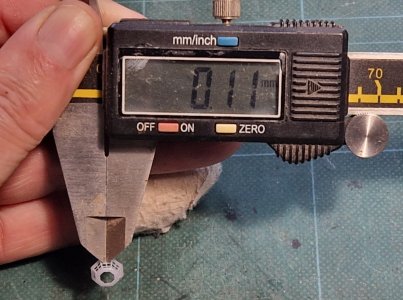

 |
The beloved Ships in Scale Magazine is back and charting a new course for 2026! Discover new skills, new techniques, and new inspirations in every issue. NOTE THAT OUR NEXT ISSUE WILL BE July/August 2026 |
|
 |
As a way to introduce our brass coins to the community, we will raffle off a free coin during the month of August. Follow link ABOVE for instructions for entering. |
|



So, this morning, I drew a belaying pin in Fusion 360 totally freehand, not to any spec. Just eyeballed it. I can add accuracy and detail later. I then created and STL file of the pin and took it into my 3D Slicer. (Anycubic Workshop). I scaled the pin to 30mm and then scaled another down to 4mm and put them side by side. They would print. Maybe after I try doing a couple of different replicas of pins and scaled them to a few different sizes, I might try printing some and see what happens. I would choose a resin that is tough and can create detail - most likely Craftsman DLP resin (it has an amount of ceramic in it too). There are other resins that would provide flexibility and toughness too.I think they would print ok with a decent resin printer.
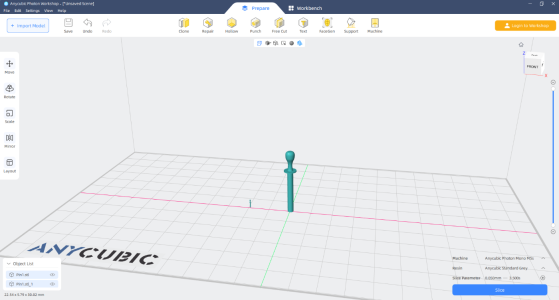
I wonder how many you can print at the same time? That would be something to look at, I think.So, this morning, I drew a belaying pin in Fusion 360 totally freehand, not to any spec. Just eyeballed it. I can add accuracy and detail later. I then created and STL file of the pin and took it into my 3D Slicer. (Anycubic Workshop). I scaled the pin to 30mm and then scaled another down to 4mm and put them side by side. They would print. Maybe after I try doing a couple of different replicas of pins and scaled them to a few different sizes, I might try printing some and see what happens. I would choose a resin that is tough and can create detail - most likely Craftsman DLP resin (it has an amount of ceramic in it too). There are other resins that would provide flexibility and toughness too.View attachment 500928
I need to sit down and see what I can do with it. Right now it`s in a box collecting dust...Until I win a lottery I’ve given up on that. I bought a budget handheld model last year but sold it on within a few months. Nowhere near sophisticated enough for our game. I imagine pro-quality gear does a better job but suspect you would still need to put in many hours converting the scan if dimensional accuracy mattered (which it did for me).
I wonder how many you can print at the same time? That would be something to look at, I think.
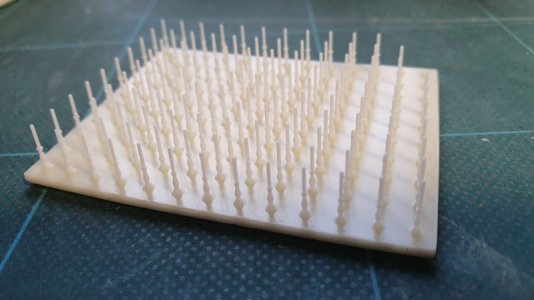
a bunch! and I would probably print a range of sizes.I wonder how many you can print at the same time? That would be something to look at, I think.
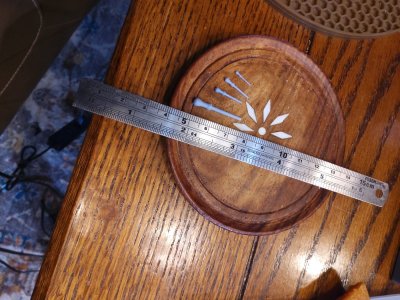
I wanted to come back to this. Parts can shrink and deform both during printing and post-processing. In my experience, most of the shrinkage occurs during printing and, if dimensional accuracy is critical, you need to play with the xyz scale settings in your slicer once you know, from a test print, what's happening. Be aware that shrinkage is not necessarily uniform, it depends on factors such as the object shape and design, orientation on the print plate, nature and extent of supports, even resin temperature, so you may need to make different adjustments for each axis. And of course this can have you chasing your tail.When I printed them, the problem was not in the printing itself, but in the fact that if the thickness of the part is 0.1-0.2 mm, it can deform and bend during the final processing (while raw) and break (after exposure), so you need to intentionally slightly increase some parts for reinforcement and for banal visualization, since very small details will not be visible on the model.
I find that calibration for each resin helps. These boxes were printed at 2X and as you can see, they're dimensionally stable. They have been washed and cured.I wanted to come back to this. Parts can shrink and deform both during printing and post-processing. In my experience, most of the shrinkage occurs during printing and, if dimensional accuracy is critical, you need to play with the xyz scale settings in your slicer once you know, from a test print, what's happening. Be aware that shrinkage is not necessarily uniform, it depends on factors such as the object shape and design, orientation on the print plate, nature and extent of supports, even resin temperature, so you may need to make different adjustments for each axis. And of course this can have you chasing your tail.
I have found that it is best to process thin section prints immediately after the print sequence has completed. Leaving ultra-thin things to sit on the plate for a couple of hours, perhaps as a way of letting the wet resin drain off, can lead to distortion. Even the breeze from the printer fan can cause thin sections of wet resin to deform.
Parts can also deform during cleanup. I do my IPA wash sequence while the parts are still attached to the plate. Small parts are bound to get damaged if they are rattling around in the cage. It also cleans up the plate for later use.
I mix resins to try to get the properties I most need for a part. Typically, I mix standard resin with ABS-like to get more rigidity but still with enough flex. I find standard resin is usually too brittle and elegoo ABS is too bendy, but a blend gives a nice result. Ultra-fine parts are always going to be very fragile though. For window bars or lattices, adding 'glass' can help.
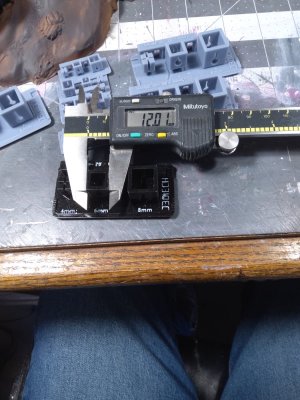
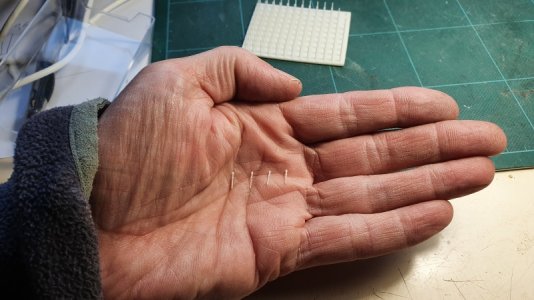
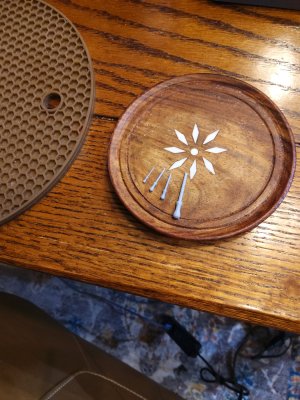
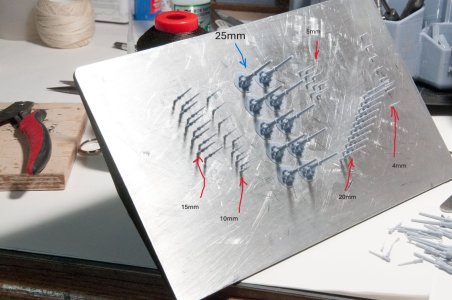
So I redrew a pin then printed a few. I took a few pictures with my SLR camera and will work on those tomorrow. But I grabber a couple of pics with this Galaxy tablet. Show here. I started with 25mm, then down to 20, 15, 10 5 and even 4mm. In keeping with scale tge 4 and 5mm pins are very small and the pins themselves, to scale are about as thick as a human hair. I do't know how you would ever wrap rigging around such a tiny pin. These pics do not show the smallest
Printed a few in different sizes. size was adjusted in my slicer by changing the scale. The slicer allows me to change scale while maintaining proportionality in all 3 axis if I so choose. I printed 25, 20, 15, 10 5, and 4mm's. One picture shows the belaying pins as printed on the build plate, the other pictures removed from the plate and photographed. Note: while I did print at least 10 each, not many of the 4mm and 5mm pins survived the scraping off the build plate. I can change the exposure times to make them more robust (rigid) but this run is only a test to see what happens. I think that when needed to print the very small sizes (5mm or less) it might be better to print the entire pin rail with pins installed as one piece. And I cannot imagine needed to actually rig to the smaller pins on a model while using the smallest pins to actually secure the ropes. Let me know what you think.So I redrew a pin then printed a few. I took a few pictures with my SLR camera and will work on those tomorrow. But I grabber a couple of pics with this Galaxy tablet. Show here. I started with 25mm, then down to 20, 15, 10 5 and even 4mm. In keeping with scale tge 4 and 5mm pins are very small and the pins themselves, to scale are about as thick as a human hair. I do't know how you would ever wrap rigging around such a tiny pin. These pics do not show the smallest pins - I'll show them here tomorrow.View attachment 501155View attachment 501156
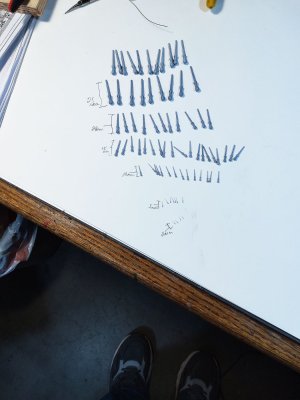
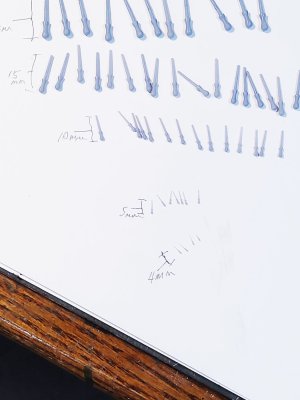

Thanks for the advice. I already figured it all out through trial and error, but thanks anyway.I wanted to come back to this. Parts can shrink and deform both during printing and post-processing. In my experience, most of the shrinkage occurs during printing and, if dimensional accuracy is critical, you need to play with the xyz scale settings in your slicer once you know, from a test print, what's happening. Be aware that shrinkage is not necessarily uniform, it depends on factors such as the object shape and design, orientation on the print plate, nature and extent of supports, even resin temperature, so you may need to make different adjustments for each axis. And of course this can have you chasing your tail.
I have found that it is best to process thin section prints immediately after the print sequence has completed. Leaving ultra-thin things to sit on the plate for a couple of hours, perhaps as a way of letting the wet resin drain off, can lead to distortion. Even the breeze from the printer fan can cause thin sections of wet resin to deform.
Parts can also deform during cleanup. I do my IPA wash sequence while the parts are still attached to the plate. Small parts are bound to get damaged if they are rattling around in the cage. It also cleans up the plate for later use.
I mix resins to try to get the properties I most need for a part. Typically, I mix standard resin with ABS-like to get more rigidity but still with enough flex. I find standard resin is usually too brittle and elegoo ABS is too bendy, but a blend gives a nice result. Ultra-fine parts are always going to be very fragile though. For window bars or lattices, adding 'glass' can help.
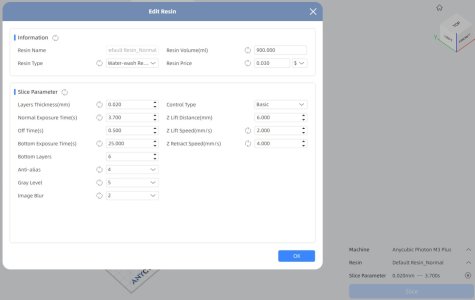
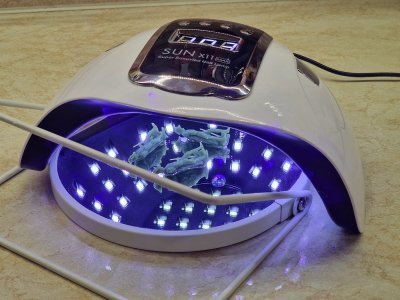
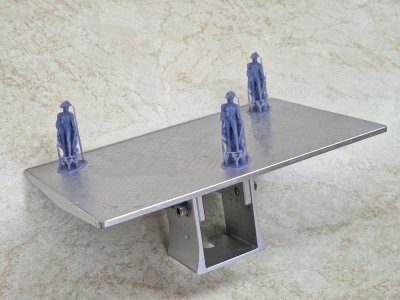
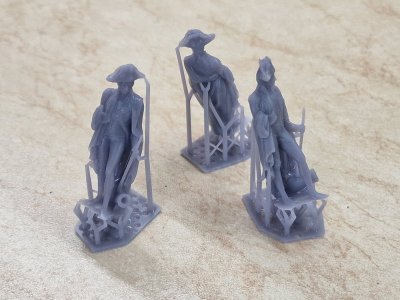
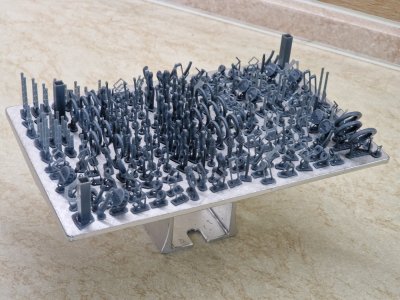
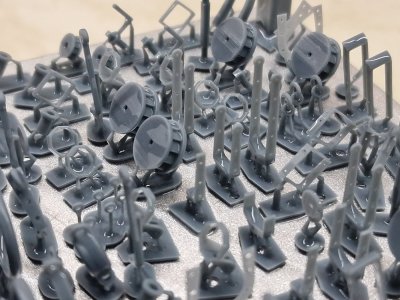
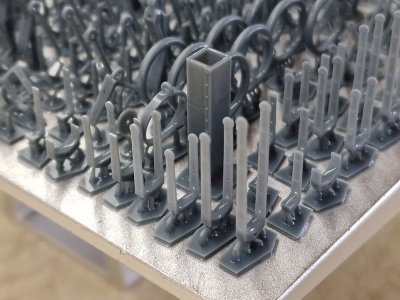
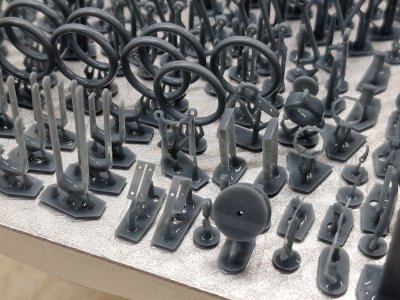
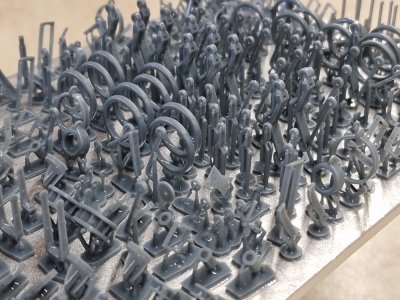
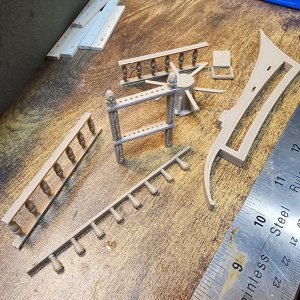
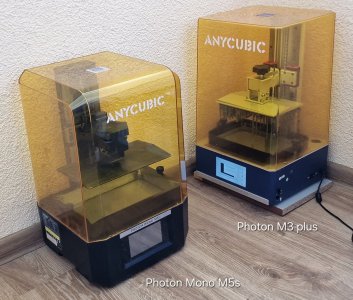
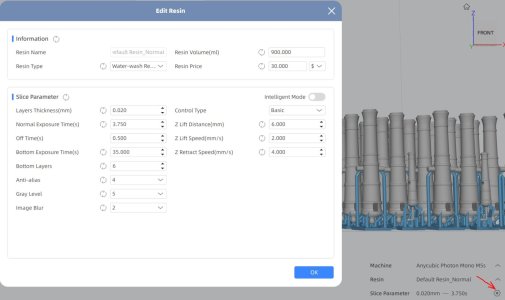
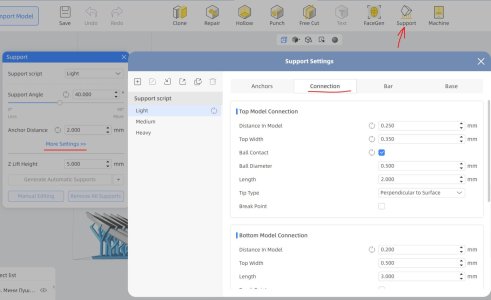
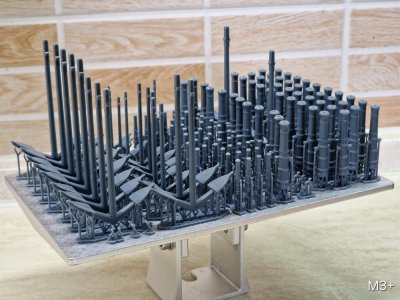
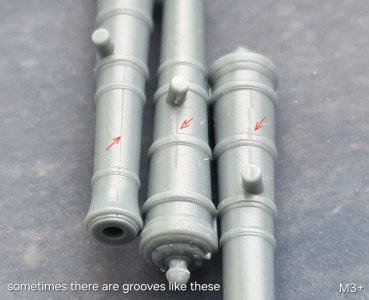
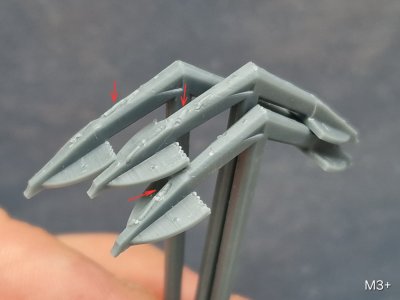
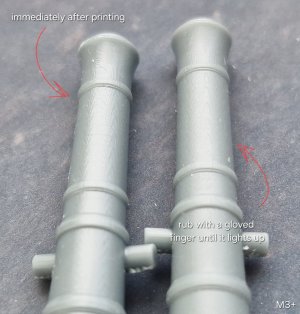
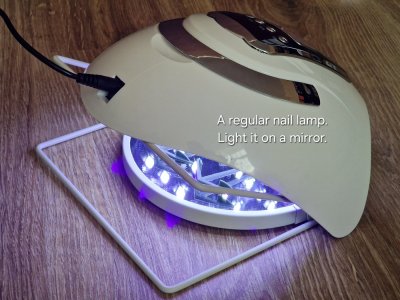
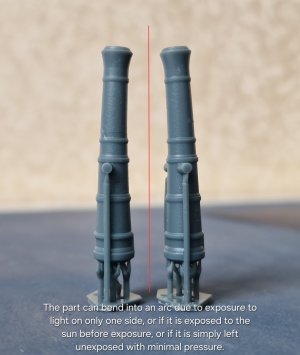
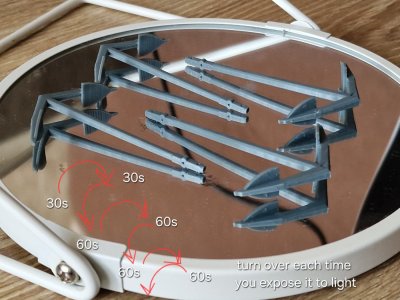
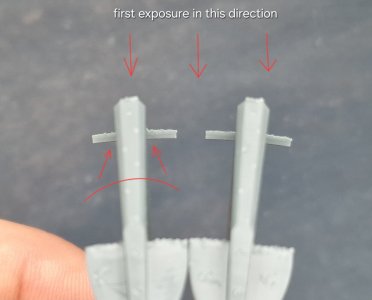
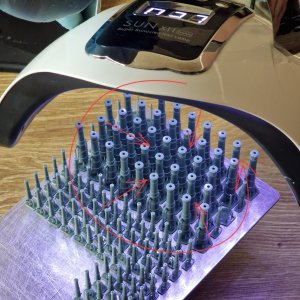
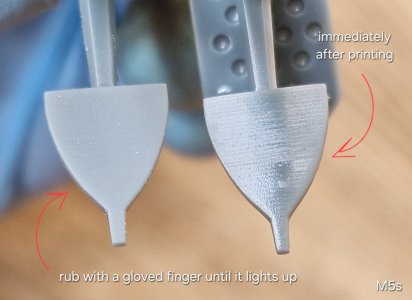
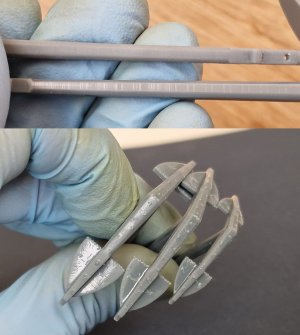
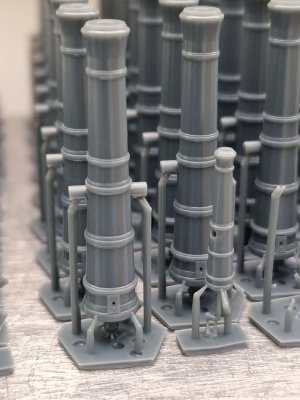
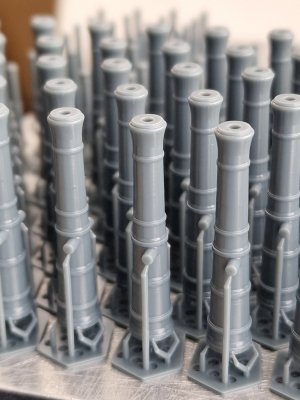
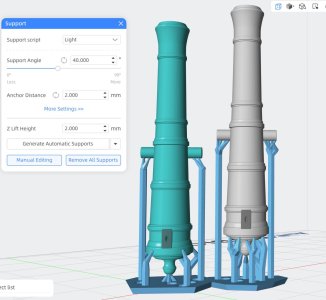
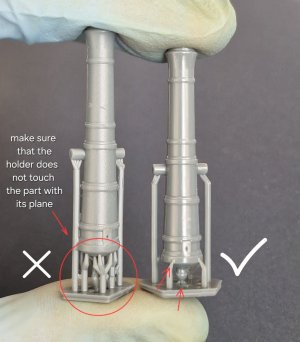
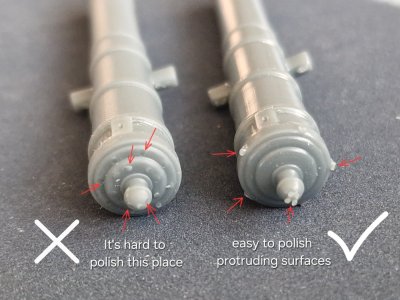
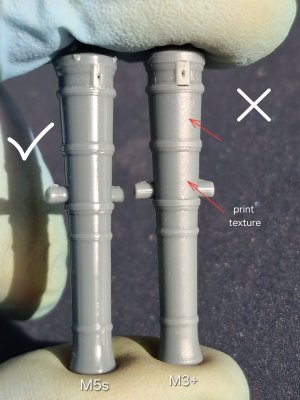
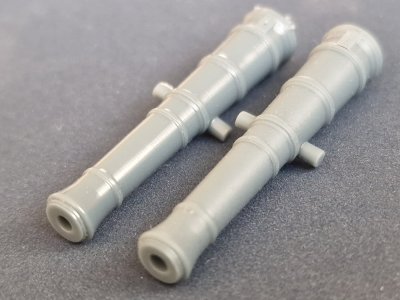
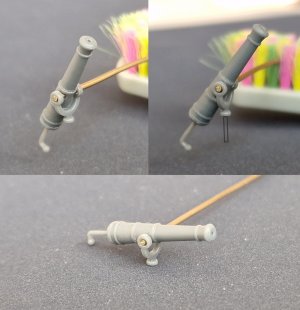
 . My problem is that I pay less than a US$ for a 3D printed cannon barrel, including shipping. The last ones were for 1:64 scale guns. With a machine that costs over $600, I would need to build six first rates to recoup my investment and that will likely never happen.
I understand. But I got both printers for free. Whenever we buy a new one at work, I keep the old one. Now I have two. And I'm saying that you can safely buy a used one and it won't be that expensive. But for copper plating, I need a lot of blanks, so having a printer is a must for me. And if you're painting the parts, then naturally buying a printer isn't always wise if you can find parts cheaply somewhere.Great post!!! Your results are superlative. Now if you can offer to provide all the 3D drawings I might convince myself to look at the payback versus buying them.
Thanks again for your report and explanations, this was great to see!
Allan