

• SUBSCRIBE TO SHIPS IN SCALE TODAY!

    The beloved Ships in Scale Magazine is back and charting a new course for 2026!
    Discover new skills, new techniques, and new inspirations in every issue.

    NOTE THAT OUR NEXT ISSUE WILL BE July/August 2026
  • Win a Free Custom Engraved Brass Coin!!!
    As a way to introduce our brass coins to the community, we will raffle off a free coin during the month of August. Follow link ABOVE for instructions for entering.

Kunstvolle Modelle

Alterung und Verwitterung

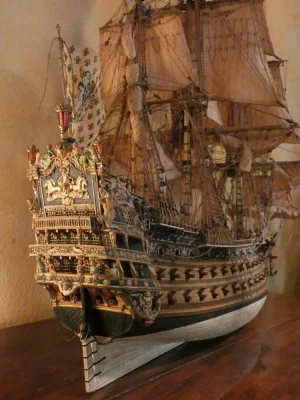
Hier habe ich vorbildlich ein wunderschönes Schiffsmodell. Ich denke, dass nur wenige Modellbauer ein so herausragendes Arbeitsergebnis erzielen. Ich denke, das ist die hohe Kunst der Ausstrahlung. In Ruhe dieses Modell betrachten und immer wieder neues entdecken. Auch ohne aufwendige Schnitzereien eine prachtvolle Darstellung und beste Anschauungsvorlage.
Ich kenne den Erbauer nicht und habe das Bild bei Pinterest entdeckt. Viel Freude wünsche ich Euch Mitgliedern .

Beste Grüße Holger

9450d73ef09388cfba4fac19b4513728.jpg

8ec974c93c43f1b72d0fc2de57341362.jpg
 
Last edited:
Weathering and Aging of Plastic Ship Models

Before I began building Heller’s 1:100 scale *Le Soleil Royal* (a project spanning the years 2007 to 2009), I spent four years intensively studying numerous books on historical seafaring and the construction of historical ship models, focusing primarily on the 17th through 19th centuries. It was an incredibly interesting and educational experience.
At the time, my goal was to make the model as realistic as possible, within the limits of my abilities. It was my first model at such a large scale, and I wanted it to be something truly special.
By the time the plastic hull was ready for painting, I already had a clear idea of how I wanted to replicate the wood grain.
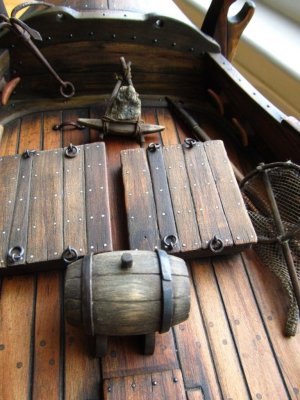
It took a good deal of courage to actually put this plan into action. I intended to paint the wood grain using a custom-mixed sand-yellow shade (I still use Revell oil paints today, particularly for painting figures). Once the sand-yellow base coat had dried, I shaded the surface contours with a dark pencil. It already looked quite promising.
The next step, however, was the crucial one. I applied a thin layer of dark brown antique wax with a brush and blended it. Then, I carefully passed the flame of a lighter over the waxed areas—a process requiring a delicate touch—working quickly and with great concentration, while simultaneously wiping away the areas touched by the flame with the brush. Finally, I ran my finger over the surface.
The result of this technique was surprisingly good; I was very pleased with it.
A quick tip: It is best to test this technique on a scrap piece first. If you hold the flame over a spot for too long, it becomes too dark; In this case, the area can be carefully sanded down again. I still occasionally use this technique on wooden blocks or anchor beams to achieve a specific effect.
By and large, however, this can also be achieved through painting—provided one has mastered that artistic skill. Visitors who have seen the model at my place always assumed it was an exquisitely crafted wooden ship model. For me, model building means pouring my heart and soul into the work, because the joy it brings lasts a lifetime.
I hope this post is helpful.

Best regards, Holger


Übersetzt mit DeepL.com (kostenlose Version)

1769371375_697676ef026ff (1).webp

1769371380_697676f4615e6.webp
 
Last edited:
Back
Top