Thanks, Jim! And to you as well! And best wishes for an enriching Pesach to you and your family!

 |
The beloved Ships in Scale Magazine is back and charting a new course for 2026! Discover new skills, new techniques, and new inspirations in every issue. NOTE THAT OUR NEXT ISSUE WILL BE July/August 2026 |
|
 |
As a way to introduce our brass coins to the community, we will raffle off a free coin during the month of August. Follow link ABOVE for instructions for entering. |
|
Thanks, Jim! And to you as well! And best wishes for an enriching Pesach to you and your family!


Happy Easter, Dirk. Your cautious review is most welcomeHappy easter ... and, yeah it looks quite ok what you are doing there :-D
 .
.
Thanks for that, Shota. I hope your Passover has been a blessing to you and your family!Happy Easter, my dear friend
Thanks, Brad. Happy Easter to you as well!Happy Easter to all!
Nice jig for the mortise joints! I'm sure it will help many of us as we work on beams!
Brad

Again a very nice outcome of this floor, Paul. Your demonstrated method with a useful tool has certainly helped you make this 148 recesses and 22 dovetails in those 12 beams. (If I have counted correctly) Yes, I do like ‘numbers’.Oops, I meant to post this last night but failed the part where you hit: Post reply...
Hello friends,
Part 1
I rarely post techniques or 'how-to' notes. I think there are people much better suited for that sort of thing. Even after more than five years of wooden ship modeling, I consider myself more of a learner than a teacher.
But I came up with a clamping jig for cutting mortices in deck beams and I am rather happy with it, so I'll show you what I made.
My set up begins with the small Proxxon mill and compound table. When I purchased the mill I also added a few accessories - including a machine vice which can be bolted to the compound table.
I fabricated a very simple jig that fits on the machine vice. It includes some clamping battens to hold the beam in place. I rounded the end of these to avoid introducing torque as the beams have a camber and do not sit perpendicular to the mill along their length. The wider battens are for beams - the narrower battens are for short pieces like carlings (I added these after-the-fact once I realized my first ones were too far apart to use for short pieces).
View attachment 589919
In order to connect the jig to the vice I added a housing on the underside. These housings fit the respective members of the vice very (very) snuggly:
View attachment 589918
I simply lay the beam on its side and mill in the mortice. But now, rather than moving the compound table to the next mortice I just loosen the vice - slide the beam to the next mortice location - tighten the vice - and mill away.
Here is a short (2 minute) video showing this in action:
That's four, perfect, identical mortices in two minutes. Much faster than I can do them by hand using chisels - and much faster than I can do them if I have to turn the tiny wheels of the compound table over the length of the beam. This approach also keeps the cutting action at right angles to the top of the beam (that will only make sense if you have ever cut mortices into curved pieces that are taped to the full length of the compound table).
I'm sure others have their own preferred approach to cutting pockets into beams, so I make no claims of superiority. And I suppose CNC milling would do this even more precisely - but this is a pretty usable solution.
Part 2
In the words of Yogi Berra: it's déjà vu all over again...
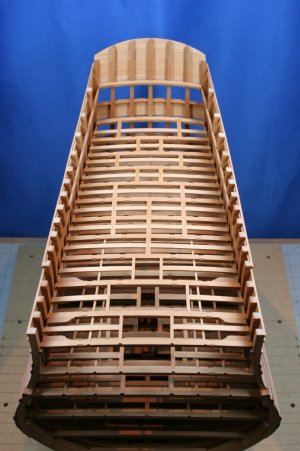
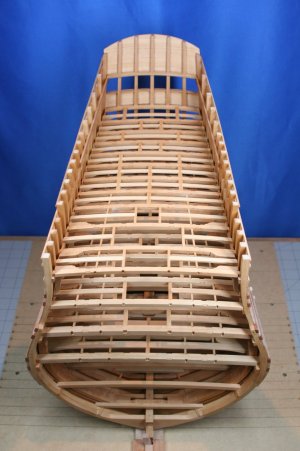
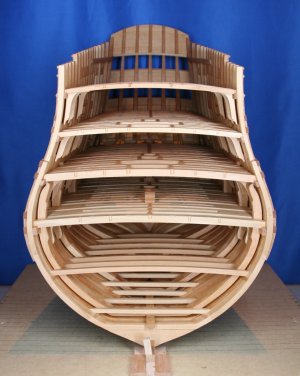
The beginnings of the quarterdeck:
View attachment 589920
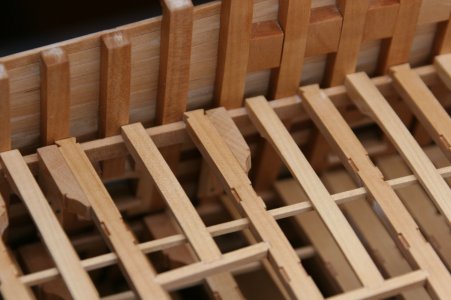
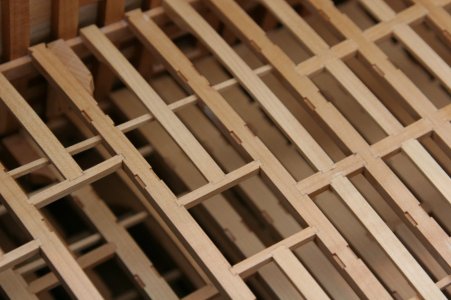
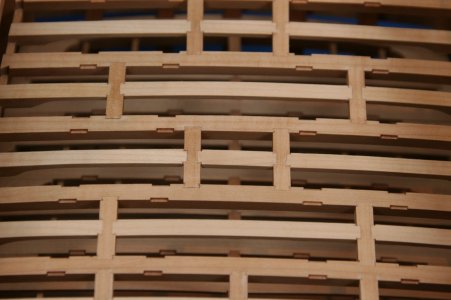
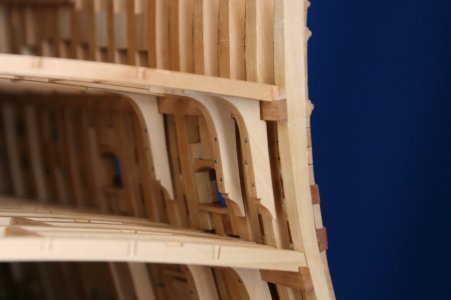
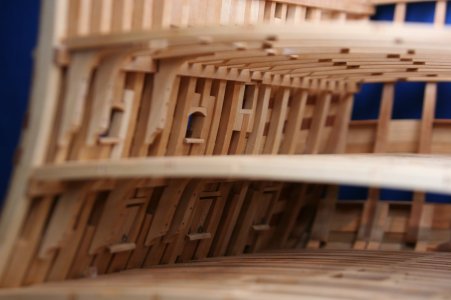
The quarter deck adds a new twist... the joinery (joint) between the deck beams and the deck clamp on the first, second, and third decks was a blind dovetail. With the quarter deck the dovetail remains visible:
View attachment 589921
My very best wishes to all of you this Easter.
And for those of you who approach this season with hearts and minds of faith: He is Risen!
View attachment 589922

Good morning Paul. A very informative log and video. Doesn’t help one bitOops, I meant to post this last night but failed the part where you hit: Post reply...
Hello friends,
Part 1
I rarely post techniques or 'how-to' notes. I think there are people much better suited for that sort of thing. Even after more than five years of wooden ship modeling, I consider myself more of a learner than a teacher.
But I came up with a clamping jig for cutting mortices in deck beams and I am rather happy with it, so I'll show you what I made.
My set up begins with the small Proxxon mill and compound table. When I purchased the mill I also added a few accessories - including a machine vice which can be bolted to the compound table.
I fabricated a very simple jig that fits on the machine vice. It includes some clamping battens to hold the beam in place. I rounded the end of these to avoid introducing torque as the beams have a camber and do not sit perpendicular to the mill along their length. The wider battens are for beams - the narrower battens are for short pieces like carlings (I added these after-the-fact once I realized my first ones were too far apart to use for short pieces).
View attachment 589919
In order to connect the jig to the vice I added a housing on the underside. These housings fit the respective members of the vice very (very) snuggly:
View attachment 589918
I simply lay the beam on its side and mill in the mortice. But now, rather than moving the compound table to the next mortice I just loosen the vice - slide the beam to the next mortice location - tighten the vice - and mill away.
Here is a short (2 minute) video showing this in action:
That's four, perfect, identical mortices in two minutes. Much faster than I can do them by hand using chisels - and much faster than I can do them if I have to turn the tiny wheels of the compound table over the length of the beam. This approach also keeps the cutting action at right angles to the top of the beam (that will only make sense if you have ever cut mortices into curved pieces that are taped to the full length of the compound table).
I'm sure others have their own preferred approach to cutting pockets into beams, so I make no claims of superiority. And I suppose CNC milling would do this even more precisely - but this is a pretty usable solution.
Part 2
In the words of Yogi Berra: it's déjà vu all over again...
The beginnings of the quarterdeck:
View attachment 589920
The quarter deck adds a new twist... the joinery (joint) between the deck beams and the deck clamp on the first, second, and third decks was a blind dovetail. With the quarter deck the dovetail remains visible:
View attachment 589921
My very best wishes to all of you this Easter.
And for those of you who approach this season with hearts and minds of faith: He is Risen!
View attachment 589922
 . Us merely mortals need a how to for a chisel blade and ruler….…. Jokes aside -4 perfect deck structures. (Well three and a half). I don’t know if you guys in USA celebrate family day today. If you do have a good one. Cheers Grant
I now wish I didn't know the numbersAgain a very nice outcome of this floor, Paul. Your demonstrated method with a useful tool has certainly helped you make this 148 recesses and 22 dovetails in those 12 beams. (If I have counted correctly) Yes, I do like ‘numbers’.
Regards, Peter
. As Grant would say: eish!
Thanks, Grant. We did have a great day with family yesterday!Good morning Paul. A very informative log and video. Doesn’t help one bit

Your patience and attention to detail is… Hmm, I don’t have the right word but staggering comes to mind.
....................speechless!!
Thanks, guys! And to everyone for the likes!Witaj
Tylko jedno słowo Pawle piękny. Pozdrawiam Mirek

Thanks, Albert! I really do enjoy this hobby - I'm pleased to learn that my work is well-received.Just a few models, even a kit, and here you are in the ship modeling empyrean. Respect!