


• Win a Free Custom Engraved Brass Coin!!!
    As a way to introduce our brass coins to the community, we will raffle off a free coin during the month of August. Follow link ABOVE for instructions for entering.
  • PRE-ORDER SHIPS IN SCALE TODAY!

    The beloved Ships in Scale Magazine is back and charting a new course for 2026!
    Discover new skills, new techniques, and new inspirations in every issue.

    NOTE THAT OUR FIRST ISSUE WILL BE JAN/FEB 2026

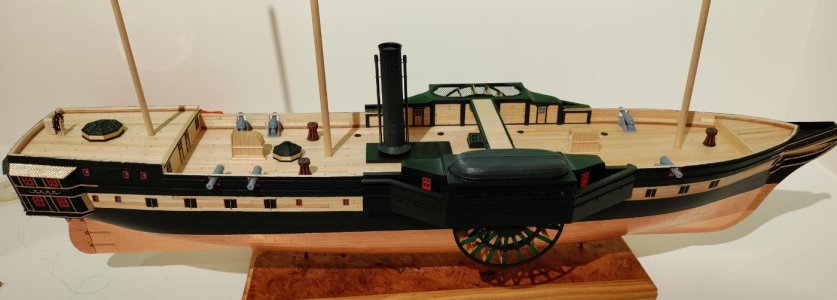
L'Orenoque Mamoli 1:100 scale

this is what i came up with (after much searching) for my coal chutes, the middle ones(6mm) are ok for l'Aigle at 1/115 and the smaller ones will do for the Sphinx at 1/200 . Etched stainless for transformer robots , about €10 . unfortunately from china , which would mean tarrifs for you....i can give you a link if you are interested.
.View attachment 572032
Martin! Nifty!

I'm probably going with my black artists paper method. Below see the mock-up. Any reasons they wouldn't be black?

First pic is the kit plan. It only has 2 coaling chutes - monster sized at 14mm.
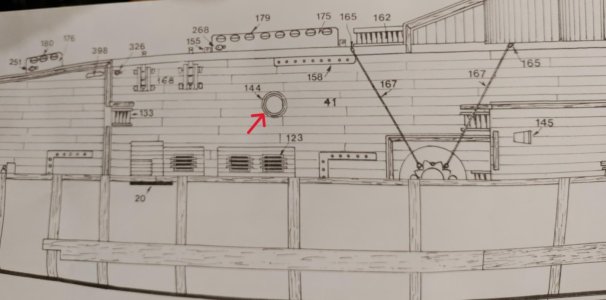
lo coal chute kit plan.jpg

Following three pics are my mock-up with 6.35 mm chutes - what my L'Aigle plans have as the size at 1:100 scale. I punch out 1/4" dots. For the detail I punch a 3/16" dot and then punch 1/4" having centered the 3/16" hole lleaving me with a 1/16" wide circle 1/4" in diameter.
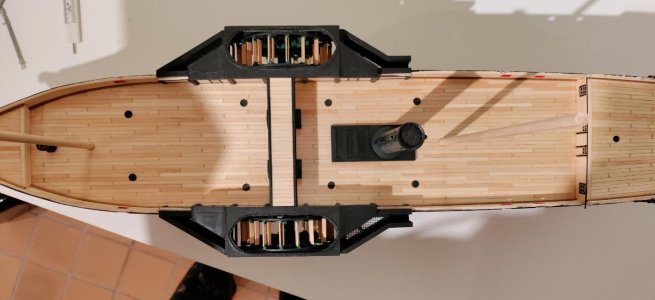
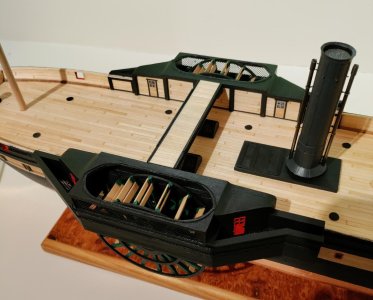
lo coaling chutes 1.jpglo coaling chutes 2.jpglo coaling chutes 3.jpg
 
Martin! Nifty!

I'm probably going with my black artists paper method. Below see the mock-up. Any reasons they wouldn't be black?

First pic is the kit plan. It only has 2 coaling chutes - monster sized at 14mm.

View attachment 572042

Following three pics are my mock-up with 6.35 mm chutes - what my L'Aigle plans have as the size at 1:100 scale. I punch out 1/4" dots. For the detail I punch a 3/16" dot and then punch 1/4" having centered the 3/16" hole lleaving me with a 1/16" wide circle 1/4" in diameter.
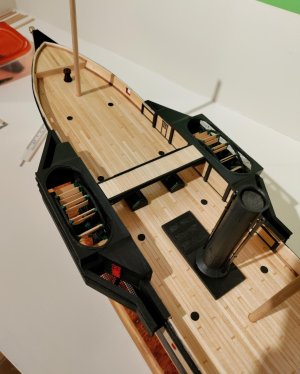
View attachment 572043View attachment 572044View attachment 572045
You are owning this Chuck. Very well done indeed.
 
Martin! Nifty!

I'm probably going with my black artists paper method. Below see the mock-up. Any reasons they wouldn't be black?

First pic is the kit plan. It only has 2 coaling chutes - monster sized at 14mm.

View attachment 572042

Following three pics are my mock-up with 6.35 mm chutes - what my L'Aigle plans have as the size at 1:100 scale. I punch out 1/4" dots. For the detail I punch a 3/16" dot and then punch 1/4" having centered the 3/16" hole lleaving me with a 1/16" wide circle 1/4" in diameter.

View attachment 572043View attachment 572044View attachment 572045
any reason they wouldn't be black ? well you might trip over them at night ROTF !
 
Yesterday, I dug through my several marine engineering books to learn what I could about the details of the boilers that powered these early steamships. I learned very little that I did not already know. The mechanics of providing combustion air or handling ashes are not mentioned.

So, what can we reasonably infer? The original engines powering most steamships were “low pressure” running on steam pressures of 5-10 psig. For non-technical types, the g in psig means that the pressure is measured using atmospheric pressure (14.7psi) as a baseline. Most of the power generated by these engines, therefore, came from the vacuum caused by condensing the steam leaving the cylinder. Boilers were not designed to generate higher steam pressures and the geometry of these paddle engines did not require it. These power plants were thermally inefficient requiring frequent refueling; one reason for retaining masts and sails. These boilers would not have to be fed with the quantities of combustion air like those generating steam at higher temperatures.

These old wooden warships also did not have the extensive compartmentation of later vessels, so there would be natural ventilation paths within the hull for feeding combustion air to the boilers.

The game changer was the compound, and ultimately the triple expansion engine, but these would not be used until later in the century.

Roger
 
Last edited:
Yesterday, I dug through my several marine engineering books to learn what I could about the details of the boilers that powered these early steamships. I learned very little that I did not already know. The mechanics of providing combustion air or handling ashes are not mentioned.

So, what can we reasonably infer? The original engines powering most steamships were “low pressure” running on steam pressures of 5-10 psig. For non-technical types, the g in psig means that the pressure is measured using atmospheric pressure (14.7psi) as a baseline. Most of the power generated by these engines, therefore, came from the vacuum caused by condensing the steam leaving the cylinder. Boilers were not designed to generate higher steam pressures and the geometry of these paddle engines did not require it. These power plants were thermally inefficient requiring frequent refueling; one reason for retaining masts and sails. These boilers would not have to be fed with the quantities of combustion air like those generating steam at higher temperatures.

These old wooden warships also did not have the extensive compartmentation of later vessels, so there would be natural ventilation paths within the hull for feeding combustion air to the boilers.

The game changer was the compound, and ultimately the triple expansion engine, but these would not be used until later in the century.

Roger
Roger!

Apologies for the delayed response, kind sir.

And, shipmates, there we have it - the definitive word courtesy of Roger's encycolpedic knowledge and resources. Thank you, Roger! Now I know I've made the right choice to omit the ventillators.

Blessings. Peace. Gratitude.
Chuck
 
What ho, shipmates!

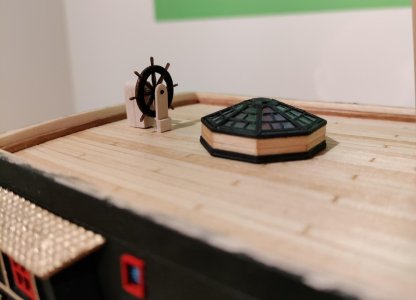
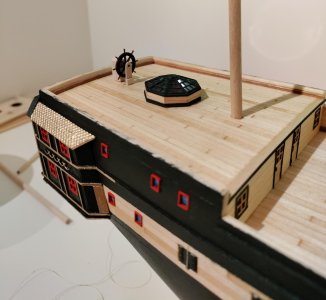
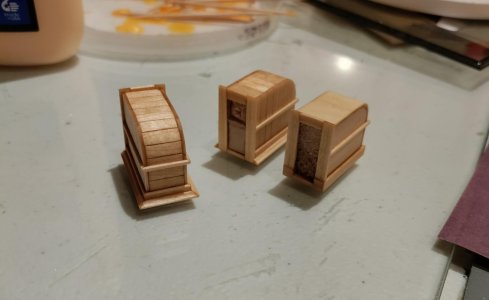
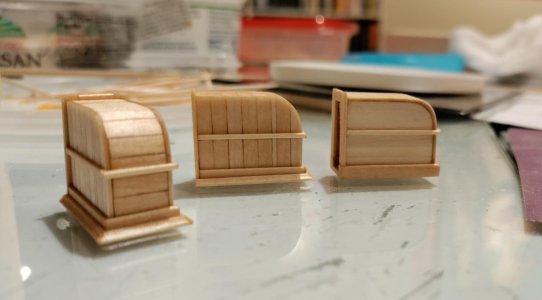
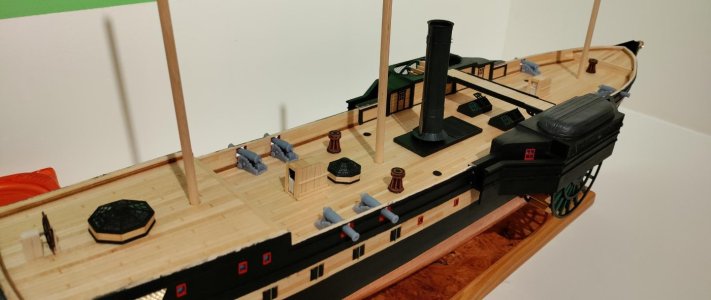
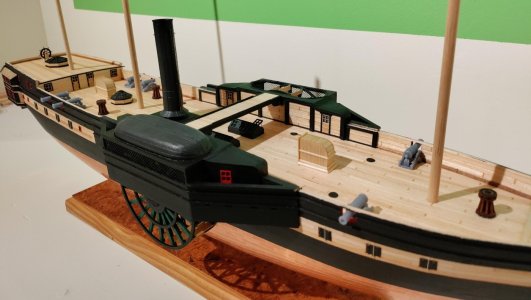
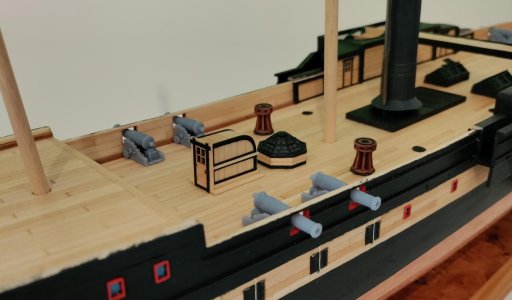
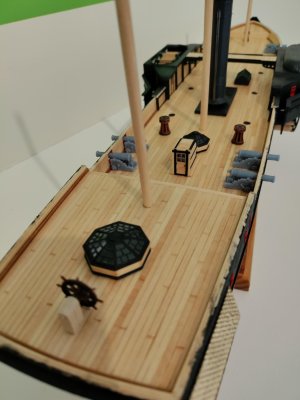
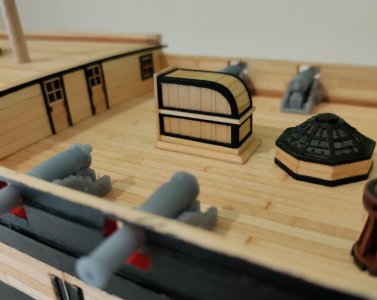
Been a lot going on. At least, a lot for me. I owe responses to many of you either here or, much to my surprise, on the Harriet Lane thread. I have managed to make tiny things to populate the deck. And, being in a hurry at the moment I'll likely just dump a bunch of pictures and come back later to explain.

Before I do that - French gun carriages in this era? Red? Looking at you Martin @Martin By Eye :p

Thank you all! If you have a moment check out the poem When Giving Is All We Have by Alberto Rios. Says it much better than I ever could.

Blessings. Peace. Gratitude.
Chuck

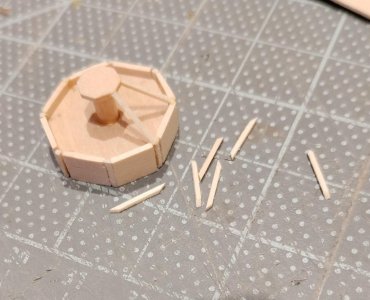
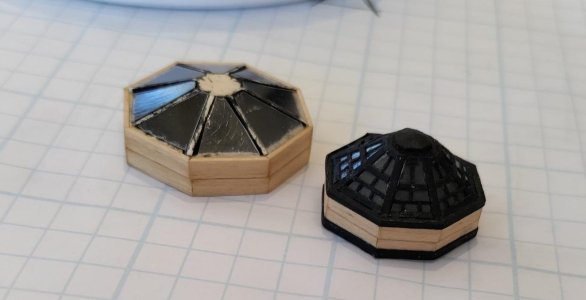
lo skylight construction.jpglo skylights 1.jpglo skylights 2.jpglo skylights 3.jpglo skylights 4.jpgLO skylights 5.jpg
 
What ho, shipmates!

Been a lot going on. At least, a lot for me. I owe responses to many of you either here or, much to my surprise, on the Harriet Lane thread. I have managed to make tiny things to populate the deck. And, being in a hurry at the moment I'll likely just dump a bunch of pictures and come back later to explain.

Before I do that - French gun carriages in this era? Red? Looking at you Martin @Martin By Eye :p

Thank you all! If you have a moment check out the poem When Giving Is All We Have by Alberto Rios. Says it much better than I ever could.

Blessings. Peace. Gratitude.
Chuck

View attachment 576901View attachment 576902View attachment 576903View attachment 576904View attachment 576905View attachment 576906
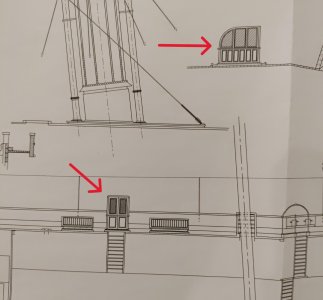
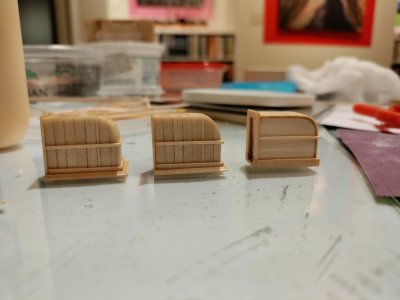
Companion-ways based on L'Aigle

The ugly duckling is a prototype - you know - you do it the cheap and easy way and it looks cheap and easy then you do it the way you should havein the first place.;)

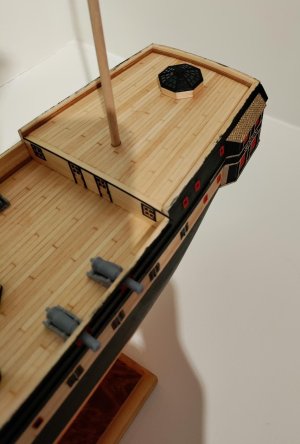
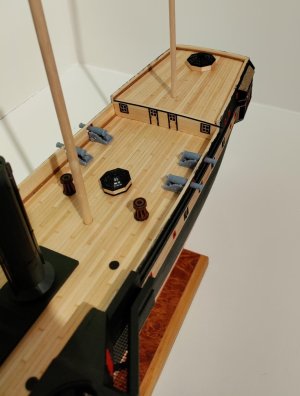
View attachment 576929View attachment 576930View attachment 576931View attachment 576932View attachment 576933View attachment 576934View attachment 576935View attachment 576936View attachment 576943View attachment 576944
You made some very nice parts, Chuck. With beautiful contrasting colors!
Regards, Peter
 
Brad! Thank you! I had the same feeling. :p I have to make some hatches forward and the kitchen chimney and other than pin racks around the masts I'll be done with the bits on the deck. Plans for the cannon's you say! Absolutely! Black cannon (steam green at the muzzel? - too much like Christmas?) I'm thinking of red carriages, but I'm waiting to hear from the crew;). Thank you for looking in, Brad!

Blessings. Peace. Gratitude.
Chuck
 
As to gratings for the hatches - what size openings at 1:100 scale? .75 mm - 1mm ? Keep in mind - only stone aged tools in my shop - no 3D printer, no cnc machine, and nothing by Proxxon. Should I go with photo etch? If so please point me in the right direction, shipmates!
 
Last edited:
Back
Top