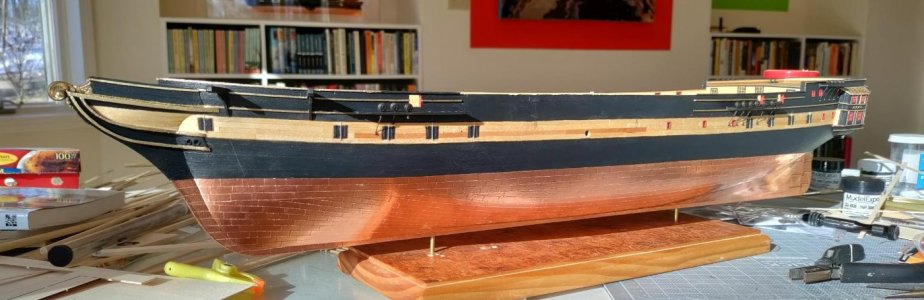
What ho, shipmates!
Here's the thrilling tale of how I invented a method of making chains . . . .
The objects that came in the kit for fastening the lower deadeyes to the hull was never in the race. I gave it some thought and remebered that I had to "invent" the chanins for my Lovely Renee build because the kit for Fair American did not include them at the time I bought her. That took me 6 months to figure out

. For that build I used 26 ga annealed steel wire and was able to make a relatively uniform set of chains. I was able to make them in one peice because at 1:48 scale the hole I drilled in the channel could accommodate the loop I made for the nail to pass through and secure the chain to the hull.
This time I used 28 ga and tried the same thing. The bottom loop was still too big and I decided I didn't want bigger holes in the channels on L'Orenoque. What to do - make the chains in two parts!
Here we go -
First pic is the tools and materials. The yellow arrow points out the 3mm ebony deadeye I sourced from DryDock.
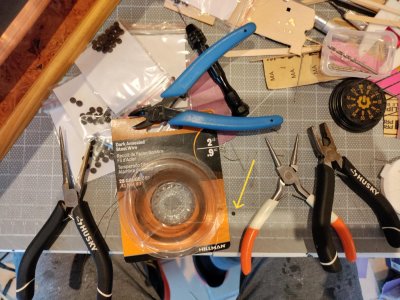
Step one: Cut two lengths of wire.
Step two: Wrap one length around the deadeye and give it a twist - just enough to snug the wire to the deadeye leaving the deadeye able to move. If you over-snug just untwist a bit.
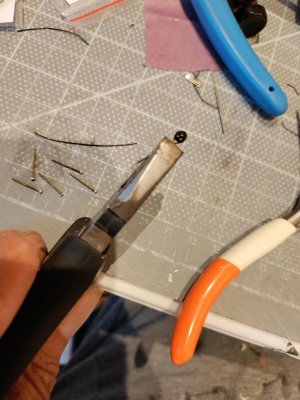
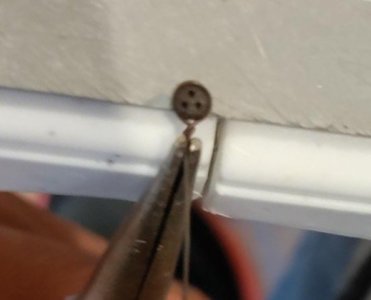
Step three: Cut off one of the tails close to the twist.
Step four: use the end of needle nose or round nose pliers to make a loop just big enough to pass a 28 ga wire through.
\
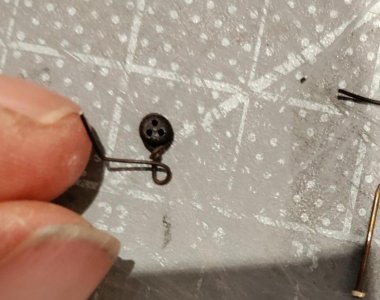
When you do this make sure to leave the deadeye loop tail long enough to be visible once you put the deadeye into the channel. My channels at 1/32nd thick so, measuring by eye I left enough

. The loop will be small enough to wiggle through the hole in the channel.
Step five: Put the deadeye in the hole!
Step six: Take the second lenght of wire and make an eye just big enough to accommodate the nail.
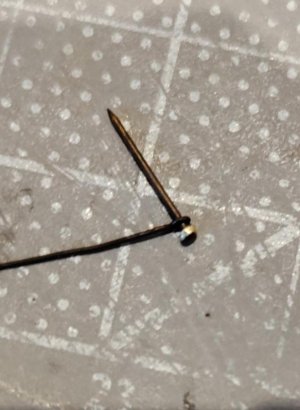
Then give the eye a slight angle to more or less match the angle of the chains - that way you put less stress on the channel as you attach the chain to the hull and you have nice flat contact hull - chain - nail.
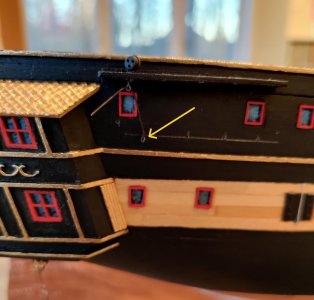
Then make a curve in the end without the eye - don't curve the whole thing - this is just to help with threding the 28 ga chain through a 28 ga wide hole. Because the deadeye can move in its hole, you can twist it to help with the threading.
Note - I first tried threading front to back - I couldn't get the chain to close properly once through the loop - looked sloppy and was otherwise hard to see what I was doing. Brainwave!!! Thread from back to front!
Step seven: Place nail through the eye and into a predrilled hole.
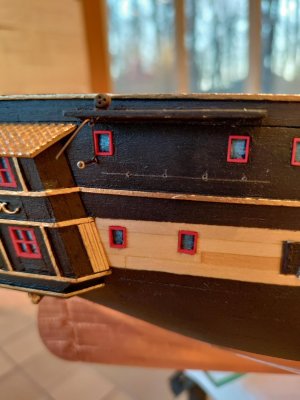
I cemented the nail and chain with CA and pushed the nail home with my fingernail.
Step eight: Taking needle nose pliers and great care, start pinching the tail end of the chain near the wire eye attached to the deadeye. Once you are satisfied that the chain is tight enough CAREFULLY remove the excess wire from the chain.
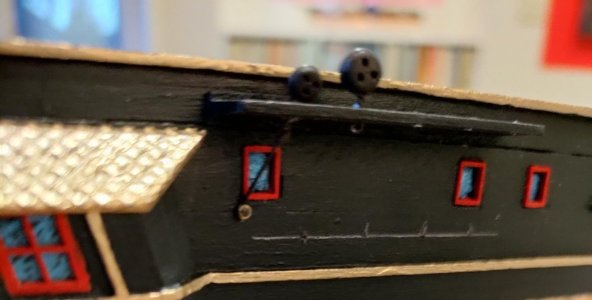
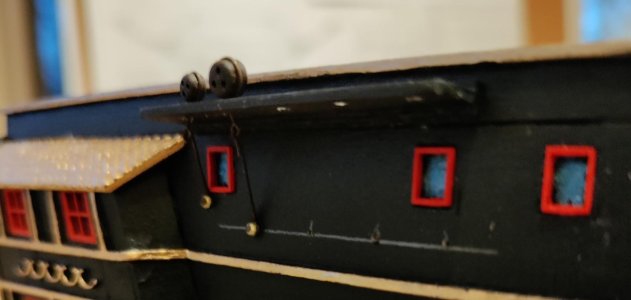
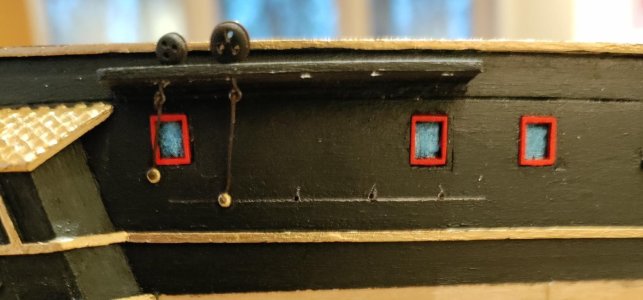
About 90 minutes later -
Step 9 - apply paint and Ta Da!
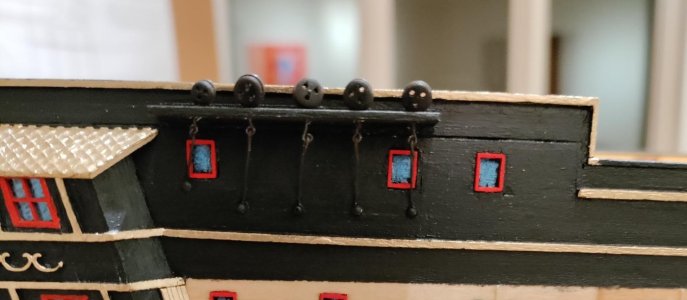
If my math is correct, I have to do this 32 more times at a rate of 5 every 90 minutes - 9 hours and 36 minutes to get the lower deadeyes in!!!
Wish me joy, shipmates! I wish the same for you!
Blessings. Peace. Gratitude.
Chuck










 ...
...


 As you can tell, I decided to finish the process I had begun rather than begin the iron work. Lower deadeyes are aboard from the mainchains aft port and starboard. Forechains in progress.