
-

SUBSCRIBE TO SHIPS IN SCALE TODAY!
The beloved Ships in Scale Magazine is back and charting a new course for 2026!
Discover new skills, new techniques, and new inspirations in every issue.
NOTE THAT OUR NEXT ISSUE WILL BE July/August 2026 -

Win a Free Custom Engraved Brass Coin!!!
As a way to introduce our brass coins to the community, we will raffle off a free coin during the month of August. Follow link ABOVE for instructions for entering.


You are using an out of date browser. It may not display this or other websites correctly.
You should upgrade or use an alternative browser.
You should upgrade or use an alternative browser.

- Joined
- Aug 8, 2019
- Messages
- 5,914
- Points
- 738

Today I was making very thin thread from Guterman Skala; I used Skala 360 to make 0.2 mm thread.
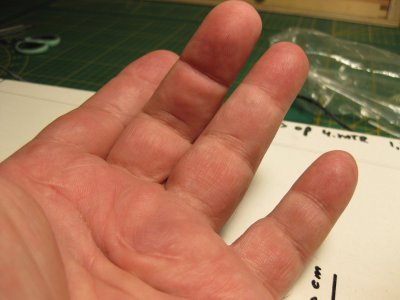
Skala 360 is as thin as a strand of hair
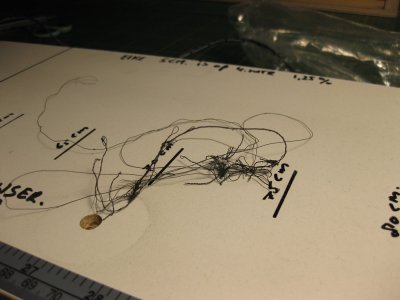
I discovered that when you make a 3x1 (or 2x1 / 4x1) thread from Skala, the same problem occurs as when using Amann’s Serafil 120/2. When you use a single thread in a strand, you can only make left-twisted rope. This is because you twist the rope against its natural twist when making right-twisted rope. There is a higher risk of breakage during twisting or irregularities. Like this:
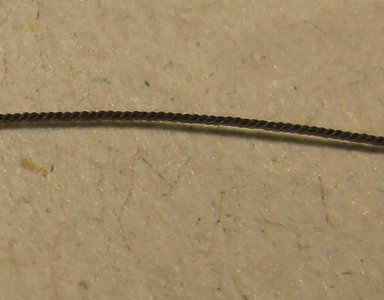
But if you turn it in LH the result is a perfect 0,2 mm rope.
Close-up photo; note the wood fibers in the paper below for a comparison of scale.
I used 40 grams of weight, 8% and not 10% before I started the turning of the rope. Both machines in same speed.
Skala 360 is as thin as a strand of hair
I discovered that when you make a 3x1 (or 2x1 / 4x1) thread from Skala, the same problem occurs as when using Amann’s Serafil 120/2. When you use a single thread in a strand, you can only make left-twisted rope. This is because you twist the rope against its natural twist when making right-twisted rope. There is a higher risk of breakage during twisting or irregularities. Like this:
But if you turn it in LH the result is a perfect 0,2 mm rope.
Close-up photo; note the wood fibers in the paper below for a comparison of scale.
I used 40 grams of weight, 8% and not 10% before I started the turning of the rope. Both machines in same speed.

- Joined
- Jul 27, 2021
- Messages
- 705
- Points
- 403

Mmmm I can't confirm this Steph, I have no problems doing 3x1 Skala 360 RH rope ... I would try much more weight! I have 1 kg to tow.

I thought Skala 360 was a monofilament? I would have guessed direction wouldn't matter - but of course I am no scholar here...
- Joined
- Aug 8, 2019
- Messages
- 5,914
- Points
- 738
When I pull on the sled, there’s already some resistance from its own weight. But 1 kilogram of pulling force??? I’ve never needed that much. The most I’ve ever needed was just 600 grams with a 2.5 mm rope.Mmmm I can't confirm this Steph, I have no problems doing 3x1 Skala 360 RH rope ... I would try much more weight! I have 1 kg to tow.
I’ve mentioned before that not every rope walk is the same. Many factors come into play, such as the type of rope used to suspend the weight, whether you use pulleys or hooks, whether the carriage has wheels or slides across a surface, the weight of the carriage, the divider, and how much resistance it offers. These factors determine the weight.
That’s what I thought too; I noticed it right away while spinning—the carriage can’t move backward, only forward. It just sat there, and the threads started to sag. It took a while before the carriage started moving.I thought Skala 360 was a monofilament? I would have guessed direction wouldn't matter - but of course I am no scholar here...
When turning to the left, the carriage started moving right away. So when turning to the right, you first untwist the yarn and getting longer; this weakens the yarn, and because the tension is lost, the end result is poorer.
I then took a closer look to see if there was a twist in the yarn, and sure enough, there is. It’s hard to see, and actually I’d need a microscope. Sofar I could see the yarn looks like a ribbon, like an old VHS tape for example, which has been twisted into a round yarn.

- Joined
- Mar 20, 2026
- Messages
- 18
- Points
- 48

Hi people,
I'm new in this forum, and enjoying my reads very much so far
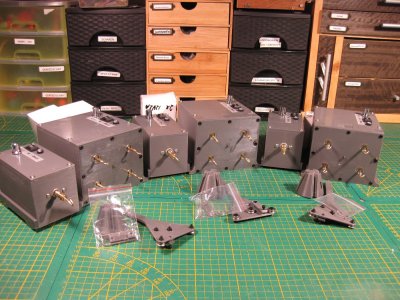
Since I've purchased the ropewalk machine discussed in this topic from the super nice Stephan Kertesz , I'm looking forward to soon start making my own ropes with it.
I have a few questions, if you guys don't mind me asking:
1. Where did you get a remote for the ropewalk, and how did you make it work with it?
2. I'm sure I've read it either here, in the instructions for use or in a user's post on FB, but the answer is escaping me... in order to make RH-laid rope, you first need to run the four-hooks module LH until the threads reduce a certain % amount of the initial length. Once you have achieved that, the twisting is stopped. Then the one-hook module is started with an RH spin. As that spins, does the four-hook module also need to spin? And if it does, I suppose it's LH if my original assumption is correct.
3. Provided that the above is all correct (and I'm not sure, or I wouldn't be asking ) how do you set the spin speed? There's no indicator on the ropewalk. And how do you get the two modules to spin at the same speed, assuming they do have to spin at the same speed?
Thanks in advance if someone can find some time to reply to this. If not, no problem. I'll repropose the same questions over and over again until some good soul will answer eventually ... just kidding
I'm new in this forum, and enjoying my reads very much so far
Since I've purchased the ropewalk machine discussed in this topic from the super nice Stephan Kertesz , I'm looking forward to soon start making my own ropes with it.
I have a few questions, if you guys don't mind me asking:
1. Where did you get a remote for the ropewalk, and how did you make it work with it?
2. I'm sure I've read it either here, in the instructions for use or in a user's post on FB, but the answer is escaping me... in order to make RH-laid rope, you first need to run the four-hooks module LH until the threads reduce a certain % amount of the initial length. Once you have achieved that, the twisting is stopped. Then the one-hook module is started with an RH spin. As that spins, does the four-hook module also need to spin? And if it does, I suppose it's LH if my original assumption is correct.
3. Provided that the above is all correct (and I'm not sure, or I wouldn't be asking ) how do you set the spin speed? There's no indicator on the ropewalk. And how do you get the two modules to spin at the same speed, assuming they do have to spin at the same speed?
Thanks in advance if someone can find some time to reply to this. If not, no problem. I'll repropose the same questions over and over again until some good soul will answer eventually ... just kidding
- Joined
- Aug 8, 2019
- Messages
- 5,914
- Points
- 738
Nice to see you here Chris
For example, RH rope:
Start with only the machine with 4 hooks in position 1 until the length is reduced by 10%. Then start the second machine with 1 hook, also in position 1. Both machines must run simultaneously from the 10% point. See also my instructional video. Make sure the potentiometers on both machines are set to roughly the same position. In other words, the speed of the machines should be approximately the same.
Succes! If you have more questions just asked.
I use an extension cord with multiple outlets and an on/off switch. But you can also find those click-to-click systems at the hardware store that let you turn your home lighting on and off using a remote control.1. Where did you get a remote for the ropewalk, and how did you make it work with it?
The machine is designed and configured so that you must set both machines to position 1 to make RH rope or to position 2 for LH rope/cable.2. I'm sure I've read it either here, in the instructions for use or in a user's post on FB, but the answer is escaping me... in order to make RH-laid rope, you first need to run the four-hooks module LH until the threads reduce a certain % amount of the initial length. Once you have achieved that, the twisting is stopped. Then the one-hook module is started with an RH spin. As that spins, does the four-hook module also need to spin? And if it does, I suppose it's LH if my original assumption is correct.
For example, RH rope:
Start with only the machine with 4 hooks in position 1 until the length is reduced by 10%. Then start the second machine with 1 hook, also in position 1. Both machines must run simultaneously from the 10% point. See also my instructional video. Make sure the potentiometers on both machines are set to roughly the same position. In other words, the speed of the machines should be approximately the same.
There isn't an indicator, but it doesn't need to be that precise. Set both to the maximum position or turn the potentiometers to the same setting. The voltage, motors, and electronics are the same on both machines, so the power supply is also the same. Generally speaking, you’ll want the machine with one hook to run slightly faster, and because it runs freely—without gears—it will also be slightly faster when the potentiometers are set to the same position. It’s a matter of developing a feel for it.3. Provided that the above is all correct (and I'm not sure, or I wouldn't be asking ) how do you set the spin speed? There's no indicator on the ropewalk. And how do you get the two modules to spin at the same speed, assuming they do have to spin at the same speed?
Succes! If you have more questions just asked.
- Joined
- Aug 8, 2019
- Messages
- 5,914
- Points
- 738
In the discription/pdf I send you there is also a step by step explanation and that belongs to this video:Awesome, thanks for the detailed replies Stephan. It's nice for me to also be here. I've reached out to Phillip and he was super nice to get into a video call with me and provide some practical demonstration of how it all is supposed to work.

Ok ok. After 7 years of wooden galleon constructing, this great info has convinced me to try and make my own rope. Until now I have been buying rope from various manufactures. The rope that typically comes with the kits are really poor quality. But Stephen you have kicked-started my motivation to undertake the task.
I think wooden galleon construction just got a lityle more complicated!!))))
Bill THANK YOU
I think wooden galleon construction just got a lityle more complicated!!))))
Bill THANK YOU
- Joined
- Aug 8, 2019
- Messages
- 5,914
- Points
- 738
You're welcome. And it is also fun to make rope and see the outcome.Ok ok. After 7 years of wooden galleon constructing, this great info has convinced me to try and make my own rope. Until now I have been buying rope from various manufactures. The rope that typically comes with the kits are really poor quality. But Stephen you have kicked-started my motivation to undertake the task.
I think wooden galleon construction just got a lityle more complicated!!))))
Bill THANK YOU

- Joined
- Oct 9, 2020
- Messages
- 2,687
- Points
- 538

I use MARA, and I noticed that it too is multifilament polyester thread. It is Z twist, like I believe most thread is. I have been trying to use the machine I have to untwist the thread and retwist it S. I tried something earlier today with no success but I recently had a breakthrough. I can adjust the machine's parameters to get what I want. Do you untwist your thread so that you can get S strands to feed your machine?

- Joined
- May 3, 2026
- Messages
- 203
- Points
- 78

FWIW, with traditional style ropewalks I have always un-twisted the thread as part of the process. It was pointed out to me at some point that making the rope involved twisting the strands the opposite of the twist in the threads. It seemed to come out best that way.
I made rope for years without consciously knowing about S and Z , and I still don't really care.
I made rope for years without consciously knowing about S and Z , and I still don't really care.
- Joined
- Oct 9, 2020
- Messages
- 2,687
- Points
- 538
i am able to untwist the Z twist from the mara 120 thread in my example and get it to retwist in the S direction. But I run the head at 50% of it's maximum speed. the strand holders spin a lot faster because of the gear ratios. It's really scary watching those things spin, Good thing there is a guard. I am having an issue with my center gear. It is rotating when the RPM's go above the 50% setting. I sent a message to the vendor to see if they have any ideas on how to or even if it is necessary to stop the shaft from turning. I feel like drilling a hole through the mount and shaft then putting a pin. That would stop the shaft from returning. But I want to talk to the vendor first even though they no longer sell the machine.FWIW, with traditional style ropewalks I have always un-twisted the thread as part of the process. It was pointed out to me at some point that making the rope involved twisting the strands the opposite of the twist in the threads. It seemed to come out best that way.
I made rope for years without consciously knowing about S and Z , and I still don't really care.
Last edited:
- Joined
- Aug 8, 2019
- Messages
- 5,914
- Points
- 738
Please don't start here a discussion about an endless ropewalk. Because I think it's a machine that's designed too make industrial and modern rope. Not for modelships. Because you need to adjust the gears (like a lathe) for every type of rope or steel cable. This topic is about traditional ropemaking transferred to model ships. Thanks.
- Joined
- Oct 9, 2020
- Messages
- 2,687
- Points
- 538
i won't sorry.
- Joined
- Aug 8, 2019
- Messages
- 5,914
- Points
- 738

14M views · 345K reactions | Tradition and craft of handmade ropes in Calatayud #ropes #calatayud #documentaries | Eugenio Monesma Documentaries
Tradition and craft of handmade ropes in Calatayud #ropes #calatayud #documentaries
 www.facebook.com