• Win a Free Custom Engraved Brass Coin!!!
    As a way to introduce our brass coins to the community, we will raffle off a free coin during the month of August. Follow link ABOVE for instructions for entering.
  • PRE-ORDER SHIPS IN SCALE TODAY!

    The beloved Ships in Scale Magazine is back and charting a new course for 2026!
    Discover new skills, new techniques, and new inspirations in every issue.

    NOTE THAT OUR FIRST ISSUE WILL BE JAN/FEB 2026

Making your own Ropes

How many strands does first thread have and in what direction is twisted.
Next do you wind to what direction several of these strands?
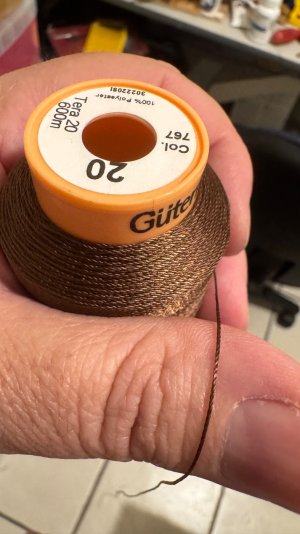
I using Guterman Tera 20. Looks like it has more than one strand that Z twist from what I can see.

I twisted two of these together same direction. This could be where I went wrong. I’m suppose to twist that in opposite direction?

I than twisted the threads to form the rope S twist.

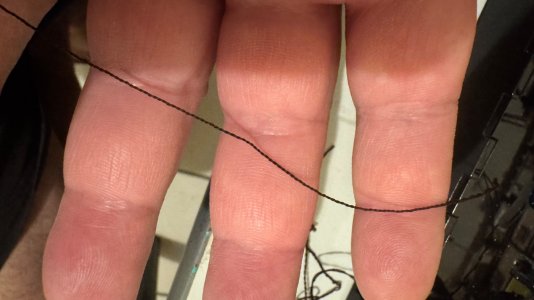
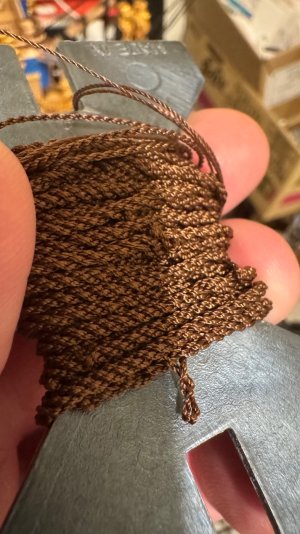
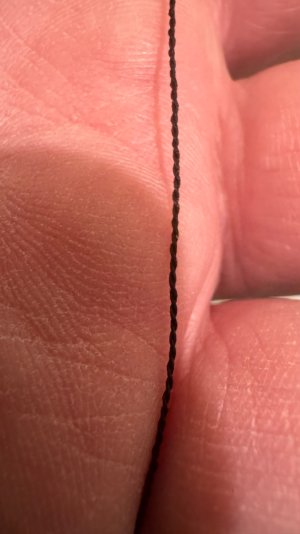
When you look at the image of the 2 yards twisted together. It does look a bit rough.

So, basically 2 strands each thread z twist

Than wind the strands S twist.
IMG_1447.jpeg

IMG_1448.jpeg

IMG_1449.jpeg
 
Last edited:
Interesting. Do you try to straight them after the first winding? Straighten them, tighten them by hand, or wind them straight onto the spool?

Three strands up to 2mm are no problem on this twister. For thicker ropes and right-hand anchors, i use a wall twister. On planetary ropewalk, i usually twist very long, thin right-hand ropes as a base for further work.

Watch KUDINs video, he shows how to unwind/straight a rope. [6:25min]

I wind them straight away onto the bobbins.
 
Maybe this could be all due to user error. I’m still not 100% sure what I’m doing, but I’m slowly starting to understand and learning some of the jargons used. . It’s a huge learning curve. I didn’t know there was so much involved in ropes.

I don’t know if I’m on the right direction here. But from what I’m learning tonight. It appears I might have wound the Tera 20 in the same direction as the yarns that’s already on the Tera 20 thread.

Looking at this thread I see there is already some yarns twisted in a z direction.

Correct me if I’m wrong. I’m just starting to learn the jargons used.

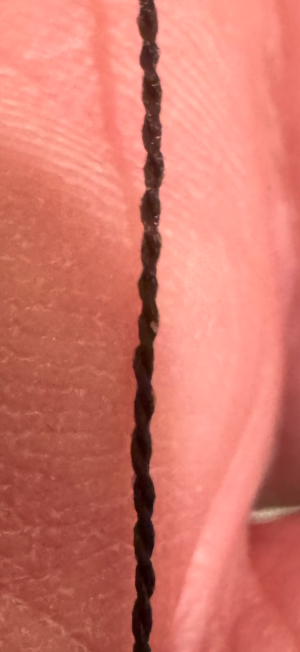
This has left me a bad foundation for the final rope. As per shown in this close up.

I than as mentioned in previous post twisted 4 threads in a s direction with a core.

Could this be what’s causing the final rope to fail.

IMG_1450.png
 
Don't use TERA but MARA or best SKALA!

For more you like read here: https://forum.dubz-modelling-world.com/thread-34.html

:)


I don't think you can get very good results with these kind of rope walks over all rope sizes unfortunately. They are way to unflexible and at a point e.g. thicker rope don't have the power to do good e.g. cable. Just my 2cent. :-(


cheers Dirk
I do have Mara 120. Have not tried it this far. I got the Tera 20 because it’s a lot thicker.

I also have all the sizes of the E threads that scale of ropes from Canada sells.

I tried the thicker e thread I have late this arvo and it turned out worse. Maybe I wound in wrong direction. I don’t know.
 
I using Guterman Tera 20. Looks like it has more than one strand that Z twist from what I can see.

I twisted two of these together same direction. This could be where I went wrong. I’m suppose to twist that in opposite direction?

I than twisted the threads to form the rope S twist.

When you look at the image of the 2 yards twisted together. It does look a bit rough.

So, basically 2 strands each thread z twist

Than wind the strands S twist.
View attachment 580051

View attachment 580052

View attachment 580053
That's exactly what I'm talking about.
If the first strand is a Z, then you twist 3 of them as an S.
Next as a Z, next as an S, and so on until the end.

If first strand is S, three of them you make as Z, next S.
 
That's exactly what I'm talking about.
If the first strand is a Z, then you twist 3 of them as an S.
Next as a Z, next as an S, and so on until the end.

If first strand is S, three of them you make as Z, next S.
I notice when the machine is on. The bobbins spin in the opposite direction.

Do I go by the bobbins or the main large gear direction.

I’m confused with this aspect. I’m assuming bobbins?
 
I notice when the machine is on. The bobbins spin in the opposite direction.

Do I go by the bobbins or the main large gear direction.

I’m confused with this aspect. I’m assuming bobbins?
Drive left or right.
Direction of the bobbin doesn't matter to you, Just which way the finished line exits.

If you're using an S rope on bobbin, you should have Z ready rope.
 
How come than today, at one stage I set the machine to twist the bobbins in opposite direction of the direction of wind. And as it fed of the bobbins the tread was untwisting and was laid onto the rope in single strands and not twisted.

I don’t get why it did that.
 
Many terms are used incorrectly here. In our hobby, you distinguish between rope and cable. A rope consists of strands. A cable consists of ropes. Rope is only twisted RH, hawser rope. These ropes are twisted LH into cable if necessary.

A rope consists of at least 3 strands. A cable consists of at least 3 ropes.

If you use yarns that consist of multiple strands, these are RH twisted and can therefore only be used as cable if you use them individually per strand. If you want to make hawser rope, you will need to use two or more yarns per strand to achieve a good result. The best results are achieved with lock yarn, as Dubz mentioned above.

But I have already mentioned it a few times. In my topic, the link is in my signature, the whole principle is explained. This applies to the PL4 or to a ropewalk like mine. Take the time to read it through carefully. There are more people who share their experiences there. And to avoid confusion, please use the correct names for the parts. This will prevent the discussion from becoming unnecessarily complicated. I do sometimes mixed things up in the beginning because my native language is not English. But it is all correcte in the topic.

If you are having difficulty with the PL4, you could contact Domanov, as he may have a user manual. I am convinced that the PL4 is best suited for the thinner ropes that you need most when rigging a ship. For the special thicker ropes, but also for a better-looking result, model builders use the standard ropewalk, as has been done for 2000 years. Horizontal or vertical. There are plenty of examples of such ropes here on SOS. Like Mati.n, Archjofo, Kudin, Ohla Batcharov, and those I forget. And me offcourse.
 
Sorry guys. I not had any luck with making rope thicker than about 1mm. I’ve persevered on this for two whole days and came to the conclusion this is not the machine for me.

I’m getting great results with thinner lines. I think this is where it shines Longer runs of 1mm or less ropes.


I thinks it’s an excellent machine for making ropes 1mm and below.

I need a rope maker that can make much thicker ropes because I build large sailing ships.

In saying this. I’m considering keeping this rope maker for the thinner lines.

I have ordered the rope maker from steef66
 
A real-world example from the bench this week…

I decided to really push things and attempt making approximately 1.7mm rope using Gutermann Tera 20 polyester thread.

heavier polyester thread — strong, smooth and ideal for building up larger diameter rope. Perfect in theory for the heavy standing rigging I need on my larger ships.

So here’s what I did.

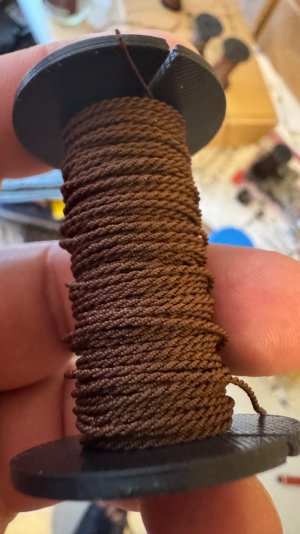
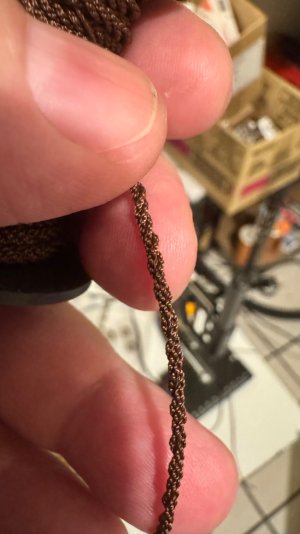
I first wound two strands together per carrier, building up the base strands before laying the final rope — exactly as shown in the photos. And honestly?

It looked fantastic.

The strands were tight, clean and uniform.

IMG_1480.jpeg
 
But once I tried to build the full rope to around 1.7mm, that’s where the limitations started to show.

The thread volume required for that thickness increases dramatically. The bobbins emptied quickly. Tension became harder to maintain consistently across all strands. And the machine started working much closer to its limits.

The material itself — Tera 20 — was not the problem. It behaved beautifully. Strong, consistent and very suitable for rope making.

The challenge was simply the capacity and configuration of the system when trying to scale up to heavier rope.

IMG_1444.jpeg

IMG_1445.jpeg
 
After spending a fair bit of time with this machine, I think it’s important to also talk about the big positives, because there are some genuinely strong advantages here.

First up — footprint.

This rope maker takes up very little bench space. For anyone working in a small workshop or on a crowded modelling bench, that alone is a huge win. It’s compact, tidy, and easy to move or store when not in use. Compared to traditional rope walkers that can take over half a room, this thing is incredibly space-efficient.

Second — rope quality (within its sweet spot).

When used for what it’s designed for — fine rope — the results are excellent. Clean lay, consistent twist, and very uniform diameter. For thin running rigging, detail work, and smaller scale builds, the quality is right up there.

But there is another practical consideration that doesn’t get talked about much — the bobbins.

If you go down this path, you’re not just buying a rope maker… you’re buying into a bobbin system.

To use it properly, you’ll need to wind your own bobbins, and realistically that means having access to a sewing machine. Hand-winding just isn’t practical if you want even tension and decent capacity. It’s not difficult, but it is another piece of equipment you need to factor in.

So before anyone jumps in, it’s worth knowing:

• You’ll need time to prepare bobbins
• You’ll likely need a sewing machine to do it properly
• Bobbin capacity becomes a limitation on thicker rope
• But for fine rope, it works extremely well

For me, this machine still has a place in the workshop. Its compact size alone makes it very attractive, and for thinner lines it produces excellent, repeatable results.

It’s just a matter of matching the tool to the job.

If your focus is fine rigging and you’re short on space, this rope maker makes a lot of sense.
If you need heavy, long runs of thick rope — you’ll want to look elsewhere.

Every tool has a purpose.
Every build teaches you something.
 
Another issue I came upon — and this was also raised by others in a separate discussion. — is what happens after I cut the rope

The rope has a strong tendency to unravel at the ends when cut.

I can’t just cut the finished rope cleanly and move on. If I do, it will immediately start to unravel at the ends. To prevent this, I must either:

• tie a knot in the rope before cutting, or

• dab a small amount of glue on the rope and let it set before cutting


It’s not a deal-breaker, but it is another extra step that becomes noticeable when you’re producing a lot of line.
 
First at all it is a good decision to get Stephans ropewalk! That will solve the issues even you will have a learning curve to get your own receipts!

I again like to suggest to read here: https://forum.dubz-modelling-world.com/thread-34.html

And here: https://forum.dubz-modelling-world.com/thread-41.html

And the thread Stephan mentioned. There you find all you need to make good rope.

About the unraveling, that is normal with polyester yarn. You can bake the rope in an oven to avoid this almost. As I said read the threads as this is mentioned there too ;-)

Have fun doing great rope!

Dirk
 
Back
Top