

• Win a Free Custom Engraved Brass Coin!!!
    As a way to introduce our brass coins to the community, we will raffle off a free coin during the month of August. Follow link ABOVE for instructions for entering.
  • PRE-ORDER SHIPS IN SCALE TODAY!

    The beloved Ships in Scale Magazine is back and charting a new course for 2026!
    Discover new skills, new techniques, and new inspirations in every issue.

    NOTE THAT OUR FIRST ISSUE WILL BE JAN/FEB 2026

Mini Hobby 80502 1/350 Scale USS Enterprise CVN-65 Early

Part 9 Addendum

After reviewing my posts for detailing the hanger I found that a portion of the text had been deleted with references for several photos. I blame over enthusiastic editing (strictly on my part). I had wanted to show some of the photos of the work that went into making the double watertight doors and the Weapons Elevator Doors. After I showed the photo of the Double WTD blank I should have had several photos showing the built up doors in position. I checked all my backups and could not find the missing text so I'm afraid that it is gone forever.
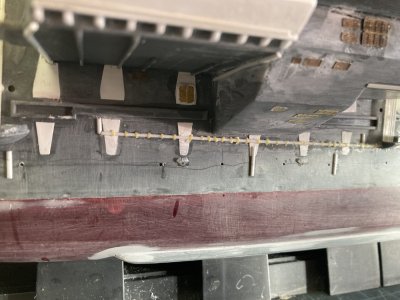
Hanger Details (7).JPG

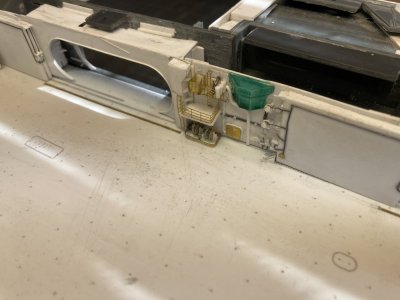
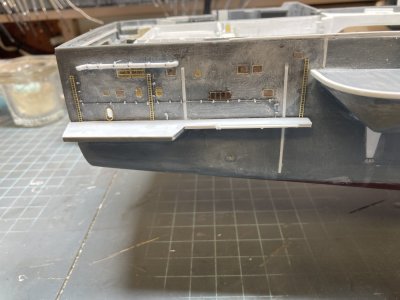
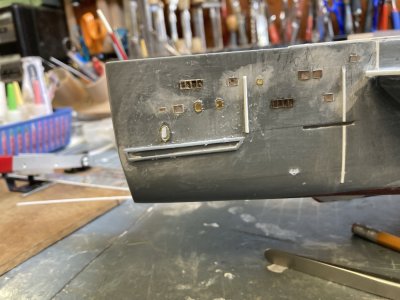
This photo shows the doors at Sponson # 5 going through these doors will bring you to the hanger via another set of double doors between the weapons elevator trunks.
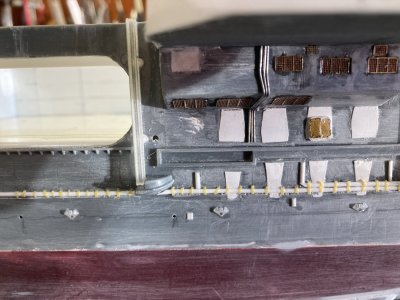
Hanger Details (8).JPG

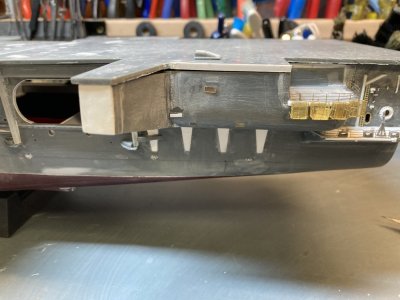
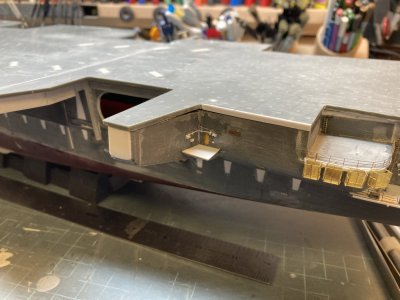
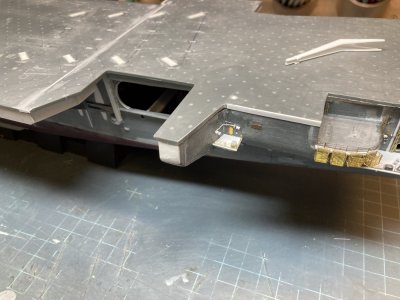
These are the doors at Sponson # 1. They lead to the hanger. This area was the quarterdeck in port when we were tied to a pier. This access to the ship was for officers and chief petty officers. I got these doors a bit crooked but fixed it later.
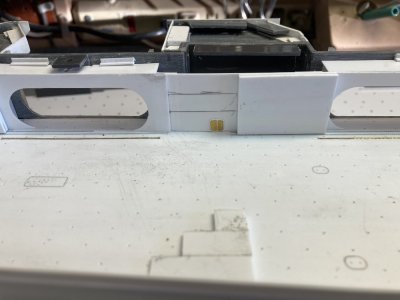
Hanger Details (10).JPG

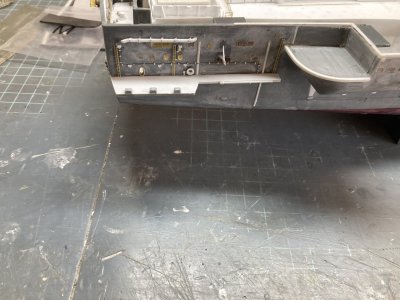
These are the hanger side doors for Sponson #1.
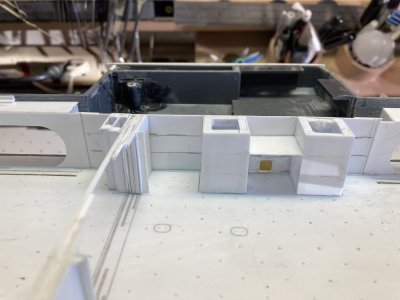
Hanger Details (11).JPG

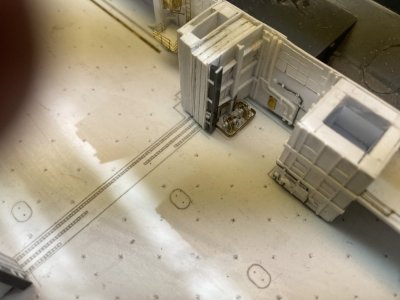
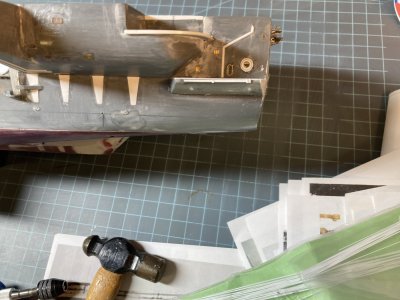
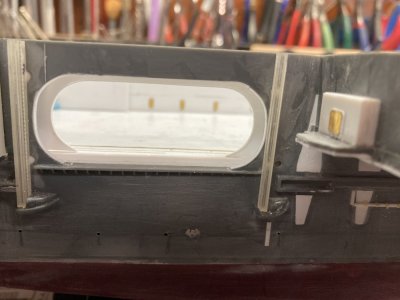
This is the hanger set of doors for Sponson # 5. Just above this door there will be another double door on the platform. This was access to the ships Calibration Lab and was used to hoist large heavy items up to the shop rather than carry them up 2 flights of inclined ladders. Note that the divisional door tracks are beginning to fail.
Hanger Details (99).JPG

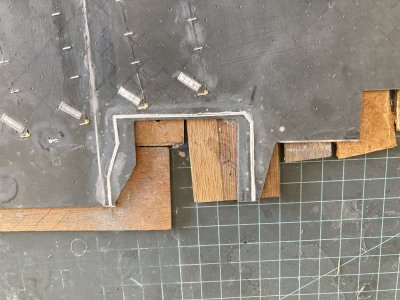
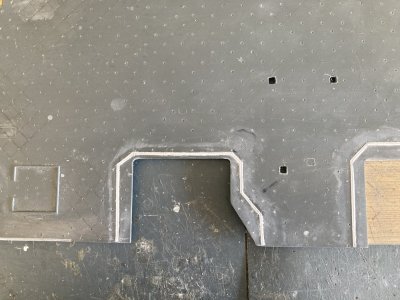
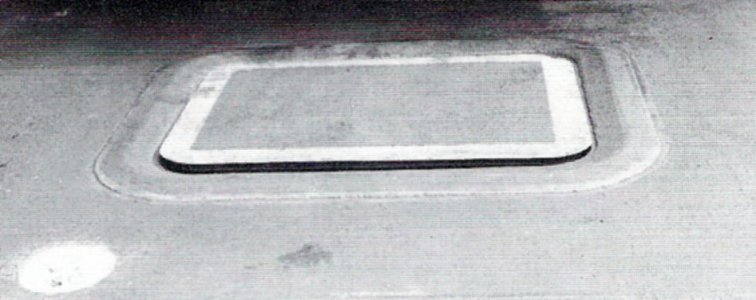
This photo shows the double doors over Elevator 3. This is also an access for the calibration lab to hoist items from the elevator when it is lowered. This area required some additional corrections to make it agree with this reference photo below.
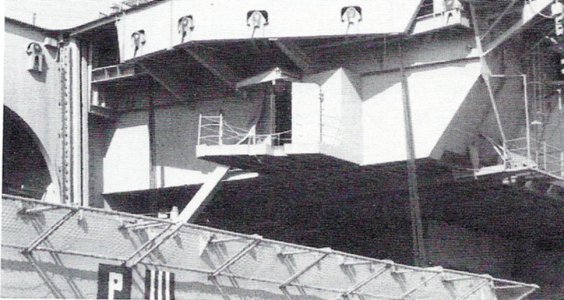
Hull 093.jpg

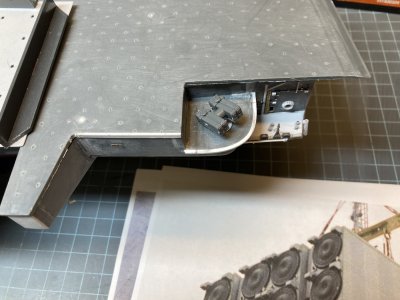
I had to cut away quite a bit of the molded deck and then add the box like door well before gluing on the double WTD.
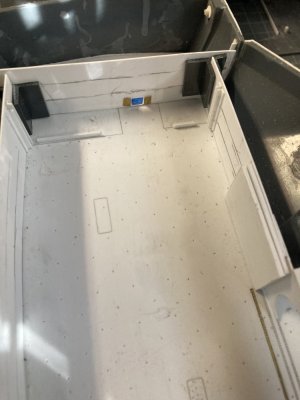

Hanger Details (38).JPG

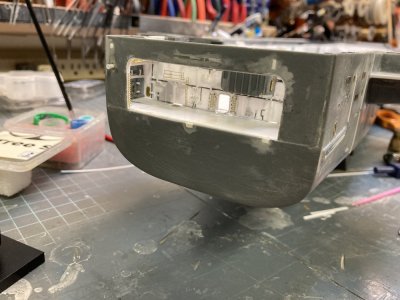
These open doors lead to the tunnel. This area is primarily Supply and AIMD avionics work centers. Because I had to move the forward bulkhead aft about a 1/2 inch (see part 8 basic construction of the hanger bay) there will be another set of open double WTD aft of this one. It is okay as this would be the alcove around the forward most weapons elevator trunk. I am going to add ramps for both of these doors.
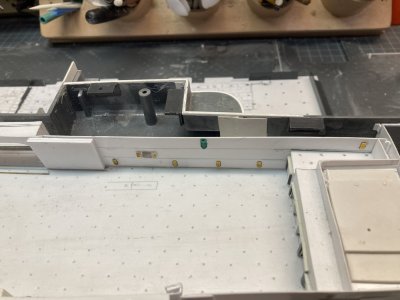
Hanger Details (80).JPG

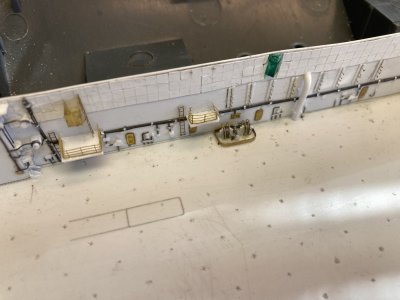
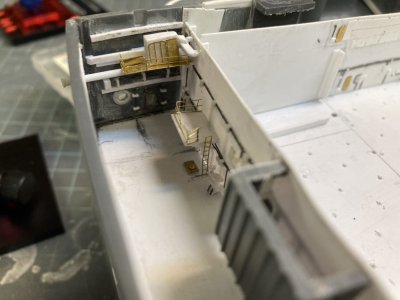
This is the set of doors leading to the Yellow Shirt Locker. I haven't placed any of the vertical ladders or the platforms yet.
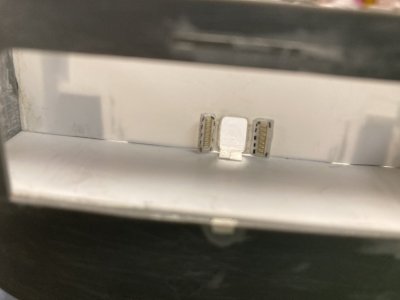
Hanger Details (4).JPG

This the installed Powerplants door looking in or forward from the fantail.
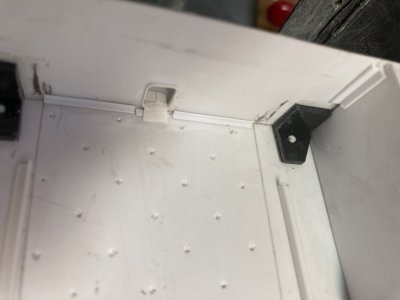
Hanger Details (3).JPG

This will become the interior bulkhead for Powerplants. I have installed the ramps and the L brackets will later be covered.
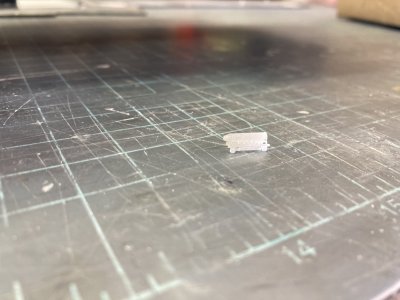
Hanger Details (12).JPG

The 3D printed engine on a trailer. The reorganization of shapeways was a great loss of detail parts. I now wish that I had spent more getting items that are no longer available unfortunately money is a finite resource.
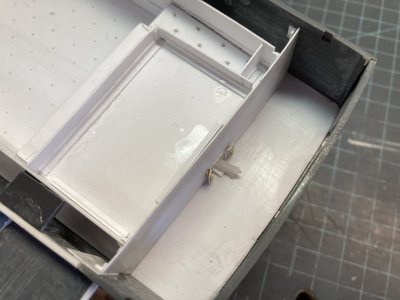
Hanger Details (14).JPG

Happily the engine and stand fit through the doors.


After this section on the double doors I would have gone back into the text in Part 9 post 2 which explained about the Weapons Elevator Doors.
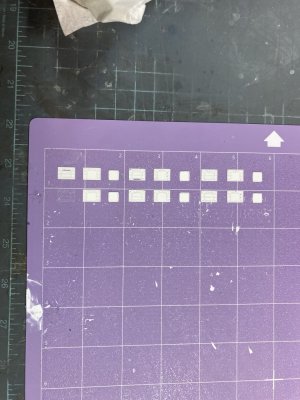
Hanger Details (28).JPG

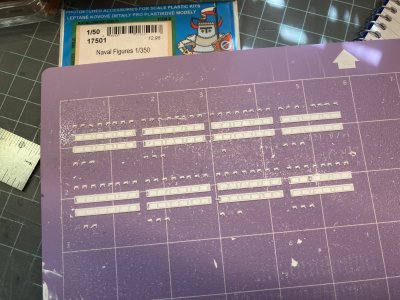
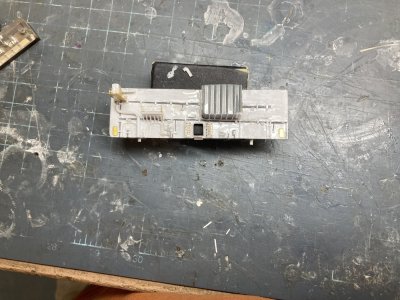
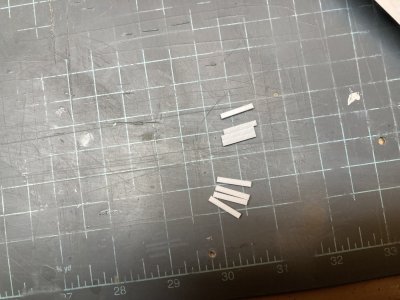
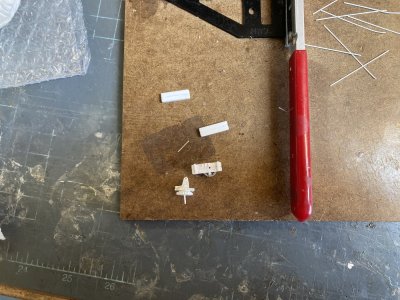
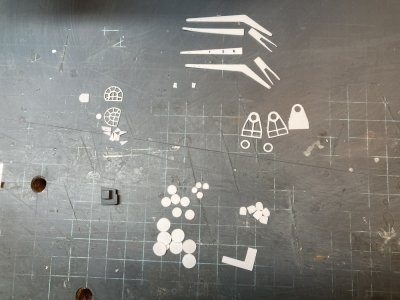
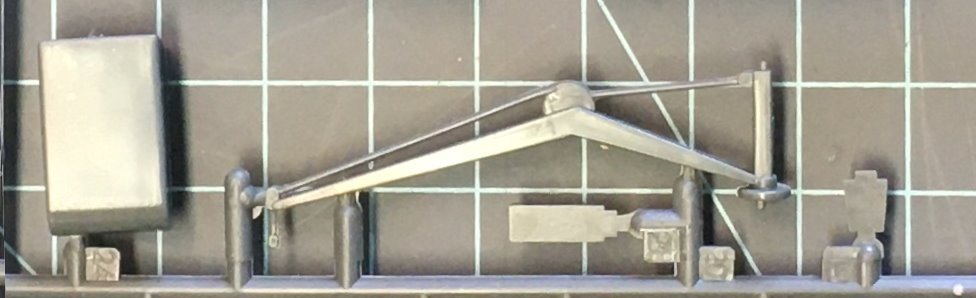
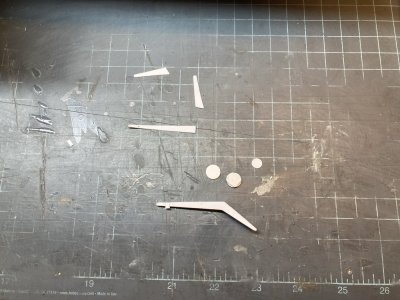
Several Weapons Elevator Door parts blanks on the cutting mat fresh out of the Silhouette.
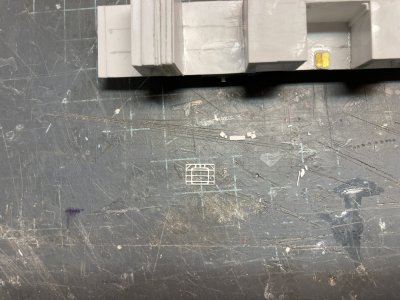
Hanger Details (27).JPG

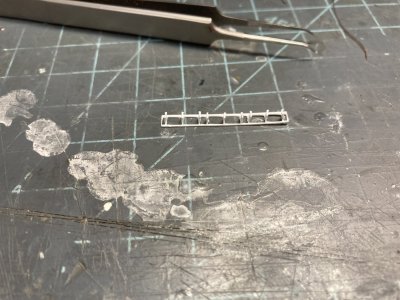
This piece has just had all the chads removed. Some of the plastic bits are nearby on the mat. That part actually went fairly easy.
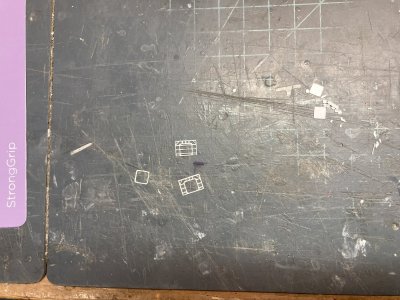
Hanger Details (29).JPG

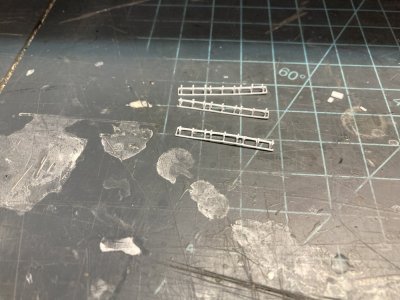
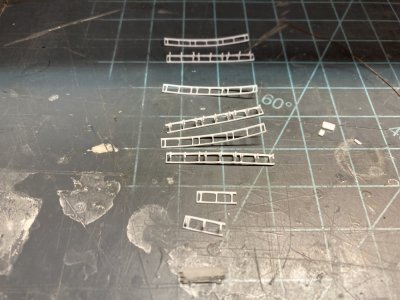
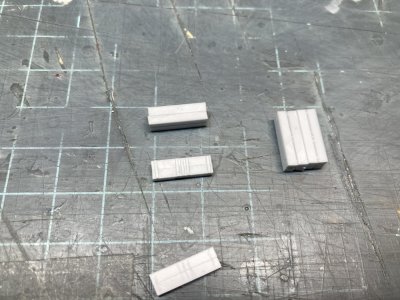
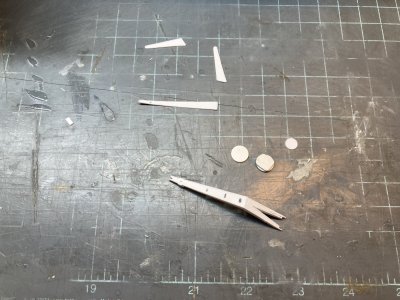
These three parts stacked up make up one door.
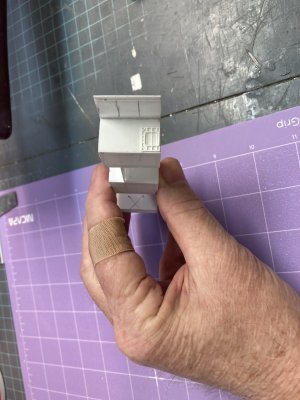
Hanger Details (30).JPG

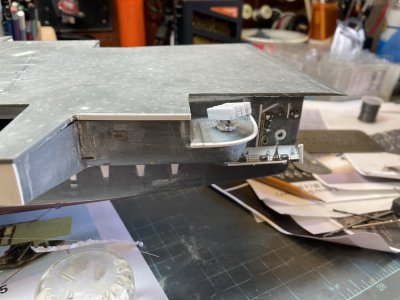
Here the door is installed on the forward elevator trunk.
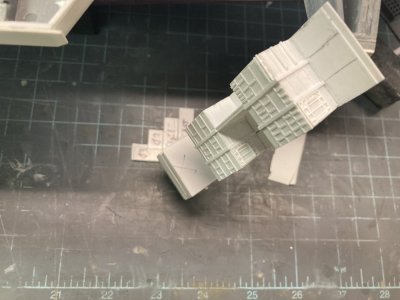
Hanger Details (32).JPG

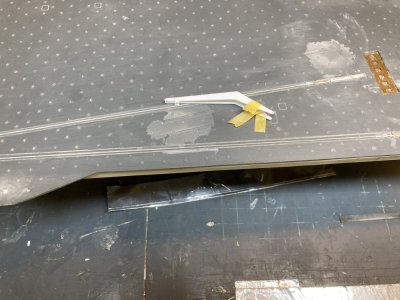
The door on the aft trunk has been added as well as frame detail on both trunks.
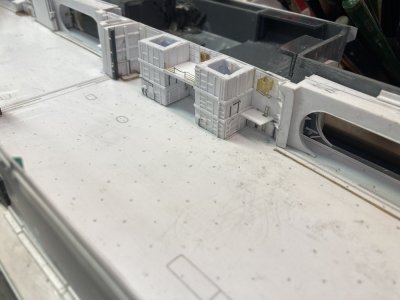
Hanger Details (152).JPG

This photo show the nearly finished elevator trunks with the pulley system represented.


Because of the trouble I had with getting the large amount of details written up in part 9 correctly I am thinking about going to a reduced amount of material in each post. I am currently working on the 3 Hanger fuel stations and I am thinking of trying a post just dealing with those. What do you prefer longer or more frequent?
 
Last edited:
Mini Hobby 80502 1/350 Scale USS Enterprise CVN-65 Early

Part 10 Hanger Bay Fuel Stations

In order to fly aircraft you must be able to fuel them. There are of course parts to represent the fuel stations on the flight deck in the kit and the photoetch sets. But the Hanger fuel stations are usually overlooked in most builds of the Enterprise. The 3 hanger JP-5 fuel stations were vital to the day to day operations for the ship. They were necessary to fuel up aircraft coming out of maintenance before testing of repaired engines, flight controls, fuel cells and drop tanks. They were used to defuel as well as fuel. Pretty much every aircraft and support equipment vehicle ran on JP5.

fuel 03.jpg

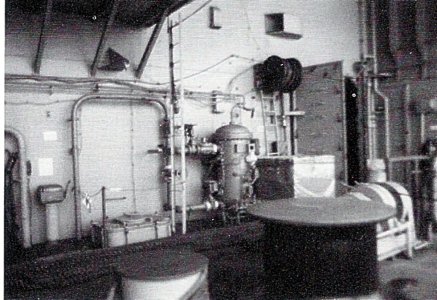
This photo is a hanger fuel station on a museum ship. It is a detailed photo which was very helpful.


JP5 and diesel are similar but JP5 is refined to the same standards worldwide while the standards for diesel can vary widely from nation to nation and time of year. Diesel can be refined from biomass as well as crude. JP5 is refined from crude oil only and it has a higher flashpoint than other jet fuels which is why it is the only jet aircraft fuel authorized for the US Navy (vice JP4, JP8 or Jet Fuel A). To me the diesel smell of jet fuel pervaded the flight deck. When you came off the flight deck after working up there for a day of flight ops your clothes and you reeked of diesel like a bus station. They carried that smell even after a trip through the ships laundry.

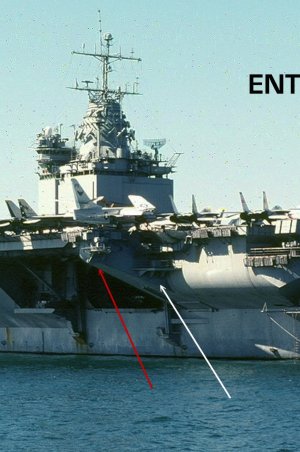
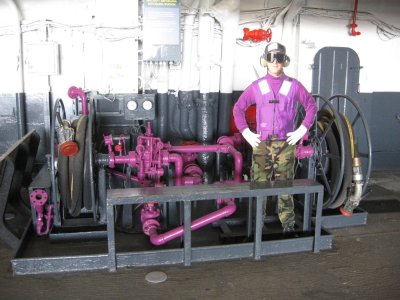
cvn-65-uss-enterprise-246.jpg

This is the midships fuel station on Enterprise. The photos that I have of the other 2 are usable but if you didn’t know what you were looking at you would miss them. Note the width of the reel to the inside versus the one to the outside


When Enterprise was first commissioned, prop aircraft with reciprocating engines were still in use. There were various marks of A-1 Skyraider aircraft and several versions of the C-1 also. Both of these aircraft were used on Enterprise. There were possibly other prop aircraft in use. When I first reported to VA-122 at NAS Lemoore California they still had two T-28 Trojan aircraft. The ship had a C-1A Trader, side number 000 which was used as a utility/ COD aircraft for both of the workups that I made. When we deployed it was left behind. This aircraft still needed type 100 aviation gasoline or AVGAS (highly flammable) .

grumman-c-1a-trader-146057-uss-enterprise-nas-alameda-8aug82-peter-b-lewis-2CB9MM1.jpg

Grumman C-1A Trader BUNO 146057, Modex 000 from USS Enterprise at NAS Alameda, CA on 8 Aug 82.


I know that after the C-1A was retired from the Navy in 1988 and they also got rid of the AVGAS reels on all the carriers at the same time. None of the reels in the hanger dispensed AVGAS according to Wikipedia. I don’t know how they knew that but it referred me to their article on Enterprise. I would guess that the volatility of AVGAS had something to do with that. There was only one AVGAS Station on the ship at the Starboard Bow Between the second and third JP-5 stations.

Hanger Fuel Stations (1)  I made this set but I wasn't at all happy with it.JPG

I made this set but I wasn't at all happy with it, the hose reel was too wide, the hose diameter was too big and the pedestals were a major pain to assemble. The pedestal base sort of dictates the width of the hose reels. Oddly none of the three sets were the same width or height.

Each set of Enterprise specific photoetch sheets that I have feature enough reels to make all the stations on the flight deck. None of them are exactly the same though. I liked the White Ensign sheet as the best of the 3 so they will be reserved for the flight deck. For the hanger I decided to use the reels from the Gold Medal set but I did not care for the pedestals from any of the sets. I did make up an example using parts from both Eduard and Gold Medal sets but I did not like the resulting prototypes. The actual reels at some of stations were different widths. In the hanger I just made them the same width although that is wrong by my one good photo. I tried 3 different versions in all before I finalized my assembly. I had to play around with the width of the reel, the size of the hose, (lead wire)as well as the parts for the pedestal to finally get what I wanted.

Hanger Fuel Stations (3)  I am cutting out the various parts for the station.JPG

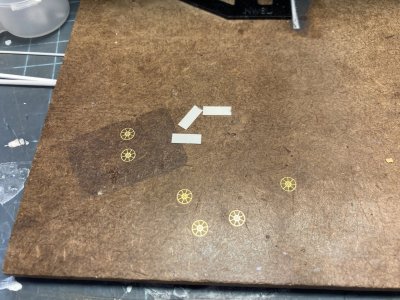
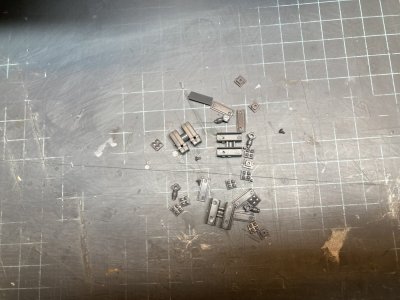
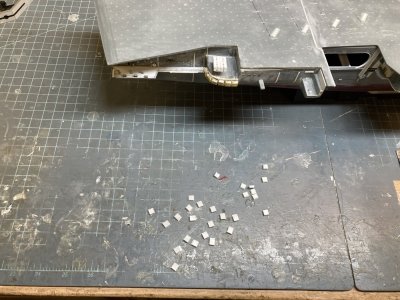
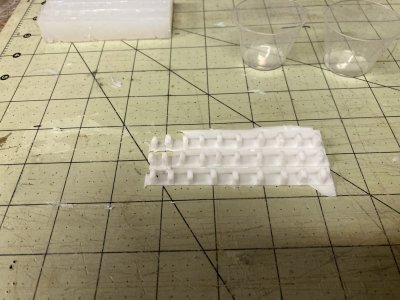
I am getting all the various parts for the fuel station. I have just cut out the bases and removed all the reels from the fret.

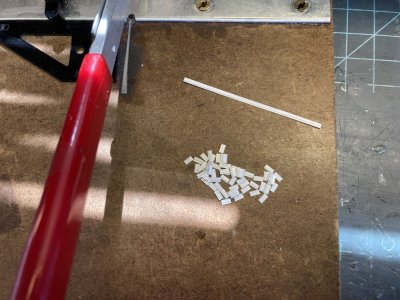
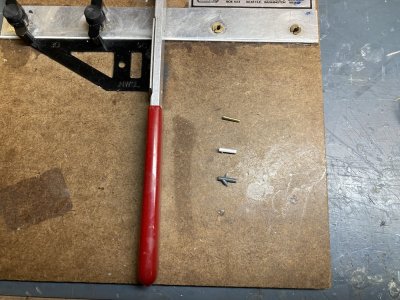
I decided to use plastic strip to make the base and pedestals. I used the widest .010 strip for the base that I had. For the uprights I glued a thin strip on the center of a .010” X .060” strip to give them some detail. This combination long strip was cut into equal lengths slightly longer than the diameter of the reels. I trimmed the pedestals at an angle from the border of the thin strip to the edge of the base. Finally I glued a shorter piece of .020” rod to the thin strip to look like an input/output pipe. For the center of the reel I wound lead wire onto a 2 inch piece of Evergreen 1/16” tubing. I glued the coiled wire tightly in place with thin CA and cut the tube into equal wafers about 1/16” thick with the Chopper.

Hanger Fuel Stations (4)  making the upright supports.JPG

Making the upright supports.

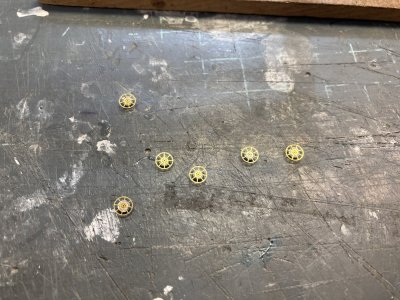
Hanger Fuel Stations (2)  Assembling the hose reels.JPG

Assembling the hose reels.


I glued one upright to the edge of each side of the base strip pipe side out and allowed them to set up, paced an assembled reel next to it and glued the other uprights in position. When the four uprights had firmed up on each base I glued a reel between each with CA. To make some representation of the plumbing I started with a very small section of .040” rod vertically between the pedestals. Another short piece of .025” rod was glued vertically on top of it. Then a second piece of .025” rod was glued on top of the .040” rod perpendicular to the base as an input pipe. This was trimmed just slightly wider than the base. I let all this dry hard.

The midships station is a bit unique since it is placed against a perpendicular bulkhead. Each of the reels is at an angle to the wall at their back in order to make rolling and unrolling the hoses easier. I have some Black Cat Hand Wheels on pipe sections which were used to provide valves. I used one large and 2 small hand wheels on each base. The large valve was glued on top of the input pipe. The smaller ones right next to each inner pedestal pipe. Finally I glued some lead wire to look like connecting pieces of pipe. Not accurate but kind of looking the part. I want a basic method of building and assembling these because there are far more on the flight deck.

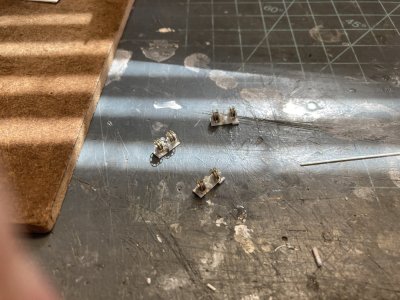
Hanger Fuel Stations (6)  The 3 stations have been assembled and I have been adding extra plum...JPG

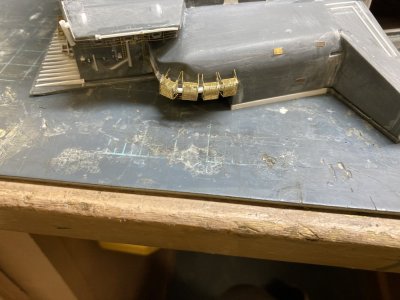
The 3 stations have been assembled and I have been adding extra plumbing to the left most one. It is almost fully assembled and the other 2 are in work.


I had to check these stations in the various positions as the assembly progressed to ensure they would continue to fit. Happily this went well and I went through assembly quickly. After testing a final time I confronted the last part. Tiny, tiny nozzles. Since most of this work will only be seen in photographs and the merest glimpse through the hanger doors the main purpose here was to come up with a sure fire way to manufacture and assemble these reels so that when I get to the flight deck it won’t be like pulling teeth.

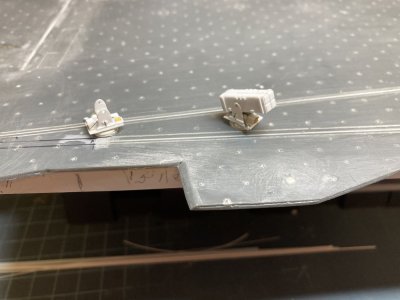
Hanger Fuel Stations (7)  The mostly completed forward fuel station dry fitted.JPG

The mostly completed forward fuel station dry fitted.

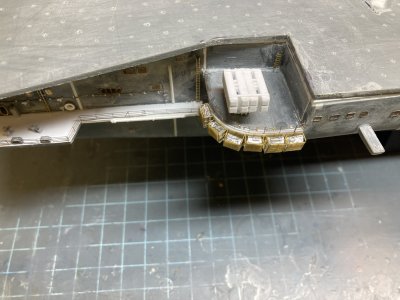
Hanger Fuel Stations (8)  Here the midships station is dry fitted.JPG

Here the midships station is in place.

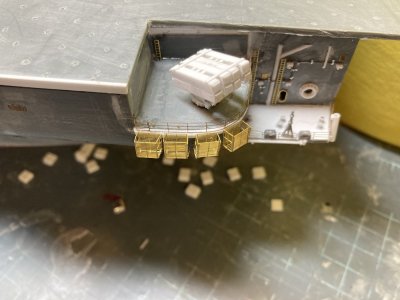
Hanger Fuel Stations (9) The aft station dry fitted note the tiny handwheels.JPG

The aft station: note the tiny hand wheels


Most of aircraft refueling is done at a single point pressure refueling port. This port allowed all the tanks including drop tanks to be refilled at just one place. The nozzle is grounded, then inserted and twisted to cam lock it tightly in place. So this nozzle has 2 handles to grip and give the technician better leverage to lock the nozzle. Fuel is fed under pressure into the system so you do not want this thing coming apart.

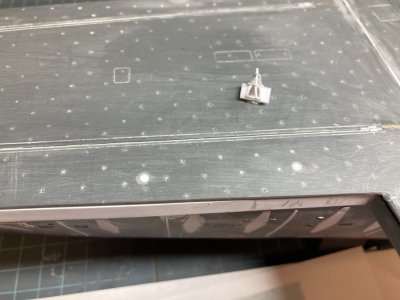
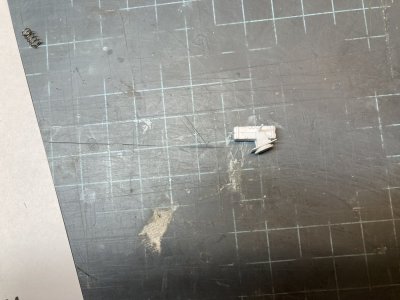
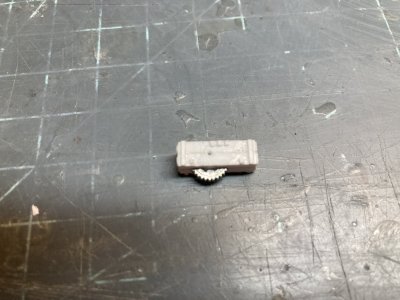
To make these nozzles I tried various gages of wire and bits of micro tubing to represent the fitting. Then since I had already used part of a 1/700 scale vertical ladder to make the windows for the hanger projection booth I cut off three sides of each ladder rung. This made a handlebar of sorts. This was placed on the nozzle and delicately glued in place. I took a small section of the lead wire for the hose and glued it to each reel to look as if the end of the hose was draped over the top. I glued the nozzle to the reel like it was connected to the hose.

This nozzle was used for aircraft but the vehicles did not have this type of port. They used a nozzle like a normal gasoline nozzle but larger. This nozzle was also used to defuel individual drop tanks when they needed to be moved or replaced. I think that they used a similar fitting to fuel the reciprocating engine aircraft. This nozzle was a bit smaller than the pressure nozzle so more experimentation with wire and tube followed until I was satisfied with it. I made three of each type nozzle and placed one of each on the 3 stations. I don’t know if this was the actual configuration but it seemed good to me.

Hanger Fuel Stations (11) The fuel nozzles have been added this part was fiddley.JPG

The fuel nozzles have been added.


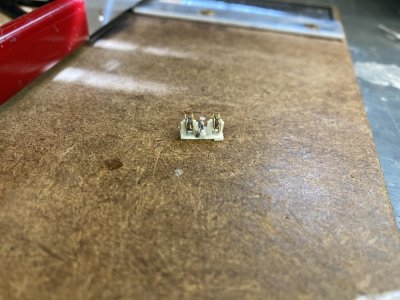
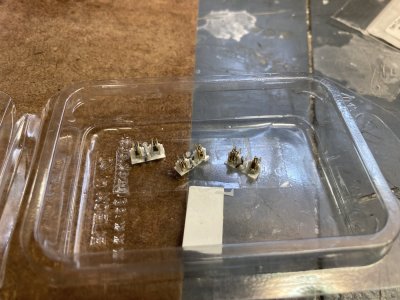
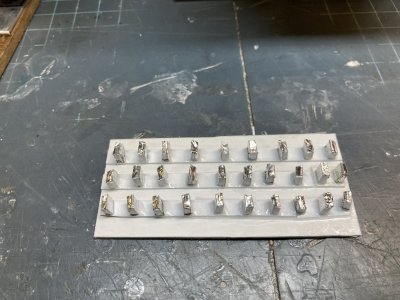
I wanted these made but not installed yet so I had to make a protective box or something to store them until I was ready to put them in place. I had used up a package of Black Cat parts so I re-purposed the package putting down a bigger strip of double sided tape. I marked it clearly and placed the 3 fuel stations inside. Then stored them in a secure location. I am pleased with the results that I have made and it will be a bit easier to make the flight deck reels.

Hanger Fuel Stations (13)  The 3 finished stations going into protective custody.JPG

The 3 finished stations going into protective custody.


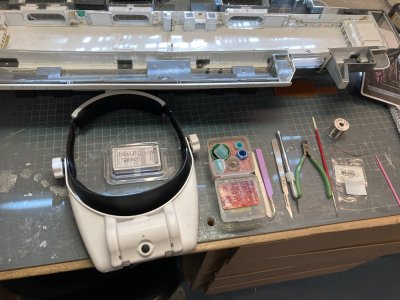
Doing work this fine is difficult for me. I have to fight my eyesight and the arthritis in my hands. So it is all the sweeter when I can make something this small and have it look at least okay. To do this I use some good tools. In the photo below you see the package of hose reels inside the headband of my lighted magnifier. It has one attached lens and 4 other lenses that can supplement it. For these parts I used a 3.5 X lens with a 1.5 X lens.

Super glue is too expensive to waste and I am clumsy so I made this glue station. The aqua colored cap holds enough thin superglue for most sessions, the blue cap holds acetone to keep my applicators clean and the clear cap holds accelerator. I use “T” pins, wire and applicators I made with the eye of a needle and an old paint brush handle. I have 3 of them in small, medium and large they work precisely and neatly. The red applicator is my medium and is lying next to the green handled nippers. I can place a dollop of thick or medium CA on the card in the lid of my station and use a toothpick or the handle from a worn out micro brush to apply glue where needed. The green lid which has a spare thin superglue holder in it is for debonder or acetone when I need to clean a part that I have messed up. This system is working really well for me.

There are two pairs of tweezers which I found by trial and error on the internet. The pink ones are eyelash tweezers and work great for photoetch. The other is an ANYZ set who make superior tweezers as well as model detail parts. They weren’t cheap, about 30 dollars for the pair but so worth it when you need to hold something tiny and not shoot it off into the ether someplace. I have many cheap tweezers that I got on the internet but found they did not work. These are now clamps and heat sink and such. I use both a small scalpel and a standard hobby knife with new sharp blades regularly. The green nippers are strictly for wire and brass. They are sharp and I have had them for years. This also is not something to chintz out on. The lead wire, tubing and copper wire went into each of these reels. I have a variety on my bench and I always look for this sort of thing whenever I am out shopping with my wife. Curiously the lead wire and tubing came from a fishing catalog that somebody sent me in the mail. I am not a fisherman but I found several items in that catalog that I use a lot.

Hanger Fuel Stations (15)  The tools necessary to put these items together.JPG

The tools necessary to put these items together


I hope you find this smaller post easier to digest. Take care and enjoy your modeling.
 
Last edited:
Part 11 The 1960 Commemorative Launching/Commissioning Bronze Medallion

This does not have to do with any part of the model build for the ship but it has a direct relationship with the original vessel. I have a friend Bill Scoggins who like me served in the US Navy. He was an Aviation Ordnance Man. Between 1987 and 1990 he served aboard Enterprise in the Weapons Department as the Leading Petty Officer in G-3 Division. They stowed, broke out, maintained and assembled the bombs that the airwing launched with. They were responsible for transferring these weapons to the flight deck. They also maintain and repair the weapons elevators that moved them. He was aboard during operation Praying Mantis.

In April of 1988 The Samuel B. Roberts FFG-58 hit a mine while operating in the Persian Gulf as part of the Task Force prosecuting Operation Earnest Will. Earnest Will was a show of force to stop Iranian efforts to deny the gulf to the Iraqis. The explosion opened the hull and broke the keel of the Roberts which nearly sank. The heroic damage control efforts of the crew saved the Roberts. The investigation traced the mine to Iran. Iran threatened and harassed ships trying to trade in the gulf and then laid mines. Praying Mantis sank 2 Iranian frigates, numerous small armed boats and captured oil platforms.

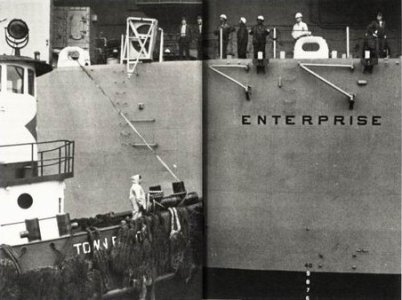
Bill and I met through our wives. He became interested in my build of the Enterprise since he served aboard and is thinking of making his own model. He is also interested in memorabilia related to his service. Neither he nor I were old enough to be invited to the launch of CVAN-65. It would have been something to be there though. On 24 September 1960, the ship was launched. The wife of the Secretary of the Navy, Mrs. William B. Franke, sponsored the ship with the traditional bottle of Champaign. On 25 November 1961, Enterprise was officially commissioned, with Captain Vincent P. de Poix, commanding. De Poix was formerly of Fighting Squadron 6 aboard her predecessor, CV-6.

Memorabilia (5).JPG

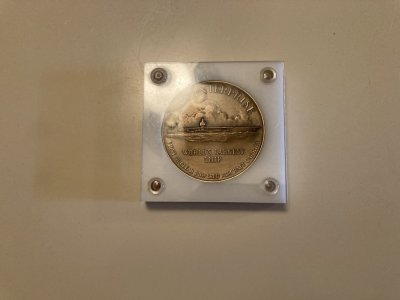
The face of the medallion.

Memorabilia (4).JPG

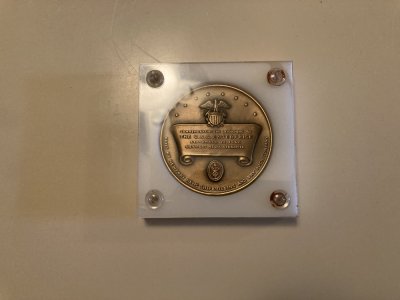
The reverse.


As part of the ceremony a 2 1/2 inch bronze medallion was struck. I haven’t been able to find out any more particulars of who received them but I would guess they were given to the invited guests at least. Maybe they were also issued to the crew as well. Bill found one of these commemorative bronze medallions from the launching ceremony and bought it. I wasn’t aware that he had it. When he told me that he was going to give it to me I was a bit nonplussed and tried to refuse. He was firm and wouldn’t take no for an answer so I accepted it. I will incorporate the medallion into the display of the model to honor the ship and all who sailed in her with many thanks to Bill. I hope my model will live up to Its Namesake.

Memorabilia (1)

Memorabilia (1).JPG

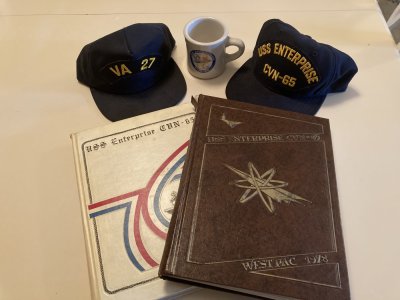
My hats, coffee cup and cruise books from my service on Enterprise.


Any of you readers who have certain knowledge on the history of the medallion please feel free to respond.

 
The medallion you have was a commemorative launch of the aircraft carrier USS Enterprise (CVN-65). This type of bronze medallion was produced to commemorate the ship’s launching on September 24, 1960, at Newport News Shipbuilding and Dry Dock Company in Newport News, Virginia. Shipyards commonly created such medallions for major milestones — keel laying, launching, commissioning, especially for historically significant vessels.
USS Enterprise (CVN-65) was:
  • The first nuclear-powered aircraft carrier
  • At the time, the world’s largest warship
  • The only carrier ever built with eight nuclear reactors
  • In service from 1961 to 2017
The medallion:
  • Front: Relief image of the carrier at sea, with the inscription “World’s Largest Ship” and “First Nuclear Powered Aircraft Carrier.”
  • Reverse: Commemorates the launching date and location, with the builder’s name around the rim.
  • The shipyard emblem at the bottom is the Newport News Shipbuilding logo.
These were typically presented to shipyard officials, Navy personnel, sponsors, or VIP guests attending the launch ceremony. Some were also sold or distributed in limited numbers.
 
Back
Top