• SUBSCRIBE TO SHIPS IN SCALE TODAY!

    The beloved Ships in Scale Magazine is back and charting a new course for 2026!
    Discover new skills, new techniques, and new inspirations in every issue.

    NOTE THAT OUR NEXT ISSUE WILL BE MARCH/APRIL 2026
  • Win a Free Custom Engraved Brass Coin!!!
    As a way to introduce our brass coins to the community, we will raffle off a free coin during the month of August. Follow link ABOVE for instructions for entering.

Planking using small nails

Hi Bob, thanks for that. As I assumed, you've confirmed what the problem is with my Jewellers Drawplate. So the Draw plate of Byrnes would be no different, or is that made for wood? They do say in their "advertising," Could you let me know, please.
BTW, I like to try the Perspex trick, as at least I can drill holes ever so slowly into the plastic, of course. I think that is achievable with the gear I have. Redface

I've only ever used my Byrnes drawplate for wood and it's worked just fine. I will say though that the Byrnes drawplate is for very small diameters and I've only ever used it with bamboo. I expect it would work fine for any quality ship modeling species, though.
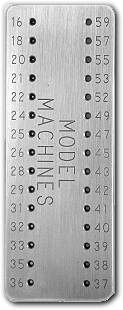
Byrnes' information explains that the drawplate holes start at .016" (3/4" at 1:48) and goes up to .059":
The Byrnes Drawplate is designed to do the job - well, and easily. Thirty precision holes cover the range from .016" through .059" - at 1:48 (1/4" scale) that represents full-size trunnels of 3/4" diameter through almost 2" in diameter!
Note that the Byrnes drawplate (pictured below at close to full size on my screen) is about one inch by three inches. You will need a drawplate that takes will produce at least a .059" diameter piece before you start working your way down on the Byrnes drawplate towards those 1:48 scale trunnels!

1777578434222.png

I have three other presumably Asian-made drawplates for larger sizes. Their accuracy is "catch as catch can." If you want an accurate drawplate, you will have to pay some real money for one, If I have reason to buy another, I won't waste time or money on a cheap one again. They are sold by jewelry supply houses and are "for wire," but I expect could be used for wood if the wood was pulled through them from the "small, holed side." They are available for drawing not only in round cross-section pieces, but also ovals, squares, triangles, diamonds, half- and quarter-rounds, stars, and so on. Bring your credit card. It's not hard to drop a couple of Benjamins on a decent drawplate. See: https://www.ottofrei.com/search?page=7&q=draw+plates

As for making a nifty holder for driving pieces of wire, if you're working with any sort of plastic, be sure to take it slowly and use plenty of lube. If you go at it with a high-speed rotary tool, you'll risk melting the plastic as you drill, possibly causing your bit to seize up and snap.
 
Hi Guys, I made my own draw plate, and it works ok but it was a rushed one. Found a 1"angle iron, 1/8" thick counter drill from underneath to within cooey of the surface and then drilled to size. I could only drill a hole to .45mm, but I can only go to .85 in size as the wood just breaks, just like everyone else says, and my fingers are real sore.
So, it's pointless to make treenails to scale, especially at 1:48 scale, as the reason is, I say again, quite blatant as the decks had plugs made to cover the holes and plugs were the same wood as the deck wood. The reason, as explained by Bob Cleek, stands for good reason not to do it. That's my thinking now. Thanks, Bob, for that.
 
Thanks for that, Mike. Any pics of how you do that? Not familiar with black cartridge paper.
I have a draw plate, and I have tried and just succeeded in using bamboo and made up some 1mm spokes for the Ship's wheel. My arthritic fingers are still feeling the effects of pulling the wood through the holes. Not complaining, though, as it would have been a huge problem to do otherwise.
I find the cocktail sticks very tough to draw down, but Bamboo was a little better. The draw plate or Jeweller's Draw Plate came from China and is supposed to be tungsten.
How many tree nails can you do in a day?

I have been looking around for just .30mm drills as advertised, but, yes, like you say, what quality are they?
I do as many as I can before boredom sets in! I may use splinters of basswood, my usual planking wood, instead of cocktail sticks. As reagrds cartridge paper, this is just thin black card which I cut into strips as wide as my planks are thick. I only do this for the deck, not the hull, but pin all planks.

IMG_0176.jpg
 
For those who feel they absolutely must use scale treenails, there is another method besides using round pegs made with a drawplate. That is to drive square pegs in round holes. This is an old ship modeler's trick that probably goes back to the eighteenth century when Admiralty Board models were being built.

The way this is done is to use two species of wood. The "receiving part" must be made of a harder species of wood than the "treenail part." An example using modernly available wood species would be cherry for the planking and basswood for the "treenail."

The treenails are gotten out of a very thin wedge of the softer wood. The wedges are gotten out of small billets of stock with the grain running perpendicular to the long length of the billet. This is easily accomplished with a table saw with the blade set at a slight angle. (A piece of thin stock can be sanded to the angled shape as well, although this is more work.) The wedge-shaped sticks produced in that fashion should be thin enough to fit easily in the holes provided for the treenails with the very gradual taper of the cross-section sized to be driven tightly into the treenail hole.

Alternately, particularly for very small treenails, round, solid birch wood toothpiciks may be used instead of 4-squared wedges. The toothpicks may alread be sufficiently tapered

The treenails are made by splitting them off the wedge-shaped stick by cutting downward with a small chisel, hobby knife, razor blade. or one of those "chopper" tools. The treenails are easy to cut off the wedge-shaped stick as the grain is running across the length of the strip. The treenails will be in the shape of elongated dowels and the points can simply be driven into the treenail holes, the excess sanded off fair. The remaining toothpick offcut can be turned in the shape of a pointed round dowel again by rotating it against a sanding disk and this process repeated until there is no longer sufficient toothpick left to make another trunnel.

The square edged treenails are then driven into the round treenail holes. What happens is that the round holes, being harder than the softer treenails, will compress the edges of the treenail, much like a drawplate works. The treenails must be shaped with a very gradual angle so that the treenail will drive into the hole and seize up in the hole as the treenail gets wider. The treenails must not be so long that they bottom out in the hole before jamming tightly against the sides of the hole. (If necessary, a wedge-shaped stick can has its pointed end cut off so that the treenails will be wide enough to be placed in the holes, but the treenails gotten out of is not so long as to bottom out in the holes.) Sizing, of the treenails will obviously depend upon the size of the holes and their depth, so a bit of experimentation is requires in each instance this method is used, but this is not difficult to accomplish with some scrap wood to determine the proper length the treenails and the degree of taper of the strips cut to cut the treenails off of. The more gradual the taper of the treenails, the better they will hold when driven into the holes. The greater the friction between the sides of the hole and the treenail, the better the fastening. Nothing more than a dip in a container of shellac should be required to ensure long-term adhesion. The friction between the hole and a properly gradually tapered square treenail is surprisingly great all on its own.

Once the treenails are placed, the ends standing proud of the fastened surface are cut flush with the fastened surface and then sanded fair. The holes will have compressed the square edges of the treenails so that when the surface is sanded fair, the treenail will appear perfectly round and perfectly fitted into the hold.

None of this should be taken as encouragement to pock-mark your models with out of scale contrasting colored treenails. In most all the usually used scales, the trunnels or countersunk fastener plugs are invisible details at scale viewing distance. Many modelers persist in portraying them, nonetheless. For that reason, I mention the above options which do not require using a drawplate and which can produce scale trunnels and plugs, if you must.

 
Back
Top