

• Win a Free Custom Engraved Brass Coin!!!
    As a way to introduce our brass coins to the community, we will raffle off a free coin during the month of August. Follow link ABOVE for instructions for entering.
  • SUBSCRIBE TO SHIPS IN SCALE TODAY!

    The beloved Ships in Scale Magazine is back and charting a new course for 2026!
    Discover new skills, new techniques, and new inspirations in every issue.

    NOTE THAT OUR NEXT ISSUE WILL BE MARCH/APRIL 2026

Planking using small nails

Bob Cleek, that is the best analysis of the application of scale to modelling that I have read. Ever. Thankyou! I have saved it for reference.
I would add a small comment.
I made a 1:93 model of Constitution, and did not add anything to mark the presence of deck securing nails or trenails, on the grounds that the scale size of the visible parts on the deck would have been only microns. But the deck looked a bit bland, naked even. A bit fake and toylike.
Currently I am making a scratch 1:72 HMS Bellerophon/Elephant (not decided which yet). I calculated the size of the trenails at deck level to be 0.25mm diameter at the scale. To avoid repeating the nakedness I lasered marks for the trenail "heads" and plank edges and end joins. Photos at different distances are attached. I think that the nakedness has been avoided but would be interested in opinions from others.
When showing the model to other modellers I have noted that they do tend to inspect the deck at a distance, then come in for a closer inspection.
Bob, do you think that while the model size of each trenail is minute, perhaps we should consider acknowledging the visual effect of the sheer number of those trenails?
trenails View attachment 594952View attachment 594953
Hi Gary,
Don't know which "26" you are referring to.
The close up photo probably equates to viewing the full size Bellerophon deck from about 15'/4.5m above. The model deck planks are 3.1mm wide; x72=220mm/9". The wooden trenails in British ships of the era were typically 1.5" diameter at the deck. So yes, I think that the model trenail dots are about the correct diameter. Maybe a little darker than required, but pretty close.
Where in Oz are you located?
Johnv

 
Btw, my fingers and hands are suffering still, from trying to pull the wood through the draw plate. My golf has been really affected as to the result of sore hands. LOL
I usually trim the end of each "stick" to get it started into the largest hole but use pliers to pull it through instead of fingers. I crush a little of the end of each stick as a result but no big deal as it saves my fingers and make things go more quickly.

If there is anything that affects my golf game, including making treenails, I add it my excuse book, which has gotten quite long over the years and comes in quite handy at times. Six of us are heading out on our first trip to St. Andrews in three weeks where I hope to learn some really good new excuses from the locals. :)

Allan
 
Gary,

Lots of differing opinions above on nails, treenails, material, size, etc.

Having viewed many superb models in Greenwich, Annapolis, etc...the range of treenail solutions shown in these renowned museums runs a wide gamut too!

Examples of invaluable models with grossly oversized treenails are the POW Bone models in the Rogers collection at the US Naval Academy. In spite of this, they still have a beauty of their own (see below):
View attachment 594975

Some make an attempt at being subdued by trying to make them not contrast too much (color wise). Almost all the period models in these collections seem oversized??
View attachment 594976

Some seem to make the model look like it has chickenpox (IMHO).
View attachment 594978

Other superb examples use no treenails at all.
View attachment 594979

Finally, contemporary models have begun using metal wire to simulate the wood plugs that cover the metal bolts.
View attachment 594980

Any choice you make will be based on your intent: true to scale replica or a piece of art that pleases you.

IMHO, an exact, true to scale replication, would not use any treenails because, as Bob Cleek explains, they wouldn't be visible without high power magnification.
Thanks, Brad. Yes, I think I stated in my last email about " how the owner wants the model to look."
All I say is whatever you do, make sure it is not blatantly out of context to the scale. I guess. I will have to wait and see what I think of doing when I get to that stage. Just trying to find a good person who sells genuine HSS drill bits would put me in a class I want to be in, not what is ok.
Thanks for the photos, the models are very impressive. cheers
 
I usually trim the end of each "stick" to get it started into the largest hole but use pliers to pull it through instead of fingers. I crush a little of the end of each stick as a result but no big deal as it saves my fingers and make things go more quickly.

If there is anything that affects my golf game, including making treenails, I add it my excuse book, which has gotten quite long over the years and comes in quite handy at times. Six of us are heading out on our first trip to St. Andrews in three weeks where I hope to learn some really good new excuses from the locals. :)

Allan
Yes, I even did that (Pliers), but the stick parted company, as I had to pull like a bull in springtime to make it work.
I am trying to contact Byrnes at the moment, as their website has a few problems if you don't live in the USA. The reason why the drawplate I use is no good is that, being a tungsten insert in the makeup of the plate when using wire, there must be a taper going into the hole, as it has to be a negative rake. That causes the problem, I think, but I wonder if your Byrnes drawplate has a taper going into the hole as well?

Lucky you, mate. Lovely course. Hope you don't have to find excuses because you have a great day of golf at St Andrews, the home of golf. Never know, you may find a Tiger around the course to give you some tips, if he travels there that is.
Regards
Gary
 
Last edited:
Bob, do you think that while the model size of each trenail is minute, perhaps we should consider acknowledging the visual effect of the sheer number of those trenails?

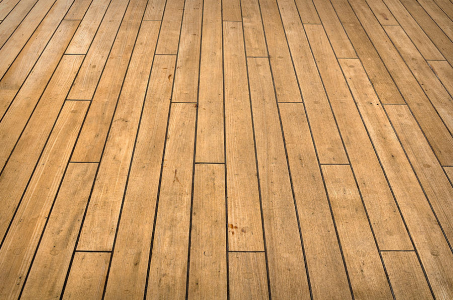
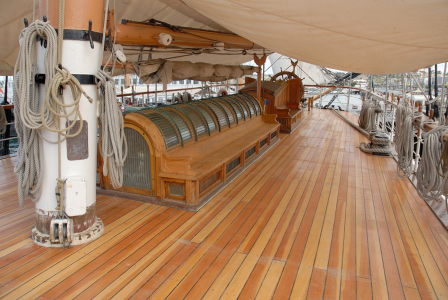
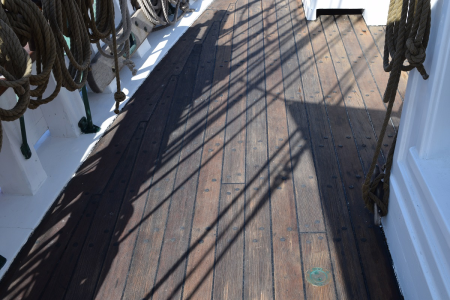
Well, unless there's some color contrast between the treenails' species and the deck planking species, the treenails (or countersink plugs) will be darn near invisible at just about any distance. Can you see the plugs in the photo below?

1777307470991.png

I agree that "clean" decks often look "too perfect" or "toy-like" on a model. I think most model decks look better with a bit of darker stain and, where possible, given the scale, a bit of unevenness of color. A light wash often works well on a deck. When the slight darkening effect of scale viewing distance on color is overlooked, the result is often a deck that looks too "light." A bit of judicious (and restrained) weathering is usually in order to get a realistic deck at scale viewing distances. Keep in mind also that deck "sheet" material, usually a sheet of plywood or thin flat stock with seams cut or laser-etched into it, can end up looking absolutely awful if the grain and figuring of the piece is itself grossly out of scale, spanning multiple planks. For this reason, individual planking, tedious as it is, generally yields the more realistic deck.
 
The reason why the drawplate I use is no good is that, being a tungsten insert in the makeup of the plate when using wire, there must be a taper going into the hole, as it has to be a negative rake. That causes the problem, I think, but I wonder if your Byrnes drawplate has a taper going into the hole as well?

Keep in mind that there are two types of drawplates. One is for wood and the other is for wire.

The wire drawplate has a chamfered hole on one side of the plate so that the opening of each hole is larger on one side of the plate than on the other. The lubricated wire is fed through the wire drawplate entering the large side of the hole and exiting the smaller side of the hole. Drawing wire through the cone-shaped hole compresses the wire to size. Thus, a piece of wire properly drawn to size will increase in length as it decreases in diameter because the compressed metal has to go someplace.

The wood drawplate appears the same as the wire one with a chamfered hole on one side of the plate so that the opening of each hole is larger on one side of the plate than on the other, but, unlike the wire drawplate, if properly made, the chamfers on the holes in a drawplate for wood will extent through the drawplate to the smaller exit hole, thereby creating a sharp edge where the bottom of the chamfer intersects with the bottom (small holes side) of the plate. The wood drawplate operates in the opposite direction from the wire drawplate and operates differently by scraping wood from the circumference of the piece of wood drawn through it. The wood drawplate does not compress the wooden piece drawn through it from the "big side" of the hole to the "small side" of the hole in the plate. Rather, the wood drawplate removes wood from the circumference of the wooden piece by scraping it from the "small side" of the hole to the "large side" of the hole past the sharp edge of the hole created by the angle of the chamfer.

The wood drawplate is "sharpened" by honing the "small holes side" of the plate on a flat surface (like you do with the back of a plane iron) so that metal is removed from the side of the plate with the small holes. There is no need to remove metal from the side of the plate with the larger chamfered holes. The hole chamfering on a wood drawplate merely serves the purpose of permitting a bit of flexion on the "exit end" of the hole when the wood is pulled through, thereby minimizing breakage of the piece during drawing it.

It's not my understanding that wood and wire drawplates are intended to be used interchangeably, although I don't know of a reason why they couldn't be if one were sharpened. I suppose a real tool wonk would be concerned about the type of metal used for each type of drawplate. That would affect the plate's edge-holding ability if used for sizing wood. On the other hand, sharpening by honing the back of a wire drawplate will have the effect of thinning the plate and thereby enlarging the small end of the holes, thereby destroying the intended accuracy of the size of the holes. I have heard tell that honing one side of a metal drill index will permit it to be used as a wood drawplate, although I've never tried it.

What are marketed as "jeweler's drawplates" are intended for use on wire. Frankly, I've never seen a drawplate marketed specifically for wood. The

In summary, wire goes in the big hole side of a wire drawplate and is drawn out of the small hole side to squeeze the wire thinner as it goes through the "funnel" created by the chamfer. Wood goes in the small hole side of the drawplate and is drawn out of the large hole side of the drawplate to scrape wood off the circumference of the wooden piece to make it thinner.

Trying to pull a piece of either wood or wire through either type of drawplate from the wrong end will not go well.
 
Examples of invaluable models with grossly oversized treenails are the POW Bone models in the Rogers collection at the US Naval Academy. In spite of this, they still have a beauty of their own (see below):
2_bone_gb.jpg

POW models are generally characterized by out-of-scale details and multiple inaccuracies. They fail the accepted test for a high-quality scale ship model: "A high-quality scale ship model provides a compelling impression of an actual vessel within the constraints of historical accuracy." POW models usually fail to "provide a compelling impression of an actual vessel within the constraints of historical accuracy. " However, this only means that they are not "high-quality scale ship models." They are ship models nonetheless, "POW" ship models to be specific. They are worthy of appreciation, study, and value by virtue of their antiquity, historicity, accuracy in some details such as rigging, and visual appeal. They are not works of "fine art" as many "high-quality scale ship models" would be, but rather are highly valued works of "folk art."

Some make an attempt at being subdued by trying to make them not contrast too much (color wise). Almost all the period models in these collections seem oversized??
2_rigging.jpg

Period models which are finished "bright" (i.e. unpainted) will sometimes show some visible treenails of the same wood species as the timbers they fasten because these treenails are actually functioning fastenings in the construction of the model. Slight color contrast between the treenail and the timbers may be the result of a difference of color between slightly different pieces of the same species or a difference in grain direction.

Some seem to make the model look like it has chickenpox (IMHO).
Bow.jpg

Some contemporary models were designed to show, or at least suggest, the actual construction details of the subject vessel. These are often those which exhibit the familiar "open framed" unplanked hull presentation and are fastened with contrasting treenails to demonstrate the run of the framing beneath the planking. They look sort of "poxy" to me, too, but I'd take one if somebody gave it to me.

Other superb examples use no treenails at all.
Stern quarter.jpg

It's a matter of taste, I suppose, but to my eye, while any Admiralty Board model is great for a lot of different reasons, these ones are the best of the bunch.

Finally, contemporary models have begun using metal wire to simulate the wood plugs that cover the metal bolts.
Robuck bow.jpg

So they have. So they have. Some use black plastic fishing line, too. This model looks like it was built by the guy who's been redecorating the White House lately. Overdone gold leaf and yellow metal ironwork. Certainly a technically well-done model and presumably accurate, as far as it goes, but the yellow metal fasteners showing make no sense at all, except to signal that the builder was apparently more interested in showcasing his own skill than he was in representational accuracy. They must have been a real pain in the butt to sand fair.
 
Hi Everyone, I am quite curious to see how many model shipwrights use nails to scale when doing planking, etc.
I have acquired these nails from the internet, and, being very hard to see with these tiny naked eyes, is that why most shipwrights use a pencil? Or is the drilling of the holes a problem?
View attachment 593853View attachment 593855
They are 0.3 mm by 4mm in length and have a 0.5 mm head.
So, I have worked out that the nails the old long-time-ago shipwrights would have used in the 17/18Th century would have been copper, wood, or iron nails, or though the latter would have begun use in the 18th century. Their sizes would have varied for the application they were going to be used for. Today I am talking about the planking on the decks, and either copper or iron was used, and a large dab of tar was added to the hole to stop the rot of the nail. So saying this is why people use a pencil to show the staining of the tar, or just a easy way to create the belief of a nail being put in the wood to hold the plank to the timbers underneath.
I would also like to know why not pre-drill the holes slightly oversized so the nails would easily fit into the holes.
Drills and what to be careful of when buying them: I have a few of those packets of modellers drills, and I decided to buy another set of them as a few of the smaller drills have gone missing or broken. I bought another pack off the net and thought, no worries, have some replacements for those missing, that was a year ago. Well, today, I pulled out this new set of drills and looked at a .3mm drill, and it appeared to be too big by my eyesight. I measured and found it was 0.6mm, not 0.30mm. So I went to the next slot and took out the next size drill and measured that, 0.6 again, and the next one was the same. In total, 4 drill bits were all the same. So I could not check out if the fit was too small at the .30 mm hole or .35 was the way to go
Olha has done a video of similar wire nail fixing. She uses a tool made of a small piece of acetate with holes drilled of varying depths to drive the nails.
 
Well, unless there's some color contrast between the treenails' species and the deck planking species, the treenails (or countersink plugs) will be darn near invisible at just about any distance. Can you see the plugs in the photo below?

View attachment 595104

I agree that "clean" decks often look "too perfect" or "toy-like" on a model. I think most model decks look better with a bit of darker stain and, where possible, given the scale, a bit of unevenness of color. A light wash often works well on a deck. When the slight darkening effect of scale viewing distance on color is overlooked, the result is often a deck that looks too "light." A bit of judicious (and restrained) weathering is usually in order to get a realistic deck at scale viewing distances. Keep in mind also that deck "sheet" material, usually a sheet of plywood or thin flat stock with seams cut or laser-etched into it, can end up looking absolutely awful if the grain and figuring of the piece is itself grossly out of scale, spanning multiple planks. For this reason, individual planking, tedious as it is, generally yields the more realistic deck.
I like the staining on the deck timbers, so what would be used on the deck wood to get this type of look?
BTW I can just see the plugs but not all of them. Is this a real wooden ship's deck? Bob,
 
Keep in mind that there are two types of drawplates. One is for wood and the other is for wire.

The wire drawplate has a chamfered hole on one side of the plate so that the opening of each hole is larger on one side of the plate than on the other. The lubricated wire is fed through the wire drawplate entering the large side of the hole and exiting the smaller side of the hole. Drawing wire through the cone-shaped hole compresses the wire to size. Thus, a piece of wire properly drawn to size will increase in length as it decreases in diameter because the compressed metal has to go someplace.

The wood drawplate appears the same as the wire one with a chamfered hole on one side of the plate so that the opening of each hole is larger on one side of the plate than on the other, but, unlike the wire drawplate, if properly made, the chamfers on the holes in a drawplate for wood will extent through the drawplate to the smaller exit hole, thereby creating a sharp edge where the bottom of the chamfer intersects with the bottom (small holes side) of the plate. The wood drawplate operates in the opposite direction from the wire drawplate and operates differently by scraping wood from the circumference of the piece of wood drawn through it. The wood drawplate does not compress the wooden piece drawn through it from the "big side" of the hole to the "small side" of the hole in the plate. Rather, the wood drawplate removes wood from the circumference of the wooden piece by scraping it from the "small side" of the hole to the "large side" of the hole past the sharp edge of the hole created by the angle of the chamfer.

The wood drawplate is "sharpened" by honing the "small holes side" of the plate on a flat surface (like you do with the back of a plane iron) so that metal is removed from the side of the plate with the small holes. There is no need to remove metal from the side of the plate with the larger chamfered holes. The hole chamfering on a wood drawplate merely serves the purpose of permitting a bit of flexion on the "exit end" of the hole when the wood is pulled through, thereby minimizing breakage of the piece during drawing it.

It's not my understanding that wood and wire drawplates are intended to be used interchangeably, although I don't know of a reason why they couldn't be if one were sharpened. I suppose a real tool wonk would be concerned about the type of metal used for each type of drawplate. That would affect the plate's edge-holding ability if used for sizing wood. On the other hand, sharpening by honing the back of a wire drawplate will have the effect of thinning the plate and thereby enlarging the small end of the holes, thereby destroying the intended accuracy of the size of the holes. I have heard tell that honing one side of a metal drill index will permit it to be used as a wood drawplate, although I've never tried it.

What are marketed as "jeweler's drawplates" are intended for use on wire. Frankly, I've never seen a drawplate marketed specifically for wood. The

In summary, wire goes in the big hole side of a wire drawplate and is drawn out of the small hole side to squeeze the wire thinner as it goes through the "funnel" created by the chamfer. Wood goes in the small hole side of the drawplate and is drawn out of the large hole side of the drawplate to scrape wood off the circumference of the wooden piece to make it thinner.

Trying to pull a piece of either wood or wire through either type of drawplate from the wrong end will not go well.
Hi Bob, thanks for that. As I assumed, you've confirmed what the problem is with my Jewellers Drawplate. So the Draw plate of Byrnes would be no different, or is that made for wood? They do say in their "advertising," Could you let me know, please.
BTW, I like to try the Perspex trick, as at least I can drill holes ever so slowly into the plastic, of course. I think that is achievable with the gear I have. Redface
 
Olha has done a video of similar wire nail fixing. She uses a tool made of a small piece of acetate with holes drilled of varying depths to drive the nails.

Yes, I am aware of Olha's video on that, bless her heart.


She uses the generally accepted method of creating headed nails and driving them with a shop-made tool. She doesn't seem to explain it too well in the beginning, but she has an international audience, so she relies on the visuals to instruct and misses some details occasionally. Anybody who plans to duplicate her technique should be aware that it is imprtant to 1) anneal the brass wire before cutting (or buy pre-annealed wire) and 2) to cut the sections of wire which are to become "nails" exactly as she does in her video, by rolling the wire under a somewhat dull knife edge against a hard surface to cut sections twice the length of the nails desired. What's happening in the video, but isn't explained, is that the pressure of the dull knife edge pressing on the rolling wire creates a "head" on either side of the cut. The sectiions cut in this fashion are then cut in the middle with a diagonal cutter which produces two headed "nails" of equal length. She gets an excellent result which looks quite nice and these headed nails pressed into a tightly fitting hole actually hold the plank as a real headed nail would.

Unfortunately, Ohla's experience, if her videos are any indication (and I've been following them since she began posting them years ago,) is very heavily weighted on the "kit assembling" end of ship modeling and, consequently, I fear she's picked up some "bad habits." :) (Which isn't to say that she's not a very good modeler and there's much that can be learned from her videos.) My own ship modeling philosophy is more closely aligned with her husband, Kroum's views, which differs somewhat from Ohla's. :D

The referenced model of Le Cerf is, as far as I know, the only one of her builds which she describes as a "scratch build." While really of no relevance to the present issue of nails, it should be noted that many "purists' would hesitate to call this build "from scratch." It is a build which follows the excellent Ancre monograph,
MONOGRAPHIE DU CERF - Cotre - 1778 (CUTTER LE CERF BUILD BY DENYS 1779-1780 A MONOGRAPH with eleven plates at 1:48 scale) written by Jean BOUDRIOT & Hubert BERTI. The monograph contains detailed instructions and scale patterns for cutting out all the parts, even down to the jogged faces of the frames which accommodate the lapped planks. From the looks of Ohla's video, she also had the benefit of a digital copy of all the parts suitable for driving a laser-cutter which produced all the parts in laser-cut form from the raw stock she provided. Thus, for all intents and purposes, it was a "digital" kit, not really an original scratch-built model researched and engineered by Ohla. This is not to say that (after a bit of a rough start) she hasn't done a high-quality job building it.


The planking on this model is lapstrake or "clinker," as some call it. The planks overlap one another, rather than being hung edge to edge. It is not uncommon in full-size practice to drive nails through the overlapping lapstrake planks, leaving the heads proud of the outboard face of the plank and clinched (points bent over) inboard or, alternately, to set rivets with the heads outboard proud of the plank face and headed over a rove ("washer") inboard. This is commonly seen in small clinker craft, as well as larger vessels such as the classic "Viking" longboats. Such fastenings, where they may be visible at scale viewing distance, are not inappropriate, of course. However, in this particular instance, if the Ancre photos of a completed model from the monograph are any indication, the hull planking was fastened with wooden plugged countersunk fasteners or treenails which are not visible at scale viewing distance even if the model is finished "bright' (without an opaque coating hiding the natural appearance of the wood.) Boudriot and Berti are a couple of the "gods" of modern scale ship modeling, so I'm going to presume that they were correct and Olha's presentation of black nail heads all over her hull planking is incorrect. Perhaps she's been "brainwashed" by her extensive history of kit assembling to appreciate such "faux detail" and just got carried away with it this time. I don't know. Such things happen. I recently saw a beautifully done lapstrake ship's boat built by one of my favorite master scale modelers who, absent mindedly perhaps, showed all the planking rivets with amazingly small headed shanks over scale roves. It was one of those things that takes your breath away to look at... except in this case, he's put the rivets in backwards with the rivets driven from the inside of the hull and the roves on the outboard face of the planks. As the saying goes, " **it happens." (On one of my first serious models, at 1:96 scale, all the deadeyes are upside down. :rolleyes: )

From all indications, Olha did a beautiful job on her Le Cerf, and to tell the truth, I'd never have noticed her faux pas and ever mentioned it if you hadn't brought it up! ROTF The moral of the story is that don't go by Ohla on this one! :D


Below: Ancre's prototype model. No nails!
1777342100421.png
 
Last edited:
Hi Gary,
Don't know which "26" you are referring to.
The close up photo probably equates to viewing the full size Bellerophon deck from about 15'/4.5m above. The model deck planks are 3.1mm wide; x72=220mm/9". The wooden trenails in British ships of the era were typically 1.5" diameter at the deck. So yes, I think that the model trenail dots are about the correct diameter. Maybe a little darker than required, but pretty close.
Where in Oz are you located?
Johnv
Hi John, the number 26 is on the model you show in the pic, and through the hatchway (near the centre mast hole) to the second floor, there is a big number 26 written in a marking pen.
I live in Western Australia, a bit south of Perth. Where do you live?
 
Last edited:
After looking at all the fantastic comments, I notice something about nails, plugs, etc. For realism, any modeler from a 1:48 scale or smaller, there is no chance to see where the nails were used, as they have a wooden plug fitted that just blends into the wood as if it were just wood. So that answers the question about authenticity for me.
Maybe someone has said that, but I am making my decision from the facts. Will there be any signs of nails on my model? If I add copper to the hull?
I don't think I will do that as I am a man of wood where wood should only be, and coppering the hull, well, not following my authenticity, I won't copper it, but show off a beautiful wood, although near extinct, called Tasmanian Myrtle. Tasmanian Myrtle is as close to Swiss Pear in its workability and finish, but the color is different.
However, if there are places on the model where bolts are used, then I will use steel or brass.
 
Well, unless there's some color contrast between the treenails' species and the deck planking species, the treenails (or countersink plugs) will be darn near invisible at just about any distance. Can you see the plugs in the photo below?

View attachment 595104

I agree that "clean" decks often look "too perfect" or "toy-like" on a model. I think most model decks look better with a bit of darker stain and, where possible, given the scale, a bit of unevenness of color. A light wash often works well on a deck. When the slight darkening effect of scale viewing distance on color is overlooked, the result is often a deck that looks too "light." A bit of judicious (and restrained) weathering is usually in order to get a realistic deck at scale viewing distances. Keep in mind also that deck "sheet" material, usually a sheet of plywood or thin flat stock with seams cut or laser-etched into it, can end up looking absolutely awful if the grain and figuring of the piece is itself grossly out of scale, spanning multiple planks. For this reason, individual planking, tedious as it is, generally yields the more realistic deck.
Well, if I was to place trenails in such an abnormal number and positioning I guess that I would try to make them as invisible as possible, even to the extent of lining up the end grain of the trenails with the figuring of the planks. Also, end grain tends to darken with ageing, effects of weathering, and staining, etc. So some contrast between the trenails and planks would not be unexpected, as is shown with many of the trenails in the photo.
Hi John, the number 26 is on the model you show in the pic, and through the hatchway (near the centre mast hole) to the second floor, there is a big number 26 written in a marking pen.
I live in Western Australia, a bit south of Perth. Where do you live?
OK found it. That part number wont be visible when the next deck goes on. And I am in Geelong Victoria. Drop in if you ever get over here. John.
 
For English ships, when securing deck planking in the 17th and 16th centuries, they used metal spikes, usually iron, but according to Peter Goodwin, once they were driven home they were covered with wooden plugs, not tar or other sealants. I would not be surprised if they were covered with other media on some ship but I have not found an information based on contemporary sources about anything other than wooden plugs. I do not like to use the words never, always, only, etc for ships in the age of sail due to the many exceptions/variations tried but you will not be wrong to use wooden treenails as the exposed part will look like a round 1.5" diameter (0.8mm for 1:48, 0.6mm for 1:64, or 0.4mm for 1:96)wooden cover over the would be spikes. Tar or similar would not look like any contemporary model of English warships in the 17th and 18th centuries that I have seen, but maybe some member has photos of an exception
Allan.

View attachment 593868
While Victory is a modern ship now with fiber glass cannon and such, if they were true to reconstruction, you can see the wooden plugs rather than tar or other sealants. Tar and feet would be a mess on hot days.

View attachment 593869
 
Well, if I was to place trenails in such an abnormal number and positioning I guess that I would try to make them as invisible as possible, even to the extent of lining up the end grain of the trenails with the figuring of the planks. Also, end grain tends to darken with ageing, effects of weathering, and staining, etc. So some contrast between the treenails and planks would not be unexpected, as is shown with many of the trenails in the photo.

Treenails are made with the grain running the length of the treenail. Carvel planking is vertically sawn. Treenails are driven with their grain running perpendicular to the wood into which they are placed in order to maximize their holding power when the treenail and the surrounding wood swell in opposite directions. "(L)ining up the end grain of the trenails with the figuring of the planks" is never done.

Countersink plugs are always cut with the grain running across the round dimension of the plug. Countersunk plugs are set with their grain running in the same direction as the grain of the wood into which they are placed. This "with the grain" orientation minimized the tendency of the surrounding wood when shrinking and swelling to "spit" the plug by working it loose by wood expansion and contraction in opposing directions. For the same reason, plugs are always made from the same species, and preferably, from offcuts of the same sawn stock, as the wood into which they are placed so their shrinking and swelling rate will be the same as the surrounding wood.

On my planet, I haven't noticed that "end grain tends to darken with the effects of aging." The greater amount of softwood exposed in endgrain may permit greater stain penetration, but since decks are never stained, that is not a consideration. Moreover, even were there any difference in the weathering appearances of the deck and plug or treenail wood, routine holystoning would have exposed "new" wood on a regular basis, thereby negating any apparent difference in appearance between plugs, treenails, and vertically grained deck planking.

Surely, many ship modelers today, especially those who focus primarily on assembling kits, will have their own particular reasons for wishing to show metal fasteners and contrasting plugs and treenails on bright-finished models, which is certainly their prerogative, but they must expect and accept that unless they are present to explain to a knowledgeable viewer's satisfaction those particular reasons, anybody who knows what they are looking at will be thinking, "Why would anybody build a model and cover it with a bunch of distracting contrasting spots?"
 
Also! Deck planking must be flush. In other words, nothing protruding that a sailor might trip over, on a dark night.

A plug driven into a hole is easily cut with a chisel flush with the surrounding deck structure because as Bob says, one is cutting with the grain.

If a treenail is driven into a hole, it would be much harder to trim truly flush as one is trying to cut across the grain.

In high quality boatbuilding the idea is to hide the fasteners.

Roger
 
Also! Deck planking must be flush. In other words, nothing protruding that a sailor might trip over, on a dark night.

A plug driven into a hole is easily cut with a chisel flush with the surrounding deck structure because as Bob says, one is cutting with the grain.

If a treenail is driven into a hole, it would be much harder to trim truly flush as one is trying to cut across the grain.

In high quality boatbuilding the idea is to hide the fasteners.

Roger
Yes, you can do your sums, and it is quite an easy thing to do. Say a nail, no matter wood or steel, protrudes on your model 0.002" (which it will after sanding also) equates on a 1:48 scale to 0.09" stickout on a full-sized boat. Could you imagine a boat being built with 9 thou sticking out of the deck wood?
Sounds a bit silly to me as wooden plugs are used, and there is no nail or tree nail used that has its top end showing.
Anyway, that's how I see it.
I will soon bring up an interesting topic regarding all the model boat essential item that has to be made or cast. Watch the new section. Have to check if someone has already made a forum for the jobbie.
Cheers everyone.
 
Treenails are made with the grain running the length of the treenail. Carvel planking is vertically sawn. Treenails are driven with their grain running perpendicular to the wood into which they are placed in order to maximize their holding power when the treenail and the surrounding wood swell in opposite directions. "(L)ining up the end grain of the trenails with the figuring of the planks" is never done.

Countersink plugs are always cut with the grain running across the round dimension of the plug. Countersunk plugs are set with their grain running in the same direction as the grain of the wood into which they are placed. This "with the grain" orientation minimized the tendency of the surrounding wood when shrinking and swelling to "spit" the plug by working it loose by wood expansion and contraction in opposing directions. For the same reason, plugs are always made from the same species, and preferably, from offcuts of the same sawn stock, as the wood into which they are placed so their shrinking and swelling rate will be the same as the surrounding wood.

On my planet, I haven't noticed that "end grain tends to darken with the effects of aging." The greater amount of softwood exposed in endgrain may permit greater stain penetration, but since decks are never stained, that is not a consideration. Moreover, even were there any difference in the weathering appearances of the deck and plug or treenail wood, routine holystoning would have exposed "new" wood on a regular basis, thereby negating any apparent difference in appearance between plugs, treenails, and vertically grained deck planking.

Surely, many ship modelers today, especially those who focus primarily on assembling kits, will have their own particular reasons for wishing to show metal fasteners and contrasting plugs and treenails on bright-finished models, which is certainly their prerogative, but they must expect and accept that unless they are present to explain to a knowledgeable viewer's satisfaction those particular reasons, anybody who knows what they are looking at will be thinking, "Why would anybody build a model and cover it with a bunch of distracting contrasting spots?"
Yet in your example photo of "invisible" trenails or wooden plugs the figuring (grain) of those plugs is clearly lined up with the figuring of the planks. Presumably not a good example to pick according to your information above.
 
Last edited:
Yet in your example photo of "invisible" trenails or wooden plugs the figuring (grain) of those plugs is clearly lined up with the figuring of the planks. Presumably not a good example to pick according to your information above.

No, that's not what I said. The picture I posted is of plugged countersunk nails, not treenails.

Countersink plugs are always cut with the grain running across the round dimension of the plug. Countersunk plugs are set with their grain running in the same direction as the grain of the wood into which they are placed. This "with the grain" orientation minimized the tendency of the surrounding wood when shrinking and swelling to "spit" the plug by working it loose by wood expansion and contraction in opposing directions. For the same reason, plugs are always made from the same species, and preferably, from offcuts of the same sawn stock, as the wood into which they are placed so their shrinking and swelling rate will be the same as the surrounding wood.

(Below) Planking with countersunk metal fasteners and plugs.

1777561256126.png


Step ten feet and more away from your computer screen to view the two pictures below to simulate "scale viewing distance" and to get a sense of how the plugs and treenails become "invisible" at scale viewing distance on a model.

(Below) Treenails, likely locust in oak. Note contrasting wood species color.

1777561423514.png


(Below) Likely metal fasteners plugged with a darker wooden plug, or possibly treenails, although these appear to be somewhat too thin for treenails. Note plugs or treenails standing proud forward of the corner of the deckhouse in the lower righthand corner of the photo.

1777561644780.png
 
Back
Top