• SUBSCRIBE TO SHIPS IN SCALE TODAY!

    The beloved Ships in Scale Magazine is back and charting a new course for 2026!
    Discover new skills, new techniques, and new inspirations in every issue.

    NOTE THAT OUR NEXT ISSUE WILL BE MARCH/APRIL 2026
  • Win a Free Custom Engraved Brass Coin!!!
    As a way to introduce our brass coins to the community, we will raffle off a free coin during the month of August. Follow link ABOVE for instructions for entering.

RMS Titanic minicraft 1:350 Scale

Hello everybody Again :)

As promised I will discuss my odyssey with the propeller wings and the bilge keels on this post.

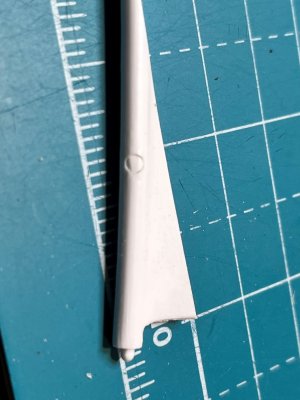
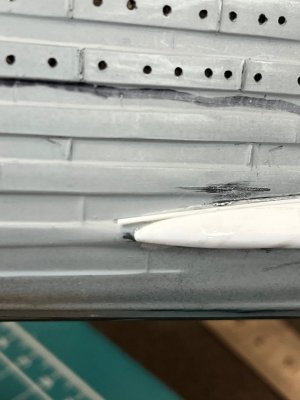
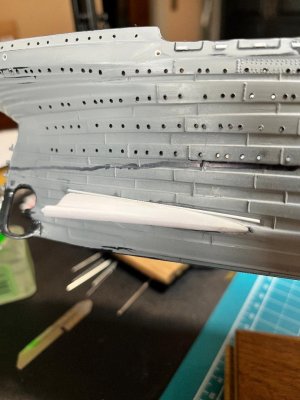
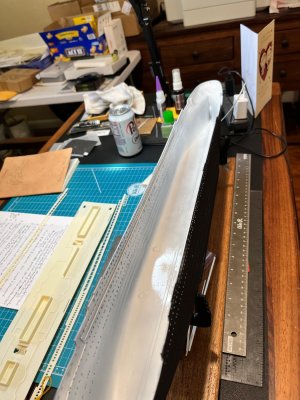
The triangular piece of plastic kit parts F1L and F1R marked as bilge keels are lacking in scale and details as you can see dry fitted to the hull

Bilge Keel 1.jpg

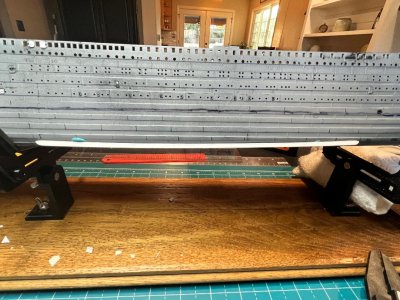
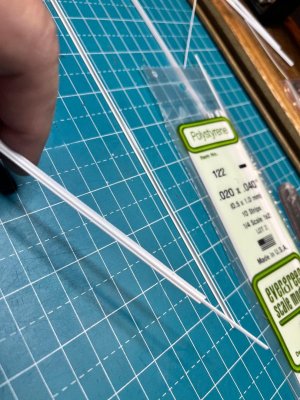
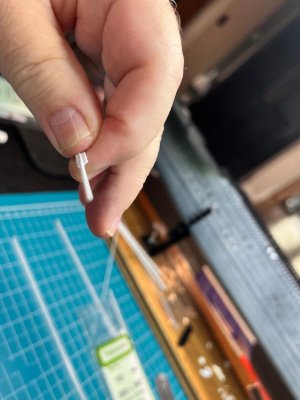
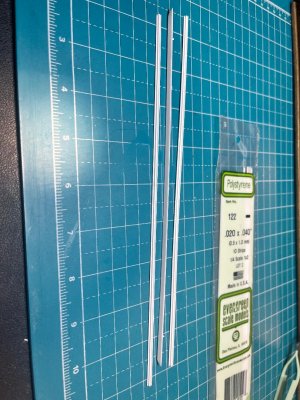
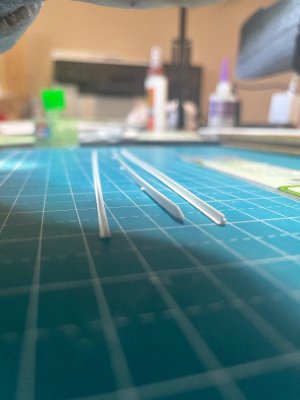
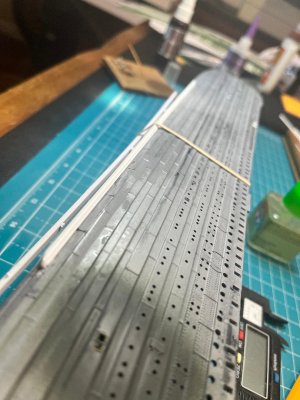
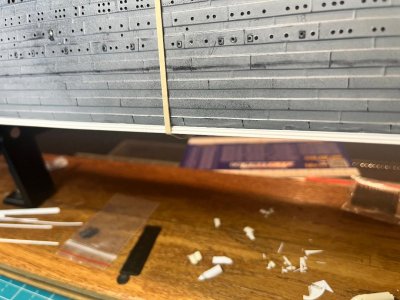
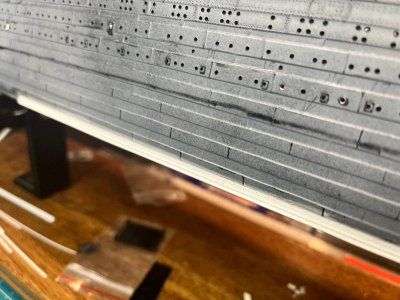
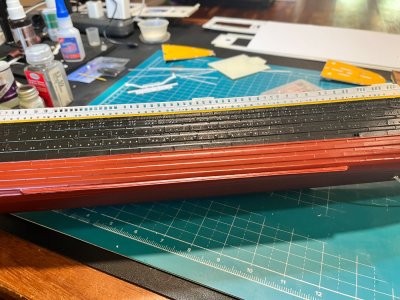
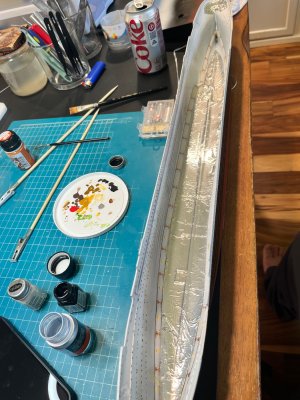
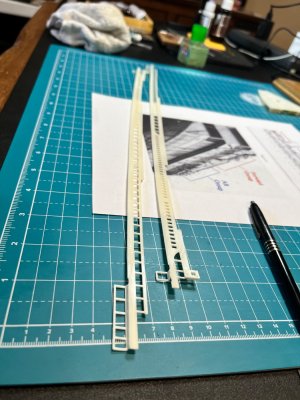
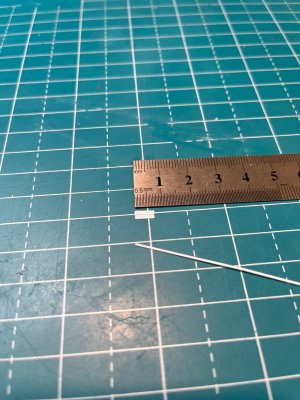
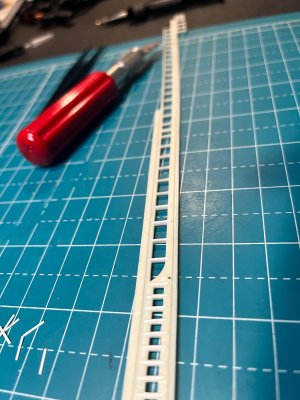
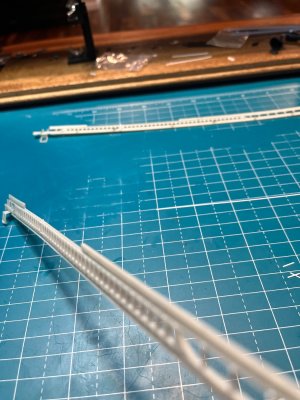
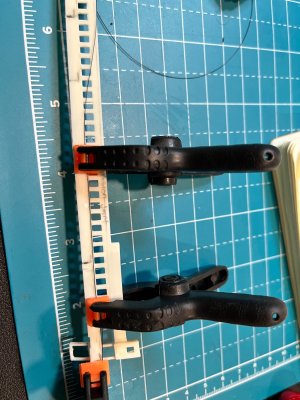
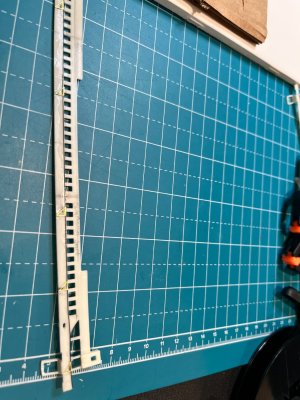
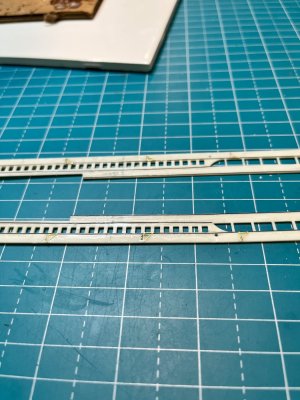
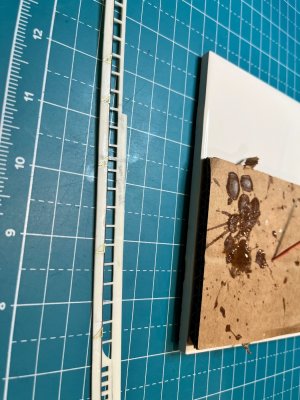
I found the bilge keel plans on encyclopedia Titanic website and found it was made in a layered fashion with a Tee beam and two L beams on each side (over simplified explanation). The dimensions from the plans converted to 1:350 scale are length 26 cm by base width 2.6 mm by height 2.6 mm. So I brought a packet of Plastisteel Tee bar that was 2.5 mm base and 2.5 mm height, and 0.5 mm thickness. Perfect! I added a 0.25 mm by 0.5 mm strip of styrene to the ends and voila. It was not feasible to find 0.25 mm thick L bar styrene. So I used 1 mm by 0.5 mm strips sanded to 0.25 mm for each side of the upright on the T.

Bilge Keel 8.jpg
Bilge Keel 7.jpgBilge Keel 9.jpgBilge Keel 6.jpg

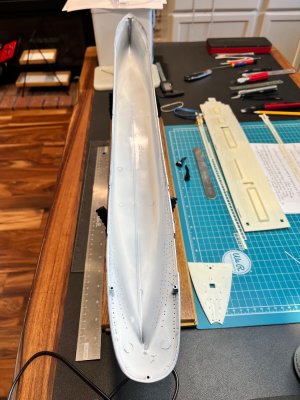
Now cut the the new keel to length and dry fit it to the hull.
Bilge Keel 10.jpgBilge Keel 11.jpg

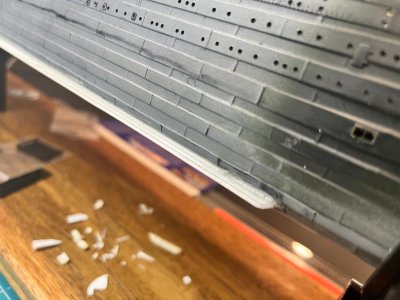
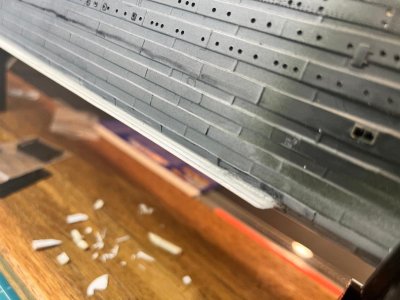
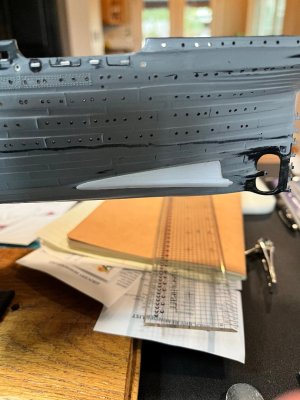
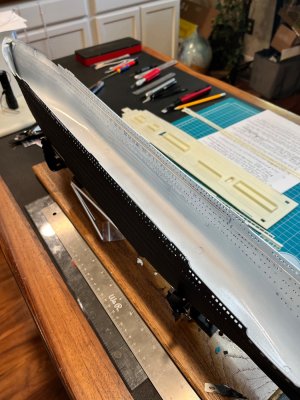
I needed to have a natural curve to the keel following the hull keel mount. I sanded and used putty to make the keel as “riveted” cleanly to the hull. Next time I install this type of part to a hull I will use epoxy glue. I tried a combination of CA glue with ultra thin liquid cement, but found that it could crack with little effort. I finally got enough liquid cement to cure.

Once I had the keel installed I blended the final product into the hull, trying not to remove any of the platting details.

The Propellers will be in the next posts
Happy Modeling- Pete

Bilge Keel 2.jpg

Bilge Keel 3.jpg

Bilge Keel 4.jpg

Bilge Keel 5.jpg
 
Last edited:
Have you seen the absolutely fantastic videos about R.M.S. Titanic on YouTube by Oceanliner Designs?
Type in the YouTube Search bar 'oceanliner designs titanic'. All sorts of in-depth videos on her design and operation.
Cheers
 
Have you seen the absolutely fantastic videos about R.M.S. Titanic on YouTube by Oceanliner Designs?
Type in the YouTube Search bar 'oceanliner designs titanic'. All sorts of in-depth videos on her design and operation.
Cheers
Yes I love that website and visit often
Same with https://www.moddb.com/mods/mafia-titanic-mod/images and Vasilije Ristovic facebook images of the Titanic.

I like the Oceanliner Designs and Titanic Honor and Glory because you can move around to those awkward places. But of course I verify with other sources. However, if I have nothing, then the videos rule because just looking at Vasilije's work and the research he puts into his images makes me feel confident that I have the latest knowledge on the Titanic ( Such as green winches and deck details when we always use to think it was just flat black).
 
Good Day Modelers,

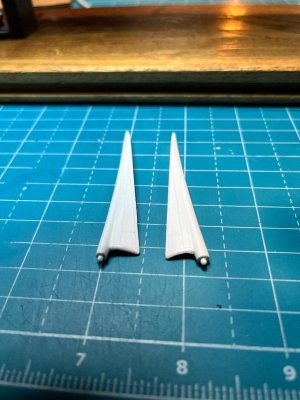
The propeller wings as promised

Propellers Wings 7.jpgPropellers Wings 8.jpg

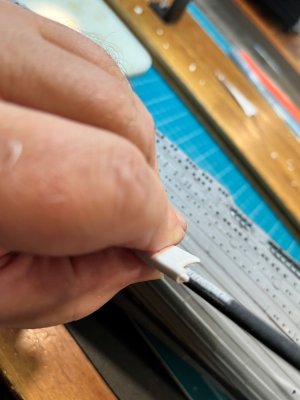
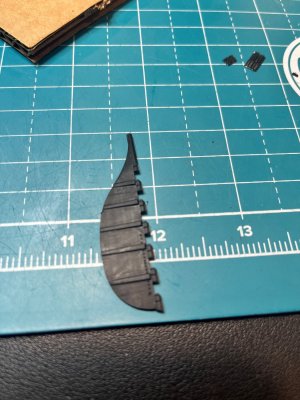
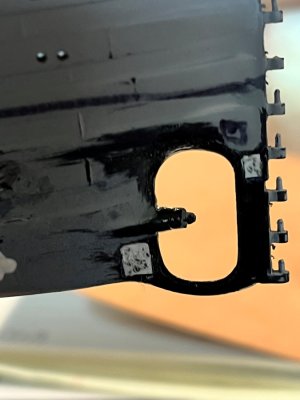
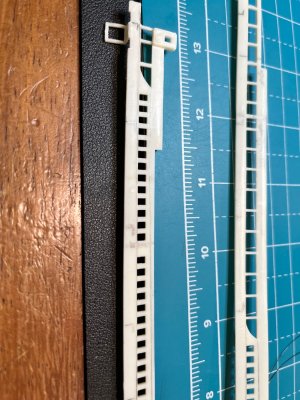
One of the first things about the propeller wings is that they have A LOT of extra material, especially at the forward part of the pieces. Therefore, I modified them to look more industrial and fit much better. After carfully sanding and some Mr Dissolved Putty applications, I got them about where I wanted.

Propellers Wings 3.jpg

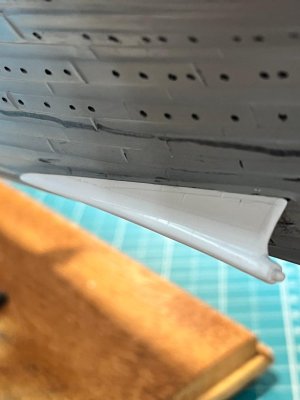
Dry fitting them top the hull required some extra sanding to the hull mounting site and some further part sanding to make them look realistic without losing the molded details.

Propellers Wings 2.jpg

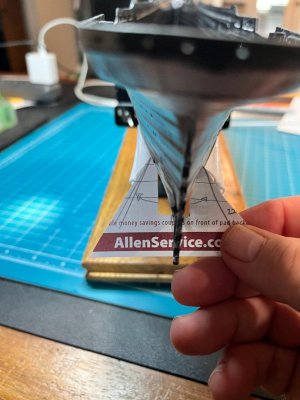
Then came the arch of the wings and what degree were they mounted on the actual ship. From files by Harland and Wolff and the website https://www.titanicology.com/Titanica/SpeedandRevolutions, I determined that the "canted angle" or spread was 2 degrees pitch past centerline, or more precisely 22.5 degree angle from the centerline. I made a template that I cound tape to the stern and get the angles correct (you can see me shakely hold my template to the wings after installation).

Propellers Wings 4.jpg

Then begun the chore of making the propeller wings seem like that at mounted to the hull in a realistic fashion. I did use 5 minute epoxy to adhere the wings (learned my lesson). I used 0.25 mm rod to fill in gaps and careful applications of putty and some judicial sanding eneded up with a product I liked (after installing the exterior hull parts and additions I primed the hull with black Mr 500 Primer and carefully sanded away any hull irregularities, blemishes, scratches and then primed Mr 1000 Primer and so on). I did not install the actual propellers because I know at some point I will knock them off. The propellers I plan to use is from China 3D and I will use the three (3) prop central propeller. I know the controversy but the article by Bob Read is too compelling! He found photographic evidence known to be the Titanic that indicates a three prop propeller sitting on dock ready for installation. I would suggest reading those articles on Titanic Cad Plans website home page.

Propellers Wings 5.jpgTransom Propellers 1.jpg

The Rudder was next and I went right to the China 3D part. This was pretty straight forward with clipping off the gimbels and pintel mounts on the stern post. There is nearly no modifications that were needed other than enlarging the hole for the rudder post into the ship. I used E6000 adhesive because I would want this part to give a little if I accidentally grab the rudder instead of the hull when I am handling the model. You can also see I added the stern central propeller base plate and anodes.

Rudder 1.jpgStern Post Anodes Central Propeller.jpgTransom Propellers 2.jpgRudder 2.jpg

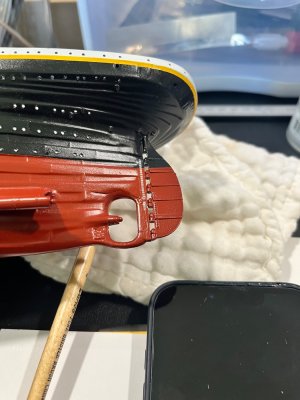
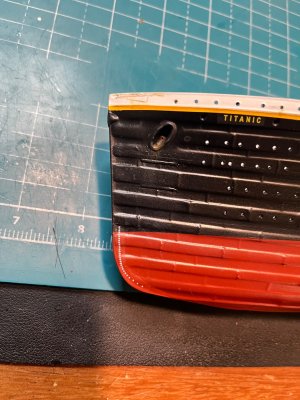
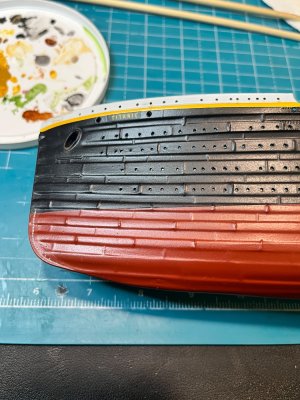
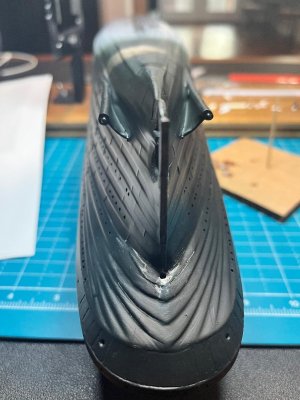
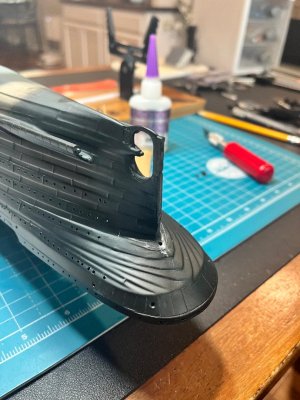
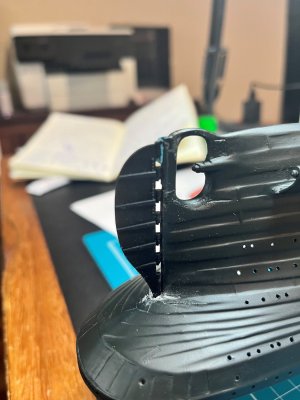
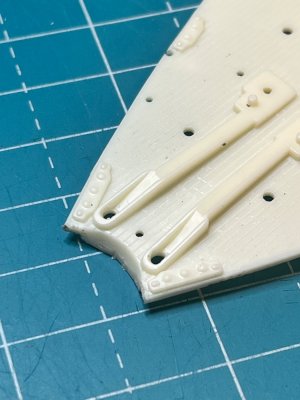
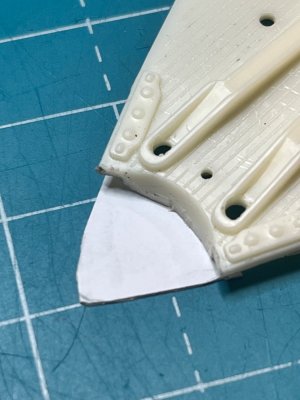
Next was the Bow Central Anchor Hawsehole. Though I did get the insert part from China 3D, I was not confident to make that serious of a major modification. I have spent some money on this model and did not want to ruin it with a hack job. Time for some magic. I know that a piece of circular plywood was attached to the hawsehold when the Titanic was at sea (which I am depicting at sea on April 13th, 1912) which I have heard is what Minicraft was trying to achieve. But I wanted the dramatic effect of seeing the bow and that awesome hawsehole. I took a piece of 0.25 mm thick styrene plastic and shaped it to the correct proportions using the China 3D piece as the guide. I drilled the central hole at ~30 degree up to the anchor well, and used a round file and dremel tool to grind the opening to the shapes I wanted and voila!
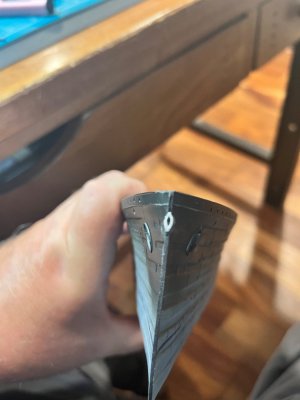
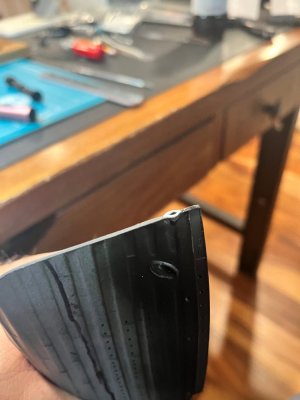
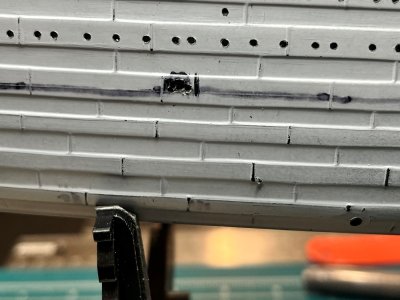
Central Anchor Hawsehole 1.jpgCentral Anchor Hawsehole 2.jpg

I then sanded the piece nearly smooth (it s just a little proud of the prow, but with the flat black paint, I doubt if you can see it) and fiddled with the sides until I was statisified with the results.

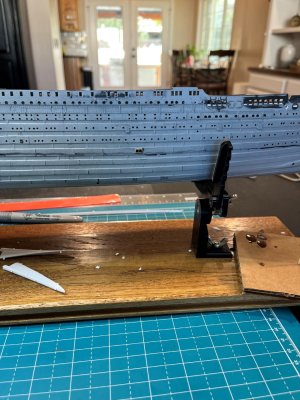
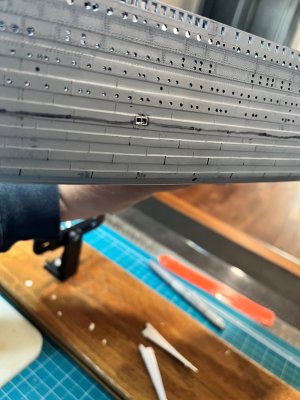
Next up was the condenser ports on the aft section of the exterior hull in line with funnel number 4 on both sides.

Condenser 3.jpgCondenser 4.jpg

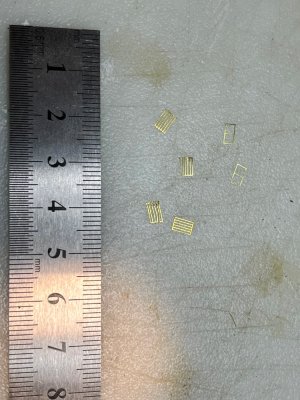
I followed Rivet Counter and the Titanic Cad Plans on the locations of the condenser outputs at the water line and and the inlets at the bilge keel level of the hull. I did find that TheModelBoatGuy on YouTube measured out the dimensions of the grills for 1:350 scale, so I used those measurements for my model (thank you to all those who diligently make videos of their fantastic builds and tips for modeling). I didn’t have the PE parts you can obtain in 1:200 scale but I wanted that same effect, so I scratch built the interior space for some depth after drilling out the rectangle shape and then used the extra parts I had from GMM PE rails for the cranes and made grills from railing panels. I will install the inlets after weathering the hull to prevent knocking parts off at such an obvious rub point.


Condenser 2.jpgCondenser 1.jpgT

Wooweee! That was a lot and obviously I did not do all that work in one sitting. I started at the beginning of April 2026 and now have reach the point of painting.

But before that I will have a post on my adventures in model illumination. I am actually pleased with my results but I had to really engineer what and how I was going to light this candle.

Happy Modeling - Pete

Propellers Wings 1.jpg

Propellers Wings 6.jpg
 
Last edited:
Good Day Modelers,

The propeller wings as promised

View attachment 612647View attachment 612648

One of the first things about the propeller wings is that they have A LOT of extra material, especially at the forward part of the pieces. Therefore, I modified them to look more industrial and fit much better. After carfully sanding and some Mr Dissolved Putty applications, I got them about where I wanted.

View attachment 612635

Dry fitting them top the hull required some extra sanding to the hull mounting site and some further part sanding to make them look realistic without losing the molded details.

View attachment 612634

Then came the arch of the wings and what degree were they mounted on the actual ship. From files by Harland and Wolff and the website https://www.titanicology.com/Titanica/SpeedandRevolutions, I determined that the "canted angle" or spread was 2 degrees pitch past centerline, or more precisely 22.5 degree angle from the centerline. I made a template that I cound tape to the stern and get the angles correct (you can see me shakely hold my template to the wings after installation).

View attachment 612636

Then begun the chore of making the propeller wings seem like that at mounted to the hull in a realistic fashion. I did use 5 minute epoxy to adhere the wings (learned my lesson). I used 0.25 mm rod to fill in gaps and careful applications of putty and some judicial sanding eneded up with a product I liked (after installing the exterior hull parts and additions I primed the hull with black Mr 500 Primer and carefully sanded away any hull irregularities, blemishes, scratches and then primed Mr 1000 Primer and so on). I did not install the actual propellers because I know at some point I will knock them off. The propellers I plan to use is from China 3D and I will use the three (3) prop central propeller. I know the controversy but the article by Bob Read is too compelling! He found photographic evidence known to be the Titanic that indicates a three prop propeller sitting on dock ready for installation. I would suggest reading those articles on Titanic Cad Plans website home page.

View attachment 612637View attachment 612639

The Rudder was next and I went right to the China 3D part. This was pretty straight forward with clipping off the gimbels and pintel mounts on the stern post. There is nearly no modifications that were needed other than enlarging the hole for the rudder post into the ship. I used E6000 adhesive because I would want this part to give a little if I accidentally grab the rudder instead of the hull when I am handling the model. You can also see I added the stern central propeller base plate and anodes.

View attachment 612649View attachment 612651View attachment 612640View attachment 612650

Next was the Bow Central Anchor Hawsehole. Though I did get the insert part from China 3D, I was not confident to make that serious of a major modification. I have spent some money on this model and did not want to ruin it with a hack job. Time for some magic. I know that a piece of circular plywood was attached to the hawsehold when the Titanic was at sea (which I am depicting at sea on April 13th, 1912) which I have heard is what Minicraft was trying to achieve. But I wanted the dramatic effect of seeing the bow and that awesome hawsehole. I took a piece of 0.25 mm thick styrene plastic and shaped it to the correct proportions using the China 3D piece as the guide. I drilled the central hole at ~30 degree up to the anchor well, and used a round file and dremel tool to grind the opening to the shapes I wanted and voila!
View attachment 612641View attachment 612642

I then sanded the piece nearly smooth (it s just a little proud of the prow, but with the flat black paint, I doubt if you can see it) and fiddled with the sides until I was statisified with the results.

Next up was the condenser ports on the aft section of the exterior hull in line with funnel number 4 on both sides.

View attachment 612645View attachment 612646

I followed Rivet Counter and the Titanic Cad Plans on the locations of the condenser outputs at the water line and and the inlets at the bilge keel level of the hull. I did find that TheModelBoatGuy on YouTube measured out the dimensions of the grills for 1:350 scale, so I used those measurements for my model (thank you to all those who diligently make videos of their fantastic builds and tips for modeling). I didn’t have the PE parts you can obtain in 1:200 scale but I wanted that same effect, so I scratch built the interior space for some depth after drilling out the rectangle shape and then used the extra parts I had from GMM PE rails for the cranes and made grills from railing panels. I will install the inlets after weathering the hull to prevent knocking parts off at such an obvious rub point.


View attachment 612644View attachment 612643T

Wooweee! That was a lot and obviously I did not do all that work in one sitting. I started at the beginning of April 2026 and now have reach the point of painting.
But before that I will have a post on my adventures in model illumination. I am actually pleased with my results but I had to really engineer what and how I was going to light this candle.

Happy Modeling - Pete

View attachment 612633

View attachment 612638
Nicely done Pete! Regards, Magic Mike
 
Now let’s talk about illumination

It was the first full decision I made after my deciding on the Minicraft kit. Now illuminating a model has a host of considerations that you need to plan for from the beginning of you build. Fiber optics vs. LED, Remote vs. Switch activation, plug-in vs. battery or USB powered, and so on. Finding the right lighting effect that is period representative is not as hard as it was several years ago. The trend for the younger generations to illuminate their rooms with soft light has brought many new products that can easily match my requirements. Then the consideration of how to display your finished product. Open display vs. encased display. Which day or night on Titanic's voyage (I am depicting April 13th, 1912 out to sea).

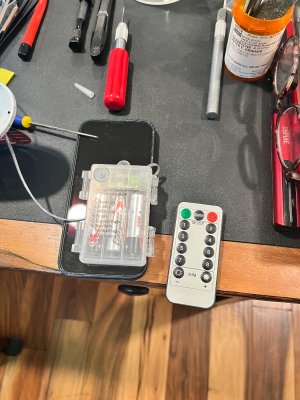
So I have mentioned this before in previous posts, but for those strictly interetsed in just how I illuminated my kit, I decided to present an encased table top display that can be moved. That means remote controlled and battery operated, incandesent light, long lasting lasting battery life so that I would not have to un-case the display to change the batteries often. I also decided on LED lighting and not fiber optics because the amount of work for my return of investment was better using just LED lighting. These decisions now caused other considerations such as how to mount the ship in such a way that the batteries can be accessible without being seen and not distrubing the model if I did have to change the batteries. The traditional pedestal mount would not work. Therefore, I decided on the "dry dock" display method with a hiddened chamber under the ship for the remote signal and battery pack.

The other challenge was the materials that the kit was made from Minicraft. The black hull is terrific, but the white and buff plastic walls and decks are notorious for having light glow throught the materials. That means I need to plan on stopping light leaks from the decks and walls, and the joints where the kit parts are installed on the model. So the plan is to used flat black on the underside of the decks as a light blocker followed by white gloss paint for reflection purposes (I tried Mr Surfacer 1000 but found that there was still a little bit of glow through the decks). I will prime all the wall/ bulkhead pieces and may have to improvise on the contact points with a 0.25 mm by 0.25 mm styrene plastc strip as a border around the bases of the deck structures to prevent light leaking where I dont want it :p

Now the plan

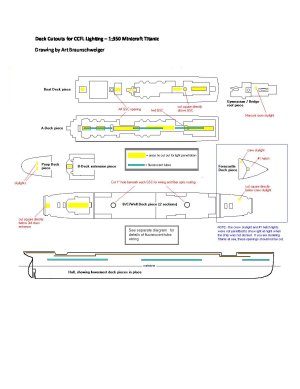
I loved what Art Braunschweiger did with illumination. In fact, I mostly used his diagram from his website titanicmodel.net. However, his source of lighting was completely different from mine, so I had to modify that plan to my needs. Also, I will not light up forecastle crew galley skylight or hatch #1 because I am depicting the ship out to sea (3rd day) and at night those areas were not illuminated for nighttime navigation and visibility (no lookout binoculars though?).
I will be illuminating the poop deck and forecastle C-Deck windows and portholes that are visible from the well decks.

deck_cutouts_for_ccfl_lighting.jpg

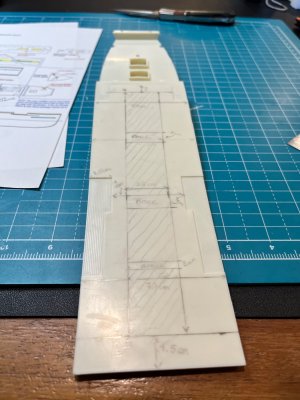
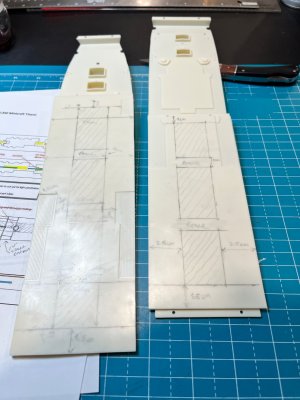
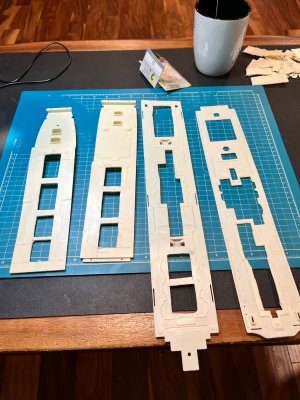
So I already discussed how I painted the interior of the hull first with gloss white. But now I need to modify the decks for maximum illumination. I planned out the areas I wanted to cut, including cross sections that where not cut as braces for the decks for strength.

IMG_0003.jpegIMG_0004.jpegIMG_0006.jpeg

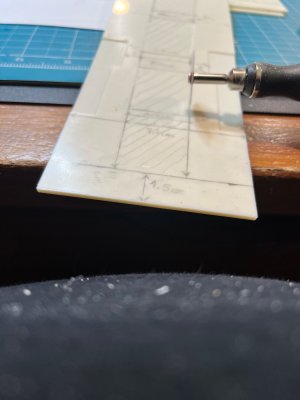
I then cut the crossed out sections using my good ole dremel with a saw blade

IMG_0005.jpegIMG_3098.jpeg

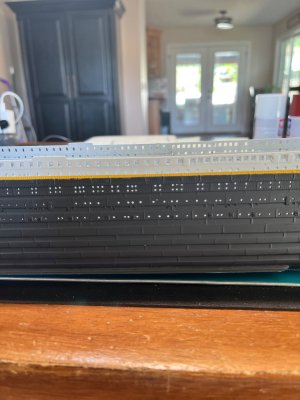
I was satisfied with the cuts and cleaned off the burrs from the cuts. Then I painted the underside of the decks first with flat black and then a gloss white for reflection. Then I carefully painted the topside of certain decks (A and B Decks) in the locations that would not be visible after installing the bulkheads and walls so the light could be reflected up to the decks above. I am planning on using Scale Deck or a similar wood verneer so I need to be careful on painting the upper portions of the deck where it might be visible through the material.

Now A Deck has these protrusions which I did remove before cutting out the deck. I again left some parts for strength at strategic locations as you can see above. The final cuts for B-Deck, A-Deck and the Boat-deck came out pretty well and I was able to correct some deck warpage too (Bonus!).

IMG_0007.jpeg

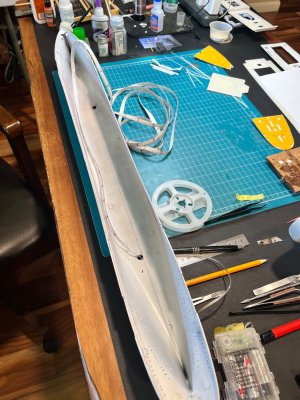
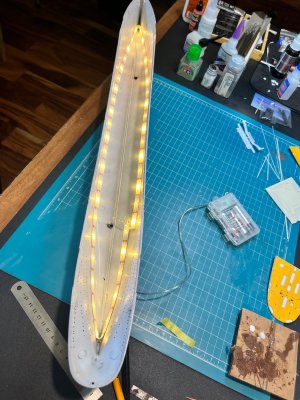
I had searched earlier for incandescent period lights with those requirements for remote control and wireless. The one I liked the best was Echosari Battery Powered Led Strip Lights with Remote Warm White, 8 Modes, Dimmable, Timer, Self-Adhesive, Cuttable, Waterproof, 9.8FT 90 Led Strip Lights. This was enough LED strip to cut into managable lengths and have the ability to soder more strips if I need more illunination above decks.

IMG_0008.jpegIMG_0009.jpegIMG_0011.jpeg

FYI, I completed painting the full hull and sealing it with Testor's Glosscote prior to final LED Installation. That way I am not messing around with cordage and battery packs while masking and painting the hull (hard enough with the sheer line without adding the lighting items).

IMG_0010.jpeg

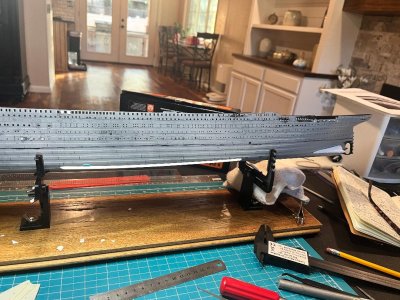
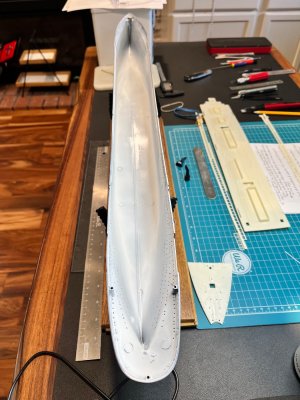
I did add HVAC aluminum chrome tape on the bottom of the hull to assist in the reflection factor. You can almost see that the lights through my drilled out portholes (I will updated a photograph with a dark room to shown the light more fully). Success!
IMG_3283.jpeg
Masking and painting the hull posts is up next since you can see my nearly finished hull (need some very slight weathering, decals, Dullcote, and filling porthole with Testor's window cement) in the above picture.

Happy Modeling - Pete
 
Last edited:
Moving on to painting

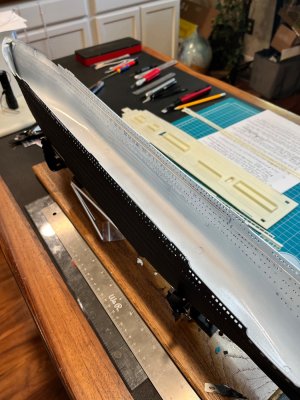
However, before I put pigment onto plastic, I wanted to finish details on the upper superstructure so when I do paint the flat white I could paint it all the same time (the hull superstructure and the A-Deck upper superstructure). This will add details and interesting depth to it promenade (I am also adding the ceiling girders to the visible portions of A-Deck and the. Boat Deck).

IMG_3060.jpegIMG_3063.jpegIMG_3065.jpeg

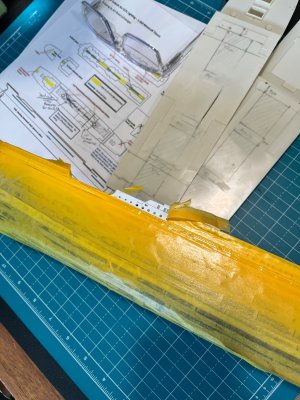
As you can see there is a lot of windows on the 1st Class Promenade that can be seen and see through. So I plan to take 0.5 mm strip styrene and install the interior supports to the windows on to the upper superstructure.

IMG_3072.jpeg

Then I added the strips to the windows frames from the bow to the stern on the kit parts. The plan will be to cut individual acetate window squares for each one

IMG_3074.jpegIMG_3073.jpeg

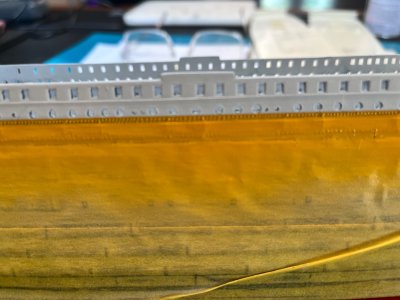
Next up was to add the knuckle line along the bottom part of the windows from the forward section of the promenade rail cap to the aft promenade rail cap which is about 25 cm in length. I used 4 lb monofilament fishing line (which is had issues with) as the material for the line. I did not cut the line into more manageable lengths because I wanted a straight, unbroken line from fore to aft. Therefore, I had to use clamps and CA adhesive to install the line (the line wanted to curve and not take the CA without clamping the line). I used the same method to add the same type of line above the promenade windows.

IMG_3067.jpegIMG_3068.jpegIMG_3070.jpeg

You can see where I installed the Coal Bunker Outriggers after I added the knuckle lines. I used Titanic Cad Plans, Ken Marshall’s work, and The Ship Magnificent for positions and locations of the outriggers. There actually two sets of of outriggers on each side of the Titanic (fore and aft).

Now to masking the hull.

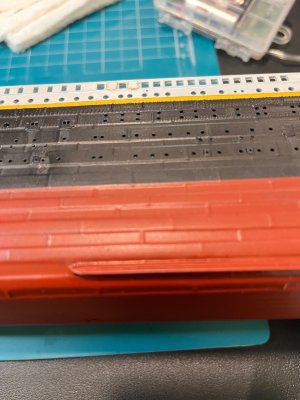
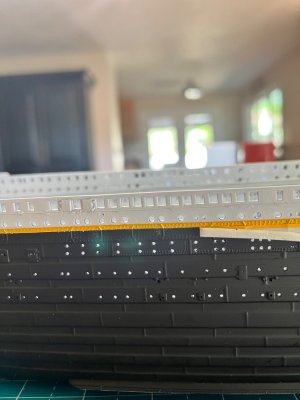
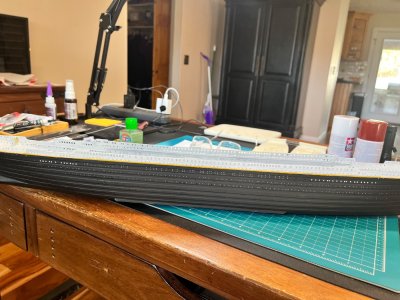
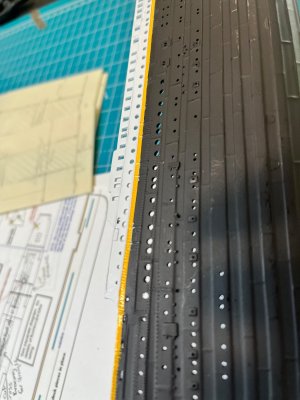
I have to apologize first because I have lost the photos of of me actually painting the hull and more of the way I masked the the hull. I started with Tamiya XF-1 Flat Black. I could have used NATO Black but want that color to highlight the hull stake plating to add depth to the black portion of the hull (I painted the entire hull). I let the paint cure for 24 hours.

IMG_3064.jpeg

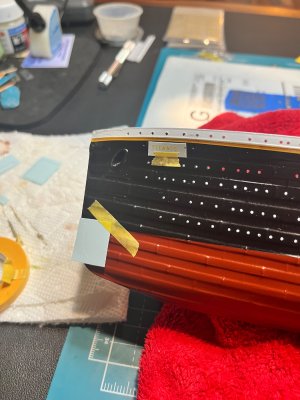
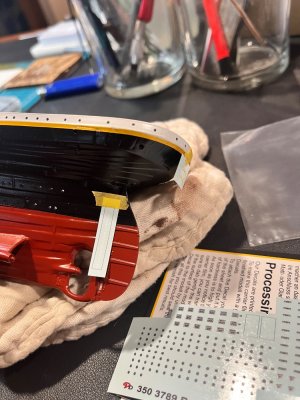
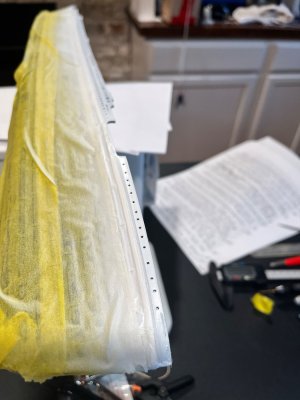
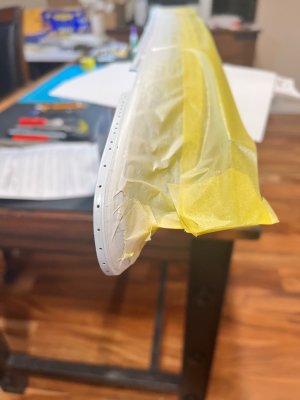
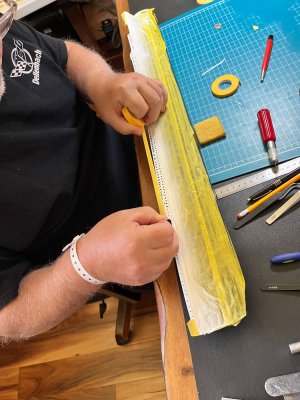
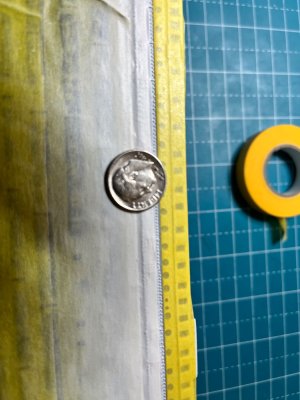
I then masked the black part of the hull up to the bottom line of the natural Sheer line (just below the row of double rivets detail). I first used 3 mm masking tape to mark the bottom line. I used a square eraser to snug down the edges and ensure to minimize the paint bleed. Then I used 10 mm and 45 mm tape to finish masking the bottom of the hull. The stern was masked with 3 mm tape carefully below the portholes at the knuckle line.

IMG_3078.jpegIMG_3079.jpeg
Then I painted the white hull superstructure using Tamiya XF-2 Flat White. When we get to the Sheer Line, the yellow chromate paint shows better on white paint vs. the flat black. So that means I painted from the bottom of the sheer line all the way up. I allowed the Flat White to cure for 48 hours. I plan to use off white and soft tone washes to add depth and tone to the stark flat white paint on other details and parts of the superstructure.

The Sheer Line

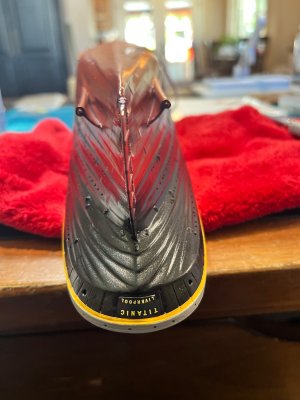
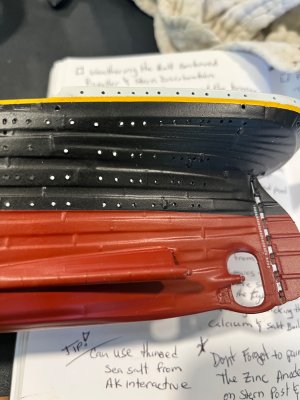
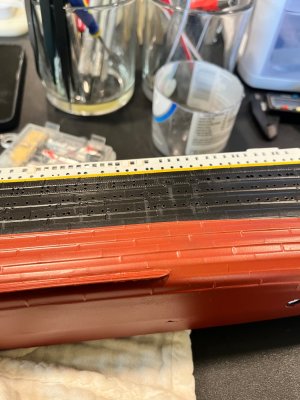
Now it’s time to tackle the sheer line that I heard so much about. Some modelers have painted the line yellow first, then mask the line with a 1 mm tape. But I thought that was more difficult because of those notorious rivets and paint bleed. I choose to mask off the white paint area at the top of the sheer line and above (so the black hull and the white superstructure where the areas that were masked). I again used the 3 mm tape and the eraser method to prevent bleeding. And added increasing sizes for the rest. This leaves the dreaded row of rivets exposed and not causing interfering protrusions the allow the paint to seep in and marr your paint job. Moreover, at the stern there is serious curve at the aft rub line just under the vertical transom plates. I did not want to try to curve the normal Tamiya masking tape. It wrinkles and allows gaps to occur for paint bleed. Therefore, I used Tamiya 3 mm curve tape (more like a plastic flex tape) to make the curve as flat as possible. I had to really apply more pressure to secure the flex tape with a dental tool I have from other projects. Then I further secured that flex tape with regular masking tape to block off the rest of the hull.

IMG_3082.jpegIMG_3081.jpeg

I had to used several coats of the yellow chromate to get the correct tone and hue of the sheer line. I allowed the yellow to cure for an additional 48 hours before removing the masking tape.

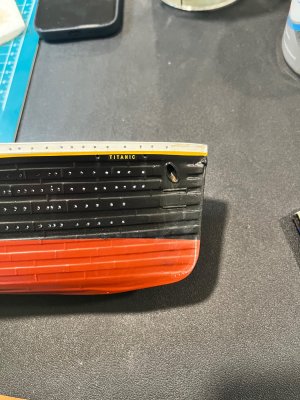
I carefully removed the tape at every level. I found crisp clean lines except at a couple of minor points that was easily touched up (it was actually the flat white that bleed onto the black). I was very careful because I have seen a couple of videos on YouTube were the yellow would peel off worse the masking tape.

IMG_3091.jpegIMG_3092.jpegIMG_3093.jpegIMG_3094.jpegIMG_3096.jpegIMG_3095.jpeg
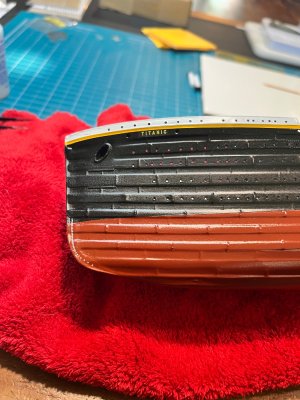
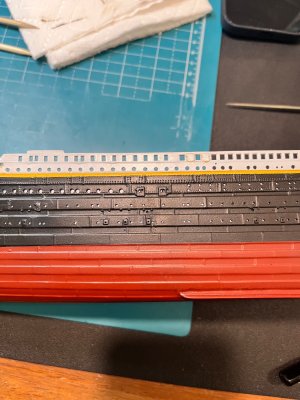
I then masked the waterline for the anti-fouling paint. I used XF-33 Tamiya Hull Red for the lower portion. I know then there is some really compelling evidence. That the anti-fouling paint was closer to a pink color. However, I wanted to use the lighter shades of red for highlights of the rows of hull plating.

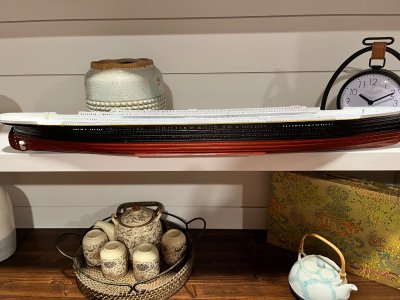
I did follow the molded waterline that Minicraft provided verified by resources and photographs. I wanted to make sure that I had the correct waterline at the rudder (which was just above the second top stake). I needed to be precise at the bow where the waterline reaches the prow. The decals I plan to use actually has a precise positioning requirements to properly fit on the model. After several coats of paint, I removed the last of the masking tape and seal the entire hull and upper superstructure with Testor’s Glosscote (for adding decals and weathering). Dullcote flat varnish is more “rough” in texture and provides air pockets that causes silvering on the decal and crevices where weathering washes seep in and is not easy to blend as the smoother Glosscote varnishes.

IMG_3102.jpeg

To can see the final product on the shelves next to my workbench. I am happy with the results.

The Forecastle and Poop Deck parts modifications are next

Happy Modeling - Pete


IMG_3060.jpeg

IMG_3063.jpeg

IMG_3064.jpeg

IMG_3065.jpeg

IMG_3066.jpeg

IMG_3067.jpeg

IMG_3068.jpeg

IMG_3069.jpeg

IMG_3070.jpeg

IMG_3072.jpeg

IMG_3073.jpeg

IMG_3074.jpeg

IMG_3095.jpeg

IMG_3094.jpeg

IMG_3093.jpeg

IMG_3092.jpeg

IMG_3091.jpeg

IMG_3096.jpeg

IMG_3102.jpeg

IMG_3082.jpeg

IMG_3079.jpeg

IMG_3081.jpeg

IMG_3078.jpegIMG_3081.jpeg
 
Last edited:
Moving on to the forecastle and poop decks.

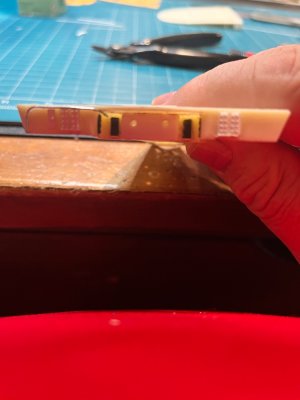
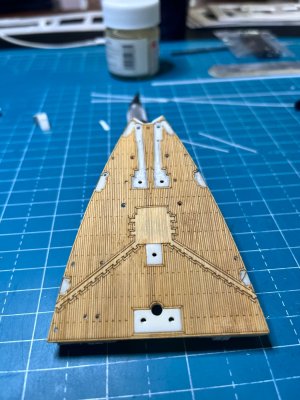
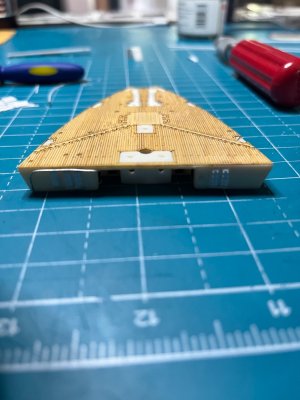
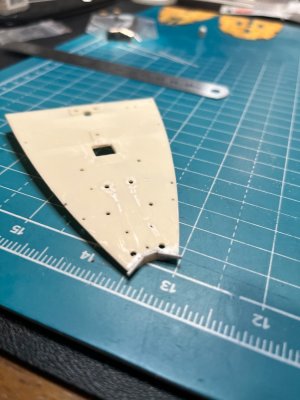
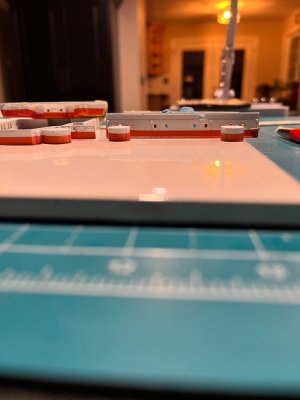
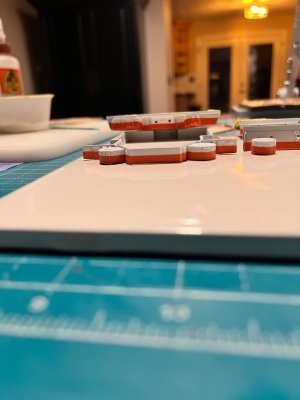
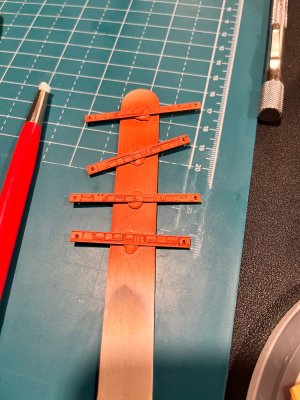
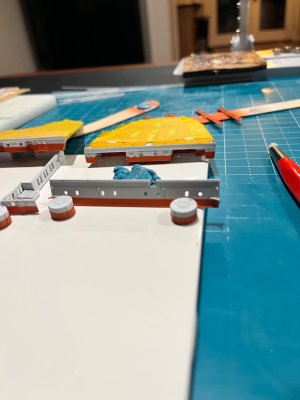
I am not strictly following the kit instructions by this point, and have moved on to modular construction and installation techniques. I decided to finish the forecastle and the poop deck to the point I can spray the dadoe line (the reddish orange paint (dark mast for me) in the fore and aft well decks bulkheads, bulwarks, and crane bases).

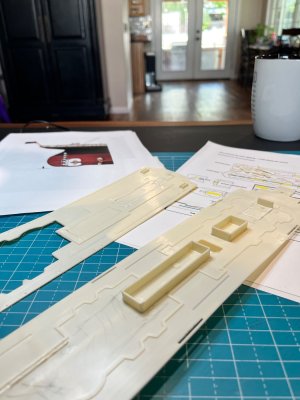
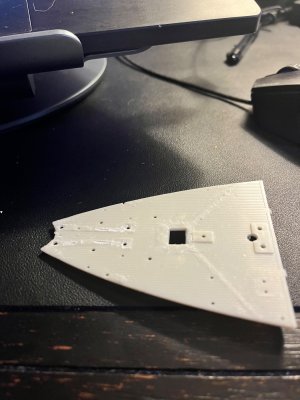
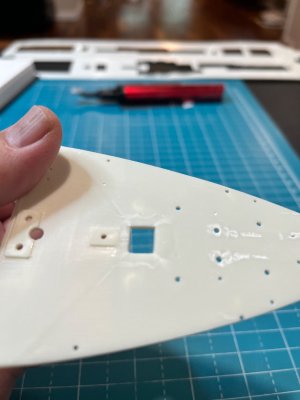
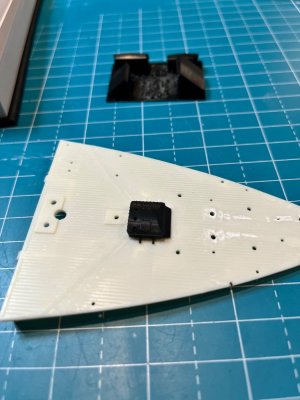
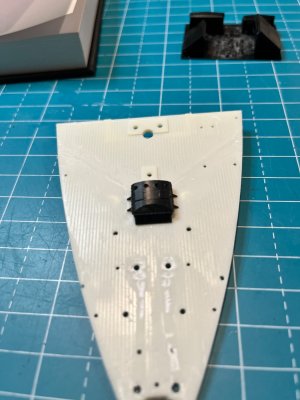
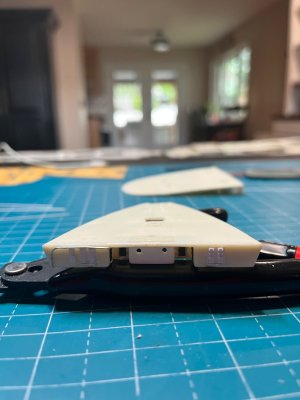
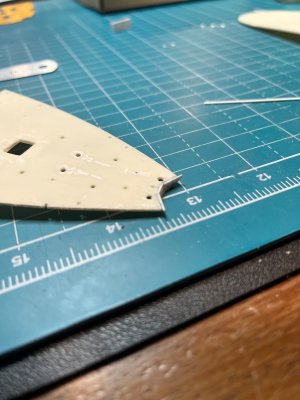
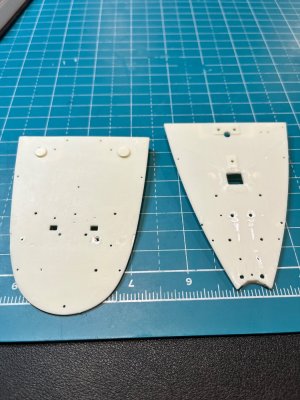
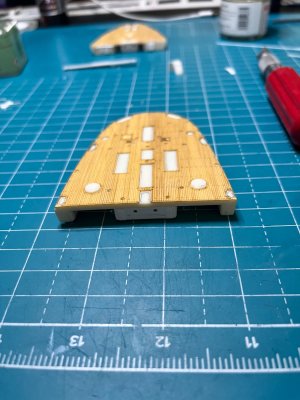
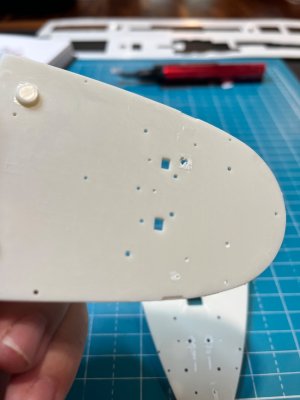
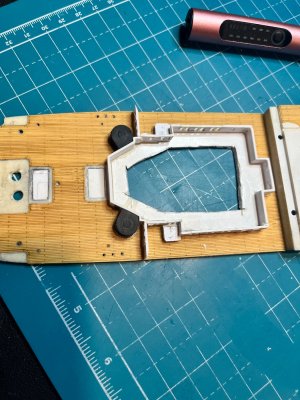
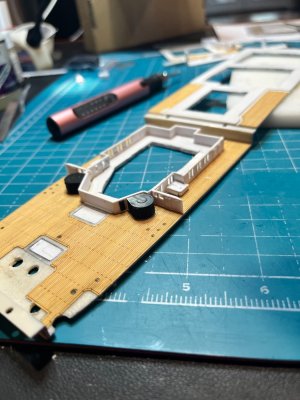
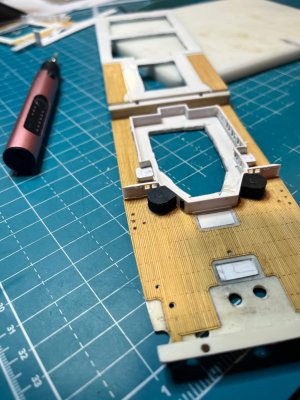
First I decided to improve the central anchor well on the forecastle. I cut off the existing well deck because it looked clunky and out of scale. I decided to reshape the well and make it look more industrial. I also have the China 3D central anchor and Toms PE gratings for the well and wanted a more three dimensional look. Following that train of thought, I decided to remove all the forecastle deck details that will be replaced by China 3D accessories, I also remove the planking mold lines to create a flat surface for installing the wooden deck veneer.

IMG_2923.jpegIMG_2925.jpegIMG_3056.jpeg

IMG_3115.jpegIMG_3056.jpeg

So with the 3D parts I ended up removing nearly all of the details except the winch pad and steam conduits platform. This resulted in the breakwater piece molded on the deck to look out of scale and bulky. So I will removed that portion and will scratch build that piece prior to installing the foreastle to the hull. You can see the #1 hatch from China 3D was less substantial in its mass than the orignial molded kit hatch.

IMG_3108.jpegIMG_3109.jpeg

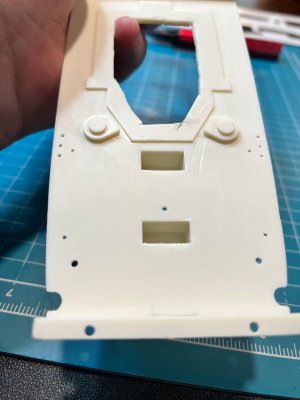
Now I can work on the underside of the forecastle. I added the bulkhead kit parts. But the watertight hatches that were provided for the front were protruding far out from the wall. So I sanded the backs down to a more reasonable scale. I also had to add 5 additional doors and hatches in the interior portion of the forecastle. Using Rivet Counter and Titanic CAD Plans, I add four doors inside and a fifth door just left of the portside watertight doors (there no additional door on the starboard side aft facing bulkhead). I also installed the water / drain line on the Portside that curves first up and starboard, then foreward under the decking with 20g wire.

IMG_3121.jpegIMG_3122.jpeg

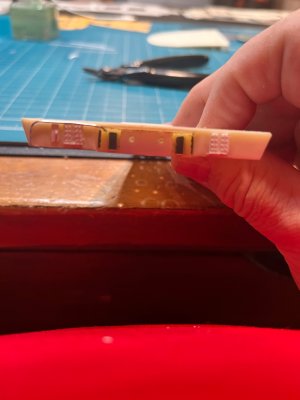
Now I can install the wooden deck and mask the areas for future painting. I wanted to install the decking so that I can add a trim piece 0.5 mm strip to the aft upper edge of the forecastle level with the deck as a border. I wanted to paint this addition at the same time I painted to the rest of the structure.

IMG_3124.jpegIMG_3125.jpeg
I also worked on the stern bulkhead to the central anchor well to flush it out and make it more angular than it was molded in.

IMG_3119.jpegIMG_3120.jpeg

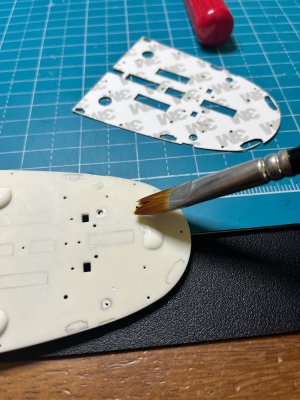
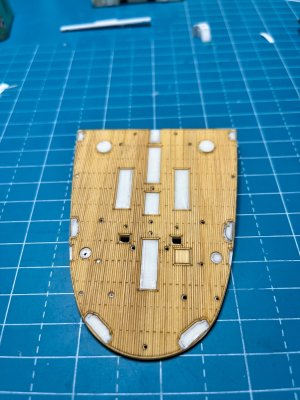
Installing the Artwox deck means that I have to deal with the adhesive backing on the veneer. Now I havent had as much trouble with these type of decks (I believe Pontos and KA uses the adhesive too), I tend to remove the backing carefully, and then apply a thin coat of Gorilla Wood Glue as per the instructions onto the veneer adhesive and allow it to dry for about 5 minutes. This tends to remove some of the stickiness and you can maneuver the piece more. I also applied a thin amount of glue to the plastic deck. When these two piece make contact, they re-activate the wood glue and makes a solid point of adhesion for the pieces. Installing the deck is straight forward by working from the middle, then outward applying pressure to make great contact with the parts. I did not have to use clamps at get a good seal and I am happy with the results. In addition, I installed the wood decks on the poop deck and the well decks parts. In hindsight, i should have waited on the well decks until I was ready to install the other deck details soon after (Saves wear on the decks). As a side note, you need to apply a varnish of your choice to the un-installed veneer decks. This prevents dirt, greesy fingers, and some scratches from soaking in on your decks.

IMG_3113.jpegIMG_3126.jpegIMG_3127.jpeg

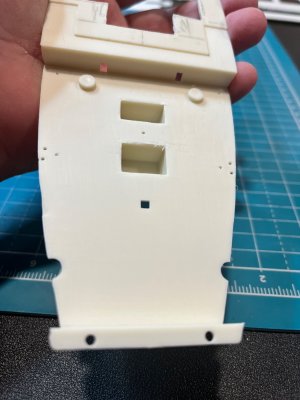
The poop deck has actually more modifications with the walls under the poop deck and the bar 3rd class bar needing adding to the structure. There were only a few walls that are somewhat out of scale. I also added the windows and doors found under the poop deck to the 3rd class common areas. I also plan to add edging in the same manner as the forecastle at the forward portion of the upper poop deck.
There is other details I need to add to the underside of the poop deck like the stanchions, the crane supports that are found directly under the poop deck cranes, and of course the ladder under the set of stairs to the well deck. Some ask about those ladders (they can be found under the stairs for the forecastle too) I refer them to an article by Bob Kerns in Titanic CAD Plans that shows a photo where the stairs were removed off to the side so that the cargo hatches can be filled in the well decks. It clearly shows the crew working the cranes with the stairs out of the way and persons climbing the ladders to the poop deck.

IMG_3128.jpegIMG_3116.jpegIMG_3117.jpeg


I will upload more pictures in future posts on the well decks, B-Deck prep, and painting the cranes, bulkheads, and bulwarks with the dadoe line.

Happy Modeling - Pete

IMG_2923.jpeg

IMG_2925.jpeg

IMG_3056.jpeg

IMG_3108.jpeg

IMG_3109.jpeg

IMG_3114.jpeg

IMG_3115.jpeg

IMG_3113.jpeg

IMG_3116.jpeg

IMG_3117.jpeg

IMG_3119.jpeg

IMG_3120.jpeg

IMG_3121.jpeg

IMG_3122.jpeg

IMG_3123.jpeg

IMG_3124.jpeg

IMG_3125.jpeg

IMG_3126.jpeg

IMG_3127.jpeg

IMG_3128.jpeg
 
Last edited:
Amazing progress PeteG! I know I have been silent on this post for a while, but coming back to this thread, so much has been done! It seems every time I take a look at this thread, an entirely new part of the ship has been finished. I can never really put this into words, but this is quite the undertaking. (The best I can do is take pre-molded and pre-colored parts and snap them together (LEGO)). Thank you for sharing this journey with this community, and I hope everything is SHIP SHAPE! (:
 
Amazing progress PeteG! I know I have been silent on this post for a while, but coming back to this thread, so much has been done! It seems every time I take a look at this thread, an entirely new part of the ship has been finished. I can never really put this into words, but this is quite the undertaking. (The best I can do is take pre-molded and pre-colored parts and snap them together (LEGO)). Thank you for sharing this journey with this community, and I hope everything is SHIP SHAPE! (:
Thank You so much. I am finally catching up to where I am currently in the build.
 
Back
Top