
• Win a Free Custom Engraved Brass Coin!!!
    As a way to introduce our brass coins to the community, we will raffle off a free coin during the month of August. Follow link ABOVE for instructions for entering.
  • PRE-ORDER SHIPS IN SCALE TODAY!

    The beloved Ships in Scale Magazine is back and charting a new course for 2026!
    Discover new skills, new techniques, and new inspirations in every issue.

    NOTE THAT OUR FIRST ISSUE WILL BE JAN/FEB 2026

The GRACIE S - a Lift Model

There are limitations in terms of the torque forces one could apply to the vise mounted on a tee track, since the tee-track is doesn't have a lot of strength for side loads, particularly if applied to a "lever" created by the height of the vise.
Bob,
I am not advocating this - just as a possible way to make it work.
Have a plywood pad under each of the two C-clamps - size and thickness TBT. Attach the C-clamp to the pad with a flat head screw/bolt that is the same diameter and TPI as the threaded rod that advances the clamping pad. Counter sunk.
Easy hold. A wide enough pad should be as resistant to torque as the C-clamps on a table edge. More than one T-track traveler - it is just a matter of drilling another 1/4" hole.

 
A simple clamp for carving half models: A piece of 1” thick board clamped vertically into a bench level carpenter’s vise. A couple of wood screws passing through the board into the the flat back of the model.

Roger
 
A simple clamp for carving half models: A piece of 1” thick board clamped vertically into a bench level carpenter’s vise. A couple of wood screws passing through the board into the the flat back of the model.

Roger

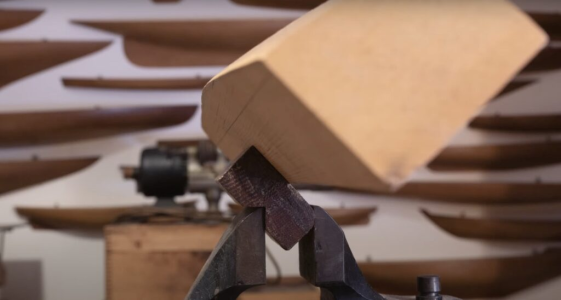
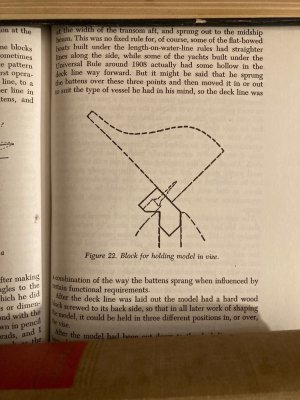
In one of his books, The Commonsense of Yacht Design, perhaps, L. Francis Herreshoff describes and pictures the use of a particularly notched length of stock which is temporarily screwed to a solid wooden hull blank to hold the blank for carving. The shape of this piece permits it to be held in a bench vise in a variety of ways which position the hull at different angles in the bench vise as might be convenient for the carver.
See one thousand word picture below:

1765155169684.png
 
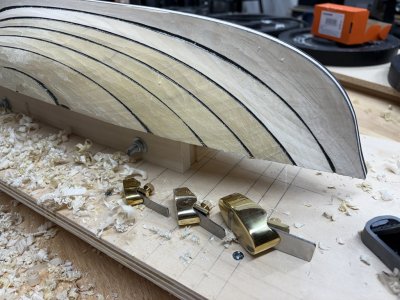
Did some more hull shaping today - other projects have slowed down this one a bit, so it will be on and off for a bt!

I've now changed to smaller finger / violin planes as they are able to remove wood in a convex shape and there is not room for the small hand plane to work where needed.

1765918754436.jpeg
 
Did some more hull shaping today - other projects have slowed down this one a bit, so it will be on and off for a bt!

I've now changed to smaller finger / violin planes as they are able to remove wood in a convex shape and there is not room for the small hand plane to work where needed.

View attachment 564175
Wow. look at those lines! Very sleek.
 
In one of his books, The Commonsense of Yacht Design, perhaps, L. Francis Herreshoff describes and pictures the use of a particularly notched length of stock which is temporarily screwed to a solid wooden hull blank to hold the blank for carving. The shape of this piece permits it to be held in a bench vise in a variety of ways which position the hull at different angles in the bench vise as might be convenient for the carver.
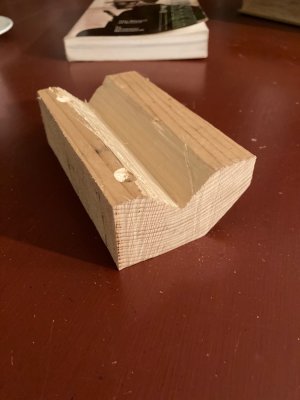
Yes, a useful tool. Here is an illustration of it from Capt. Nat Herreshoff: the Wizard of Bristol by his son L. Francis Herreshoff. Also, here's a photo of mine, which, I must admit, has been used more for decoy ducks than model ships. Somewhere around here there is also a much smaller version that has been used for miniature decoys. Fair winds!

holder 1.jpegholder 2.jpeg
 
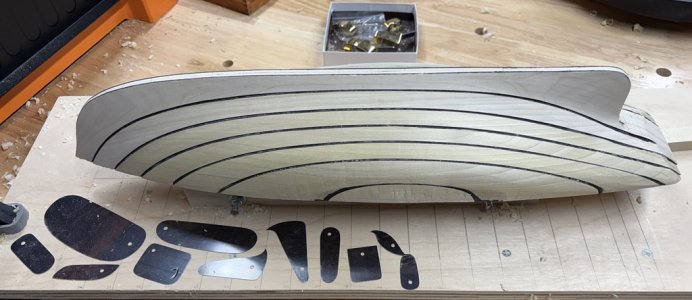
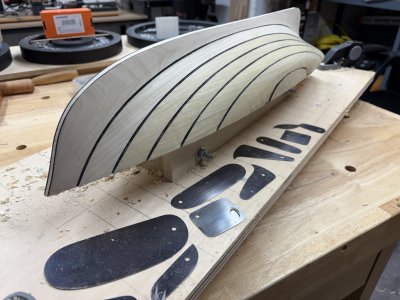
As I get closer to the proper hull shape I'm changing tools again - first it was the palm plane, then the violin planes, now I'm making use of a set of violin scrapers: to refine the hull. The set of scraper has many shapes and it is not too hard to find one that is appropriate for any given portion of the hull. Most of the cards were in good shape / ready to use as delivered; however a few had burrs that needed to be removed before they could be used.

I'm testing myself on how far I can get with cutting and scraping tools before resorting to any filing and/or sanding.

1768177277920.jpeg
1768177287673.jpeg
 
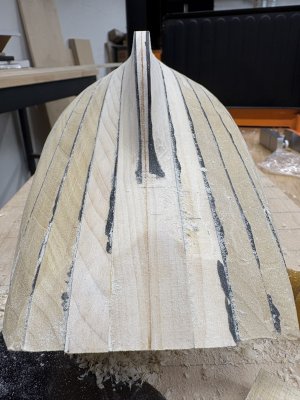
Making my way to the stern (on the starboard side) - this has been going slowly, but in the correct direction. I am still doing a great deal of the shaping using scrapers. I scrape a bit and then run my fingers along the hull in multiple directions to determine locations that are not flowing continuously. Some of the black paint showing where the lifts are joined is getting very narrow. This signifies that finishing sanding is not far away in those locations.


1768882942211.jpeg
 
More fun than planking?

Roger
Good question! This work is certainly satisfying to me. Later, planking will need to be done as the Gracie plans the hull is being fashioned on are drawn to the inside of the planking. It is nice to note that the plan set does include cross-sections that indicate the planking widths. This will be most helpful when laying out the planking scheme. Thus there will come a point that all of this hull shaping work will become concealed. After the planking comes another decision point - copper the bottom or not; if so, how will it be done?

Of course, an alternative option would have been to redraw the HAMMS plans to the outside of the planking before making the lifts. The hull could then be painted once the shaping is done. If I had gone this way, I would have shaped the solid hull to include bulwarks. Here I will be adding station timbers to fasten the bulwarks to when the planking is being done.
 
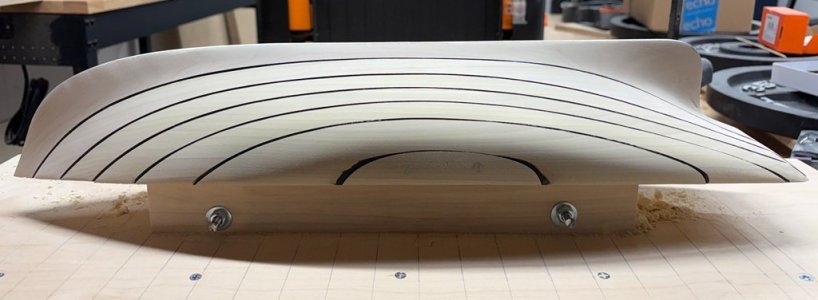
It may not look to different, but a first round of sanding on this side has been done with 120 grit has been done. Like with the scrapers and planes, it is important to remember that the hull is a continuously changing smooth surface, thus shaping / smoothing is related to the whole more than to the part. Now there is very little excess wood before the lines will disappear and I do not want to remove more than I should. I will stop here on the starboard side and move to the port side. After the scraper work and a round of sanding on the port side I will prepare a set of gauges from the body plan to zero in on the final shape. At that point I plan to work on both sides simultaneously to maintain symmetries.

Shaping Hull with Sandpaper 1.jpg
 
Now there is very little excess wood before the lines will disappear and I do not want to remove more than I should. I will stop here on the starboard side and move to the port side. After the scraper work and a round of sanding on the port side I will prepare a set of gauges from the body plan to zero in on the final shape. At that point I plan to work on both sides simultaneously to maintain symmetries.

If your waterline lifts were accurately cut out, in theory at least, if you can bring the surface fairly down to where the glue lines are all uniformly razor-thin, and no further, you should find that your hull should conform exactly to any accurate body plate gauge at the corresponding section line. If you haven't already, you may want to consider making up a "sanding batten" or two. This is done by gluing sandpaper to a wooden, springy metal, or plastic strip and on the opposite ends provide for some sort of handle, even just small block of wood glued onto the batten. These sanding battens can be "sprung" across the hull surface in multiple directions to sand a fair curve to bring down the hull shape to conform with the glue lines. Because the batten can be made to contact both convex and concave hull surfaces, it is possible to reduce the shape of the hull without creating an unfair surface that can easily result from "spot sanding."

... Later, planking will need to be done as the Gracie plans the hull is being fashioned on are drawn to the inside of the planking. It is nice to note that the plan set does include cross-sections that indicate the planking widths. This will be most helpful when laying out the planking scheme. Thus there will come a point that all of this hull shaping work will become concealed. After the planking comes another decision point - copper the bottom or not; if so, how will it be done?

Of course, an alternative option would have been to redraw the HAMMS plans to the outside of the planking before making the lifts. The hull could then be painted once the shaping is done. If I had gone this way, I would have shaped the solid hull to include bulwarks. Here I will be adding station timbers to fasten the bulwarks to when the planking is being done.

Heretical as it may sound, as a practical matter, I might suggest with some temerity that any concern about the plank thickness can be dispensed with by simply ignoring it. If, for example, at 1:48 scale, the protype planks were two inches thick, the scale plank thickness would be about .04" or 1/25 of an inch. As long as that 1/25 plank thickness is uniformly ignored, it should not be missed. This is especially so if you apply a couple of primer coats beneath your finish coats.

As has been discussed of late in a number of posts, there are a number of ways to realistically portray a copper-sheathed bottom. At 1:48 scale, I would urge you to the thinnest paper you can source and apply it with overlapping edges adhered with and sealed with thinned clear shellac, then paint it, either realistically weathered, or in a solid color. These are artistic decisions, of course. Painting the hull below the boot line with a uniform finish coat of "old copper penny brown" or even "verdigris" color would be entirely acceptable in my book as well. The biggest danger with "coppering" scale model hulls is going over scale size and ruining the realistic effect of the overall model. It's always better to err on the side of "too small" than on the side of "too large" when it comes to scale details.
 
If your waterline lifts were accurately cut out
Of course they were!

I was thinking of trying sanding battens - do you have a recommendation for dimensions if batten?

At this point I feel the need to plank the hull for two reasons. First is so the keel structure is the correctly dimensioned. The body plan, to inside the planks leaves a 'significant' rabbet.

1769721866139.png

Second - the bulwarks have been left off of the solid portion and will need to be planked after timberheads have been inserted. Although, I could get around this by setting the timberheads in the thickness of planking.

As far as the coppering, I was hoping to try the paper technique - something new to learn!
 
I was thinking of trying sanding battens - do you have a recommendation for dimensions if batten?

At this point I feel the need to plank the hull for two reasons. First is so the keel structure is the correctly dimensioned. The body plan, to inside the planks leaves a 'significant' rabbet.


View attachment 573995

Second - the bulwarks have been left off of the solid portion and will need to be planked after timberheads have been inserted. Although, I could get around this by setting the timberheads in the thickness of planking.

As far as the coppering, I was hoping to try the paper technique - something new to learn!

Sanding battens can be however long and wide one wishes. The size of the hull is what really dicates their size. Big, long ones for the "wide open spaces" and shorter narrower ones below the turn of the bilge, and so on. The point is to have a flexible sanding surface which will sand evenly, a flexible sanding block, as it were. Some guys even use manicurists' "emery boards." I'd start with one that's about 1" X 6" for starters.

In terms of proportions, that body plan drawing shows some pretty thick planking to my eye. You could just shave off the edge of the rabbet, fairing the line of the inside of the planking straight down to the corner of the bottom of the keel. Alternately, you could just work upward and use body filler or epoxy with sanding additive and fair the space between the outer edge of the keel and the hull with planking omitted. These are admitted "cheats," but it's not like anybody is ever going to try to take the lines off this model to preserve for posterity. Or you can plank the solid hull, but that looks like a god-awful lot of work, the avoiding of which was the major advantage of the lift-build hull in the first place. I fear "just" gluing planks on the solid hull is going to be a tedious undertaking. You may have to use three or four layers of thin wood (plane shavings off the edge of a board, heated and pressed between two flat surfaces to uncurl them) because the substrate is curved. If you use stiff, relatively thick (scale) planking, you may have to back out (hollow the backs of the planks) to fit flat on the convex curves of the hull or carve the inside faces to lay fair on concave hull surfaces ... and you'll have to allow for that where necessary by using thicker planking stock. You'll definitely have to cut the bevels in your plank edges or fill the splayed seams with putting. And all your planking is going to have to be sanded fair after its hung. That's all do-able, but you may want to "cheat" a little bit and "dance with the girl you brought." ;)

As for the bulwarks, you can do the same thing that was done with the machine-carved hull blanks in the old days. They had a thick bulwark on them that you had the option of thinning to produce the bulwark and then gluing on the bulwark stanchions ("frame heads") or you could saw the thick "bulwark" off at the deck line (which made shaping the deck camber a lot easier) and then cutting a rabbet as deep as the bulwark running just below the deck line, then carving notches in the inner face of the rabbet into which you'd glue your bulwark stanchions. A wide sheet of wood the thickness of the bulwark, or separate bulwark planks, were then glued into the rabbet and against the outboard faces of the stanchions. (It's easier to do that it is to describe in writing.)
 
As for the bulwarks, you can do the same thing that was done with the machine-carved hull blanks in the old days. They had a thick bulwark on them that you had the option of thinning to produce the bulwark and then gluing on the bulwark stanchions ("frame heads") or you could saw the thick "bulwark" off at the deck line (which made shaping the deck camber a lot easier) and then cutting a rabbet as deep as the bulwark running just below the deck line, then carving notches in the inner face of the rabbet into which you'd glue your bulwark stanchions. A wide sheet of wood the thickness of the bulwark, or separate bulwark planks, were then glued into the rabbet and against the outboard faces of the stanchions. (It's easier to do that it is to describe in writing.)
This is an option that seems reasonable as the prime outcome is a hull with the correct lines built via lifts.

I took a few measurements today which confirmed what I thought might be true - there is actually enough material remaining to shape the hull slightly 'bigger' than to inside the planking. When I cut the lifts I went to the outside of the line defining the lift on the plan so I picked up some extra thickness. This would let me fair the solid hull to outside the planking within a more than reasonable tolerance.

Since the hull will be painted, at viewing distance for this scale, the chances of seeing hull planking is slim - and of course the lower hull being coppered, covers up anything that had been done below. Seems like I'm at one of those modeling dilemmas - do you add certain details, cover them up and feel good they are there; or take the view - if you can't see it does it really matter its not there!
 
Back
Top