



• SUBSCRIBE TO SHIPS IN SCALE TODAY!

    The beloved Ships in Scale Magazine is back and charting a new course for 2026!
    Discover new skills, new techniques, and new inspirations in every issue.

    NOTE THAT OUR NEXT ISSUE WILL BE MARCH/APRIL 2026
  • Win a Free Custom Engraved Brass Coin!!!
    As a way to introduce our brass coins to the community, we will raffle off a free coin during the month of August. Follow link ABOVE for instructions for entering.

USS Constitution - Model Shipway’s 5/32” = 1 ft. (1:76.8) Kit No.: MS2040

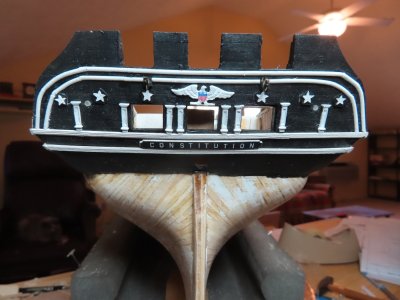
Transom Ring Bolts

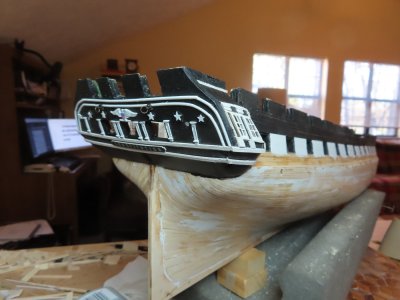
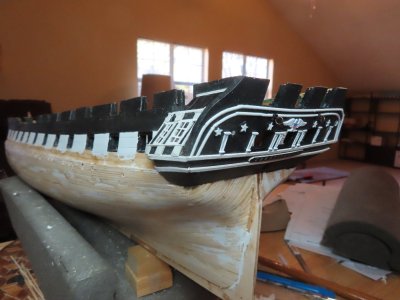
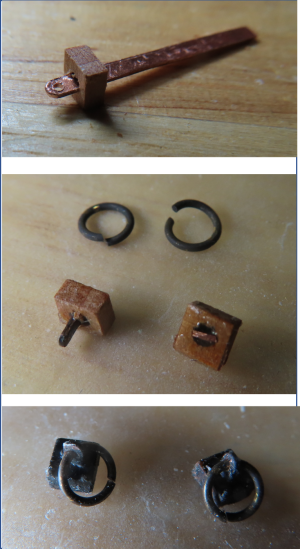
There are two large ring bolts located on either side of the eagle. A horizontal tab with a hole in it holds the vertical ring. The bases were made of 1/8” x 1/8” x 1/16” pieces of wood. The horizontal tab was fabricated from 0.016” copper plate. I wanted to use brass plate, but I didn’t have a brass plate thick enough. Holes were drilled into the tabs to accept the ring, and the end was filed to a half round. Both the copper tabs and the rings were blackened. The wood blocks were painted black, and holes were drilled to accept the horizontal copper tabs. The tabs were inserted into the block holes and glued with PVC glue so that the glue also acted a hole filler. Finally, the excess copper was cut off and the back of the block sanded flush. The rings were then inserted into the tab holes. The white transom trim was cut to accept the ring bolts, and they were glued into place. The gun port lids are the last thing to be installed on the transom. These I will hold off until I install all the lids to ensure consistency in fabrication.
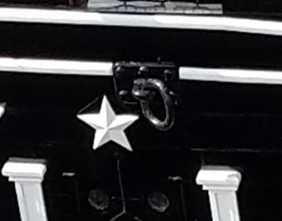
Transom Ring Bolt Close-up.png

Transom Ring Bolts.png
 
Berth Deck Port Lights Continued

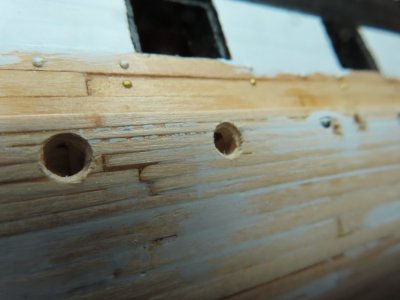
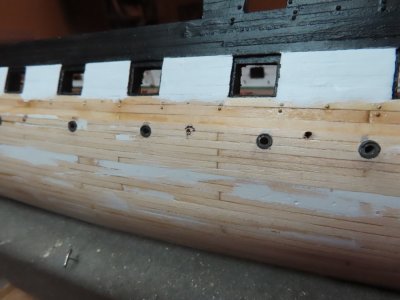
Back in July 2021, which if you dig back in this log, I was going install the berth deck port lights and scuttles into hull. I had marked and drilled pilot holes for their positions into the hull and discussed in detail how and why I was going to do, what I was going to do. However, I didn’t go any further than that because I decided to work on the quarter galleries and transom first. Well, your long wait is over.

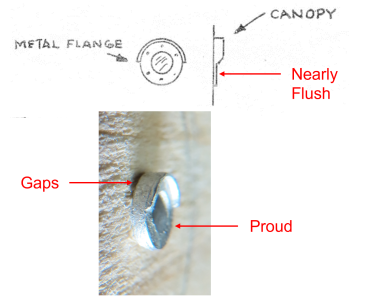
I had noticed on some of the other Model Shipway builds that the modelers were installing the port lights incorrectly. They were installed proud of the hull. According to the kit plans, and as evidenced on the actual ship, the only part of the port light that is proud of the hull is the canopy. I planned not to make that mistake.

Port Light - Kit Plan & Casting.png

Port Light - Hull.png
 
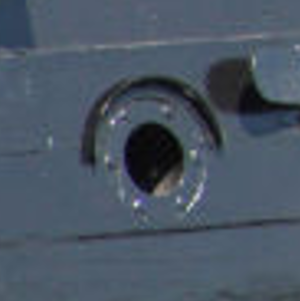
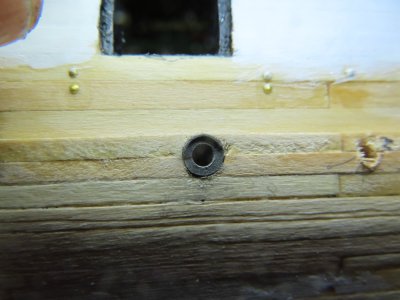
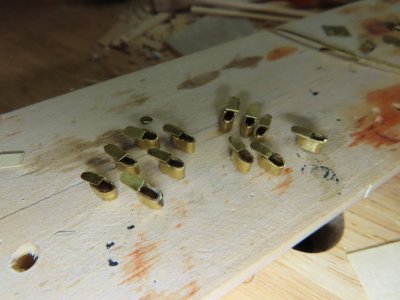
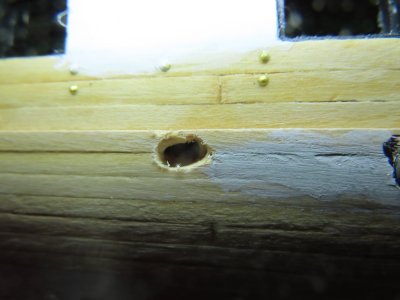
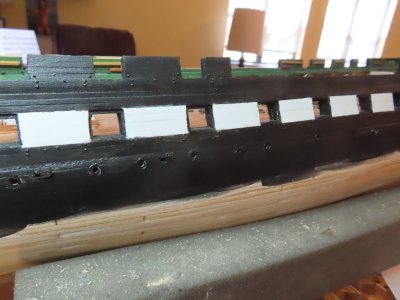
After trimming the metal port lights castings, they were blackened so as to show what little detail they had. However, they might be painted later because they didn’t show much. The original positioning holes that were drilled into the hull last time were finalized with a shoulder to accept the metal parts properly. The castings were installed with PVA glue so that I could adjust them if need be.

IMG_2106.JPG

IMG_2107.JPG

IMG_2109.JPG

IMG_2108.JPG
 
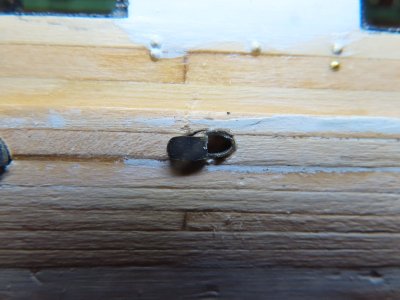
When I last handled the hull scuppers, I had just fabricated them, drilled the hull pilot holes, and painted them black (not shown below). You may note, some of the paint wore off due to handling. This why I blackened the port lights. They will be repainted after they are installed on the model.

IMG_1893.JPG
 
The openings in the hull required a bit more manipulation with drills and files because the final opening shape was oblong. Also, during the installation, I had to make sure that the scupper lid swung open forward on both sides of the ship due the requirement that the lid hinge (which is covered by the open lid) is always on the forward side of the scupper. I’ve not found another builder who has done this.

IMG_2110.JPG

IMG_2111.JPG

IMG_2112.JPG
 
As a result of this catastrophe, my USS Constitution and Rattlesnake build logs are gone. However, because of my belief that nothing is ever secure or will remain in the same place on the internet where I last saw it, I have copied everything I’ve posted including the posts of others that I have followed. Therefore this 8-year build log will start at the beginning. It will consist of just about everything I’ve posted, but not necessarily the comments. If anyone has questions between the posts in this log, I’ll try to answer them as best as my memory will allow.

I should mention here that I have MS Word documents of a majority of USS Constitution logs posted on MSW that I read. Should anyone want a copy of their lost build log, send me a PM.

USS Constitution - Model Shipway’s Kit No.: MS2040
“Old Ironsides” 1797 Frigate
Scale: 5/32” = 1 ft. (1:76.8)
Feb 19, 2017 -

This is my second POB square rigged ship; I spent about seven years building my first, Mamoli’s Rattlesnake. Like the first one, I will be following Hunt’s practicum, but unlike the first, I have a multitude of excellent build logs and books to supplement it and help guide me through the inevitable pitfalls that are sure to raise their ugly heads. Hopefully, based on this and my hard-earned experience with the Rattlesnake, it won’t take another half a lifetime to build.

Now for the obligatory part. Below is the kit box and contents. I won’t bore you with showing all the little packets that are stuffed in the box, that has been done very well by numerous other builders. I will state that in addition to what came with the kit, I purchased a few more items:

  • Robert Hunt’s practicum
  • Hobby Mill’s wood supplement package (based on Hunt’s practicum) *
  • Additional copper plate tape (as I understand it, the kit was a bit too frugal with their supply)
  • 2 - 2½” x 2½” x ¾” genuine pieces of USS Constitution wood **
  • Medallion made from genuine USS Constitution copper plate. Not sure yet how or if it will be used.
* Wood package purchased before HobbyMills closed shop. The supplement package was derived by HobbyMills where Mr. Hunt made his substitutions in the practicum. It was not identified as a package that could be purchased in the practicum. I have the original price list which describes what the wood is being substituted for and where in the practicum it is being described. If anyone wants a copy of the supplement wood list, please send me a PM.

** Constitution wood was purchased from the museum just before the ship went into drydock, December 2014. I have since tried to get a larger size for the keel or nameplate but accordioning to popeye2sea (who as I understand it volunteers on the ship), the US Navy is withholding any more wood from the public for now for reasons unknown. The museum told me, maybe in the Spring sometime.

This will be my third attempt at constructing this model. The first attempt was done when I was a child building Revell’s small plastic model which I really botched. I hadn’t yet learned to read and follow instructions, but just dove into assembling the parts with expected results. My second attempt was as a young teenager and when the wounds of that failed build had waned, went a bit better. This time I got the larger plastic model. I did follow instructions and even painted the parts but had absolutely no idea how a rigged ship worked let alone how the lines were attached or what they were for. It looked decent to my young ignorant eyes at the time. Both models met their demise at my hand with firecrackers; usual method of disposing such items

This time I expect a glorious finish…I hope.

View attachment 598231

View attachment 598232

View attachment 598233

View attachment 598234
I appreciate that you are posing this build on SOS. I have been following your build on MSW and have referred to it many times as I have worked on building the same kit.
 
Coppering Preparation

Once more I’m deviating from the build sequence laid out in the practicum. Instead of moving on to the stem with all its complications intricacies, I’ve elected to work on coppering the hull before any delicate structures are added to the stem. Thus, I painted more of the hull black just below the waterline. The copper plates will eventually define the actual waterline once they are installed.

IMG_2113.JPG

IMG_2114.JPG

IMG_2115.JPG
 
The practicum uses a coppering method which I feel could use a little improvement. Mr. Hunt used a ponce wheel to make plate edge dimples on the copper plate edge. Unfortunately, I feel they are oversized for the scale and look more like a boilerplate. A lot of builders used this method of just outlining the plate, and some made them with bumps raising above the plate like rivets. But after seeing actual pictures of the Constitution’s plating, I going to attempt an alternative method of embossed plates.

According to Roger Frye’s Shop Notes in the Nautical Research Journal V66-4 Winter 2021:

“Many attempts that emboss the plates result in bumps or dimples that are over size and draw too much attention to this feature. In full size practice, nails are pounded flat leaving only a small depression. Since the nailing pattern is generally subtle the decision on whether or not to depict it becomes a matter of scale. There seems to be a consensus that depicting nailing in 1:96 scale or smaller is difficult to appreciate without magnification and can be eliminated, while at 1:48. scale or larger the nailing pattern adds visual interest if done realistically.”

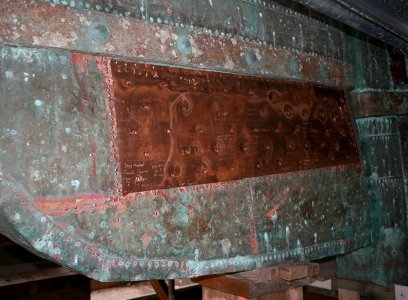
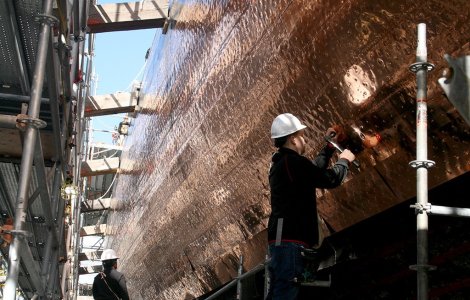
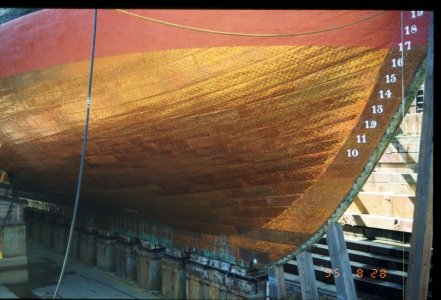
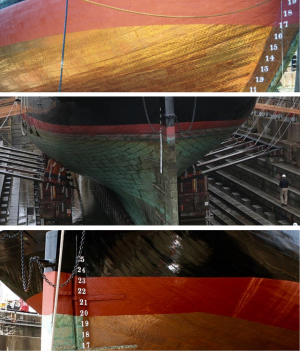
Per the quote above, the range between 1:96 scale and the Model Shipways kit at 1:76.8 scale, is left to the judgement and skills of the builder. The plate nails make small minor depressions so the indentations will have to be almost flat, just enough to disrupt the natural smooth mirror finish of the copper tape that is provided in the kit. The first image below is what Mr. Hunt created. The following images are of the actual ship for comparison.

P2240011.jpg

A piece of copper installed on the ship’s rudder where the ceremonial “first piece” was remove...jpg

Crew of USS Constitution have assisted NHHC Detachment Boston ship restorers with the installa...jpg

1995 - Copper Plates 01.jpg
 
I have several choices for my copper plates:

  • Full accuracy - Make an embossing stamp for ½” x 3/16” plates. Problems, the copper tape is ¼” wide, I need to make the stamp and jig to create 50 interior dimples plus a method to make the close quarter edge dimples
  • Impressionable – give the impression of nail indentations only
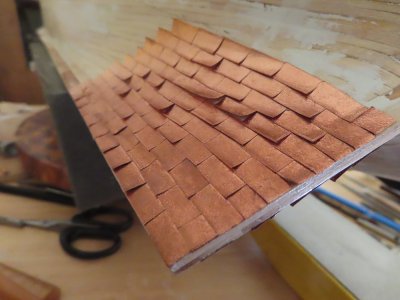
  • No nail impressions at all and may or may not overlap the plates
I made the pattern for the fully accurate pate by counting the nail heads and their locations on the real plates from photographs. When I reduced the pattern down to scale size, the nail pattern would be indiscernible let alone easy to make. When I considered the number of plates needed, I didn’t think it was worth the effort.

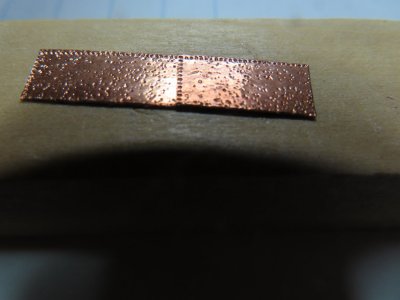
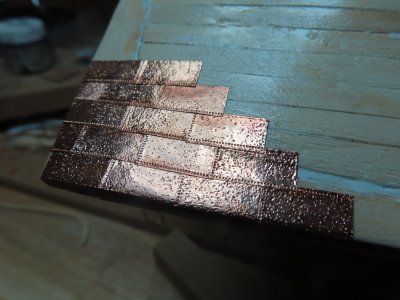
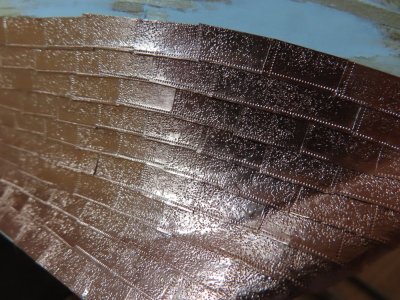
What I call the impressionable method is relatively easy to do, but still tedious. The idea is to emboss the copper using sandpaper. The rough surface of the sandpaper would make random impressions in the copper just enough for the viewer to realize the copper has some texture detail, not enough to discern a pattern while cutting down the mirror finish of the copper tape. I do have a method for edging nails using a method which I’ll discuss below

The last method is just to add plain copper plates straight off the copper tape roll without any embellishments, just cut to size. The relies on the idea that the scale is so small, you can’t see the details.

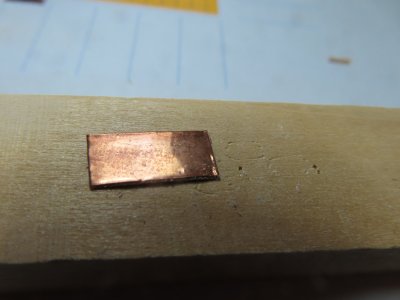
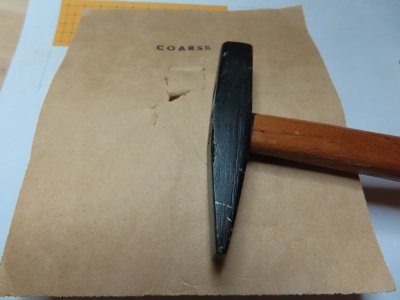
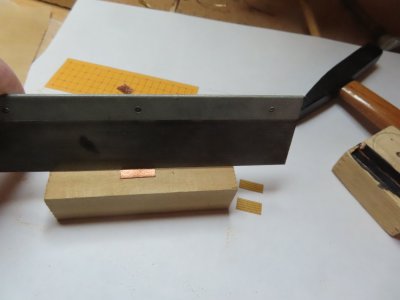
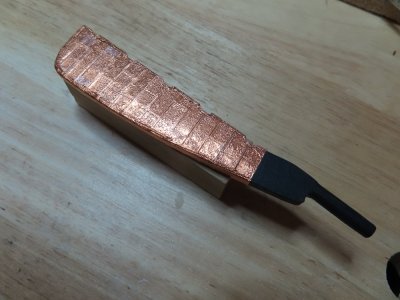
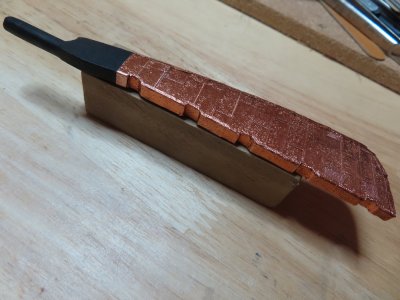
I felt that the impressionable method might be the best way to, but I had to make a test run first. I cut a few ½” length strips for my trial and create the plate with these steps:

1. Cover the plate with a piece of coarse sandpaper and using another block of wood (not shown), lightly tapped the block so it forces the sandpaper into the copper.

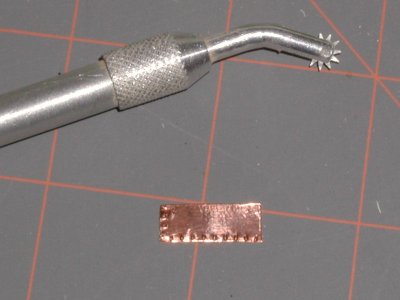
2. Per Nautical Research Guild’s Ship Modeler’s Shop Notes II, Pgs.138-9 I used a fine-tooth modeler’s saw blade and with a single tap embossed the edge of the plate top and one side.

3. Just rubbing the plate with my fingers to burnish the plate smooth.

From just a few inches away, any discernable pattern would have been lost in the full accuracy method, so this method is my choice.

IMG_2117.JPG

IMG_2118.JPG

IMG_2119.JPG

IMG_2116.JPG
 
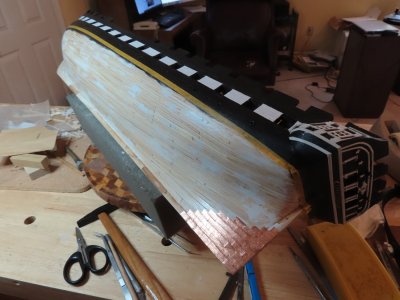
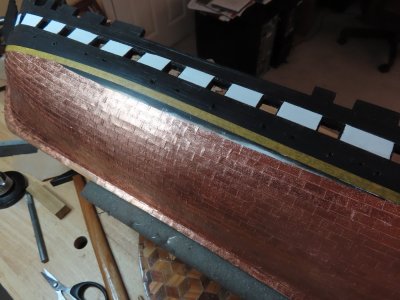
A couple of images to show the initial start of the hull coppering. It’s a slow tedious process, Couple of hours a day is all I can take: cut a bunch of plates, emboss, then apply each plate, repeat.

IMG_2120.JPG

IMG_2121.JPG
 
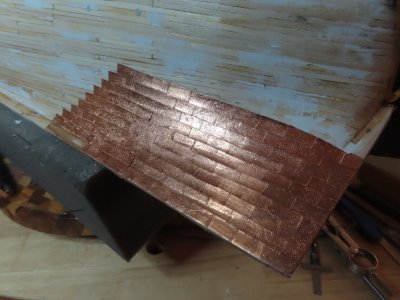
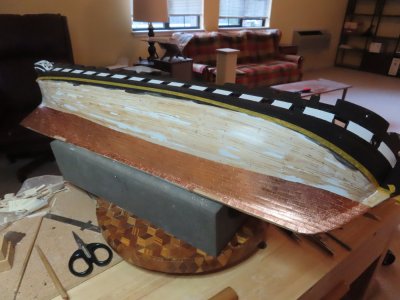
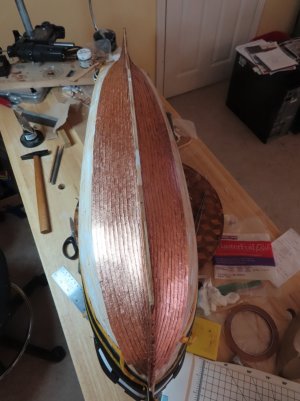
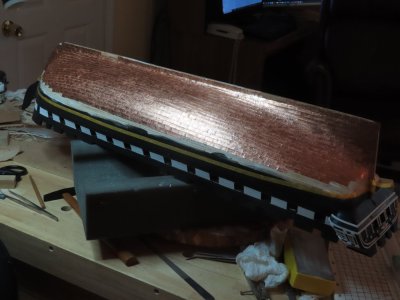
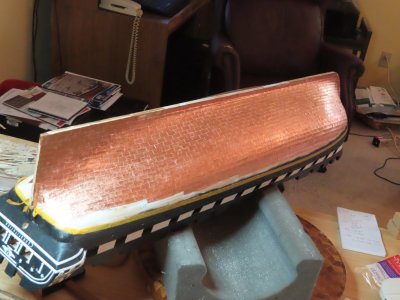
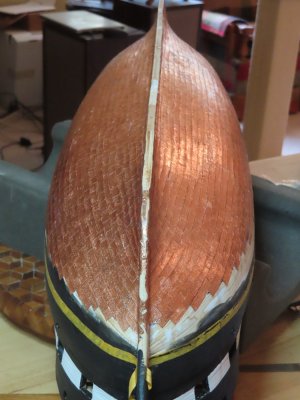
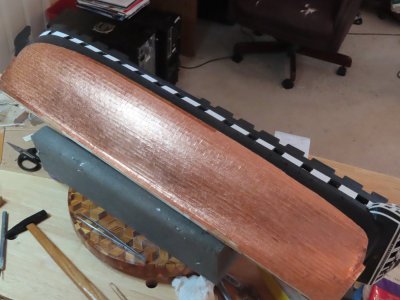
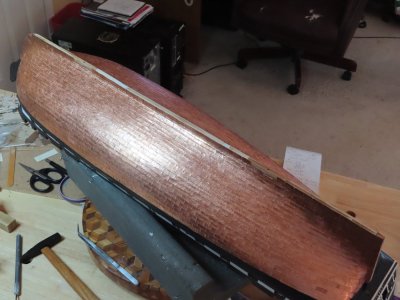
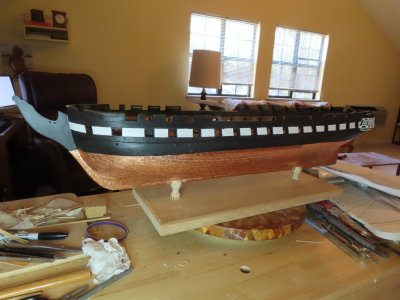
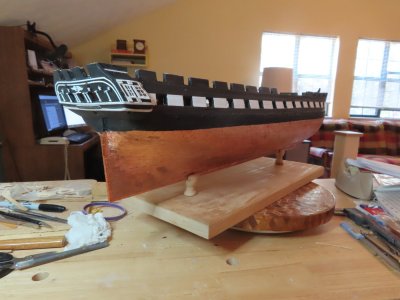
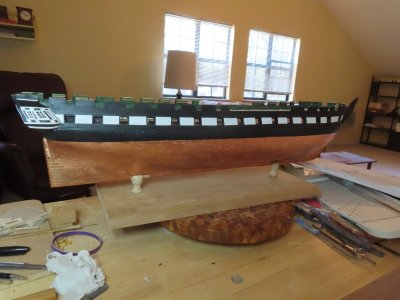
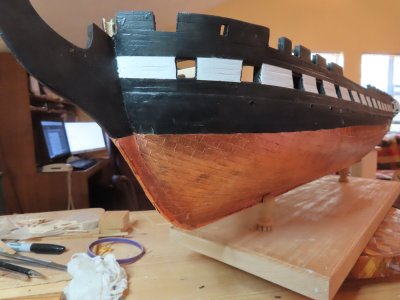
A week or so into copper plating and all is going slow (my usual pace) with decent results. I did run into one annoying problem – the plating wants to lift even after multiple burnishing. I burnish by rolling a short 3/8” diameter wooden dowel over the copper tape. I want to flatten the embossing, not rub it out. With carefully applied CA glue under the plates that lift, I gotten most of them to stay down. So, it’s two steps forward and one back. The pictures below show only one side although both sides are being plated at the same rate.

IMG_2123.JPG

IMG_2124.JPG
 
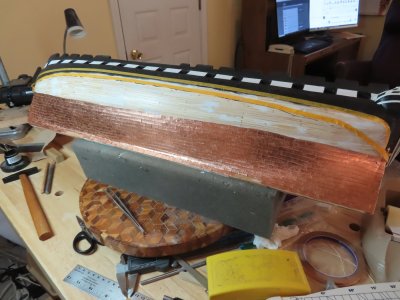
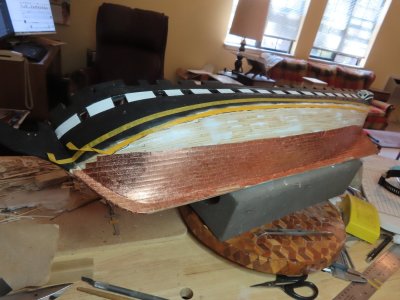
Progress report on the copper plating: I believe I am approaching the halfway point, if not already on it. If you look closely, you may notice two areas of the keel where the sides are not covered in copper. I left those aeras untouched so it can be identified as the places I used wood from the actual ship. Also, I have not yet plated the bottom of the keel.

IMG_2127.JPG

IMG_2128.JPG

IMG_2129.JPG
 
Still in the routine of cutting up about 20-25 plates at a time, embossing the face of the plate with the sandpaper and the fine teeth of my miter saw on two edges then placing, and finally burnishing the plates into position. After about 40 to sixty plates, I’d quit. I couldn’t take it anymore. Before I could add any additional plates the next session, I’d have to CA glue all the plates that curled up not sticking permanently. That is a pain.
IMG_2130.JPG

IMG_2131.JPG

IMG_2132.JPG

IMG_2133.JPG

IMG_2134.JPG

IMG_2135.JPG

IMG_2136.JPG

IMG_2137.JPG
 
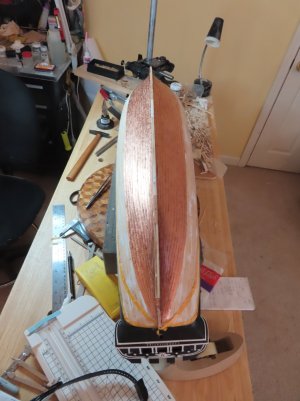
Now I am approaching the top edge boundary of the plating. Up until now I have been using Robert Hunt’s practicum as a guide to perform this task. His plating method used a double capping row to end his coppering. This method is shown in numerous guides as one method which copper was done, but not the only method. The actual ship, it turns out, uses a different method, at least it does currently. It may have used different patterns in the past, but since my model reflects the current version for the most part, Mr. Hunts method is incorrect for the current method as you can see from the pictures below. I had started to create the double copper capping row but ripped it out when I realized the discrepancy. I still have about 3-4 hull rows to the water line, plus the stem, keel, and stem edges as well as the rudder, to plate.
PA03042003 012.jpg

Coppering Waterline.png
 
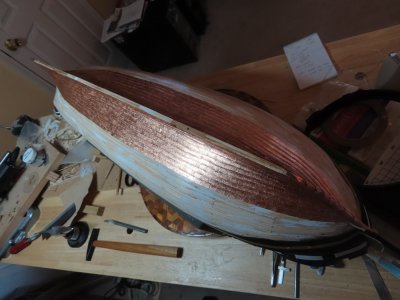
My copper tape roll ran out 24 plates shy of completing the hull. However, I was prepared as Hunt’s practicum warned me that may happen, and I also read the same accounts in a couple build logs. This did not include coppering the stem, keel, stern, and rudder. Also, it was not unexpected that the oxidation color of the second roll of tape was of a slightly darker hue. Over time they will even out going from shiny new copper to old penny brown, and finally green copper oxide (if the model lasts that long).

IMG_2140.JPG

IMG_2141.JPG

IMG_2142.JPG

IMG_2143.JPG

IMG_2144.JPG
 
Copper Completed

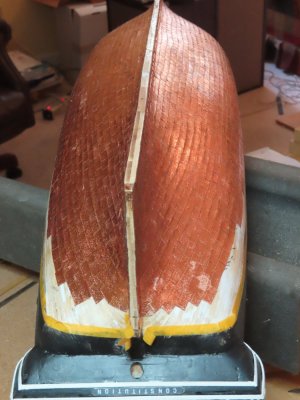
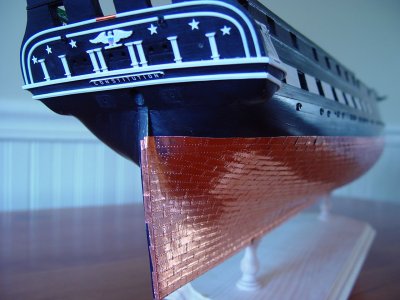
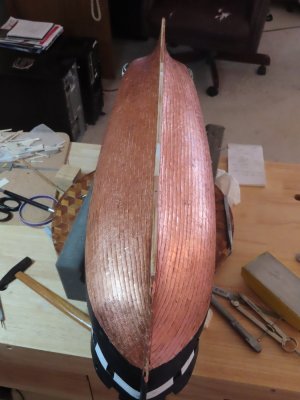
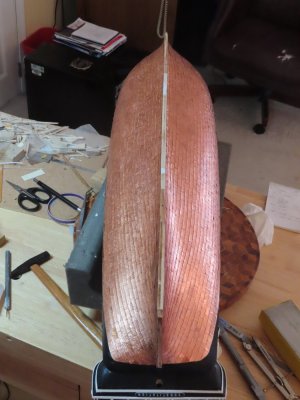
Finally…the major milestone has been reached – The coppering has been completed, including the stem, keel, stern, and rudder. I’m estimating it took cutting, embossing, and placing 2,600 -2,700 plates to do the job. I’m glad that’s over and done.

IMG_2147.JPG

IMG_2148.JPG

IMG_2149.JPG

IMG_2150.JPG

IMG_2145.JPG

IMG_2146.JPG
 
Back
Top