• SUBSCRIBE TO SHIPS IN SCALE TODAY!

    The beloved Ships in Scale Magazine is back and charting a new course for 2026!
    Discover new skills, new techniques, and new inspirations in every issue.

    NOTE THAT OUR NEXT ISSUE WILL BE MARCH/APRIL 2026
  • Win a Free Custom Engraved Brass Coin!!!
    As a way to introduce our brass coins to the community, we will raffle off a free coin during the month of August. Follow link ABOVE for instructions for entering.

USS Constitution - Model Shipway’s 5/32” = 1 ft. (1:76.8) Kit No.: MS2040

Rudder and Rudder Head Box

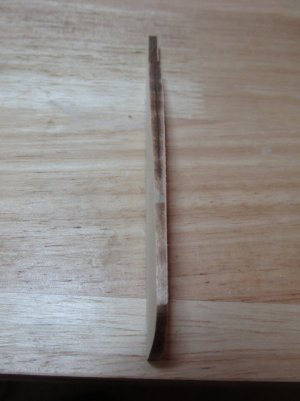
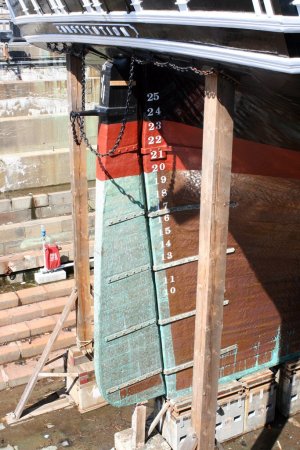
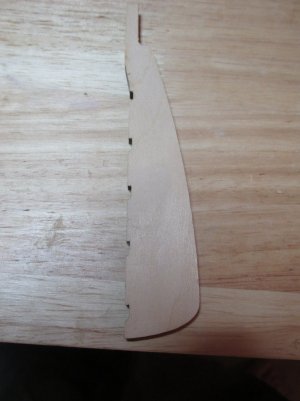
Continuing with my idea of creating an essence of this space and not an actual reproduction, the last major element to be installed in this area was the Rudder Head Box. Since this obviously involves the rudder fitting into the rudder top box, this was a good time to finally shape it. The rudder tapers down top to bottom from 3/16” to 1/8”. It also tapers near the bottom, forward to aft 1/8” to 3/32”. This was done with a very light and delicate touch with the disk sander and elbow grease with a block sander. Interestingly, the plans call for the rudder shaft to be “round stock” but I believe that is not necessary. That part of the rudder is not seen. I checked a lot of the model builds where they show that detail, and no one fully rounded the shaft if they bothered at all. The pictures below show the actual ship rudder in which you can clearly see the taper and my rudder in which I attempted but failed miserably to show the taper I created.
2017 Rudder.jpg

IMG_1345.JPG

IMG_1344.JPG
 
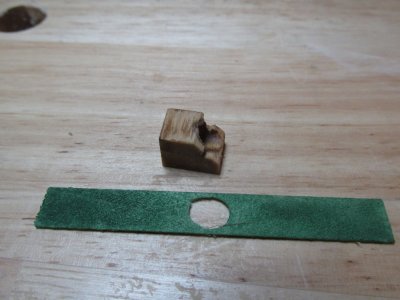
My first attempt to create the rudder top box also failed. I had tried using a block of basswood with a hole drilled into it. As I tried to increase the hole size to accommodate the rudder shaft, it obviously got closer and closer to the edge of the block till it structurally failed. The green strip (1/32” basswood) reflects the internal counter bending toward as seen in the actual photo above.

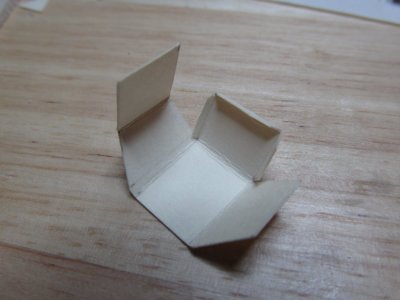
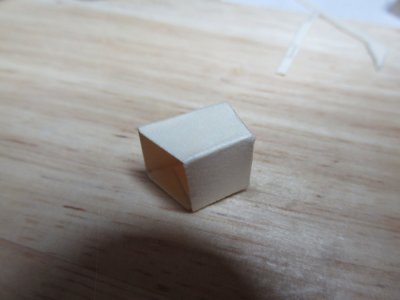
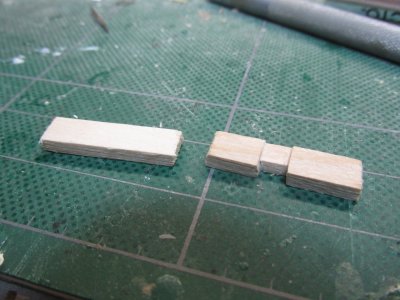
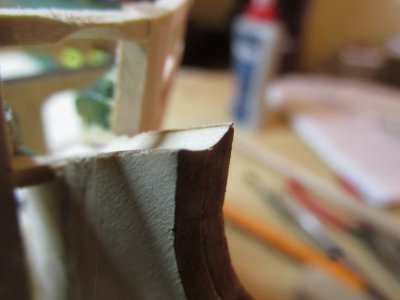
Because the rudder top box will not be seen clearly, it did not require much detail other than its overall shape. That meant it didn’t even have to be made from wood. My second attempt, I tried cardstock. Using a single piece of cardstock, I fashioned a pattern with glue tabs which was then folded into shape. It worked. I gave it a splash of stain and you would swear it was made from wood.

IMG_1346.JPG

IMG_1347.JPG

IMG_1348.JPG

IMG_1349.JPG

IMG_1350.JPG
 
Mast Reinforcements

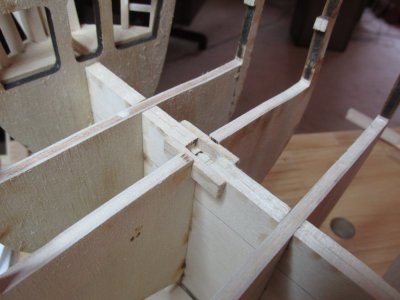
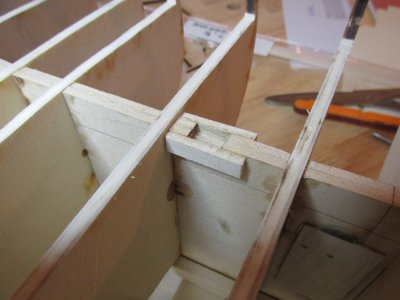
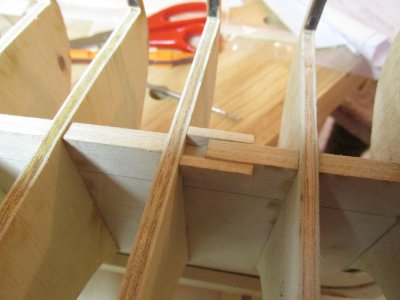
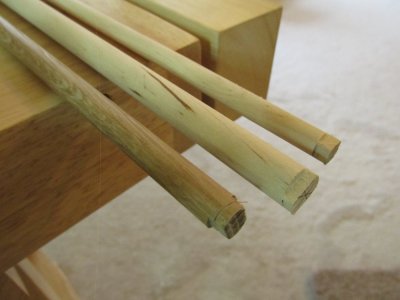
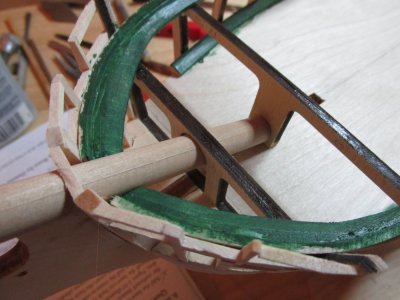
Before I go off script again, the next items to be added per Mr. Hunt’s practicum and the kit instructions are the mast reinforcement. These add sides to the mast slots in the keel bulkhead. The main and mizzen mast are constructed the same. The foremast has the added complication that it also is in a slot of a bulkhead. The kit plans state that the pieces are to be 1/8” thick, no width or length is specified. The practicum calls for 1/8” x 5/16” stock (basswood). The problem is that the kit does not supply 1/8” x 5/16” stock. I used 1/8” x ¼” stock which close enough. The main and mizzen masts reinforcements were cut to length by eyeball and glued into place. The foremast had to be notched along one side to allow for the bulkhead to slide by and notched at the bottom so that it could sit low enough on the bulkhead to cover the keel notch. Once those were done, stock dowels for the fore (3/8” ᶲ), main (7/16” ᶲ), and mizzen (5/16” ᶲ) masts were notched to create a mortice to fit into those slots.

IMG_1352.JPG

IMG_1353.JPG

IMG_1354.JPG

IMG_1355.JPG

IMG_1356.JPG
 
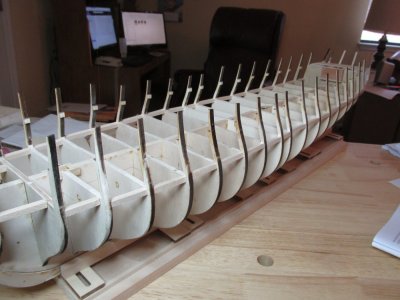
What to do next? What to do…According to the kit instructions, I should be attaching the transom extensions (the aft side of the quarter galleys) but I don’t want to add those on until I’m actually working on the quarter galleys. I’m afraid I could snap those off by accident. But in looking at the transom, I thought I’d better check how the planking boards will curve into the stern. I discovered that I needed to trim more wood off the filler blocks. You can see in the image below, the subtle but significant difference between the untrimmed port side and the trimmed starboard side.

IMG_1357.JPG
 
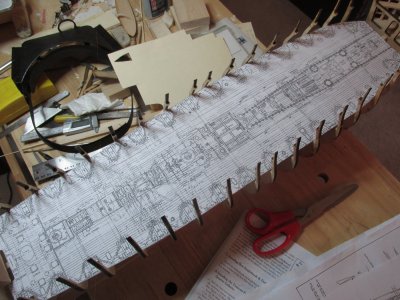
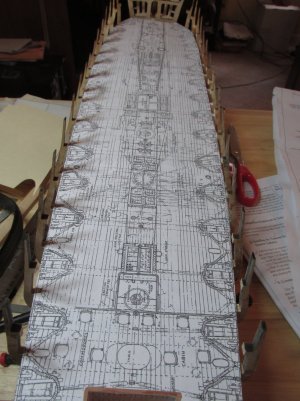
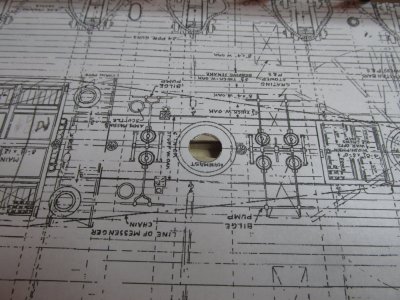
Then my curiosity got the better of me. I wanted to see what the gun deck looked like on the model. I will have to know where the ladders are located and whether I need to make those or gratings if I leave the stair openings covered. Using the US Navy plans, I matched their scale to the kit’s and printed the layout (3 sheets). These will also be used to make the template for the gundeck support flooring for the planking.

IMG_1358.JPG

IMG_1359.JPG
 
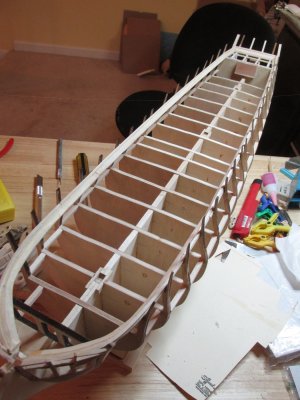
The kit offers, as an option, the creation of bulkhead stiffeners. I took the option. I discovered that as careful as I was making sure the bullheads were installed at eight angles to the keel, there were some differences in distances between the outer edges of the bulkheads from one side to the other by as much as 5/32”. To counter act this, the stiffeners were cut the average of the two sides. So, if I added 1/32” to the port side stiffener, I reduced it by 1/32” on the starboard. This forced the bulkhead to twist back to a right angle.

IMG_1360.JPG
 
The Next Step

At this point I have no instructions on what to do next. The practicum and the kit instructions do not describe the kit bash I’m about to plunge into. After a number of false starts, I thought I would start by making the sills for the gun deck gunports only to quickly realize that I needed a reference point to measure from. This lead me to think I should use the floor of the gundeck, but I had chopped them down to make room for the plywood floor support and planking. If those cuts weren’t perfect, all my subsequent measurements would be off. Also, the wood needed to make those sills was going to be different than what the kit called for because I wasn’t planning to use a lot of the dummy cannons which require a “cannon barrel box” to be fabricated. When I started to research whether I needed to buy additional wood for “my” gunports or if I could recut the kit suppled wood, I checked the practicum to see what Mr. Hunt used for the “cannon barrel box”.

I discovered that he didn’t get to that stage until Chapter 3 in his practicum while I was in the middle of Chapter Two where he had come to the same question: where do you measure from? He stated:
We will make and install the [spar deck] waterway first, then the planksheer [which sits on the waterway]. Once the planksheer is in place we have the defined bottom sill of our [spar deck] gunports. To establish the top sills or main rail, we will then install four planks on the inside of the bulkhead tops to form the bulwarks. These four planks will then establish the location of the main rail, which sits on top of the fourth plank. That will ensure proper framing of our gunports based on the wood stock provided in our kit. [The text in brackets are my notations for clarity]
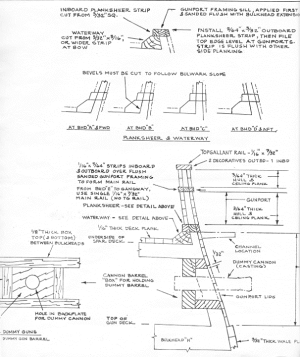
Even though he is referring to the spar deck, the planksheer reference point will also apply to the gun deck. Hence, the next step is the construction of the waterway. This should be interesting as this element bends and is beveled 45° on the inner side and varying acute and obtuse angles on the outer depending where along its length it meets each bulkhead.

Gun port and Waterway.png
 
The Waterway and Planksheer

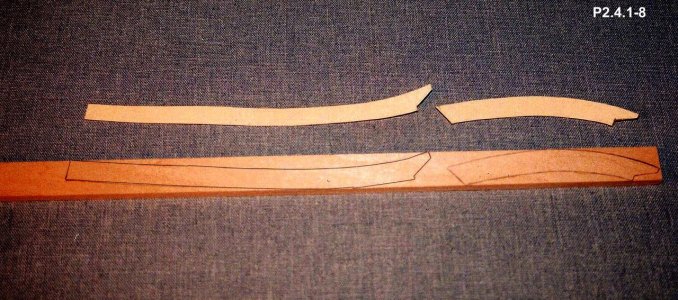
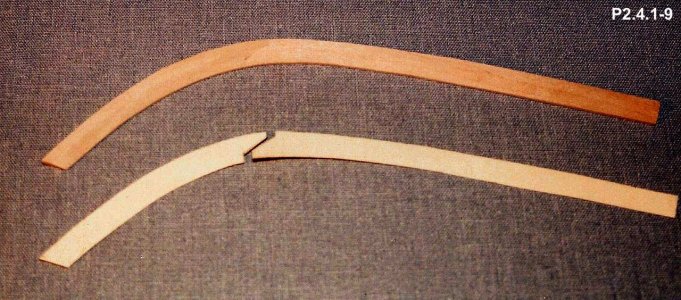
The waterway is made from 5/32” x 5/16” basswood stock. This is fine for most of the waterway but trying to bend this thickness of wood from bulkhead E forward around the inside of the bow would be exceedingly difficult. For this reason, the practicum directs the builder to use the ½” x 3/16” basswood stock supplied with the kit to make a two-piece pattern for the curve for each side of the bow as shown in the images below.

P2.4.1-8.jpg

P2.4.1-9.jpg
 
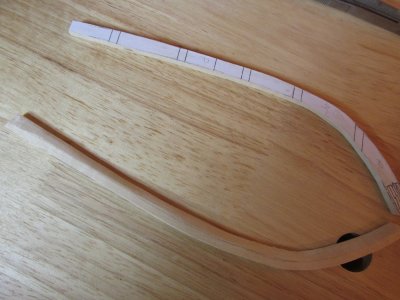
I found that I could not fit the curve onto my piece of ½” wide wood. Instead, I opted to buy a 3” x 3/16” piece of basswood from my local hobby store. This enabled me to make a one-piece pattern directly from the kit plans. Note that in either case, the stock wood was 1/32” too thick and had to be sanded down.

As mentioned in the post “The Next Step”, the waterway has a trapezoidal cross-section that changes as it moves away from the bow and stern. Mr. Hunt made his bevels using an X-acto knife. I’m not that good that I could make consistent cuts over the length of the model. I chose instead to use my $10 mini razor plane I got a Micro-Mark some years ago. The curved section was however had to be formed with the X-acto knife, files, and sanding sticks.

IMG_1361.JPG

IMG_1362.JPG

IMG_1363.JPG
 
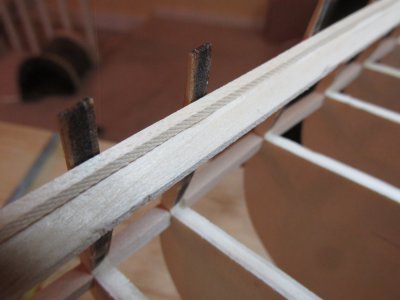
You may have noticed that when I originally cut the bulkheads to allow the formation of the gundeck, I left a remnant of the spar deck on the bulkhead. The waterway was fitted against the bulkheads and glued to these short outcroppings. Then the planksheer, made from 1/16” x 1/16” basswood stock, was fitted and glued on top of waterway, also flush against the bulkheads.

IMG_1365.JPG

IMG_1366.JPG
 
Gun Deck Waterway – Plywood Foundation

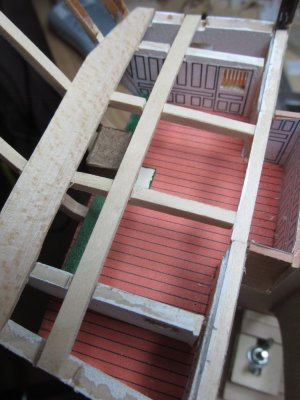
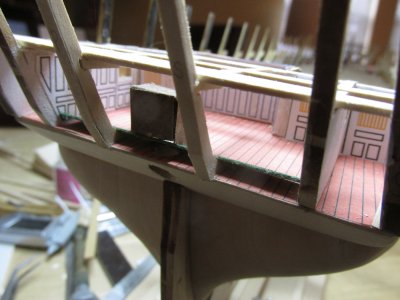
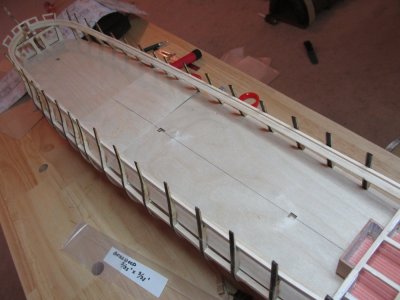
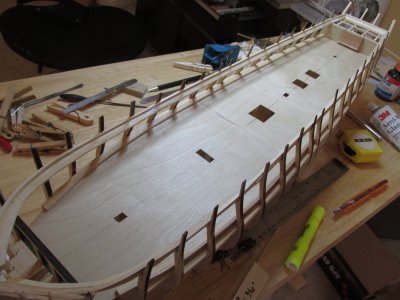
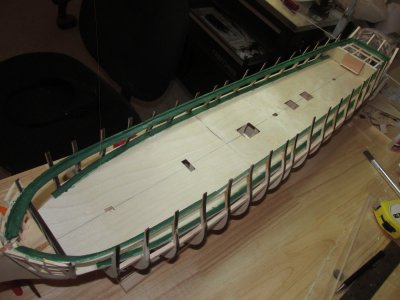
There are several different paths I could have chosen pertaining to what to do next. Some builders installed their framing for the gun ports, others worked on the transom. Since I just installed the waterway on the spar deck, I decided to install the waterway on the gun. To do that, I purchased a large sheet of 1/32” plywood and using the US Navy plans for the gun deck as a template, three pieces were formed to fit onto the bulkheads. This has a twofold effect; it provides a solid smooth support for the gundeck planking and it smooths out any imperfections in bulkhead heights and shapes of the deck when I modified the bulkheads and keel. Once the plywood is installed, the waterway will sit on top and against the bulkhead frames just like the spar deck. I decided that since the interior of the gundeck bow from bulkhead A forward would be unviewable, that portion would not be detailed.

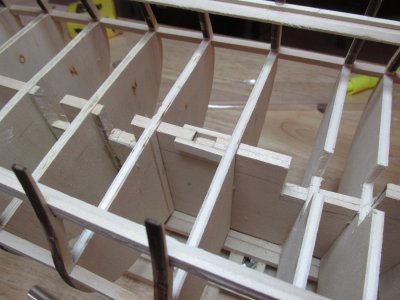
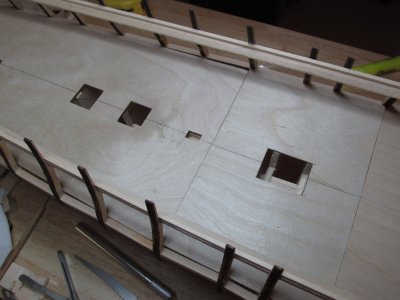
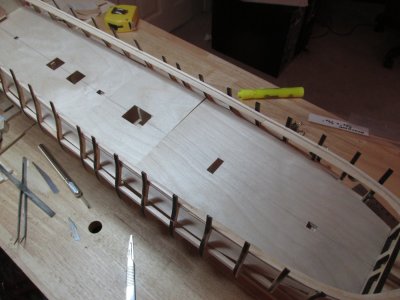
Before I can secure the plywood to the bulkheads and keel, now would be the time to cut the holes for the masts and any openings that may be seen through the open planks I plan to leave on the spar deck. The masts were simple enough, I drew the center line on the 3 plywood deck pieces and measured where the mast opening had to go and cut them out with an X-acto knife. That worked just fine. As noted, the plywood is not glued down in the photos below.

IMG_1368.JPG

IMG_1369.JPG
 
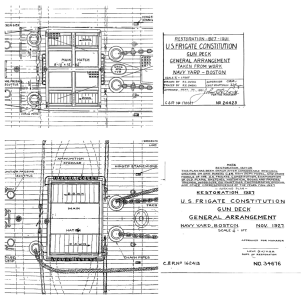
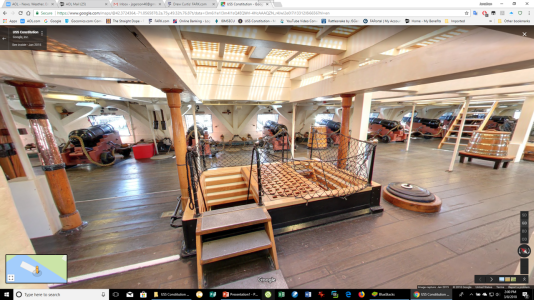
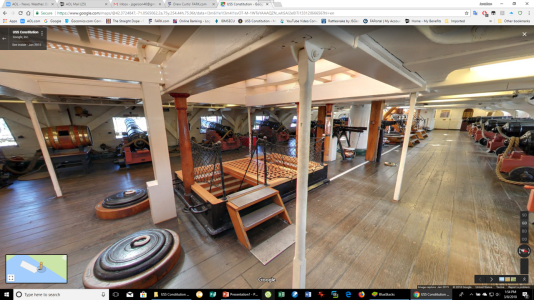
Those openings which will be covered with a grating do not need to be cut. So, the only places which do require cutting a hole are where the ladders pass through the hatches to the berthing deck. That should be easy too, I have the US Navy plans to show me where to cut…But not so fast. I have two detailed arrangement plans for the gun deck, one dated September 30, 1931 and the other November 1927. For the gun deck main hatch, they don’t match. To make matters more interesting, neither of them match what is existing today. My original assumption was that the 1927 version was the “before” and the 1931 was “after” the restoration. But somewhere along the line, there is what actual exists, so the plan is to build the reality.

Main Hatch Plans Gun Deck.png

Under Main Hatch 01.png

Under Main Hatch 02.png
 
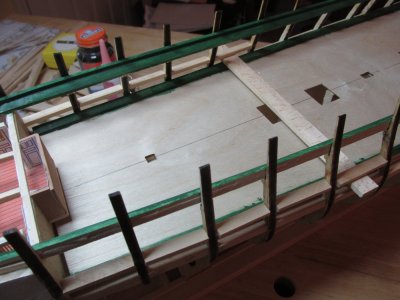
I determined which and where the openings in the gundeck were to be, measured for their locations and cut them out of the plywood gundeck support pieces. Not only did the support needed to be cut, but areas of the keel and certain bulkheads under them had to be modified to allow the installation of ladders. The support pieces were placed back onto the model, so I could mark where the keel and affected bulkheads needed to be cut. I figured that approximately 1” in depth needed to be removed to give the illusion of the berthing deck below. I thought about just painting those areas black, but if light hit those spots wrong, the bulkheads and keel might be visible, and the illusion would be lost. Images below were taken just before the plywood was glued down.

IMG_1370.JPG

IMG_1371.JPG

IMG_1372.JPG
 
The gundeck waterway was installed in two pieces like the spar deck only it falls short of the bow. That portion of the gun deck won’t be seen. This made it easier to bend the waterway. A little touch-up with glazing putty and sanding at the waterway joints, and they were painted green. It’s much easier to paint them now than later.

IMG_1373.JPG

IMG_1374.JPG
 
On a Side Note…
In anticipation of constructing gratings for the gundeck, I contacted Model Expo, the manufacturers of Model Shipways models. They have a guaranteed replacement policy for lost, missing, broken, or even builder screwed-up installation parts. My situation was different; I wanted to buy an additional laser cut “Part S” to use for the gundeck. This is the part with all the gratings. I was trying to be honest.

I called them on the phone and finally got a hold of “John.” He sounds like a really busy guy because some days he doesn’t answer the phone and you have leave a voice message. He will get back to you…most of the time. I told him I wanted a special order. I wanted to buy a USS Constitution kit part. I guess this was unusual because he had to email someone in order to get a price and would contact me later with it. Three weeks later, after 3 follow-up calls, it turns out that at present, their computer system cannot handle this type of special order. They were in the process of upgrading their system so in the future they could do special orders, but not just now. He then told me to request the part as a free replacement instead, which I did. I offered to buy the part and pay shipping which they couldn’t do (?), but a free replacement, no problem, go figure. It’s been 3 days since I requested the “replacement” part…we’ll see what happens.

Fitting the Bowsprit

If I were strictly following the practicum, Mr. Hunt would have me plank the spar deck bulwarks “without concern for the locations of the gunports.” The reason for this was as he stated, “Later, when we have framed the gunports out, we will cut the openings through these strips.” I will have to check out the wisdom of this method before I commit to it. So, skipping that section brought me to the last section of Chapter 2 of the practicum, fitting the bowsprit.

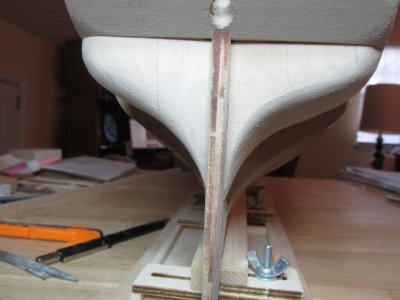
The first thing that needed to be done was to create a concave surface on the stem for the bowsprit to rest on. A curved file did the trick.

IMG_1376.JPG
 
When I did the lobotomy on the bulkheads and keel to create the gun deck, I spliced off that part of bulkhead “B” which had the “keyhole” for the bowsprit to lock into. When I did that at that time, I thought, “Oops, I should not have done that;” but I did not throw that piece away. (If the truth be known, I don’t throw away anything that I think I could use sometime in the future. Luckily(?), I don’t have a significant other, or she would have toss me out 8-). It was fortuitous that I did. It made it a lot easier to fit the bowsprit into it during the carving process. If you look closely at the base of the “T,” there is a wedge of wood I used to level off the part. I had cut the bulkhead off at a slight angle. In addition, due to the waste from the cutting process and the addition of the plywood, the part no longer fit. The wedge corrected both problems.
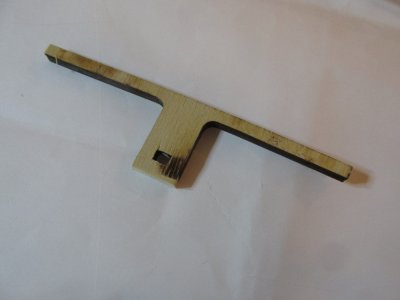
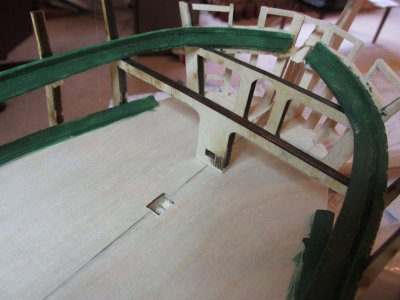
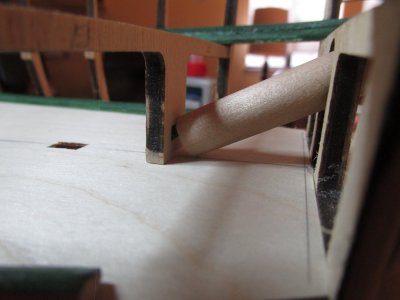
Note, I haven’t decided yet whether to glue the bulkhead back on now or wait till the deck planking is finished. If I wait, the planking will be easier, but I will have trim down the bulkhead again for the 1/16” planks.

IMG_1378.JPG

IMG_1379.JPG
 
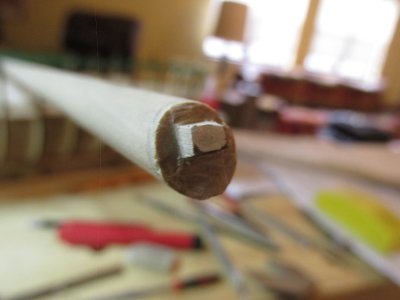
According to the kit plans, the bowsprit rests at angle of 25.5 to the deck°. To my delight, it is on my model. As you can barely see from my photo below, the dowel that is to become the bowsprit needs to be beveled so it fits flush to the face of bulkhead “B” as well as have a tenon carved into it to fit into the bulkhead “keyhole.” Using my disk sander, I made the bevel. The dowel was then inserted into the bowsprit slot to verify proper fit. Then, with a fine paint brush with a small dab of white paint, a mark was made on the face of the dowel by painting it through the “keyhole” while on the model. The tenon was made with an X-acto knife. And as stated above, because this part of the bulkhead was removable, fitting the parts was relatively easy.

IMG_1375.JPG

IMG_1377.JPG

IMG_1380.JPG
 
Gundeck Gunport Framing

The gundeck gunport framing is more complicated than I thought. At this point I am not following the nice detailed instructions in the practicum because he is not kit bashing the model, so I am constantly second guessing myself.

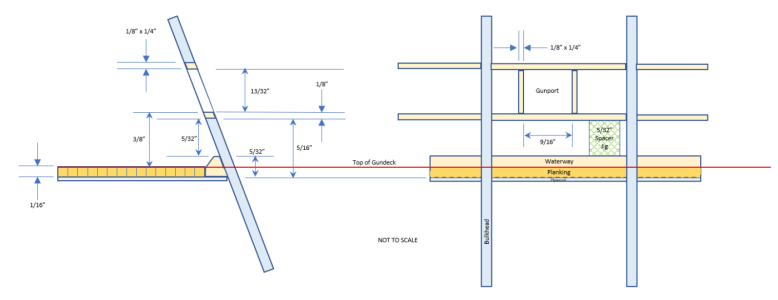
The consistent benchmark from which all measurements originate is “top of gundeck.” However, my “top of gundeck” has not been completely rebuilt yet as the 1/16” decking has not been installed on top of the 1/32” plywood support. The kit plans show that the top edge of the gun port sills is 3/8” from the top of the gundeck. I want to use a spacer block as a jig to ensure all the sills are installed at the same height be having the sills resting on top of the spacer. But because I have installed the gundeck waterway, the spacer must rest on it rather than the plywood. The top of the waterway is 5/32” from the top of the plywood. The top of the spacer goes to the bottom of the sill. Confused yet? I was getting myself lost, so being a visual person, I made a dimensional plan. Now I know (I think) that if I lay a 5/32” thick spacer block on top of the waterway, the sills lying on top of the spacer, should be at the proper height.

Gundeck Gunport Framing.png
 
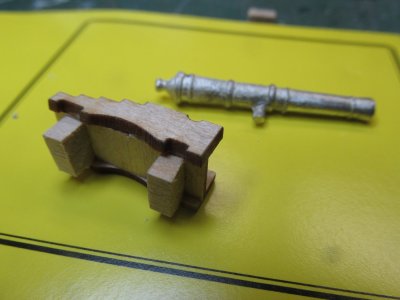
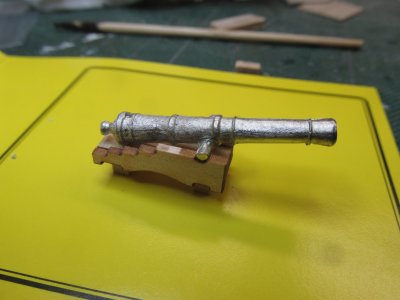
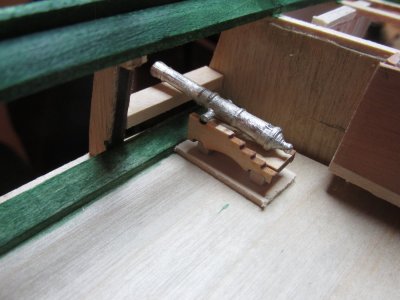
Based on my calculations above, I proceeded to install the first sill using 1/8” x ¼” stock basswood. To verify that those calculations were correct, I put together one long muzzle cannon to act as a gage as briefly mentioned by Darrell earlier. Instead of assembling the axis and wheels for the carriage, I simply used some blocks of equivalent height per kmart’s idea. It’s quick and dirty but does the trick. The mock-up cannon then was placed on a piece of 1/16” thick wood to represent the future planking and then onto the plywood support deck. I think I got it right.

IMG_1382.JPG

IMG_1381.JPG

IMG_1383.JPG

IMG_1384.JPG
 
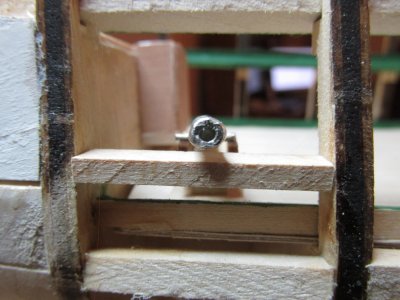
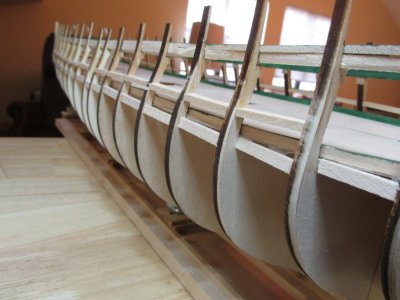
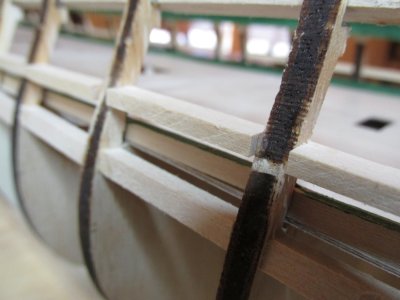
Using the 5/32” thick spacer, which passes through both sides of the model, per kmart, the remaining sills were inserted. As seen looking along the side of the model, the sills correctly follow the curve of the deck. As also seen in the closeup image, excess wood must be trimmed off to bring the sills flush with the hull. I’ve now determined that the first two gunports from the stern and from the stem will use the dummy cannons that came with the kit. That is because I don’t expect these guns to be seen by the observer, plus it will allow me to close those gun port lids so that the observer can see what they look like closed. That’s eight carriage rigs I won’t have to make plus $40 I can keep in my pocket because Model Expo charges $5/cannon & carriage should anyone want to add that gundeck detail.

There is one other point I should mention – the sills for those dummy cannons will probably need their width adjusted to accommodate the dummy gun box the kit plans show. Because I plan to close the gunport lids, the muzzle of the cannons will be pulled back, so it only protrudes through the round opening in the closed lids. The kit plans show only the guns in their extended firing position. I don’t know what those measurements will be yet.

IMG_1385.JPG

IMG_1386.JPG

IMG_1387.JPG
 
Back
Top