-

SUBSCRIBE TO SHIPS IN SCALE TODAY!
The beloved Ships in Scale Magazine is back and charting a new course for 2026!
Discover new skills, new techniques, and new inspirations in every issue.
NOTE THAT OUR NEXT ISSUE WILL BE July/August 2026 -

Win a Free Custom Engraved Brass Coin!!!
As a way to introduce our brass coins to the community, we will raffle off a free coin during the month of August. Follow link ABOVE for instructions for entering.


You are using an out of date browser. It may not display this or other websites correctly.
You should upgrade or use an alternative browser.
You should upgrade or use an alternative browser.
USS Constitution - Model Shipway’s 5/32” = 1 ft. (1:76.8) Kit No.: MS2040


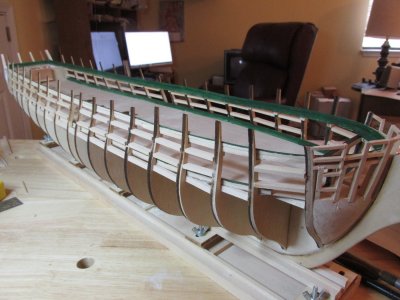
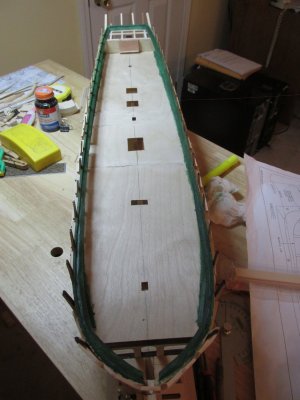
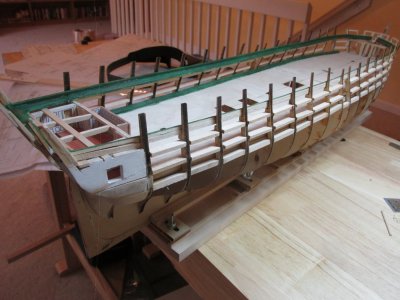
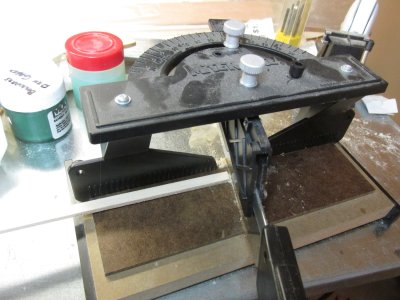
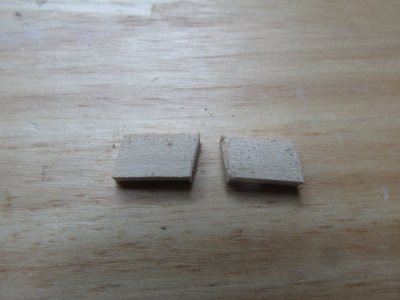
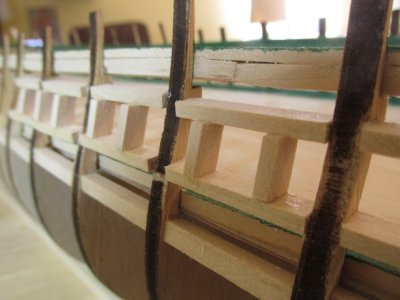
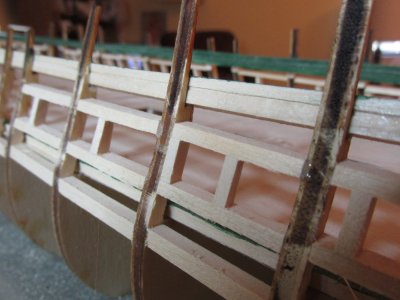
The spacer which I used to install the gunport headers was designed so that its cross section was exactly the dimensions of the opening of the gunports. The side pieces were pressed against the spacer sides and glued into place completing the gunport framework. Some of the gunports were formed with one bulkhead as the gunport side, others with two pieces I cut as dictated by the plans.
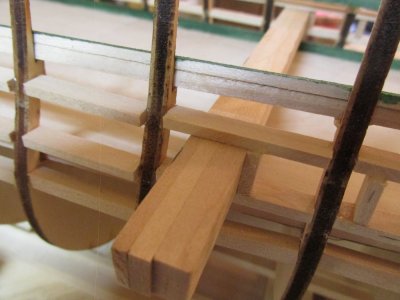
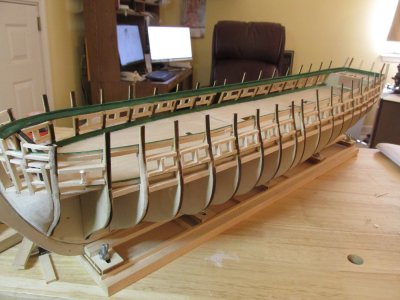
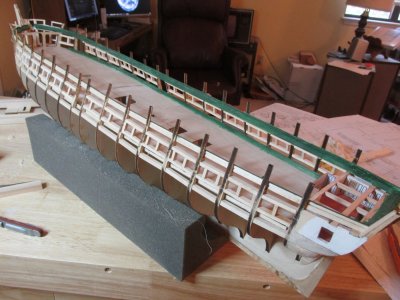
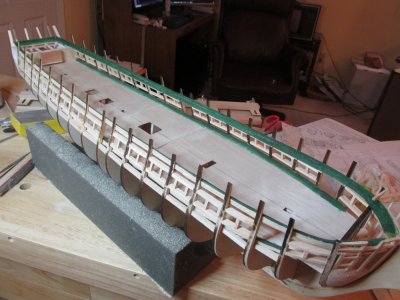
Once all the side pieces were installed. The gunport framework had to be trimmed to conform to the hull. This was accomplished with grease…elbow grease and sanding sticks. I suppose I could have trimmed the excess wood with a knife, but I was afraid that I might cut too much accidentally or worse, cut me. Although sanding slow, it’s more controllable. You can see the trim difference in the before and after images


Hey Jon, Great to see you made the transition. Even better, you managed to beautifully resurrect your build log. Good on you!
You've mentioned Ships of Scale to me on more than one occasion at the other site - even suggesting this was the better of the two. Now that I've had a few days to acclimate, I have to agree, It was the recollection of one of those comments, brought me here. for that, I just want to say,
thank you...
You've mentioned Ships of Scale to me on more than one occasion at the other site - even suggesting this was the better of the two. Now that I've had a few days to acclimate, I have to agree, It was the recollection of one of those comments, brought me here. for that, I just want to say,
thank you...
Access Openings to Berthing Deck
In order to progress on the Gun Deck, the deck planking must be installed. But before that can be accomplished, the openings (gratings, hatchways, and ladders) must be constructed and installed first. Since none of the materials to construct these items came with the kit, they had to be fabricated from scratch, well mostly.
As I mentioned earlier in this log, I had attempted to procure a second sheet of gratings intended for the Spar Deck to use on the Gun Deck. That didn’t work out so well as Model Expo’s computer couldn’t recognize sales of non-catalog items, but they would send me one for free as part of their replacement policy, which they did.
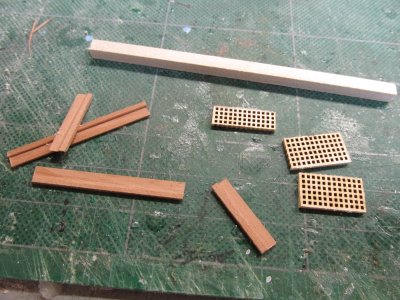
In order to progress on the Gun Deck, the deck planking must be installed. But before that can be accomplished, the openings (gratings, hatchways, and ladders) must be constructed and installed first. Since none of the materials to construct these items came with the kit, they had to be fabricated from scratch, well mostly.
As I mentioned earlier in this log, I had attempted to procure a second sheet of gratings intended for the Spar Deck to use on the Gun Deck. That didn’t work out so well as Model Expo’s computer couldn’t recognize sales of non-catalog items, but they would send me one for free as part of their replacement policy, which they did.
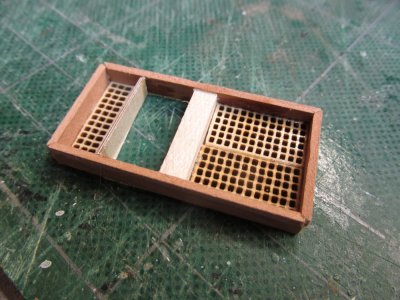
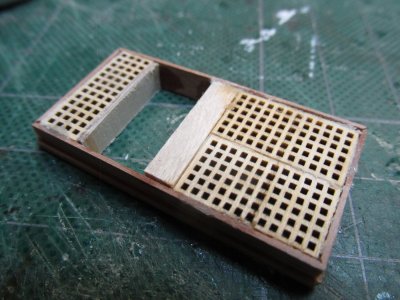
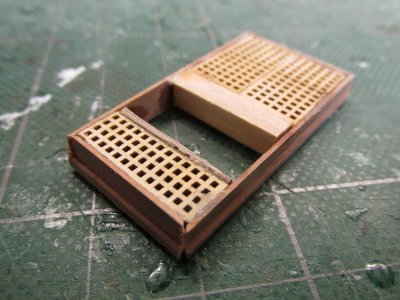
Because I needed to add a profile to the frame, hardwood was preferred material over basswood which get fuzzy at the edges. From my cache of hardwood, I decided on a whim to use pearwood for the grating frames as opposed to boxwood – a little more contrast for interest. The dimensions were taken from the US Navy plans where possible.
The Main Hatch and ladders (grating with ladder openings on either side of it) was guesstimated as the US Navy plans showed two different configurations, neither of which matched the one existing today.
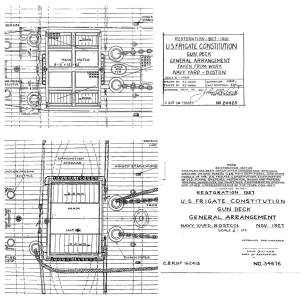
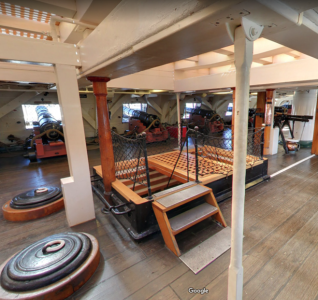
The Main Hatch and ladders (grating with ladder openings on either side of it) was guesstimated as the US Navy plans showed two different configurations, neither of which matched the one existing today.
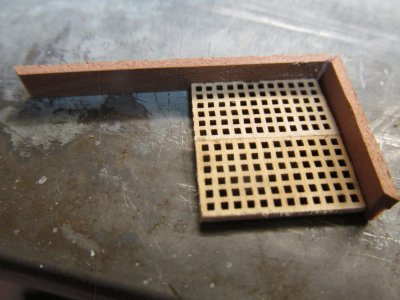
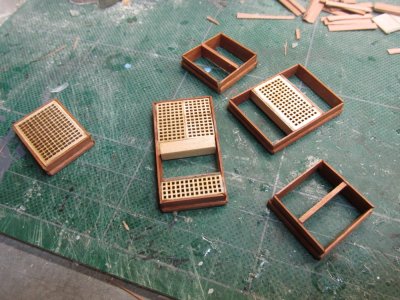
The construction of the framework proceeded upside-down using mitered joints. This kept the grating flush with top of the frame. I used mitered joints because of the profile, which was made using the Byrnes saw, an X-acto knife, and files. Lastly, a coat of Wipe-On Poly was brushed onto the bare wood. The last image shows where the frames will be installed after the ladders are fabricated.
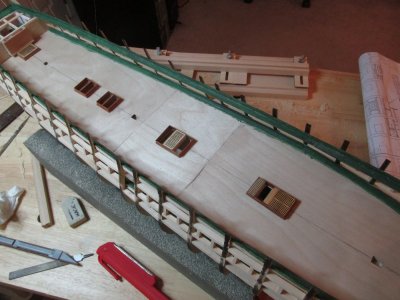
Hatchway Preparation for Ladders
The inside of the hatchways extends down to the bottom of the support 9” (1/8” scale) beams below the gun deck and are painted white. To simulate this, lengths of 3/32” (1/8” less 1/32” plywood = 3/32” scale) thick basswood were glued on the underside of the 1/32” plywood gun deck support. Then the inside of the hatchways and the hatchway framework were painted white. Not anyone will see it when completed, but I just could not leave it alone.
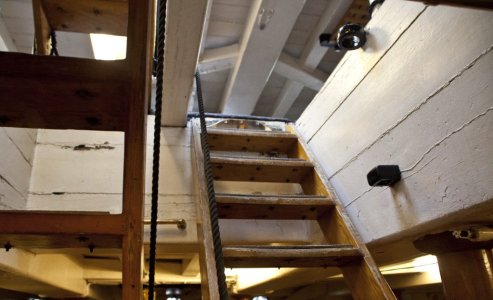
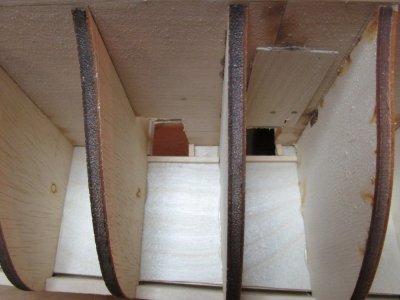
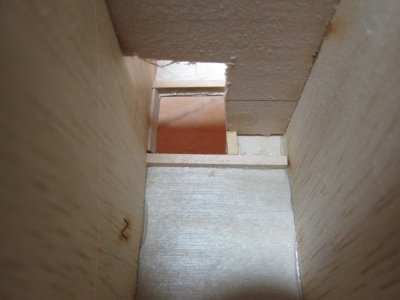
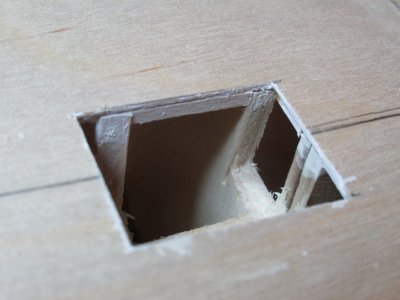
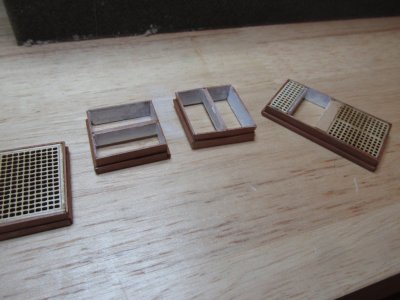
The inside of the hatchways extends down to the bottom of the support 9” (1/8” scale) beams below the gun deck and are painted white. To simulate this, lengths of 3/32” (1/8” less 1/32” plywood = 3/32” scale) thick basswood were glued on the underside of the 1/32” plywood gun deck support. Then the inside of the hatchways and the hatchway framework were painted white. Not anyone will see it when completed, but I just could not leave it alone.
Gun Deck to Berth Deck Ladders
One of my building nemeses are ladders. My first and only experience with them was on the Rattlesnake (1/64 scale). According to Mr. Hunt’s practicum, he made his ladders using slots cut into the ladder legs to accept and support the steps. Mr. Hunt did this on his Preac micro table saw without any jigs, and he did it very well. Of course, the scale was a little bit larger and he used larger dimensions. I was able to make mine, but with a lot less finesse and more cursing
One of my building nemeses are ladders. My first and only experience with them was on the Rattlesnake (1/64 scale). According to Mr. Hunt’s practicum, he made his ladders using slots cut into the ladder legs to accept and support the steps. Mr. Hunt did this on his Preac micro table saw without any jigs, and he did it very well. Of course, the scale was a little bit larger and he used larger dimensions. I was able to make mine, but with a lot less finesse and more cursing
Per the US Navy plans, the steps are 1 3/8” thick (3/128” scale) and the legs are 1 ½” thick (3/128” scale). I have seen jigs that use the Byrnes saw (or similar) to cut these slots as well, but at these scales 1/76.8, the slicing blade on the saw is too wide and never mind the miniscule depth cut of the slot that would be needed. In his practicum for the USS Constitution, Mr. Hunt avoided the problem all together by not building the gun deck and not showing any ladders leading to it. I needed something better. I found another ladder building method that other builders have used, albeit at a larger scale, but I am going to try it anyways. No leg slots are required.
The jig consists of alternate layers of two different thicknesses and lengths of wood glued together in such a way as to create slots of equal spacing. The wood thicknesses represent the step thickness and spacing distance. With aid of a ladder guide stuck on with double sided tape, the steps are placed into the thin slots up against the guide which is set at 53° for example. Because different hatchways have different widths and ladder angles, the jig must accept the narrowest ladder tread such that it extends out on either side to accept the gluing of the ladder legs.
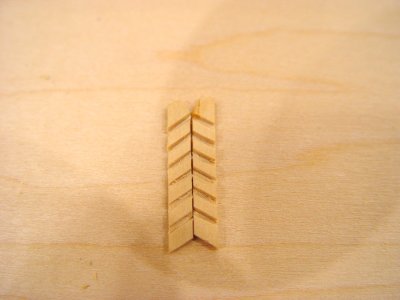
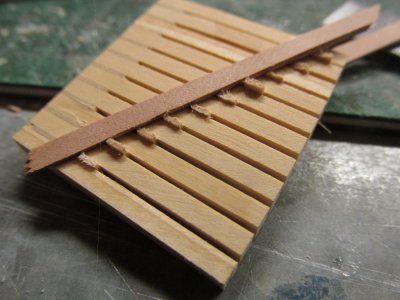
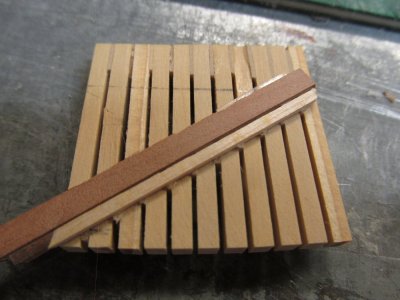
I went ahead and built the jig but forgot to account for the ladder lean angle. As a result, my first jig was too narrow (left jig, the revised one is on the right). The second image shows the jig after a bit of sanding, and the third image shows it with the angle guides. I’m going to use two to support the steps on both sides to ensure all at the same angle. Then the ladder legs will be glued on.
I’m going to leave the build at this point as I must get ready for my trip to Mom’s to celebrate her 100th birthday at the beginning of June as I have previously mentioned. We’ll see how well the jig works when I get back to the shipyard.
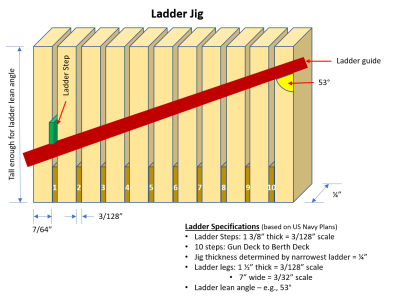
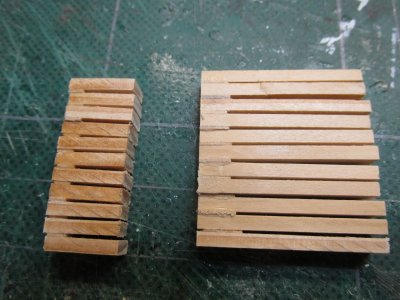
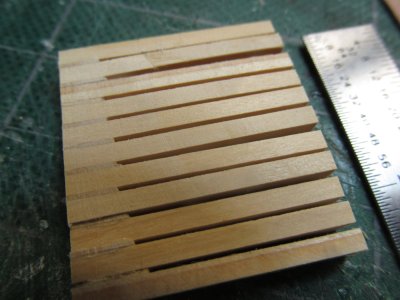
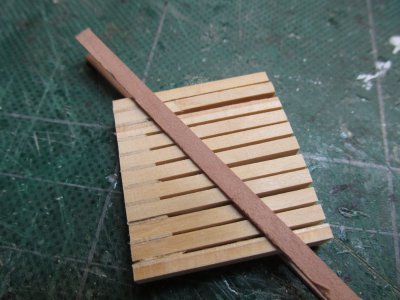
The jig consists of alternate layers of two different thicknesses and lengths of wood glued together in such a way as to create slots of equal spacing. The wood thicknesses represent the step thickness and spacing distance. With aid of a ladder guide stuck on with double sided tape, the steps are placed into the thin slots up against the guide which is set at 53° for example. Because different hatchways have different widths and ladder angles, the jig must accept the narrowest ladder tread such that it extends out on either side to accept the gluing of the ladder legs.
I went ahead and built the jig but forgot to account for the ladder lean angle. As a result, my first jig was too narrow (left jig, the revised one is on the right). The second image shows the jig after a bit of sanding, and the third image shows it with the angle guides. I’m going to use two to support the steps on both sides to ensure all at the same angle. Then the ladder legs will be glued on.
I’m going to leave the build at this point as I must get ready for my trip to Mom’s to celebrate her 100th birthday at the beginning of June as I have previously mentioned. We’ll see how well the jig works when I get back to the shipyard.
The angle of the ladder is based on hatch length (the horizontal base) and the vertical height. Since I know the step spacings and the number of steps (10, the full height of the jig), I can lay out the angle on the jig. I drew a vertical reference line first (long pencil line). Then, I measured the base off the model and marked it on the jig (the short pencil mark). The top edge of the guide is placed where the long line meets the top of the guide. The other top edge is placed where the short line meets the bottom of the jig. This held down with double sided tape. The other side of the jig was mirrored the same.
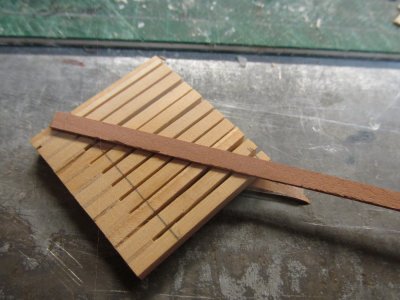
The steps were inserted into the slots against the guide. Due to the shortness of the steps I was able to place the first ladder leg against the guide when it was glued to the steps. Care had to be taken not to get any PVC glue on the jig. After about an hour. I did the opposite side.
Finally, after waiting about two hours more, I very gingerly slid the ladder out of the jig. The ladder wasn’t perfect. During the gluing process, one of the legs shifted about a millimeter, so the ladder very slightly skewed. It was then given a coat of Wipe-On Poly. This won’t matter much because it will be difficult to see. Had this been on the spar deck, I’d do it over. For a first attempt, not too bad.
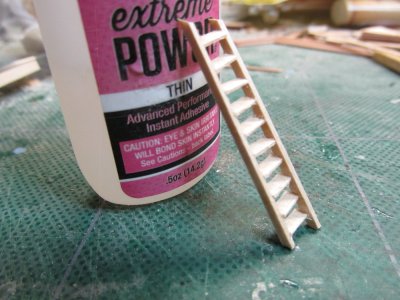
For a dry fit, I placed the hatch onto the gun deck to see how it would look. As you can see from the last image, the ladder is hanging out into space. I’ll need to add a small landing for physical support as well as stanchions and the hand rope. One down, four to go. Yes, I know, no one but me will know they are even there.
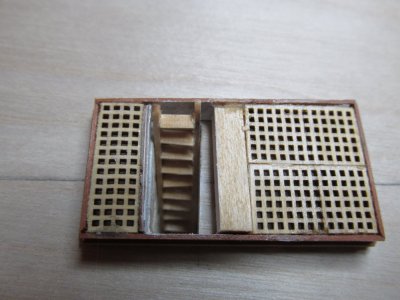
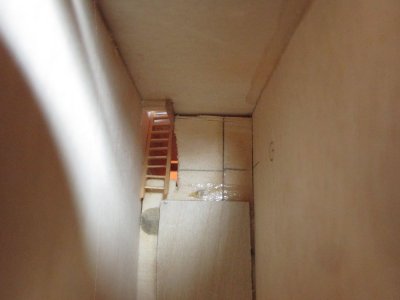
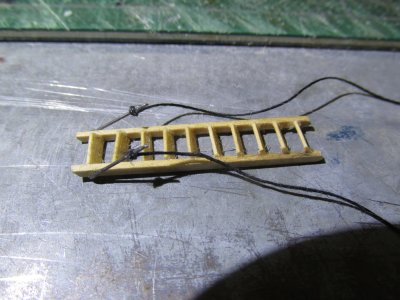
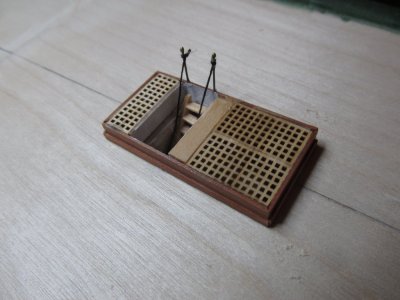
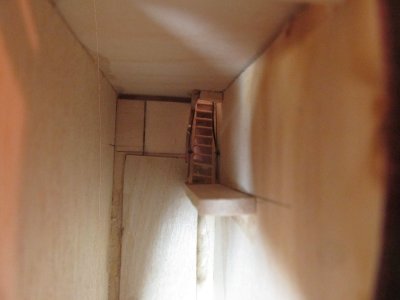
I’ve glued a piece of wood to act as support for the first ladder, and I’ve completed all the remaining ladders that go from the gun deck to the berth deck. To install the ladders, the hatches must be glued in, but before I can do that, I had to add the two hatch stanchions that hold the hand ropes. Two more stanchions were added to the base of the ladder and tied with a length of 0.3mm “rope.” The stanchions were made from 0.02” music wire. For the hatch stanchions, I added a tiny blob of PVC glue and painted it with brass paint. I doubt that anyone will notice. The bottom ones are not visible, so they weren’t done. The actual stanchions have rope rings through which the rope is attached, but at these scales and locations, I made it easier for myself and left them off. Finally, I glued the first hatch in place, then the ladder, and finally tied off the ropes to the top stanchion.
My back is quickly going down the toilet. I’ve started physical therapy, which has helped some, but I can remain on my feet only for a short period of time before I start walking with a limp due to pain. Seems I got some rust on my golden years. I’ve got X-rays, CAT scans scheduled, and an appointment with an Orthopedic doctor. So, we’ll see what happens.

My back is quickly going down the toilet. I’ve started physical therapy, which has helped some, but I can remain on my feet only for a short period of time before I start walking with a limp due to pain. Seems I got some rust on my golden years. I’ve got X-rays, CAT scans scheduled, and an appointment with an Orthopedic doctor. So, we’ll see what happens.
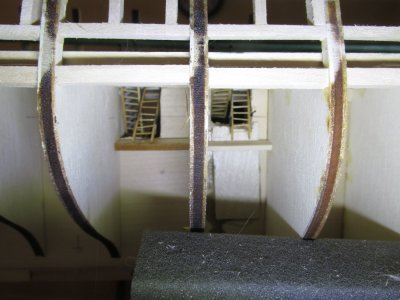
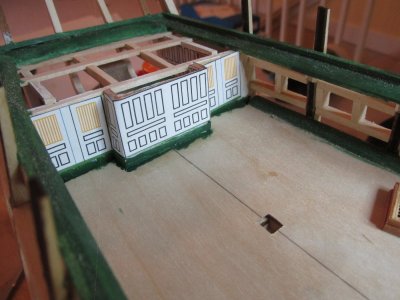
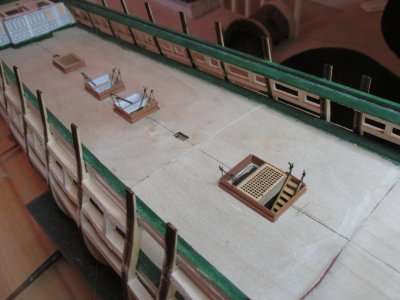
I did manage to move forward with build by completing all the stairs going to the berth deck. For something most viewers won’t even see unless they look closely, Still, I had to put in a fair amount of detail. I even prepared the forward-facing wall of the Captain’s cabin complex. It is like the transom cabin with printed detail due to its inaccessibility to the viewer.
Cannonball Racks
After I added the printed detail on the Captain’s cabin complex, I realized I hadn’t installed the Wardroom skylight grating. I then realized that now would be the most opportune time to add the cannonball racks to the skylight.
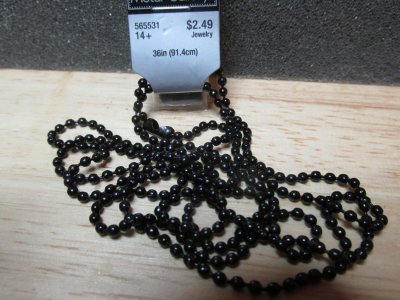
Because the kit did not provide anything to construct the gun deck, I needed something to represent the cannonballs. Taking a cue from xKen’s (a.k.a. Ken Forman, ModelShipWorld.com) build, I purchased some black 2 mm ball ball-chain from the jewelry section of Hobby Lobby. The ball size is close enough for this scale.
After I added the printed detail on the Captain’s cabin complex, I realized I hadn’t installed the Wardroom skylight grating. I then realized that now would be the most opportune time to add the cannonball racks to the skylight.
Because the kit did not provide anything to construct the gun deck, I needed something to represent the cannonballs. Taking a cue from xKen’s (a.k.a. Ken Forman, ModelShipWorld.com) build, I purchased some black 2 mm ball ball-chain from the jewelry section of Hobby Lobby. The ball size is close enough for this scale.
Since the chain was already colored black, no color preparation was required. All that was needed was to cut the appropriate length of chain. When laid down on the side of the skylight, the chain was push together so that the links were not visible. In fact, the links made handling quite easy.
At this point I had a decision to make: add the ball racks or not. My modeler’s gut reaction was to at least attempt to make them. The practical side said no, no one will see them due to the awkward viewing angle and lighting, not to mention how difficult and delicate they would be to make; at least not on the gun deck, maybe on the spar deck.
That was all fine and good for the skylight, but if the cannon balls are to be installed there, I should also install them on the other appropriate hatches. They, however, would be a bit more difficult since they were already installed on the gun deck. By tipping the hull frame on its sides I was able to place and glue the balls into position with CA glue. For those balls which had to be installed on the fore and aft sides of the hatches, the hull frame was supported on its transom and stem
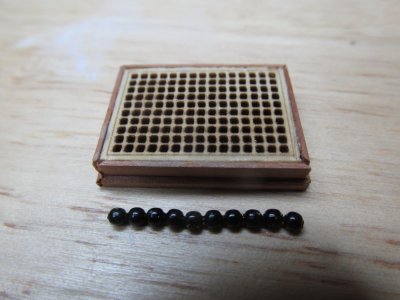
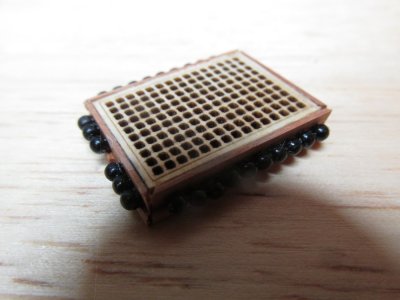
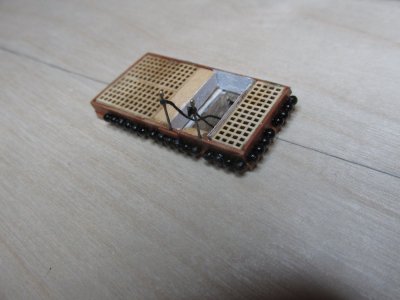
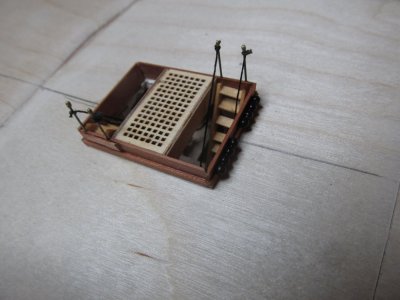
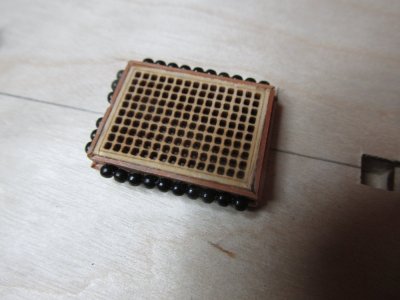
At this point I had a decision to make: add the ball racks or not. My modeler’s gut reaction was to at least attempt to make them. The practical side said no, no one will see them due to the awkward viewing angle and lighting, not to mention how difficult and delicate they would be to make; at least not on the gun deck, maybe on the spar deck.
That was all fine and good for the skylight, but if the cannon balls are to be installed there, I should also install them on the other appropriate hatches. They, however, would be a bit more difficult since they were already installed on the gun deck. By tipping the hull frame on its sides I was able to place and glue the balls into position with CA glue. For those balls which had to be installed on the fore and aft sides of the hatches, the hull frame was supported on its transom and stem
I thought I was done with the gun deck gratings, but upon checking the Navy plans, it seems I missed one. This was labeled “scuttle” on the plans, and it is just aft of the bowsprit support. This one’s a little different from the hatchway gratings as its grating is raised above the scuttle side walls and is painted.