• SUBSCRIBE TO SHIPS IN SCALE TODAY!

    The beloved Ships in Scale Magazine is back and charting a new course for 2026!
    Discover new skills, new techniques, and new inspirations in every issue.

    NOTE THAT OUR NEXT ISSUE WILL BE MARCH/APRIL 2026
  • Win a Free Custom Engraved Brass Coin!!!
    As a way to introduce our brass coins to the community, we will raffle off a free coin during the month of August. Follow link ABOVE for instructions for entering.

USS Constitution - Model Shipway’s 5/32” = 1 ft. (1:76.8) Kit No.: MS2040

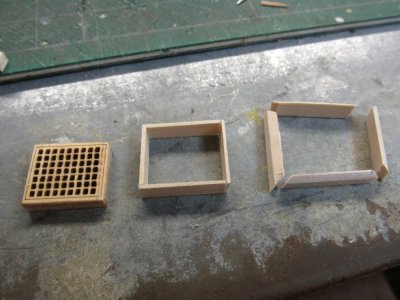
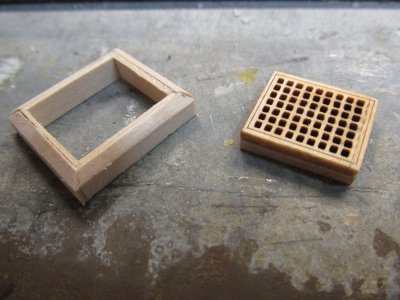
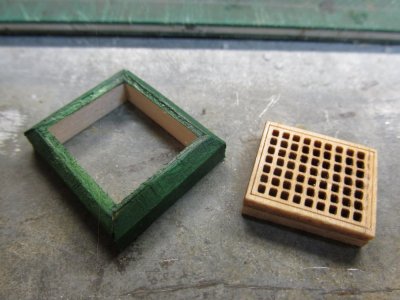
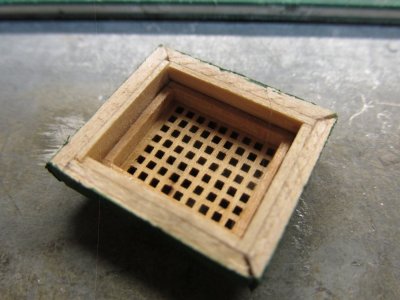
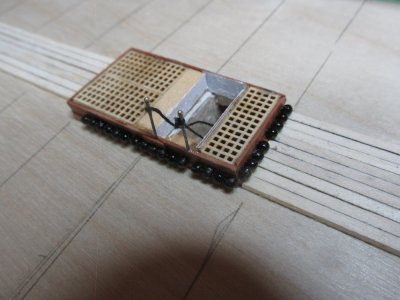
As with the previous gun deck hatch gratings, I used the grating stock I bought earlier. After creating the size I wanted, I extended the side walls by 1/32” to eventually raise it above the grating frame. Then I created a frame to go around the grating. Finally, I created another frame that was beveled on the top edge.

IMG_1435.JPG
 
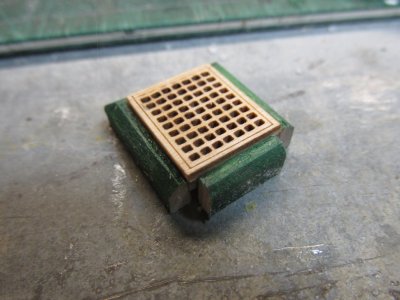
The beveled frame pieces were glued individually to the inner frame. I know this could have been done with four pieces of stock instead of eight, but my problem was the bevel. I don’t have a proper tool to cut a bevel along the length of a piece of wood accurately. I was able to cut the bevel on the outer frame with my disk sander.

IMG_1436.JPG
 
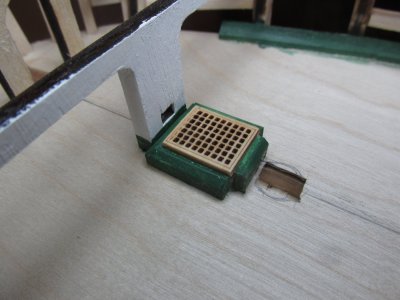
At this point I thought I was done but then realized I needed to do one more thing. If you look at the picture of the actual scuttle (above), you will notice there is a post on either side of the scuttle where vertical posts are. They notched into the scuttle frame Using my Byrne’s saw; I very delicately cut out the notches and painted them. The bow sprint support was painted, and the scuttle was set into place. The kit’s bow sprit support brace is the furthest forward I plan to add details on the gun deck.

IMG_1439.JPG

IMG_1440.JPG
 
Gun Deck Planking

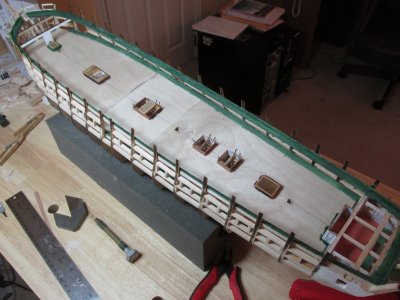
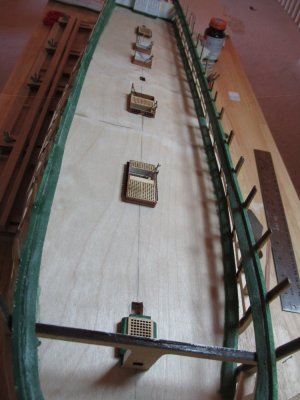
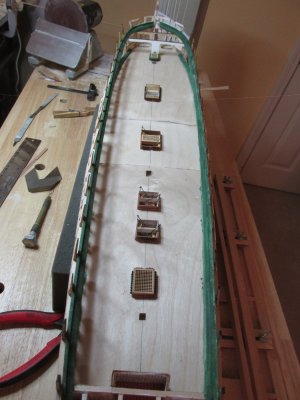
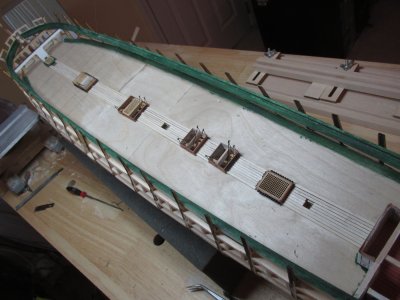
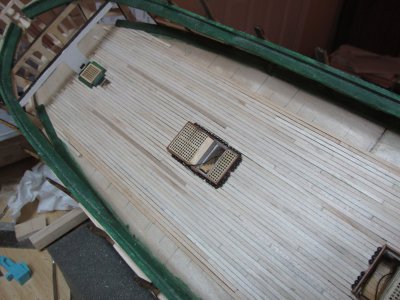
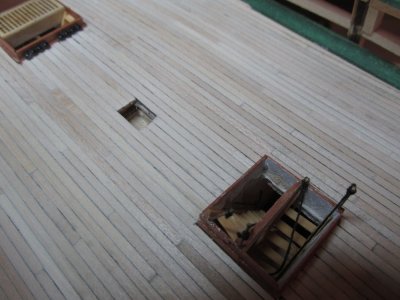
Now that the gun deck hatches and ladders have been installed, it was time to install the gun deck planking. After a little research, I’ve determined that the deck plank length vary from about 16’ – 30’. The distance between the various hatchways and scuttles is well within those limits. Therefore, there would be no planking joints when planking in those areas. Robert Hunt’s practicum also reached that conclusion although he was only dealing with the spar deck.

Using artist’s charcoal, I colored just one side of each plank which worked well. I had originally thought to use CA glue to fasten down the planks, but I found the CA glue soak too quickly into the plywood subdeck. Making the glue bead thicker just made it messier with no time to adjust plank positions. I resorted to wood glue (Wellbond) and had no problems.

I added lines perpendicular to the beam on the subdeck to represent the underlying gun deck support beams. This is where plank joints will appear and line up as necessary.

IMG_1445.JPG

IMG_1444.JPG
 
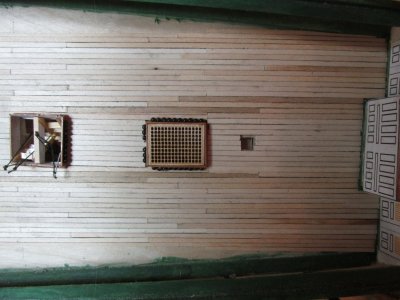
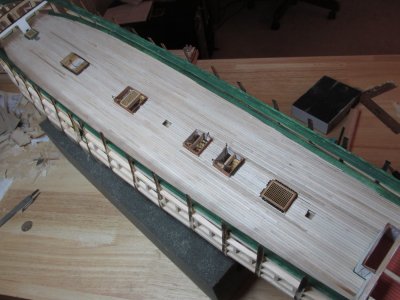
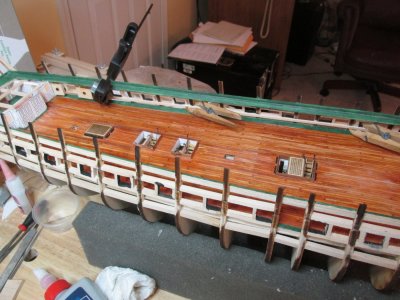
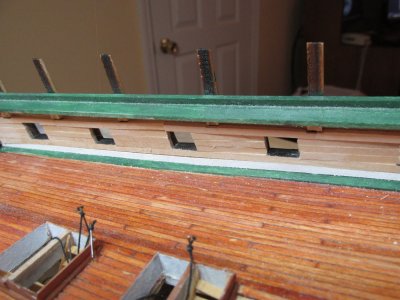
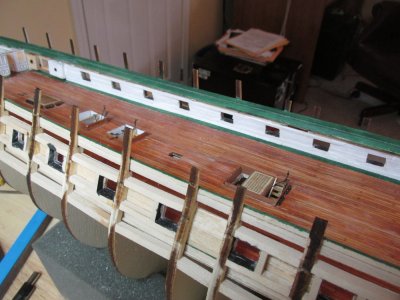
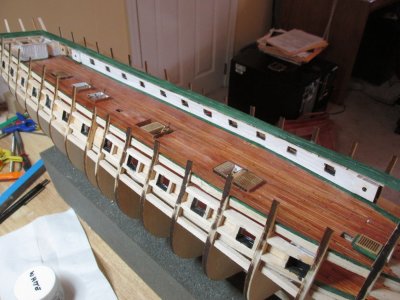
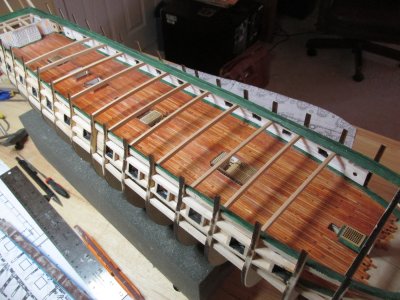
I’ve completed planking the gun deck, but there is still work to be done on it before I can move on. The deck required about 45 sticks of 3/32” x 1/16” x 24” basswood. Surprisingly, I had very little waste, about 6” combined.

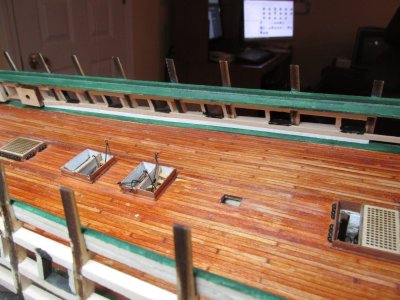
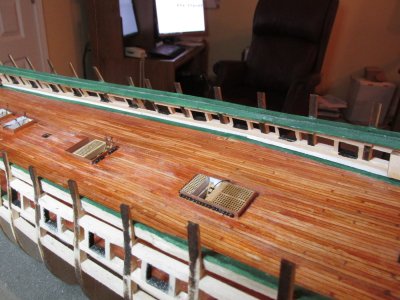
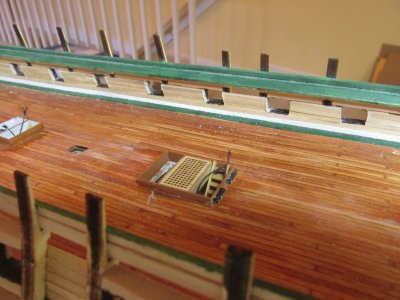
As you will see from the images below, I managed to knock down almost every ladder stanchion so those will have to be repaired. The planks still need more sanding and then will need to be stained and sealed.

IMG_1448.JPG

IMG_1449.JPG

IMG_1450.JPG

IMG_1451.JPG
 
Gun Deck Stained & Sealed

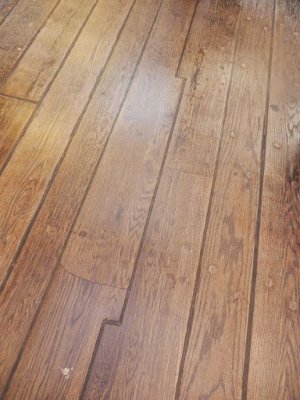
I tried to stain the Gun Deck as close to the color of the actual ship as I could. I have several images and each one is slightly different than the next due to the various lighting conditions of artificial lighting and indirect daylight among other things. One of those images is shown below.

Interlocking Planking on Gun Deck.JPG
 
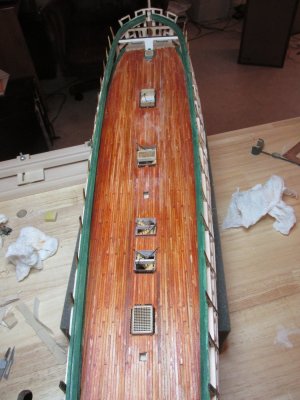
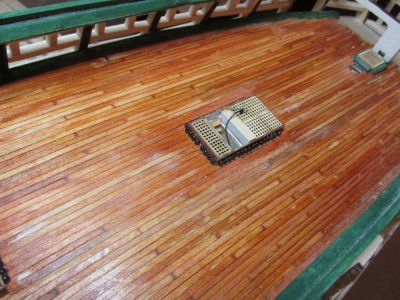
My first attempt, if you remember, was the decking in the captain cabin which I printed on paper and glued to the plywood. Not very realistic but then most viewers won’t even see that interior. This attempt was made using Minwax Gunstock 231 as the first coat. This has a rosy hue to it. Then, I applied Minwax Golden Pecan 245 to tone down the red and add some depth to the stain. Finally, I added Minwax Polycrylic Clear Satin as the sealer. I got a good simulation of planking, but maybe just a smidge too much red. As it turned out, the color did match to captain cabin. Once more, the viewer will have limited access and dim lighting conditions as well. In any event, it is what it is.

The ladder stanchions have not been repaired yet, and I might delay the repair till the last possible moment so that I won’t damage them any further.

IMG_1452.JPG

IMG_1453.JPG
 
Gun Port Boxes for Dummy Cannons

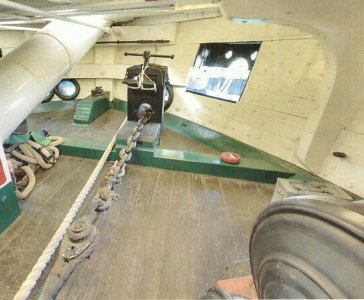
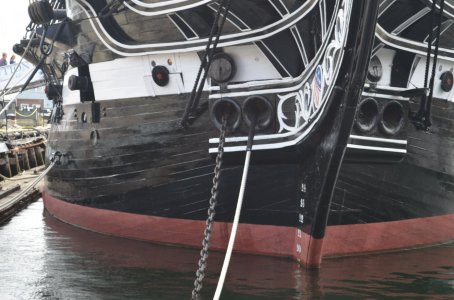
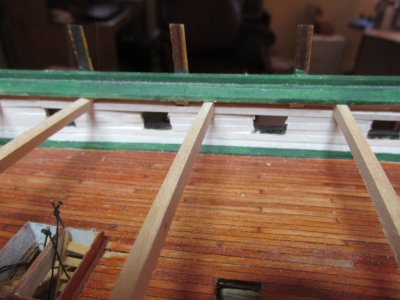
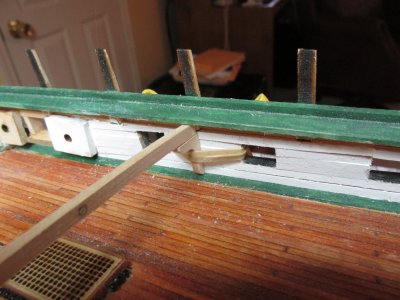
As noted, way earlier in my log, I plan to use some dummy guns on the gun deck. The first pair of gun ports in the bow won’t have any guns at all, as there is no room for them to operate. They may be some confusion when looking at the ship from the outside, because it appears there are guns with a tampion in their barrels poking out through the gun port lids. The tampions are there only to plug the muzzle openings created by the lids. You can see one lying on the green floor beam in the first image.

Stopperbil 01.jpg

dsc_0159.jpg
 
The next set of gun ports aft of the bow and the last two gun ports forward of the quarter gallery will have the dummy guns because they won’t be seen (hopefully) through the opens in spar deck. All these ports will have their lids closed so that the gun boxes won’t be visible.

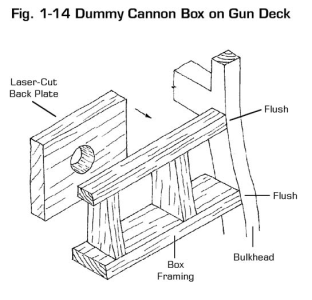
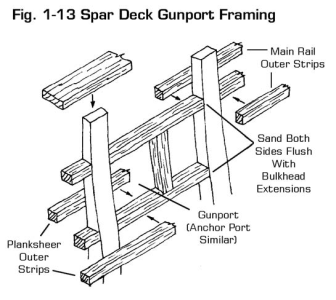
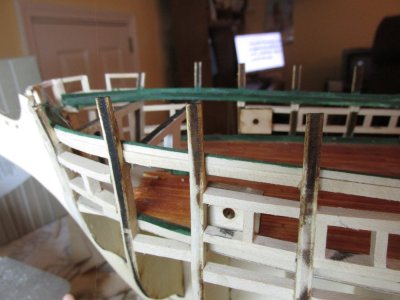
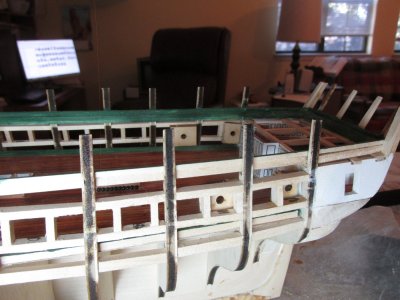
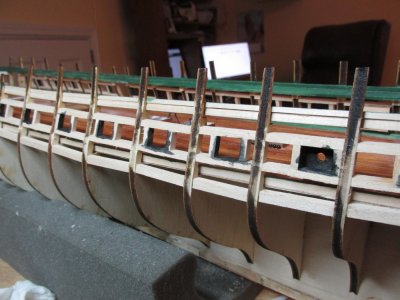
The kit instructions show the box piece being added to the framework and states specifically that they should be mounted vertically. The diagram shows the gun port wall back edges perfectly vertical, however mine are like the spar deck diagram. To make them vertical, I added a small piece of wood to the base of the box. I also had to trim the far aft pair of boxes because they butted up against the captain’s cabin which wasn’t part of the kit’s plans.

Those with sharp eyes will notice that I have marked the port openings with black chalk, so I don’t stick the cannons in the wrong openings or plank over them.

Page_13_Image_1.png

Page_13_Image_2.png

IMG_1454.JPG

IMG_1455.JPG

IMG_1456.JPG
 
Gun Deck Bulwarks

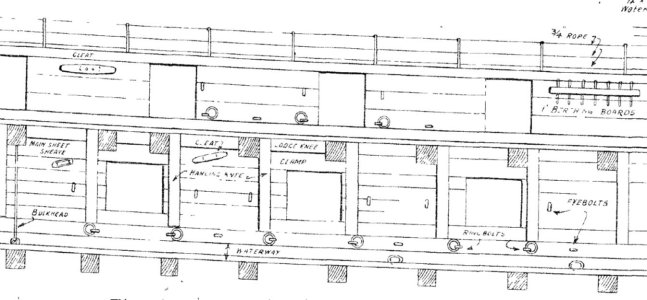
I have a US Navy plan titled Gun Deck & Inside of Bulwarks by G.F. Campbell with no identifying number or date. Based on the drawing letter style, I would guess it’s from the 1927 restoration. I believe this is when the waist was incorrectly covered by the bulwarks. It shows it took 3 bulwark planks to extend from the spar deck gun port sill to its header. At the same time, it took four planks to do the same on the gun deck. Today, based on photographs, they are both the same at four planks which is also reflected in the kit plans. The kit calls for 3/64” thick spar deck bulwark planks. Per direct measurement from the plans (as it does not specify), the planks are 3/32” wide, thus 3/32” wide x 3/64” thick.

Spar Deck Bulwarks.jpg

const06.jpg

IMG_0528.JPG
 
Because the kit does not supply planking for the gun deck, and I’m trying to save a few bucks, I purchased a 1/8” x 4” x 24” piece of basswood instead of buying precut strips. Using my Byrnes saw, I plan to slice the wood into 1/8” x 3/64”. Other build logs I seen have indicated 1/8” x 1/32” and 1/8” x 1/16”, so I’m in the ballpark.

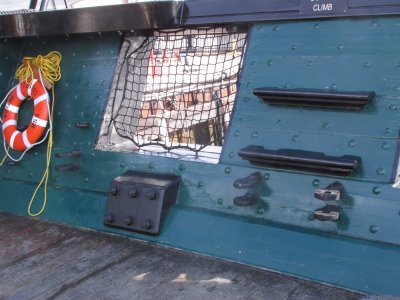
Another thing I’ve noticed is just about nobody has incorporated the netting inside the gun port openings (both decks); I assume for its delicacy and difficulty of fabrication and installation. I may have a simple solution for that.

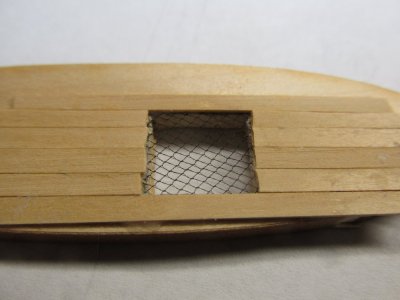
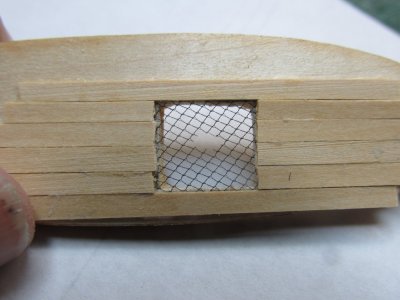
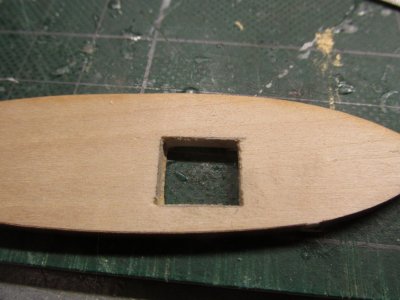
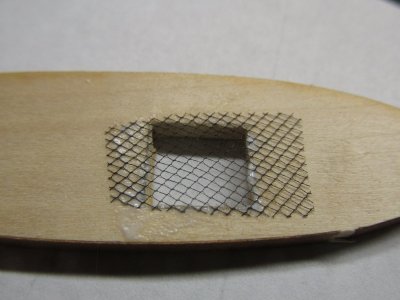
My first try at a proof of concept seems to have worked. Using a piece of laser cut scrap wood from the ship’s boats, I cut out an opening to represent the gun port. Then with a very thin layer of PVC glue, I glued a piece of black tulle over the “gun port” opening. Tulle is a sheer (often stiffened silk, rayon, or nylon) net used chiefly for veils. I bought some when I made my Rattlesnake. I got a lifetime supply in both black and white colors for $0.30

Then I planked it as I would the bulwarks. Because this was a proof of concept, I wasn’t too concerned with the squareness of the edges at the port opening, but this will be a precise operation when done for real because there will no opportunity to square up the edges with a file as the opening will be “closed” with the net.

Finally, an opening was made in the net for the gun barrel by cutting the central portion with fine sewing scissors. I thought about using a hot metal rod to melt a round opening but discarded that idea as too imprecise and very prone to error with one false hand tremor. The outside hull would be planked as you normally would.

On the actual model, the interior of the port openings would have to be painted black prior to the net being installed. The bulwarks are to be painted white, so care must be taken not to get any white paint where its not intended to be.
IMG_1457.JPG

IMG_1458.JPG

IMG_1459.JPG

IMG_1460.JPG
 
It was pointed out to me that the gun port netting may be a modern safety feature like the sprinklers or electrical lighting. If it is, then That would be the reason I've haven't seen it modeled before.
I left an email on the USS Constitution Website and called the USS Constitution Museum Public Historian and left messages asking if the gun port netting was a modern safety feature of actual ship fittings. The first week the silence was deafening with all the crickets chirping. I went through my library of images and the first images I have of the port netting were from the 1960’s. Up until then I couldn’t find an image of them. Finally, I got a call from the museum historian, and he confirmed that the gun port netting is a modern addition. So, it looks like I won’t install them after all.
Gun Deck Bulwarks

With the gun port netting detail dropped, I can now move on with the gun deck bulwarks. Looking at other builds, I’ve seen some builders make these bulwarks out of full width sheets of basswood or plywood because the surface is to be painted white, making any planking wood seams disappear.

I find planking easier than custom fitting large pieces of inflexible wood. Once again, due to the poor visibility and the painting of the gun deck bulwarks, my choice of plank length will be based on ease of installment and not of historical size.

The first thing I did was paint the inside walls, sills, and headers of the gun port black. The subsequent planking will cover any black paint spillover.

IMG_1461.JPG
 
The first bulwark plank installed was a piece the full length of the visible gun deck placed flush with gun port sills on the port side. This acts as a baseline for the subsequent plank levels. The next plank was a pre-painted white, short piece placed at the aft end in between the waterway and the sill baseline plank. Because these planks must be custom fit due to the slight spacing irregularities between the waterway and the baseline plank, short pieces ease the fittings. It was pre-painted because painting these planks after installation so close to the green waterway would have been very difficult trying to avoid white paint spillovers. The remaining planks will be painted white after installation. As you can see (or not?) the joints between the planks are all but invisible.

IMG_1462.JPG

IMG_1463.JPG

IMG_1464.JPG
 
The bulwarks continue with short unpainted pieces in between the gun ports working upward. The excess wood that protruded into the gun port spaces were filed and sanded off.

IMG_1465.JPG
 
I just finished installing and painting the gun deck bulwarks. They didn’t come out as even as I would have liked, but by the time I add all the knees and bracings, guns, eyebolts, and furniture, these imperfections won’t be areas of interest to be noticed…I hope. Also, there still are a bunch of painting touch-ups on the waterways and inside the gun ports to be done. Right now, I think the diagonal knees and gun rigging eye bolts need to be installed next.

IMG_1466.JPG

IMG_1467.JPG

IMG_1468.JPG
 
Gun Deck Hanging Knees & Gun Rigging Eye Bolts

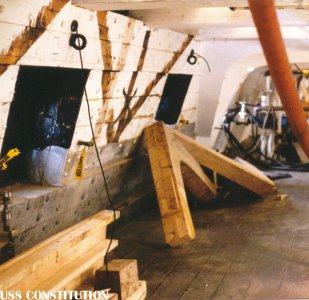
The order of installing the gun deck knees, as I’ve interpreted the plans, are first the vertical hanging knees under every other spar deck brace, next the diagonal knees and remaining spar deck braces above each gun port, (Whether I’ll make those braces completely or partially I’ve yet to determine), and finally the horizontal knees between the spar deck braces. Once all of this is installed, then I can work on building the gun carriages, mounting the guns and rigging them onto the model. I think I’m scaring myself.

So, to paraphrase an old saying, a journey of a thousand miles starts with taking the first step. Following the US Navy Plans for the structure of the gun deck, they indicated that the spar deck braces do not always line up with the kit’s bulkheads. Those braces determine where the vertical knees are located. Therefore, the first thing I fabricated were the braces using 1/8” thick basswood stock. To ensure I had the proper beam curvature, I used as a guide the bulkhead spar deck braces, that I cut off from the bulkheads when I made gun deck. I traced the curves onto the basswood.

Each brace was dry fitted into their proper location as indicated by the US Navy plans. They will be glued into place once the gun deck is completed

IMG_1469.JPG

IMG_1470.JPG
 
The hanging knees for each brace must be custom made as the bulkhead changes angles along the length of the deck. But before any vertical knee is glued into place, the rigging hardware needs to be installed now. To do that later would make the task much more difficult.

IMG_1471.JPG
 
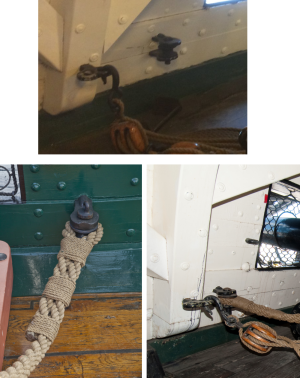
As it turns out, the rigging hardware are not your typical eyebolts. The side tackle of the gun hooks into a double eyebolt while the breeching tackle connects to two rings, one over the other, on the bulwarks using, such a seized loop of thick rope fits between the two rings and is held in place via a pin which drops through the top ring, through the loop of rope, and finally through the bottom ring. It appears the pin has a cap which prevents the pin from dropping all the way through.

Gun Deck Gun Rigging Hardware.png
 
Back
Top