
-

SUBSCRIBE TO SHIPS IN SCALE TODAY!
The beloved Ships in Scale Magazine is back and charting a new course for 2026!
Discover new skills, new techniques, and new inspirations in every issue.
NOTE THAT OUR NEXT ISSUE WILL BE July/August 2026 -

Win a Free Custom Engraved Brass Coin!!!
As a way to introduce our brass coins to the community, we will raffle off a free coin during the month of August. Follow link ABOVE for instructions for entering.


You are using an out of date browser. It may not display this or other websites correctly.
You should upgrade or use an alternative browser.
You should upgrade or use an alternative browser.
USS Constitution - Model Shipway’s 5/32” = 1 ft. (1:76.8) Kit No.: MS2040


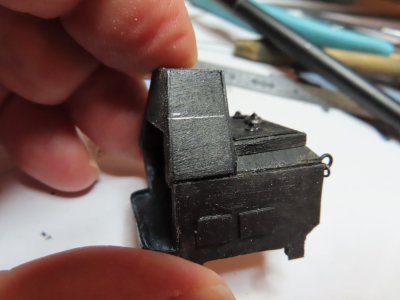
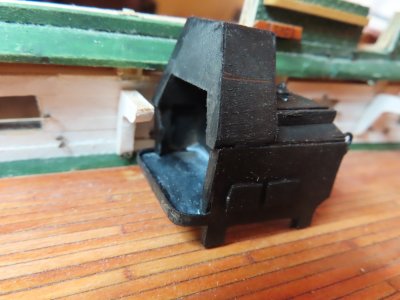
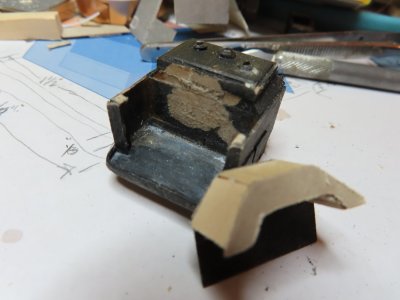
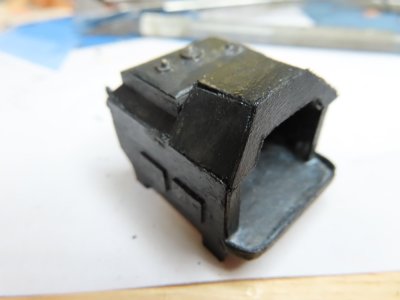
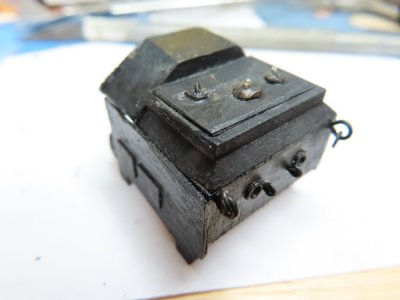
If you look at my original PowerPoint layout and the computer drawing, you will notice the stove hood is shaped like a trapezoid with a somewhat square box on top. The BlueJacket stove parts just had the trapezoid which made their stove’s height correct. When I converted my original design to match BlueJacket’s configuration, I incorporated the box’s height which I shouldn’t of. So, either I can somehow slice off the stove’s hood and rebuild a proper one or I must start over.
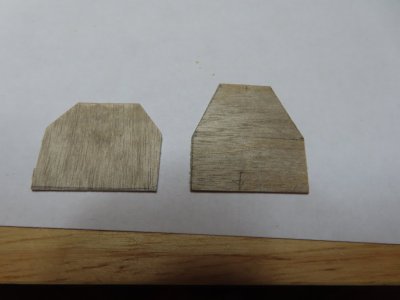
Well, I got lucky. I was able to slice off the excess portion of the stove hood as disassemble the back plate from the remaining portion of the stove. The stove was held together with PVC glue because it gave me a chance to make final adjustments before the glue set. I had used just enough glue to hold everything together but not super bonded so that I could pry it apart.
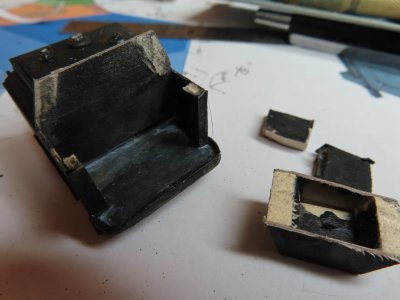
A new hood was constructed which definitely gives the stove a more compact look. Once more the hood was reassembled and glued into place. The new hood was painted and the whole stove was given another light coat to cover up some minor wood discoloration due to the additional work.
Gun Deck Chain Bitts
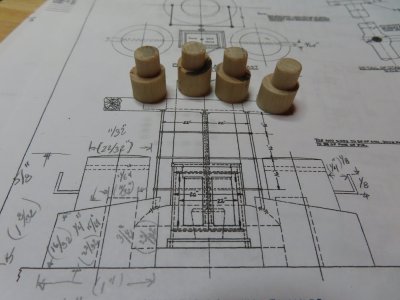
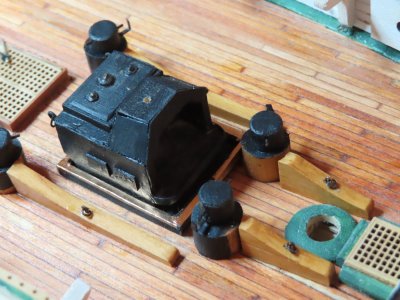
Working from the stove position, fabricating the chain bitts logically follows. The bitts are somewhat shaped like a small oil drum on top of a bigger oil drum. Using US Navy Plan 22167, I got most of the basic dimensions.
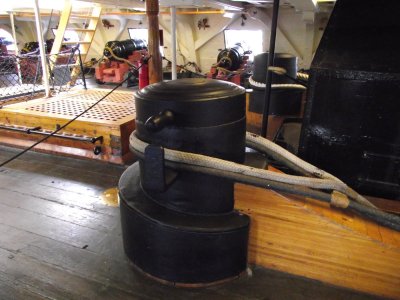
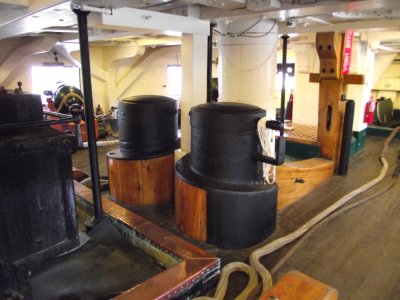
Working from the stove position, fabricating the chain bitts logically follows. The bitts are somewhat shaped like a small oil drum on top of a bigger oil drum. Using US Navy Plan 22167, I got most of the basic dimensions.
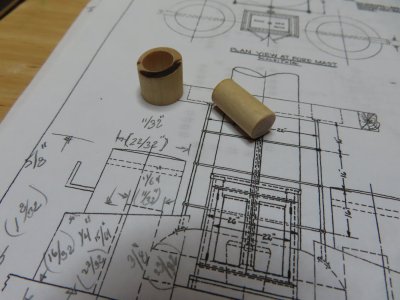
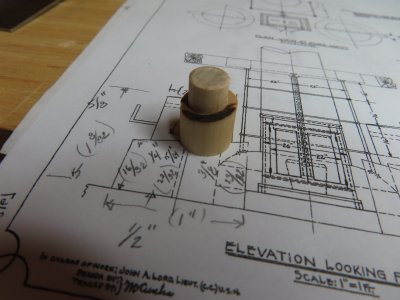
The lower portion of the bitt worked out to be ½” diameter while the upper portion came out to be approximately 3/8” diameter. What makes the construct a bit more complex is the top surface of the lower wider portion has a tilted surface, a difference in height of 1/8” scale between one side and the other. My solution to this fabrication puzzle was to first drill a hole 3/8” in diameter straight through the ½” dowel on a lathe enough for 4 bitts using progressively larger drills. Next, I sliced 4 pieces off making 4 tall wooden donuts. Then, using my disc sander, I tilted the sanding plate 9° and sanded one surface to create the bitt’s tilted surface. Then I sliced a 3/8” dowel into four 5/8” pieces. Each of the pieces were then inserted into the donuts and voila…I have the basis of chain bitts.
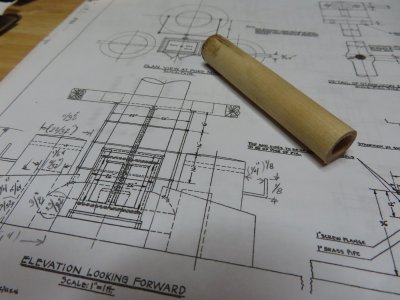
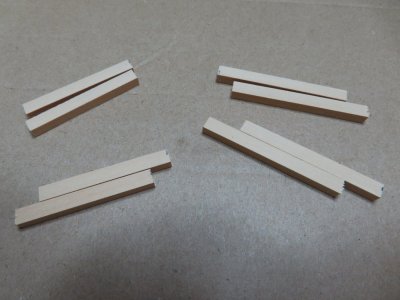
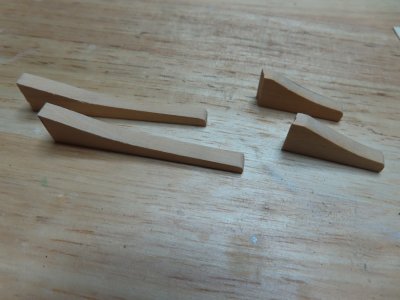
The next component is what I call the chain bitt rails, the swooping rail forward of each bitt. Scaling down from the Navy plans, I worked out the basic block dimensions I need to cut these rails from. The long pair was 3/8” H x 5/32” W x 1 7/8” L and the shorter pair was 7/8” L. Because the rail was bare wood, I chose to use boxwood, but as it turned out, I only had 3/16” x 5/32” stock. Thus, I glued two pieces together to get the required height.
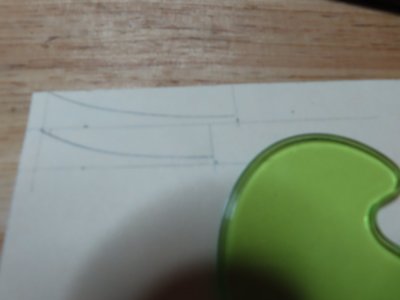
With the use of a French Curve, I guesstimated the curve shape and end points and drew them onto the rail blanks. Then with my scroll saw I cut them out. You will notice in the photos below, there seems to be a discrepancy with the before and after cut of the short rails. When the “before” photo was taken I had drawn the wrong curve length. This was caught before I made any cuts but didn’t retake the photo.
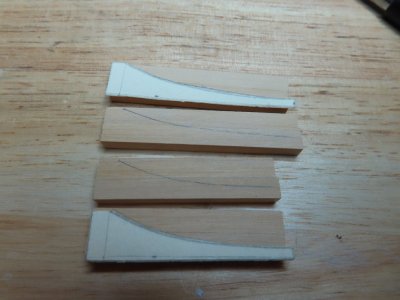
The rails had three coats of wipe-on poly applied and then I added the eye bolts and rings. The bitts were a bit more complicated. I had to guesstimate where exactly metal cladding started and stopped because I couldn’t find anything on the Navy plans and none of my reference library photos were shot with the purpose of showing the cladding details as their subjects.
The navy plans do show the L-shaped bitt “guide” (?) so I was able fabricate those out of stock .016” copper plate which just happens to be almost the exact required thickness scale. The rods just above the guide were not in the Navy plans, so those were just eyeballed.
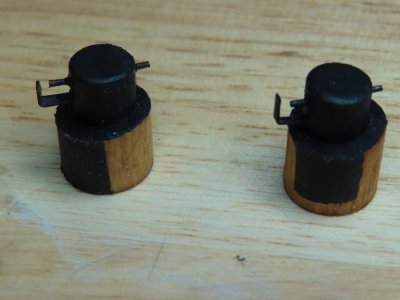
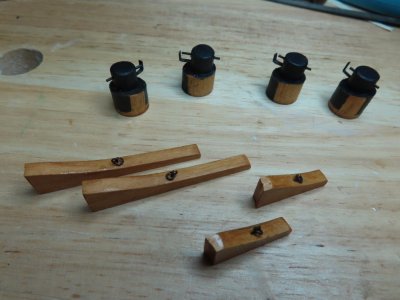
The navy plans do show the L-shaped bitt “guide” (?) so I was able fabricate those out of stock .016” copper plate which just happens to be almost the exact required thickness scale. The rods just above the guide were not in the Navy plans, so those were just eyeballed.
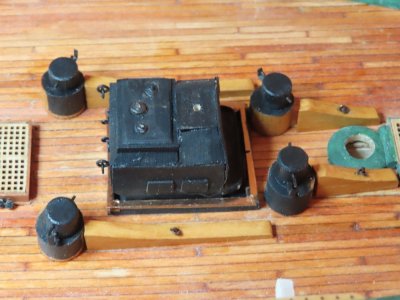
Gun Deck Capstan
This capstan will be my first scratch capstan construct. I have the US Navy plan No. 29621 “Capstans” with a lot of the detail. It indicates only the major dimensions. If I had the full-size plan, then the scales on the plan would have been useful, but I don’t. Obviously, mine are printed on my home printer so the marked scales are useless. However, the dimensions for various lengths of items shown on the plan can be used to determine the 1:76.8 scale required.
1. Measure the longest indicated dimension (for accuracy) shown on the plan with a ruler.
e.g. 5 27/64” measured = 11’ 9 ½” indicated on plan
2. Calculate what 1” or 1/32” would represent on the drawing
1” calculated = 26.1” on plan
1/32” calculated = .816” (~13/16”) on plan
3. Measure a length from the plans with no indicated dimensions and multiple it by the appropriate conversion multiplier then divide by 76.8
e.g. measured 7/32” from the plan:
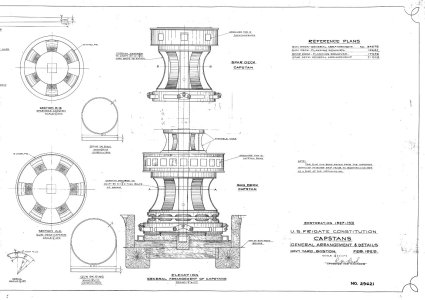
This capstan will be my first scratch capstan construct. I have the US Navy plan No. 29621 “Capstans” with a lot of the detail. It indicates only the major dimensions. If I had the full-size plan, then the scales on the plan would have been useful, but I don’t. Obviously, mine are printed on my home printer so the marked scales are useless. However, the dimensions for various lengths of items shown on the plan can be used to determine the 1:76.8 scale required.
1. Measure the longest indicated dimension (for accuracy) shown on the plan with a ruler.
e.g. 5 27/64” measured = 11’ 9 ½” indicated on plan
2. Calculate what 1” or 1/32” would represent on the drawing
1” calculated = 26.1” on plan
1/32” calculated = .816” (~13/16”) on plan
3. Measure a length from the plans with no indicated dimensions and multiple it by the appropriate conversion multiplier then divide by 76.8
e.g. measured 7/32” from the plan:
- 7 x .816 = 5.712
- 5.712/76.8 = 0.074” or about 5/64” (0.0781”) scale
I did this for all the dimensions I thought necessary. And yes, I did get lost and confused in the computations and had to constantly check and recheck my math. Once I had my dimensions, I could then figure out what size stock wood I would need. In this case, because there are a lot of small intricate parts, I chose boxwood for its ability to hold a crisp edge which was essential for all the small intricate parts. Normally if the wood were to be painted, I would have chosen basswood. No point in using the good stuff if it’s going to be covered in paint. In some cases, I used 1/64” plywood for its ability not to split.
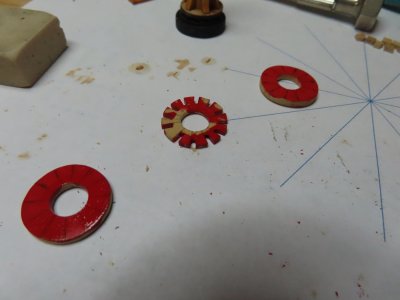
In the image below, the first four disc parts on the left will become the capstan base. The remaining disc pieces will support the six whelps when attached to the shaft. They were all cut from sheet stock and sanded and filed to shape. The shaft is a 5/16” dia. dowel.
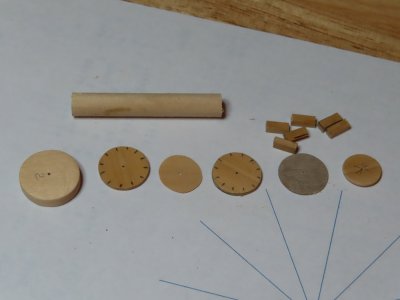
In the image below, the first four disc parts on the left will become the capstan base. The remaining disc pieces will support the six whelps when attached to the shaft. They were all cut from sheet stock and sanded and filed to shape. The shaft is a 5/16” dia. dowel.
The capstan has an area for a chain. (not certain how this is supposed to work) I notched out two discs. The two discs are stacked on top of each other with the notches facing each other and a separator disc in between. That assembly is placed on top first base disc.
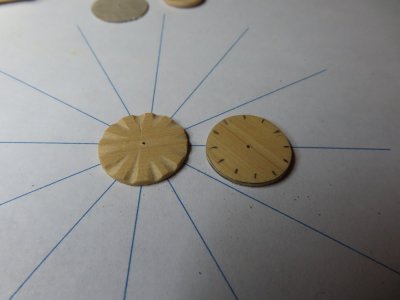
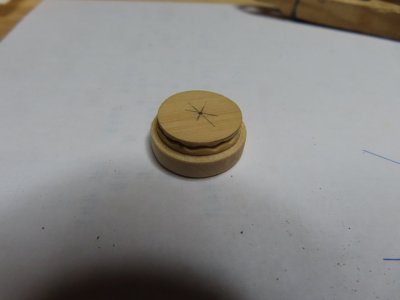
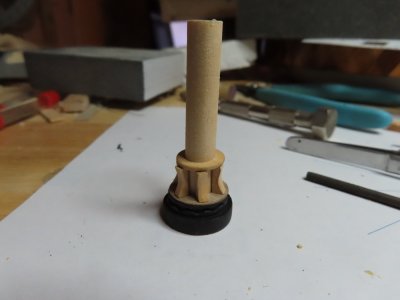
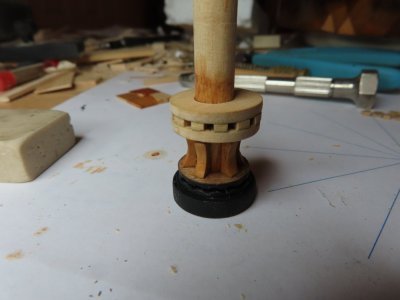
You may have noticed that all the disc parts have a small hole drilled in their centers. This was used to align the disc parts with a pin when they were glued together. It then becomes the starter hole for a series of progressive larger drillings to widen the opening to 5/16” to accommodate the dowel. The center hole was drilled after the discs were glued because the assembly would be a solid piece and not subject to breakage during the drilling process. It also ensures total alignment of all the openings. In the images below, the base is drilled, and the dowel has the first support disc (1/64” plywood) for the whelps. The dowel was inserted for a dry fit. The dowel has not been cut to its final length at this point.
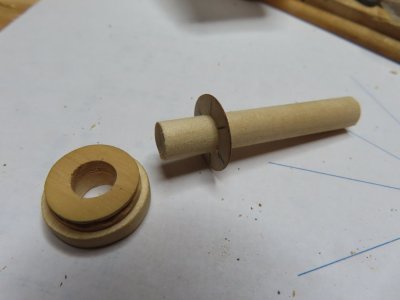
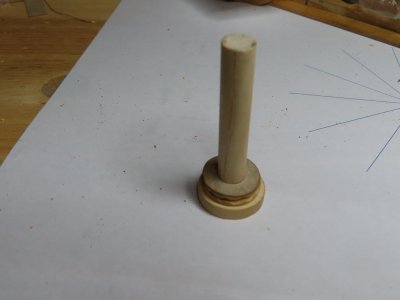
The base was painted black so what little detail I added here for the chain notches has vanished. This was expected and was the reason I did not add any other details. Next, I carved the whelps using a Dremel tool and files. The upper support ring was fabricated just like the previous discs I made for the base. The whelps, the upper- and lower-disc support rings, and the dowel were stained with Minwax Wood Finish Golden Pecan 245. They all glued into place.
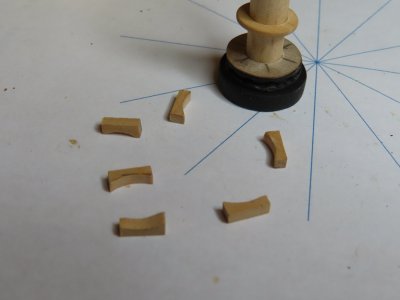
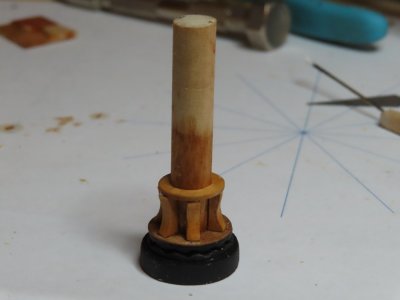
This next section had a false start. I started to construct the section where the capstan bars are inserted to rotate the capstan. (God, I wish I knew what the name of the various capstan sections are called). And I started to make these parts the same way I made the previous section with the whelps. I formed two discs and drilled out the centers. In lieu of whelps I started to make the pieces in between the capstan bar holes. These worked out to be twelve 1/8” x 1/8” x 1/16” pieces which I quickly realized I had to taper into a trapezoid shape to make them fit around the ring to leave a proper opening for the bars. It just became too much fiddley work. A quiver of a fingers, or an ill aimed breath would set the tiny piece out of alignment during the dry fit. I didn’t fight it and immediately tried another solution, which I think was much easier and had better results.
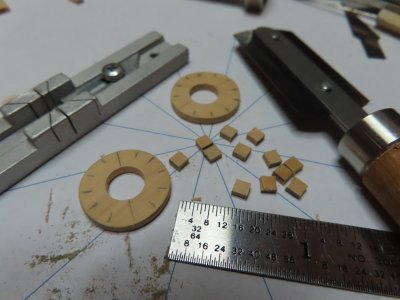
This time I constructed a third, 1/16”, thick ring. Guidelines were laid out for the purpose of making twelve 1/16” notches. Why twelve you ask? If you look closely at the actual capstan, every other square cutout in the brass plating is not hollow, but solid wood. Why it was constructed this way, I don’t know, but there it is. My brass “plating” is brass tape I got at Hobby Lobby, a crafts store. And attempting to cut out 1/16” x 1/16” openings cleanly directly on the tape is almost impossible for me at least. It is much easier to cut out the squares if there is an opening behind the tape that a sharp tool can easily pass into using the opening as a guide for the blade.
The Byrnes saw was perfect for the job of cutting the notches. The cuts were made by eyeball following the guidelines. This notched ring became the “meat” in my sandwich.
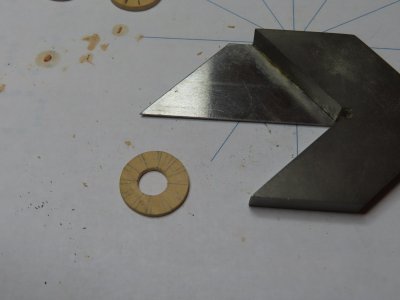
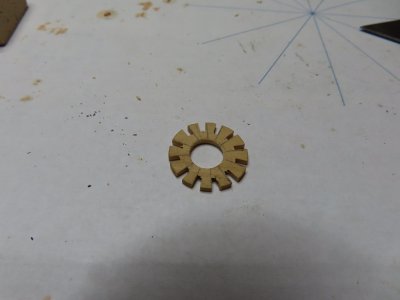
The Byrnes saw was perfect for the job of cutting the notches. The cuts were made by eyeball following the guidelines. This notched ring became the “meat” in my sandwich.
The color of the interior of the bar holes is red, so I painted the interior of the notches and one side of each of the other rings. I got a bit too sloppy with the paint. The excess paint, that wasn’t covered during the assembly, was sanded off and covered by the brass tape. As it turns out you can’t see any color because it’s too dark.
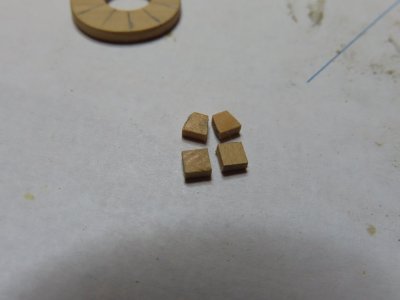
A strip of brass tape was added and pressed on real hard to ensure that it would not come off and to show by indentation where the openings were. Using a couple of fine chisels (1/16” width) I cut the clean square openings. Then I inserted six small pieces of wood into every other opening and stained it with a fine drop of the same Minwax I used before. One more section to go.
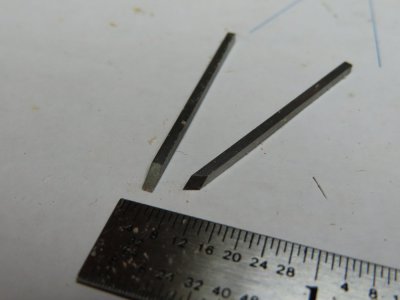
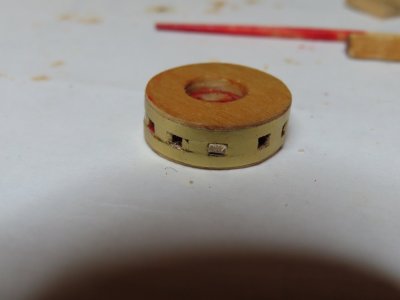
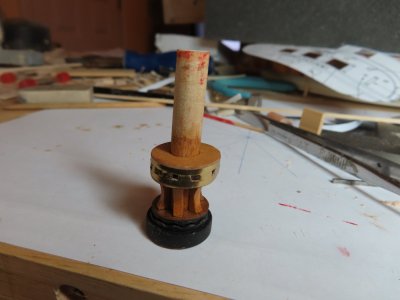
A strip of brass tape was added and pressed on real hard to ensure that it would not come off and to show by indentation where the openings were. Using a couple of fine chisels (1/16” width) I cut the clean square openings. Then I inserted six small pieces of wood into every other opening and stained it with a fine drop of the same Minwax I used before. One more section to go.
The rings of this section were a bit more delicate. They are only 1/32” thick with the edge about 1/32” and 3/64” wide. The trick to making them is to drill the center hole first in the wood stock, then cut the circle around the hole. That way the stresses of drilling won’t break the ring.
The whelps were almost too small to handle. Those were roughly shaped and glued into place, then filed into its final shape. In the first image, you can see the bottom ring partially in place on the capstan. The capstan axle will be trimmed later. All the gun deck items will be glued into place after the guns have been fabricated. The pumps are next.
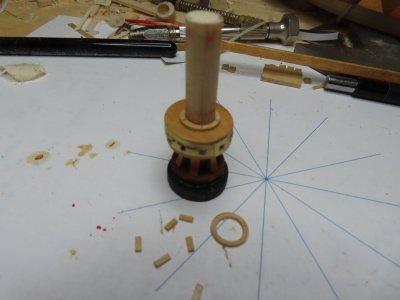
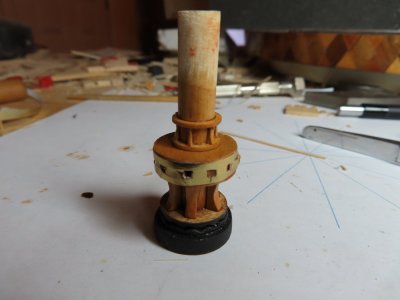
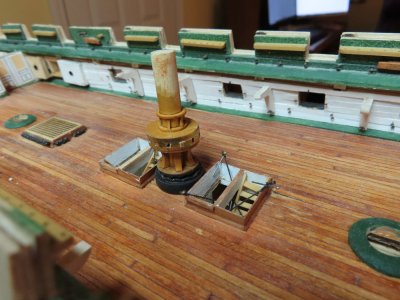
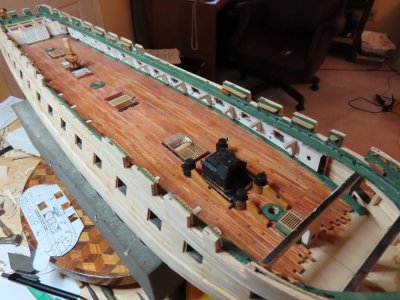
The whelps were almost too small to handle. Those were roughly shaped and glued into place, then filed into its final shape. In the first image, you can see the bottom ring partially in place on the capstan. The capstan axle will be trimmed later. All the gun deck items will be glued into place after the guns have been fabricated. The pumps are next.
Gun Deck Bilge Pumps
I studied the photos of the bilge pumps long and hard trying to figure out how to recreate them in miniature. These things were going to be delicate. Therefore, I had to make them from strong material if they were going to survive the rigors of the modeler continuing to work on the model. I had one US Navy Plan No. 50976 which shows the pumps from copper bowls down to the lower decks. The A-frame mechanisms were not shown. With this plan, the plan view of the gun deck, and the photos (one of which is shown below), was all I had to work out the details.
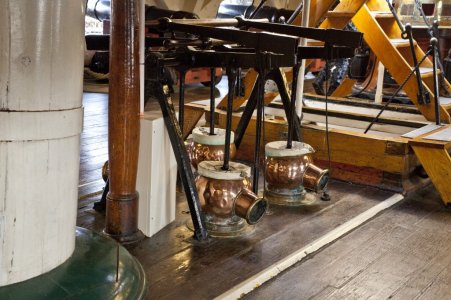
I studied the photos of the bilge pumps long and hard trying to figure out how to recreate them in miniature. These things were going to be delicate. Therefore, I had to make them from strong material if they were going to survive the rigors of the modeler continuing to work on the model. I had one US Navy Plan No. 50976 which shows the pumps from copper bowls down to the lower decks. The A-frame mechanisms were not shown. With this plan, the plan view of the gun deck, and the photos (one of which is shown below), was all I had to work out the details.