



• SUBSCRIBE TO SHIPS IN SCALE TODAY!

    The beloved Ships in Scale Magazine is back and charting a new course for 2026!
    Discover new skills, new techniques, and new inspirations in every issue.

    NOTE THAT OUR NEXT ISSUE WILL BE MARCH/APRIL 2026
  • Win a Free Custom Engraved Brass Coin!!!
    As a way to introduce our brass coins to the community, we will raffle off a free coin during the month of August. Follow link ABOVE for instructions for entering.

USS Constitution - Model Shipway’s 5/32” = 1 ft. (1:76.8) Kit No.: MS2040

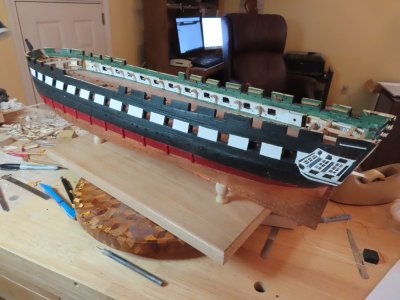
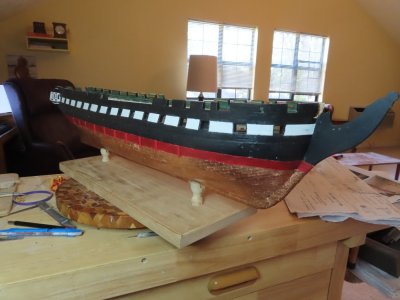
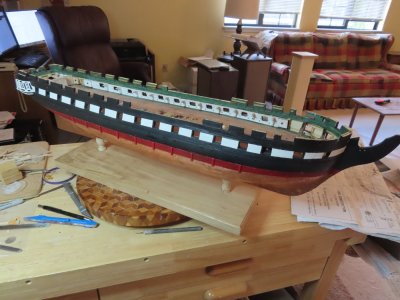
In case anyone is following where I am in the practicum, it’s Chapter 9.1.5. I skipped Chapter 7 for the time being. In any case, this the part where the practicum adds the “iron red” (plans state “red lead”) waterline stripe. According to the Model Shipway plans, the stripe is “not an historic feature.” By this statement, I assume it was added in the twentieth century. But since this is a US Navy commissioned ship (oldest commissioned ship still floating in the world by the way), anything the US Navy does to the ship is, by definition, historic. Here is a blurb from the USS Constitution Museum newsletter from 2017:

In her early years, the ship’s hull sported a yellow ochre-colored gun streak/stripe. Her familiar black and white hull color was established by at least 1811. Interestingly, Captain Charles Stewart had the gun stripe re-painted yellow in 1814, likely in an attempt to disguise Constitution and trick the Royal Navy into thinking she was another British warship in the War of 1812.

In 1842, the Board of Naval Commissioners decreed that U.S. Navy vessels were to have black hulls and white gun streaks/stripes. For the rest of her active career, until her last sail in 1881, Constitution‘s hull color changed only once, when, according to ship’s carpenter Henry George Thomas in 1844,

“December 20…Since leaving Rio, the ship has been painted white or lead color with a red streak, in place of black with a white streak…the ship is cooler…both inside and out…” [Around the World in Old Ironsides, The Voyage of the USS Constitution, 1844-1846 by Henry George Thomas]

As most of us Conny builders know, this ship has been constantly modified. The red waterline is no different than painting the ship white with a red gun stripe like a hospital ship. So yes, I’m adding the “historic” red waterline.

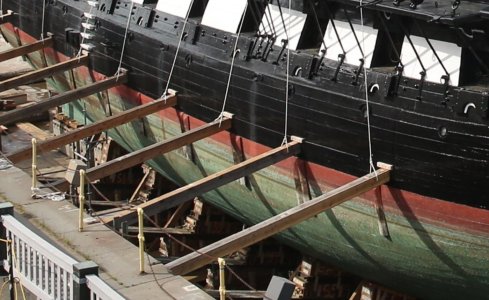
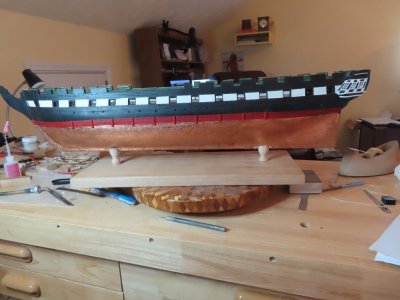
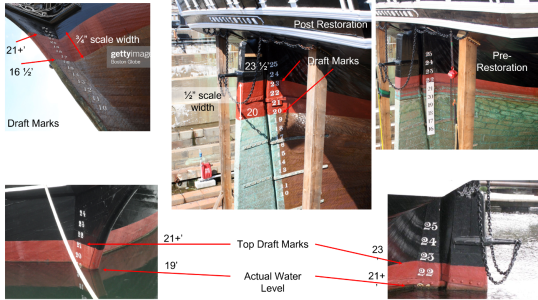
To make things a tad more interesting (read more complicated), the Model Shipway plans show the red stripe between draft marks just about mark 21’ to the top of mark 18’, which at scale is ½” wide. There are photos to show this is correct …aaaannnnd photos to show this to be wrong. The composite image below shows multiple locations for the top and bottoms of the red waterline stripe - top of draft mark: 23’, below the mark 23’, and top of mark 21; the bottom locations at just above mark 18’ and below mark 20’. ‘When the ship is floating, the actual water line on the boat is at mark 19 and just above 21’. Since there doesn’t seem to be a definitive position for the red waterline, when in doubt, follow the plan, in this case the MS plan which appear to follow the US Navy 1844 Draught & Lines plan #11249 which shows the high and low draught range.
Red Waterline.png
 
When I purchased the model Shipways kit from Model Expo, I also bought their paint set for the model. It did not however, come with red paint for the stripe. To create the red stripe, the practicum used an airbrush. I have used spray cans but not an airbrush, nor do I have any or the experience to use it even if I did. The practicum used Badger Caboose Red, number 16-08 and to tone the brightness down slightly, added 2 drops of Badger Black, number 16-01 with an eyedropper. A 2 oz bottle of badger paint costs $9.59 on Amazon. For the practicum paint recipe, it would cost $19.18 plus shipping, if any. That’s an awful lot for paint.

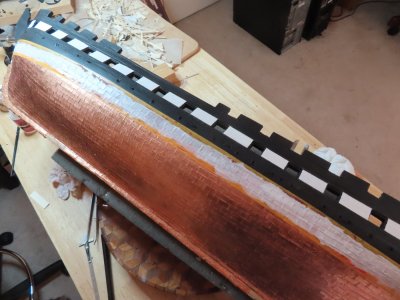
I do have a Hobby Lobby within 1 mile of where I live, so I went there. They were having a sale on artist acrylic paints: 8 oz for $0.99. Just a slight difference in price. I initially purchased Anita’s Craft Paint #11025 Red Rust because I couldn’t find anything that implied hull red, iron red, or red lead. After taping off the stripe, I painted the inside edges of the tape with clear acrylic to prevent bleeding. Then, I applied the red paint straight from the bottle. Eventually, I applied three coats to get an even application.

There was a slight problem…I didn’t like the color; it had the color of a dark red brick, and if I got water on the dried paint, it could be peeled off with hardly any effort. I realized I didn’t use a paint primer. So, I took it off.

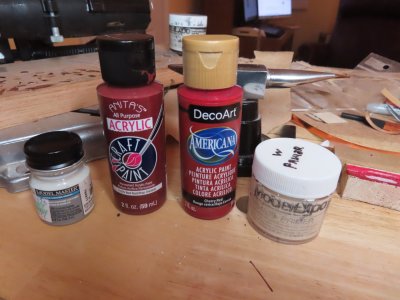
I went back to Hobby Lobby and bought 8 oz of DecoArt Americana Cherry Red for $0.99 (still a bargain). The only primers I found were in spray cans and they weren’t acrylic. I had a bottle of Model Master White Acrylic Primer, but unfortunately it had dried out and Hobby Lobby didn’t have any. I did have a container of White Acrylic primer that came with the paint set, but for all I knew, it was the same as the white paint container.

This time I did a test. I painted a strip of copper with the Model Expo white primer and then a coat of the Cherry Red and I did the same with the red Rust. The Cherry red stuck to the primer much better than the Red Rust which still peeled off when wetted with water. So, Cherry Red it is with maybe a drop or two of black to tone the brightness down slightly (like the practicum stated)

My sister is an accomplished artist who uses acrylic paints (see PaintedFurnitureBySue). I told her about the peeling problem I had with the Rust Red paint. First thing she asked was who manufactured the paint. I told her Anita’s Craft Paint for the rust red and DecoArt Americana for cherry red. She informed me that the proper term for the peeling was crocking, and it was an indicator of poor-quality paint. She was not familiar with Anita’s Craft Paint, but that DecoArt Americana was a high-quality paint which she uses. Here are the paints I referred to in my earlier post.

IMG_2152.JPG
 
The red stripe was painted by applying Model Shipways primer white and two coats of Cherry Red mixed with a few drops of hull black following the lead of the practicum. I neglected to take pictures of the resulting red stripe.at this stage.
IMG_2151.JPG
 
Fenders

Per USS Constitution Museum:
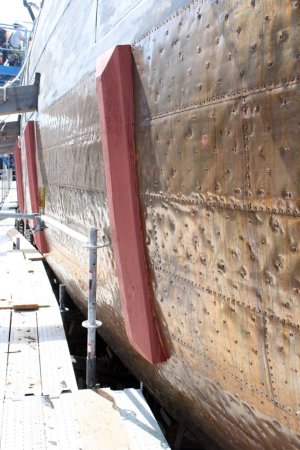
“Since at least the 1973-1974 dry docking, when USS Constitution‘s copper sheathing was replaced, fixed fenders have been attached to the hull to protect the waterline area of the ship. For the 2015-2017 restoration, new fenders were once again made, but this time each fender was cut and fashioned to individually fit the contour of the hull.”

What’s interesting is that the 1927-31 restoration MS based plans show the oak fenders. How are there fenders on the plans? It also states that the fenders are “Not a historical feature. Installed by Navy to protect copper from camel damage in dock” Again, my argument that anything the Navy does to a commissioned ship, IS historic. Albeit, adding permanent fenders is not something you would do an active warship as it would obviously slow the speed of the ship.

Fender 01.jpg
 
I followed the practicum for the most part in constructing 20 fenders, 10 for each side with the following modifications:
  • The MS plans, the practicum, and the pre 2015-17 restoration photos, show the fenders are chamfered on the vertical sides and top edges, not the bottom. According to the 2015-17 restoration photographs, all four sides are now chamfered.
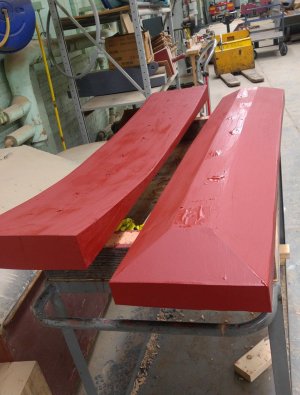
  • The practicum left the fenders as bare wood, but the photographs (even before the 2015-17 restoration) showed they were painted the same color as the red stripe.
  • The practicum would have you just simply glue the fenders to the hull. I added two pins for each fender for a more secure attachment.
To be fair, at the time the practicum was written sometime in 2014 I believe, there were very few images available showing details of what the fenders looked like on or off the ship. I’ve only located these images from the 2015-17 renovation shown below. Moreover, when the ship is afloat, most of the fenders are not visible as they are hidden below the waterline. And, for some reason, very few images with any detail are available even today (at least on Google) when she was in dry dock. I guess they’re not very interesting subjects to photograph.

0502171312.jpg

IMG_8296.jpg
 
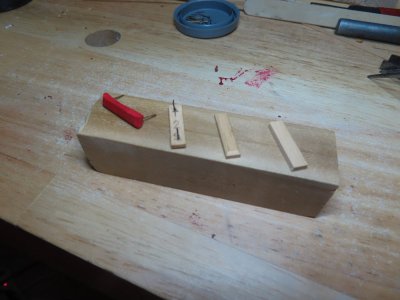
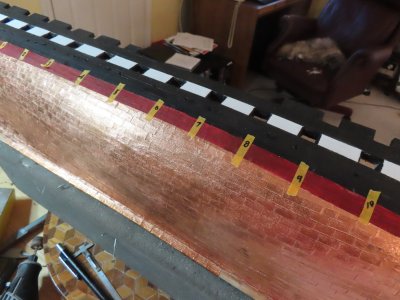
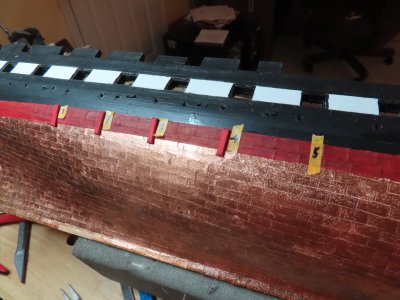
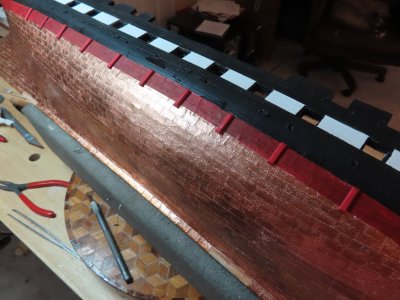
Using 5/32” x 1/8” stock boxwood, twenty pieces were cut 21/32” in length. Boxwood was chosen over basswood because it holds a very fine edge. The chamfers were created using a sanding block. I didn’t trust myself to cut them using an X-acto knife as Mr. Hunt did in his practicum. Then, using a drum sander bit on the Dremel rotary tool at a slow rpm, the hull face side was sanded down ever so gently to match the contour of the hull at each position. The fenders were identified on the inside face with an arrow indicating UP orientation, S or P for the proper side, and the position 1 -10. I just arbitrarily made the aft most position No. 1. Using leftover metal wire trimmed from eye bolts and other hardware for the pins, holes were drilled into the backside of the fenders and the pins were CA’d into the holes. Before installation, the fenders were painted red. Pressing the fender onto the hull, the pins left an impression indicating were I had to drill holes into the hull for the fender pins. The fender locations were premeasured and indicated on the hull with paint trim tape.

IMG_2154.JPG

IMG_2155.JPG

IMG_2156.JPG

IMG_2157.JPG
 
Bow Details

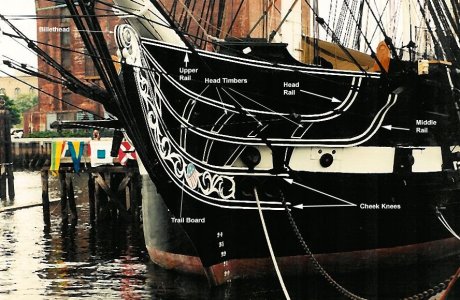
it’s time to work on the bow details, Chapter 8 of the practicum. Taking a deep breath and I jumped in with both feet. The practicum instructions provide an annotated image of the bow with the pertinent nomenclature.

HP8.1-1.jpg
 
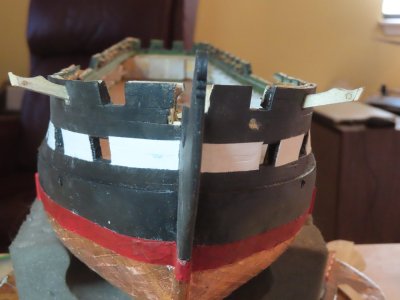
After studying the photographs long and hard, the practicum, and other build logs, I’ve concluded that this going to be a bitch. The problem I see is that there is not a straight line anywhere, the plans provide no explanation as to how to fabricate the bow rails. The practicum does try to show how its to done, but for my skills, I needed more details. What I did realize is that I needed to install the catheads now because the head rails tie into them.

Catheads

If I were following the practicum religiously, which I’m not obviously, the cathead would have already been installed by this time. I had planned to install them when I started to work on the spar deck. The kit provided the basic raw cathead shapes which I used to ensure that I made the cathead hull openings the proper size earlier on in the build.

At the outside ends of the catheads, there is a triple sheave. Mr. Hunt in his practicum, simulated these sheaves in the kit provided catheads by drilling two holes per sheave at the outer end of the catheads and carved a groove between each pair to give them the appearance of the imbedded pulleys.

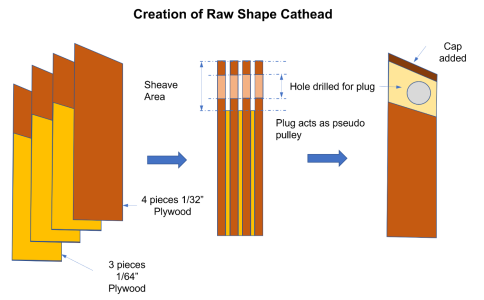
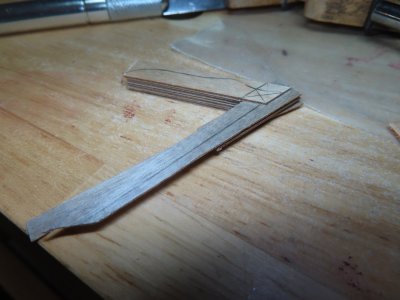
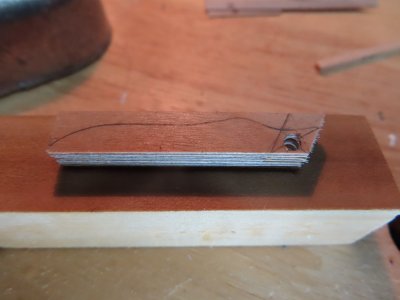
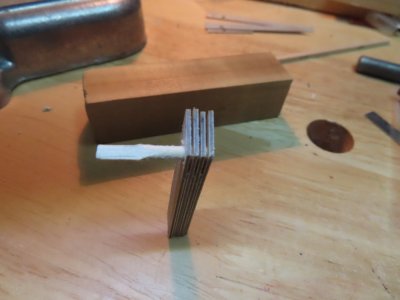
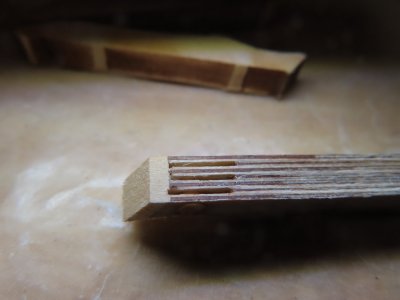
The catheads do not extend out from the hull horizontally, but at an upward angle. This requires that the triple sheeves openings at the end of the cathead must be drilled at angle, so they are vertical when installed. Drilling six holes perfectly parallel at an angle for each cathead is beyond my skill set or available tools at my disposal. Instead, I made the holes by layering 1/32” and 1/64” birch plywood using the plan below. I chose to alternate two thicknesses of plywood because the final cathead must be 3/16” wide. Seven pieces of 1/32” plywood is too much. With the addition of glue, the combo plywood assembly worked out exactly 3/16”.

Creation of Raw Shape Cathead.png
 
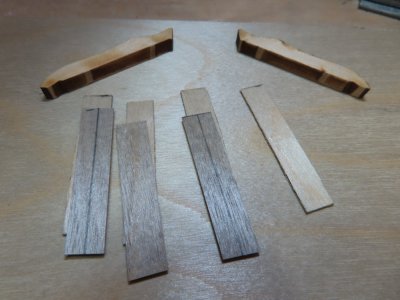
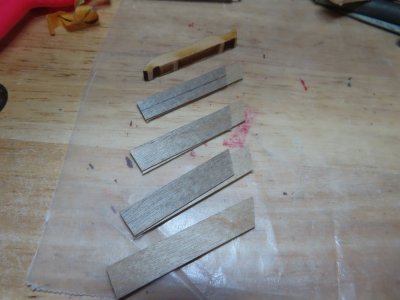
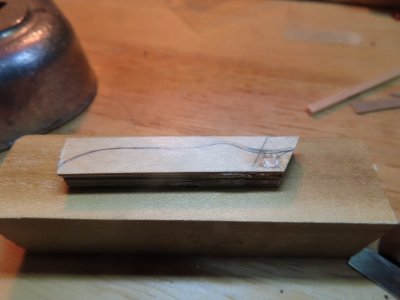
Using the kit supplied raw shape catheads, stock 1/32” and 1/64” birch plywood was cut to size, 4 pieces of 1/32” and 3 pieces of 1/64”. with one end sliced 60° to the long sides. Also, the 1/64” pieces were also sized ½” shorter length than the 1/32” pieces. The pieces were assembled, clamped, and glued with wood glue. Temporary 1/64” spacers were added to maintain separation during gluing.

IMG_2163.JPG

IMG_2165.JPG

IMG_2166.JPG
 
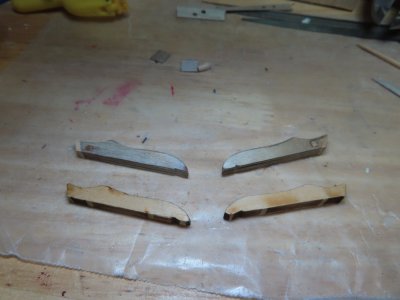
I waited 24 hours to make sure the glue dried solid. The kit supplied catheads were traced onto the assemblies and the location of the pulleys were located and drilled. I checked the kit’s cathead shape against the US Navy plans and they are a close match. The spacers were removed after the holes were drilled. Wood plugs, which would become the pseudo pulleys were then inserted into the holes, glued with CA glue and the ends cut flush. Finally, caps were glued onto the ends of the sheaves to complete the assembly. Using my drill stand mounted Dremel rotary tool with a drum sander bit, I shaped the raw pieces. The finished catheads looked almost identical to the kit supplied pieces, but these now had sheeves and pseudo pulleys.

IMG_2167.JPG

IMG_2168.JPG

IMG_2169.JPG

IMG_2172.JPG

IMG_2171.JPG

IMG_2170.JPG
 
Cathead Hardware

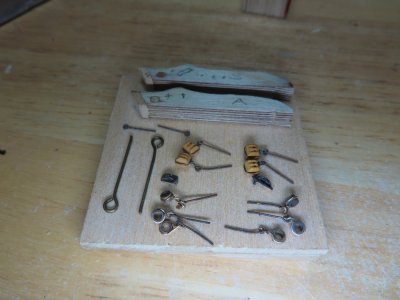
For such a small structural piece, the cathead has a lot of hardware. All the double blocks and hearts are attached to the cathead with eyebolts and shackle connections. For the model, simple eyebolts were used due to scale.

h-Bracket

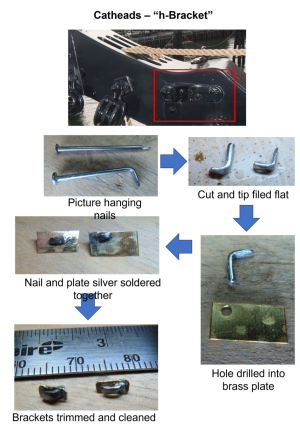
I don’t know the technical term for this, but I’m calling it an “h”-bracket due to it being shaped like an “h.” I used a typical picture hanger nail and bent the pointed tip 90°, flattened, and thinned the bend portion. This was then cut off. A piece of brass plate was cut a bit larger than the final bracket size for ease of handling and a hole was drilled to accept the fabricated right-angle piece. These were silver soldered together so that the flattened nail tip was parallel to the plate leaving a fine gap between the two. The excess brass plated was trimmed to size. The actual size of the bracket was based on its relative size as compared to the cathead beam as were all the pieces of hardware. I did not have dimensions for these pieces.

Cathead h-Bracket.png
 
Hearts

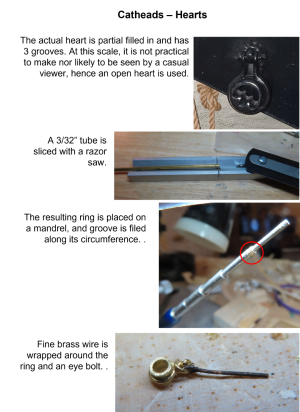
The actual hearts are partial filled in and have 3 grooves. At this scale, it is not practical to make nor likely to be seen by a casual viewer once the parts are paint black, hence a simple open heart was fabricated. They were made by slicing 3/32” dia. brass tubes to create rings. The rings were placed on a mandrel for ease of handling, and a circumferential groove was filed. Brass wire was used to strop the hearts because the actual hearts were stropped with metal. This was done by wrapping the wire around the ring and securing it to the eyebolt.

Catheads - Hearts.png
 
Cathead Double Blocks

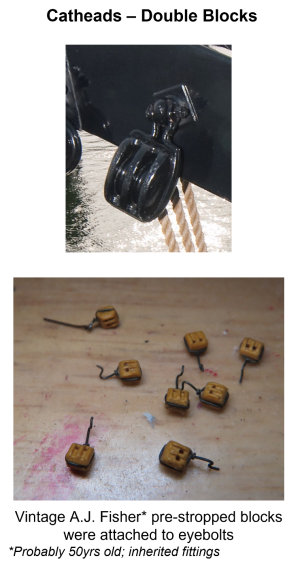
I got lucky on the double blocks. A friend of mine, a model train buff, was given a bunch of old ship fittings way back when. Because he knew I made wooden model boats, he gave them to me. Among the gems were vintage A.J. Fisher pre-stropped blocks which were the perfect size for the catheads. For all I know they may be 50yrs. - 60yrs. old. All I had to do was attach them to the eyebolts.

Cathead - Double Blocks.png
 
Cathead Assembly

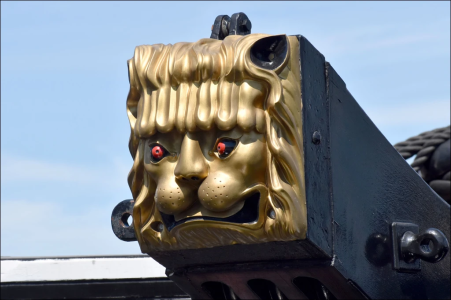
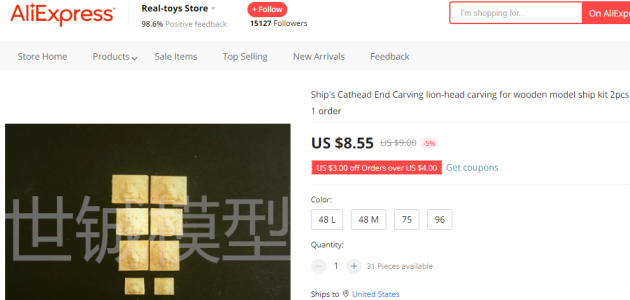
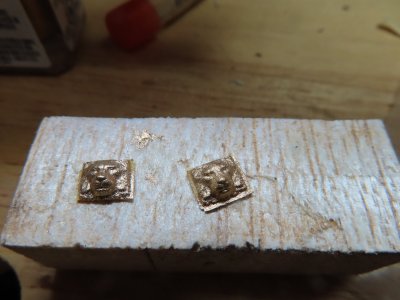
The only parts left were the cathead sculptures. I know my limitations, and sculpture is not one of my talents. Taking a shot in the dark, I Googled “model Cathead carving” and found just what needed at AliExpress.com (https://www.aliexpress.com/item/1005002780549303.html). It’s not an exact match, but it’s a whole lot better that I could have fabricated. It’s close enough for this scale. It takes a while to ship it from China but to be fair, I did this last year in anticipation of this, so I had the parts in hand waiting for my use.

180721-038-uss-constitution.png

IMG_2185.JPG

AliExpress Cathead Carving.png
 
A problem with posting en masse as we have done with our logs, is that it's not easy to comment on earlier posts. I don't know how I overlooked it your MSW posts, but your copper plating is AWESOME!
 
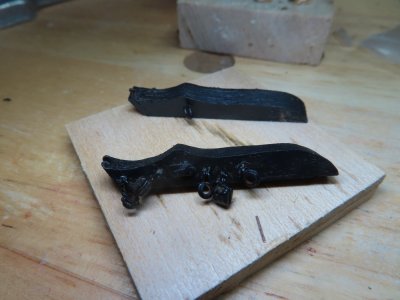
The parts (except the carvings) were assembled, and everything was painted black as per the actual ship photos. The carvings were painted gold with enamel paint for a shiny appearance.

IMG_2188.JPG

IMG_2189.JPG
 
Back
Top