• SUBSCRIBE TO SHIPS IN SCALE TODAY!

    The beloved Ships in Scale Magazine is back and charting a new course for 2026!
    Discover new skills, new techniques, and new inspirations in every issue.

    NOTE THAT OUR NEXT ISSUE WILL BE MARCH/APRIL 2026
  • Win a Free Custom Engraved Brass Coin!!!
    As a way to introduce our brass coins to the community, we will raffle off a free coin during the month of August. Follow link ABOVE for instructions for entering.

USS Constitution - Model Shipway’s 5/32” = 1 ft. (1:76.8) Kit No.: MS2040

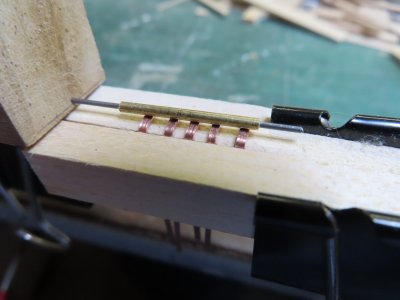
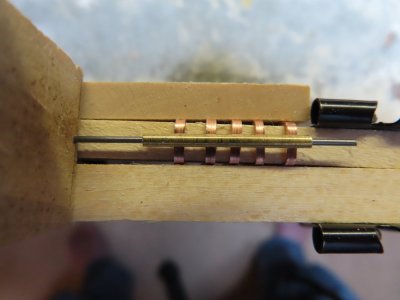
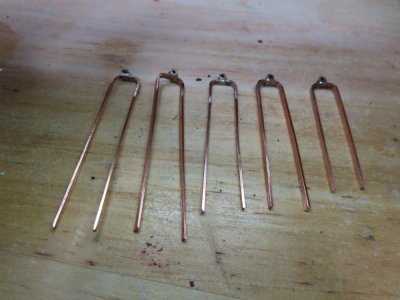
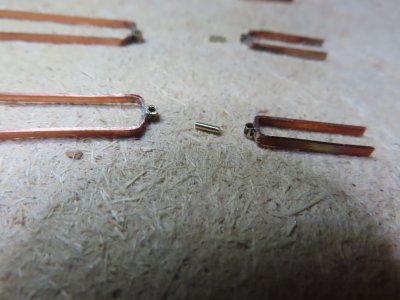
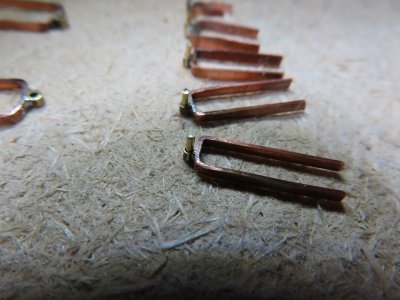
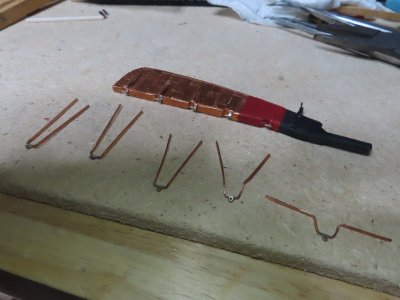
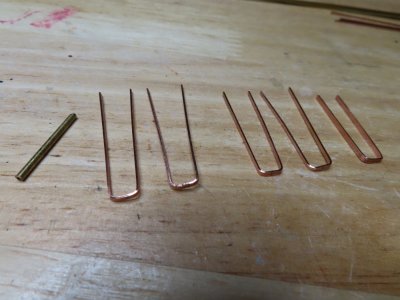
The hull side hinges consisted of two parts, the strap structural element that attached to the hull and the gudgeon. The trick was to form the five gudgeons in perfect alignment so the rudder would be able to pivot smoothly. This was something that Ken Forman made note of. I modified his method so I could not only maintain alignment but made the silver soldering easy.

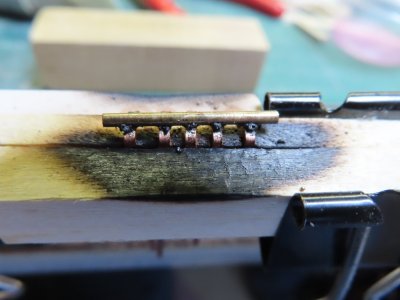
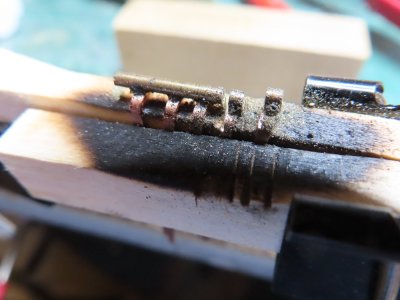
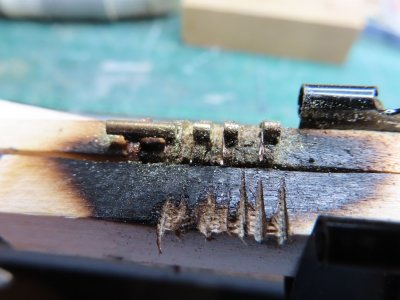
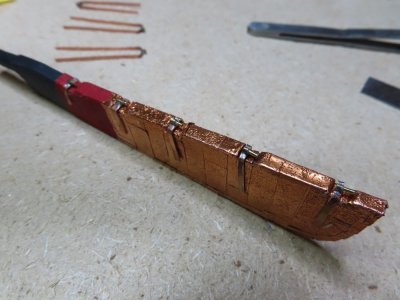
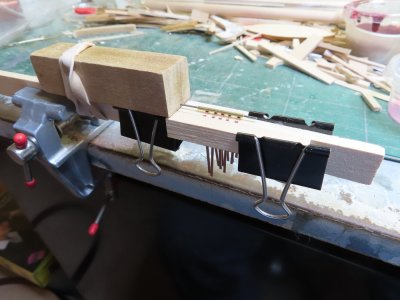
First, I formed the hinges by wrapping the copper strips over a 3/8” thick piece of stock basswood. Then I drilled a 1/32” hole into a piece of wood so a length of 0.032” stiff music wire could be inserted. A length of 1/16” brass tube was slipped over the music wire. The five hinge straps were draped over the same piece of wood that was used to form them and clamped on either side. The block of wood holding the music wire with the brass tube was then held in place over the hinges with a rubber band. When silver soldering paste was dabbed onto each hinge and the brass tube positioned onto the hinges, everything was in place. With a couple of passes with a small torch, the tube was soldered to all five hinges assuring the gudgeons would be perfectly aligned.
IMG_2344.JPG

IMG_2345.JPG

IMG_2346.JPG

IMG_2347.JPG

IMG_2348.JPG
 
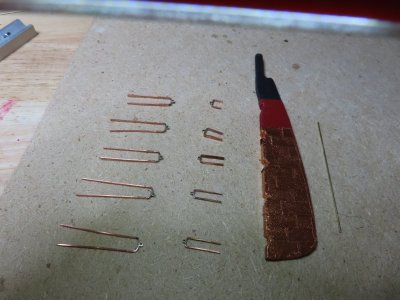
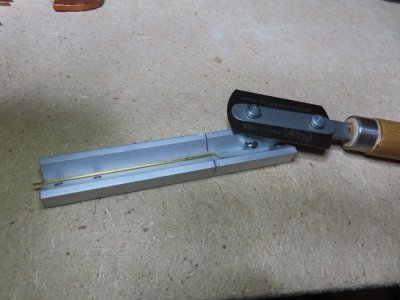
Using fine toothed hand saw, the hinges were cut apart. I thought about using my Dremel with a rotary saw or cutting disc, but I realized I couldn’t hold my hand steady enough for a clean cut. A few finishing touches with a file to clean off and smooth the edges, and the hull side hinges and gudgeons were formed.

IMG_2349.JPG

IMG_2350.JPG

IMG_2351.JPG
 
The pintles were fabricated initially as a gudgeon with one extra step. After fabricating the preliminary gudgeons were formed, a length of 1/32” brass rod was sliced into five 1/8” pieces using the razor saw for clean cuts. These 1/8” pieces were inserted into the gudgeons converting them into pintles and fastened with CA glue to complete the process. CA glue was used because it set quickly, was strong, neat, and needed no additional cleanup.

IMG_2366.JPG

IMG_2369.JPG

IMG_2370.JPG

IMG_2371.JPG
 
Jon, There's someone's build here that's as awesome as Mustafa's, hopefully I'll find it again, but as I finish my natural finish Conny, I'm actually inspired to do it again in the black and white scheme - this time with all the bells and whistles (now that I have some inkling of what I'm doing). If that happens, I'll be bookmarking - no (have we learned nothing? :D) COPYING everything you've done with the copper plating. Now that would be am ambitious goal for my 80th birthday.
 
I haven't worked on my model since Tuesday, April 28 because the next day I started my trip to visit my sister in Connecticut MA. There, I found out about the MSW disaster. When I got home this past Wednesday, I put the model aside, took a deep breath, and started the rebuilding of my log. Right now my goal is to finish the log first and get it out of the way. I hope to make a lot of progress before my 80th birthday in November.

After reviewing the build log in the process of rebuilding it, I've amazed myself as to how much effort and work I've invested in it. Based on that, I've got to give you a lot of credit even if you are just considering taking on this model again. You will however, have the advantage of your previous experience, but still, it's an undertaking.

Jon
 
I did say that it was an "ambitious" goal..

I have a plan B (Horst Wessel, aka US coast guard cutter Eagle) and a plan C (USS Niagra - I'm often in Erir PA, where I can study the original up close as well. In any case if there's copper plating involved I'm looking to you as my inspiration.

November is just around the corner young man. Where do you hope to be with your Connie on that auspicious occasion?
 
Rudder Iron (Chain Iron)

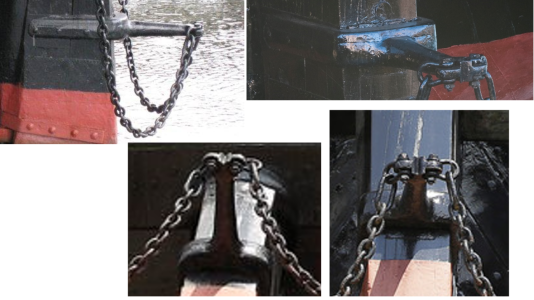
I decided that before I install the rudder to the yet to be installed hull gudgeon hinges, I better fabricate and install the rudder iron to the rudder while it’s still off the model. On the MS plans it looks similar to a simple tuning fork with a couple rings at the aft end. Looking at photographs, it’s a bit more complicated…of course. The kit does not provide any hardware for this item so it’s a scratch build. Once more the practicum shows how to fabricate it with styrene, while other builders tried other various methods using brass strips and tubes.

Rudder Iron - Actual Ship.png
 
I didn’t like the idea of styrene as it just felt wrong and the final construct, I believed, would be too flimsy to support the rudder chains properly. Other builders merged the straps gripping the rudder together and just extended them to where the rings attached. Some builders used a square cross section brass tube to support the rings. The problem I felt was that the straps had to support an extrusion that extended 90° from the aft end of the rudder beginning with a round cross section and morphing into a flat vertical tail where the two rings are attached.

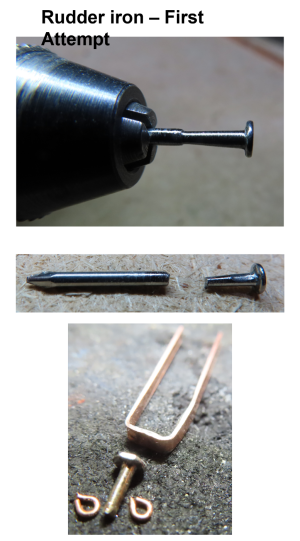
I initially tried to use my limited silver solder skills with a flat head nail. I placed the 1/16” diameter nail in my Dremel to spin like a lathe. With a file, I tapered the nail shaft down a bit away from the nail head using photographs as my guide. Then I cut the tip off the nail leaving the nail head and shaft at the proper length. Using the file again, the aft end was flattened vertically to accept the eventual chain rings. Finally, I silver soldered the nail head to the center of a length of 3/32” wide strip of brass.

I had hoped the nail head would give me enough surface area for a strong solid joint. Then I could wrap the length of the brass strip around the back edge of the rudder so the nail shaft would protrude aft. At this point I still hadn’t figured out how to attach the rings. This became a moot point when I tried to wrap the solder part onto the rudder, so I would know how much I had to trim the straps. The soldered joint broke apart and the nail fell off.

Rudder Iron -  1st Attempt.png
 
Thinking about this more, even if the joint had held, how do I fasten the rings? If I solder the rings on, I risked unsoldering the nail head (I didn’t have different temperature solders). Gluing with either CA or epoxy was iffy at best due to the miniscule gluing surface areas.

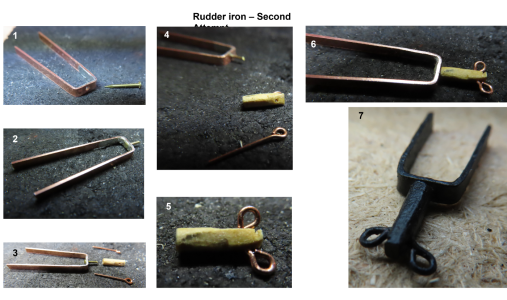
I opted for another method. Instead of a metal shaft. I used boxwood. This time I used a small brass head nail. I drilled a hole in the center of the strap and pushed the nail through it from the backside pointing aft. This was silver soldered into place. The shaft was made from a piece of boxwood for strength and ease of shaping the round cross section forward and vertical flat aft. Two holes were drilled on either side of the tail for the eventual ring bolts. An additional hole was drilled at the forward end along the axis to accept the shaft of the soldered nail. Still, the wood piece was very difficult to hold and carve, so I did not get the precise shape I wanted. The CA glued nail will provide a solid connection and structural strength. Finally, the eyebolts were cut to length and inserted into the aft hole with CA glue. The whole component was painted black, and CA glued into place on the rudder. Using wood in lieu of metal is just fine. It’s painted black and no one will be able to discern the material it’s made of.

Rudder Iron -  2nd Attempt.png
 
Gudgeon Hinges Installation

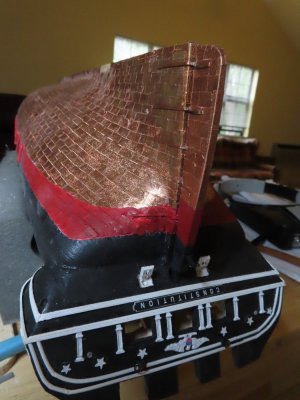
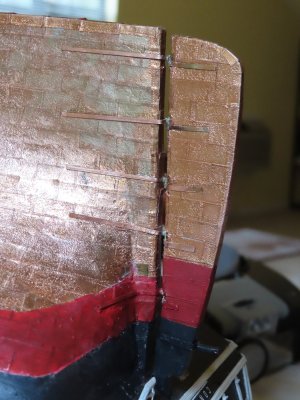
Now it was time to install the straps and gudgeons to the hull. This was not as easy as I thought it would be. The plan was to install the topmost one and then one by one, the next in order using the rudder as my guide. Since I had the model upside down, I was working from the bottom up, but I had a devil of a time. The highest strap (on the bottom) had the most radical bends. I rough shaped the strap bends just to position them onto the hull.

IMG_2384.JPG
 
Once I got the first one installed, I tried to install the second. I emphasize the word “tried” because I couldn’t get the two pintles to slip into their respective gudgeons at the same time. Just a thousandth of an inch off in any direction, and they wouldn’t fit. If I did get them to fit, the angle of the whole rudder was off. I must have ripped off these two gudgeons and straps at least a half dozen times or more. However, once I finally got them to fit, the remainder of the strap and gudgeons fell into place relatively easily. I emphasize. “relatively”.

IMG_2385.JPG

IMG_2387.JPG
 
Stern Draught Marks

Now that the rudder has been installed, I created the aft draught marks and installed them just like the ones on the stem. I did this now, so that the rudder iron chains won’t get in the way.

Rudder Iron Chains

I had some preconceived thoughts as to the purpose of the rudder Iron chains, but surprisingly, I found little written about them until I checked one of my books, Ship Model Making Vol. III, How to Make a Model of the U.S. Frigate Constitution, by E. Armitage McCann, 1927. He stated:

These chains are quite small and are there to save the rudder, if it comes off or to steer with, if the other steering gear breaks down.

It matched my original conjecture. Well, now you know.

I felt the practicum didn’t pay enough attention to details of rudder iron chains.:

  • It used out of scale large hull eye bolts.
  • It used four eye bolts per side in lieu of the present day five. (Note: prior to 1927 it had six per side)
  • It had the chains pass through the hull eye bolts’ eye instead of hanging from them.
  • No attempt at measurement of chains length or counting the number of chain links between the eye bolts or to the rudder iron was made.
  • It instructed the builder to paint the chain black after installation on the model

Rudder Iron Chain.jpg
 
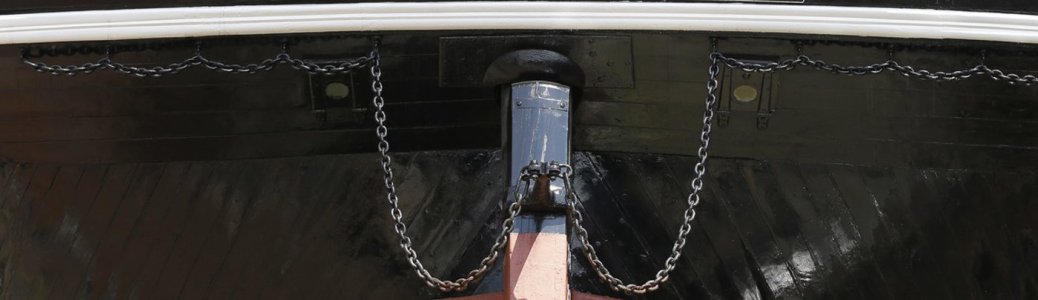
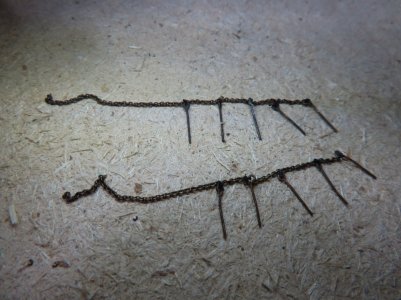
By now, you know that I will attempt to follow the actual ship’s configuration. I counted the actual number of links. As best as I could make out from the photographs, there is a shackle and a long link followed by 50 links from the rudder iron to the first hull eye bolt and then 11 or 12 links between the remaining eye bolts. The kit calls for 40 links/inch chain which is about at scale (based on the link count) and the smallest of the three sizes provided in the kit. Each link is about 1/32” long. The brass kit chain was too bright and shiny, so I used Blacken-It to well, blacken it to match the actual chain.

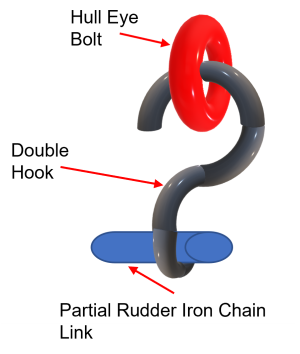
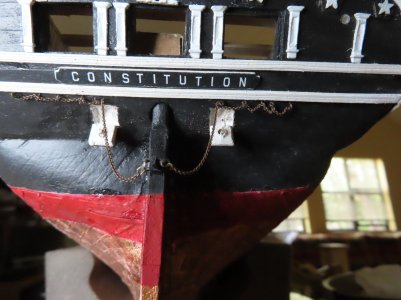
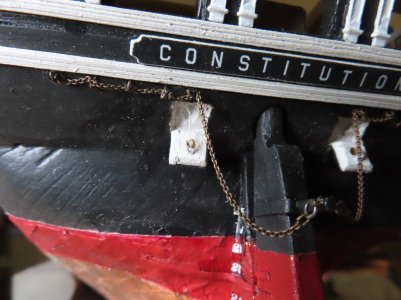
The first problem was to determine how the chain was attached to the hull eyebolts. It certainly did not pass the eye of the hull bolt nor did the eyebolt link to the chain. As near as I could figure out, the chains are hung from each eye bolt with a double twisted hook. I’ve tried to recreate what I think is being used below. This would allow the chain to be removed or hung with relative ease in real life. That being said, at this scale there is no way of reproducing these hooks and even if I could, no one would see them. The simplest and most effect thing to do is to tie the chains to the eye bolts with black thread. It wouldn’t look any different than an actual hook at this scale.

Rudder Iron Chain Closeup.jpg

Rudder Iron Chain Hook.png
 
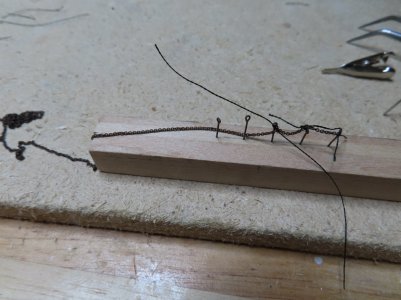
looked easy. Tying the first eyebolt to the end link was. The thread passed through the end link and eyebolt and was tied off with a minuscule drop of CA glue with the point of a needle. The next eye bolt had to tied off about 12 links in from the end of the chain. Try as I might, the thread would (or could) not pass through a link attached to two other links, even when the thread was stiffened with CA glue. There just wasn’t room enough Therefore I went to Plan B and I connected the second eyebolt by first tying a knot to 2nd eyebolt then wrapping the thread around the chain and tying that off to the eyebolt. The third eyebolt was more difficult to position and tie off because I already had two eyebolts hanging off the chain with excess thread (in case I had to adjust) which caused interference with everything else. After all, the eyebolts were only 9/32“apart. It was at this point I created a simple jig to hold all five of the eyebolts 9/32” apart while I tied the chain to them. Trying to manipulate a tiny chain like that is like holding a wet noodle, it just does not do what you need it to do.

IMG_2388.JPG
 
However, I did not like the way the natural hang of the chain was distorted by wrapping the thread around the whole chain. I abandoned Method B and returned to a modified Method A, trying once more to thread through the links.

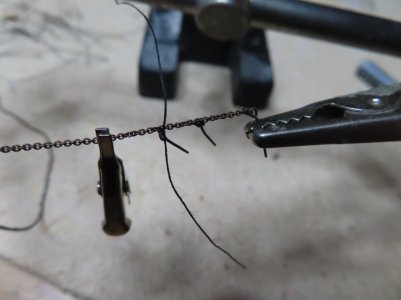
This time, after stiffening the thread with CA glue, the end of the thread was trimmed to a long sharp point using an X-acto knife with a fresh blade. This allowed the thread to poke through the link just enough to be caught by my forceps. Then the thread could be tugged gently and coaxed through the link. The problem was that the fine thread tip was weak and would break easily. Also, any excess CA glue on the thread surface made the thread too thick to be pulled through the link if and when I was lucky enough to get a hold of the protruding thread point. Therefore, the excess glue had to be scrapped off but still leave the thread smooth, pointy, straight, and stiff.

This process was learned by trial and error, mostly error, but I managed to get the first one through the links after about a dozen or so tries over a couple of hours. By the time I did the last one, a week had passed but I was able to thread the last link in less than 15 minutes.

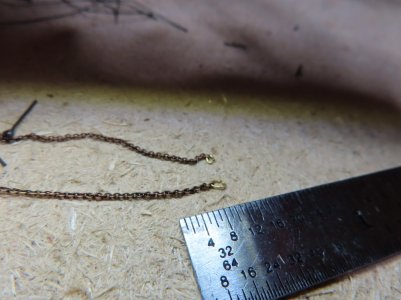
Once all the eyebolts were attached to the chains, adjusted as needed, and excess thread trimmed, 50 links were counted from the last eyebolt (closest to the rudder), about a 1¼”, and the excess was cut off.

IMG_2390.JPG

IMG_2392.JPG
 
The last connection from the chain was to the anchor iron. I needed to make a link that would be thin enough to pass through the last link in the chain and strong enough for the anchor iron. The photographs show an extra-long link as the last link on the chain connecting to a shackle bolted to the rudder iron. This was how I would make the transition.

The long links were made from thin brass wire and the “shackles” were made from a typical staple found in any common stapler. It was a little thicker but would pass through the long link as well as the eyebolt on the rudder iron. A staple is tough, malleable, and easy to manipulate. The components were formed by bending the metal to shape and then blackened. The staple did not blacken very well. But it removed the shine from the metal. The chain and eyebolts were then “simply” inserted into the predrilled holes just under the transom. Well, not so simple. I had to re-drill the holes because my well measured spacing of the eyebolts didn’t match the well measured holes in the hull. If I had to do it over again, I would have added a couple of more links per eyebolt.

Finally, the “shackle” was attached to the rudder iron and the long link connected to the shackle,

IMG_2395.JPG

IMG_2396.JPG

IMG_2397.JPG
 
Stern Window Port Lids

The last major items on the stern are the window port lids. These have changed their appearance over the years, but I am consistent to model them as they are today, simple horizontal lid openings with no internal window sashes.

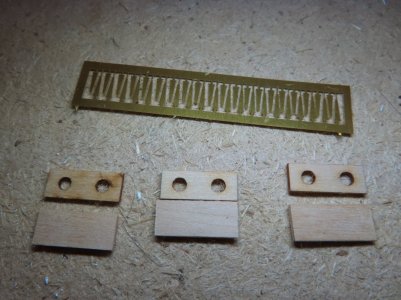
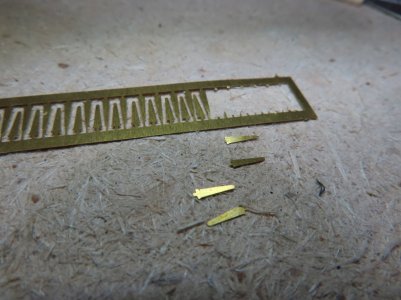
The kit provides only the top half lids with the round window openings pre-cut out. The bottom lid halves are simply pieces of wood cut to size. The practicum fabricated all their lids in a closed position. I decided to open the center one partially because although there is nothing to see inside except my pseudo printed walls and flooring, I wanted the viewer to be aware that they opened. Photo-etched hinges were provided by the kit. They are just for looks and are not functional.

IMG_2400.JPG
 
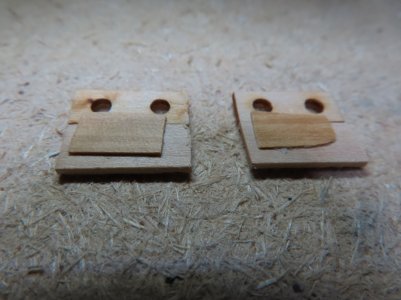
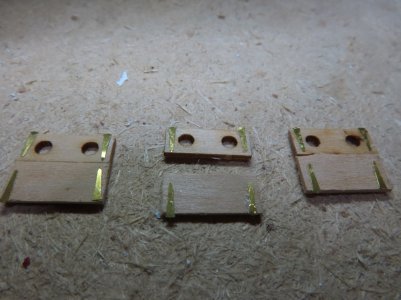
To ensure that the double lids are flush with each other, a backing was added which the top and bottom lids were glued to. Obviously, the backing won’t be seen when the port lids are installed. Then the photo etched hinges were glued on’

IMG_2401.JPG

IMG_2402.JPG

IMG_2403.JPG
 
Back
Top