• SUBSCRIBE TO SHIPS IN SCALE TODAY!

    The beloved Ships in Scale Magazine is back and charting a new course for 2026!
    Discover new skills, new techniques, and new inspirations in every issue.

    NOTE THAT OUR NEXT ISSUE WILL BE MARCH/APRIL 2026
  • Win a Free Custom Engraved Brass Coin!!!
    As a way to introduce our brass coins to the community, we will raffle off a free coin during the month of August. Follow link ABOVE for instructions for entering.

USS Constitution - Model Shipway’s 5/32” = 1 ft. (1:76.8) Kit No.: MS2040

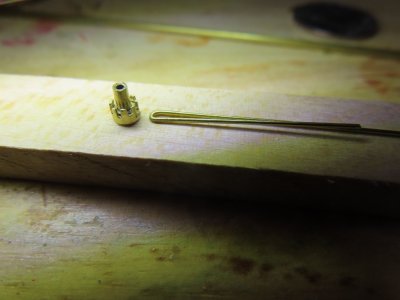
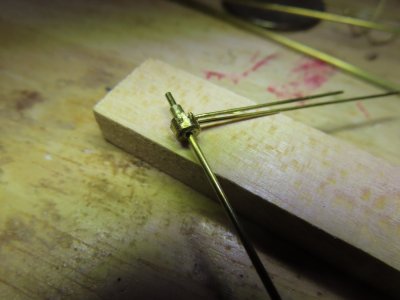
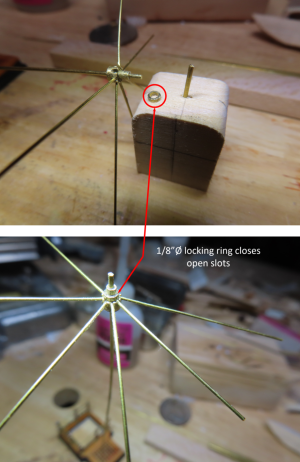
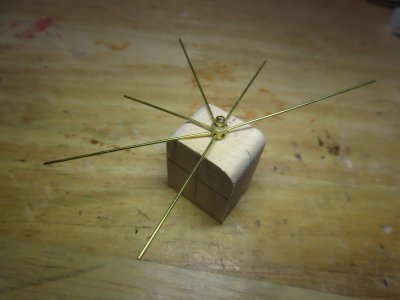
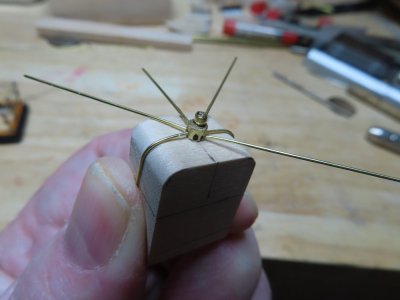
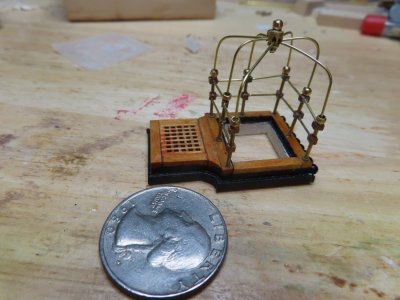
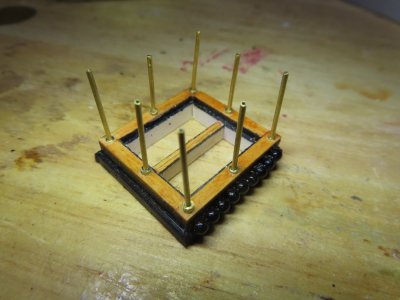
A length of 2 3/8” 0.020” brass rod was cut and bent so that one leg was 1” and the other 1 3/8” for the two supports lengths of the frames. This is a bit more than was needed, but it is easier to cut off excess than extend a short leg. Three pairs or 6 supports were created, however, this canopy required 7 supports. The last support (non-pair) was planned to be added once the canopy was assembled. At that point the seventh support will slide into the remaining opening in the hub and be glued into place. A length of 1/16”Ø brass tube was inserted into the hub assembly as a “working” handle. As each pair of supports was added to the hub, it was secured by CA glue.

IMG_2786.JPG

IMG_2787.JPG

IMG_2788.JPG
 
To complete the mechanical hub structure, a locking ring was cut from the 1/8ӯ tube and fitted over the slots converting the slots into holes and locking the supports to the hub.

Canopy Hub Locking Ring.png
 
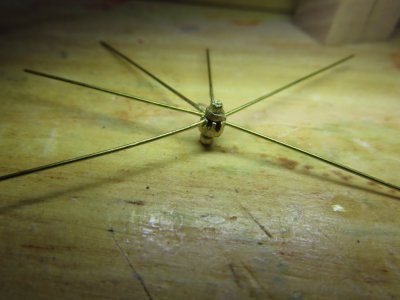
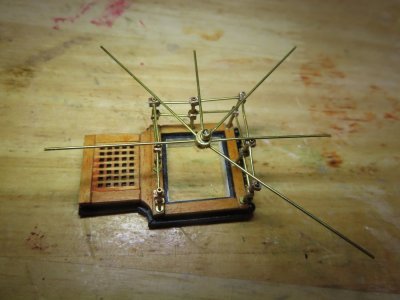
The assembly was cut off from the working “handle,” the ornamental top was trimmed, and the ornamental brass bead was glued to the bottom stem. The second photo shows assembly lying on the hatchway.

IMG_2793.JPG

IMG_2794.JPG
 
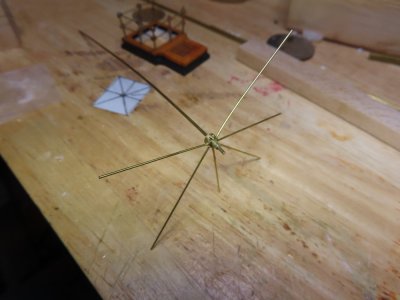
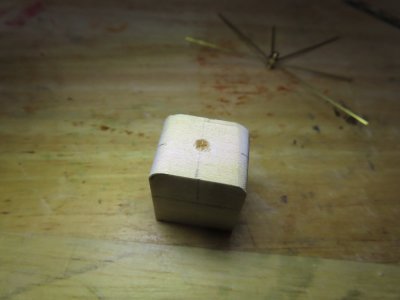
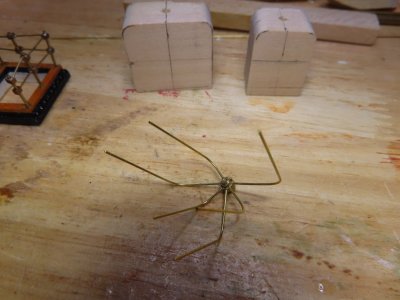
A 3/32” hole was drill into each of the two bending jigs to position the canopy hub. The canopy supports were easily bent which created a brass “spider.” Note, the 7th support remains to be fabricated.

IMG_2796.JPG

IMG_2795.JPG

IMG_2798.JPG

IMG_2799.JPG
 
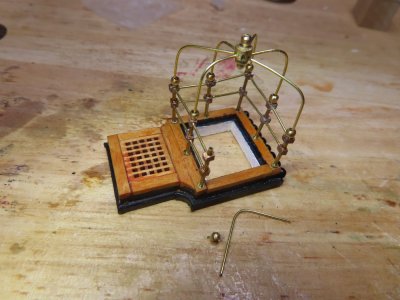
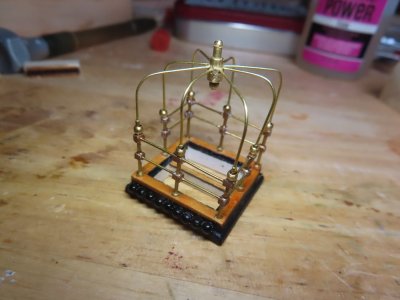
Attaching the “spider” to the stanchions went smoother than I had expected. The legs of the “spider” were trimmed and be approximately even with each other. Then a brass bead was added to each support and inserted into a stanchion, moving around the hatchway one by one in turn. The last support (unpaired) was cut to size from the “0.020” brass rod and added to complete the canopy. It’s not perfect, a little out of scale, and maybe a tad crooked, but it’s done. This one assembly took almost two months to complete. Now that I know what to do, hopefully the remaining four frames will go a little easier and quicker…maybe.

IMG_2800.JPG

IMG_2801.JPG
 
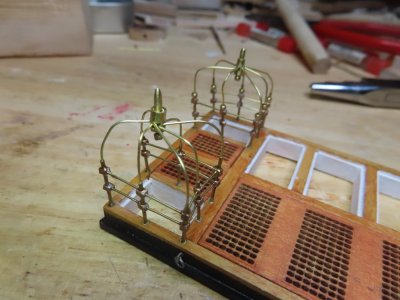
The second canopy frame is completed in one month, half the time it took me for the first one. This is one of the pairs of hatchways at the ship’s wheel. The other one is closed and therefore has no frame. The last two are on the main hatchway. They are a bit smaller and have only seven stanchions each.

IMG_2802.JPG

IMG_2803.JPG
 
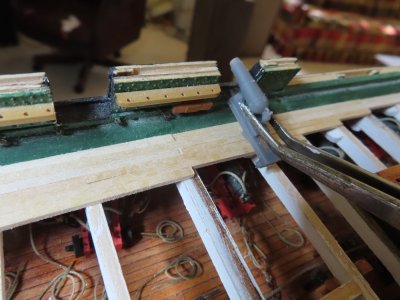
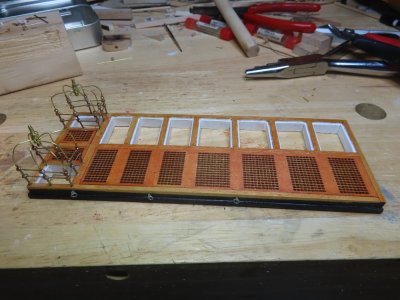
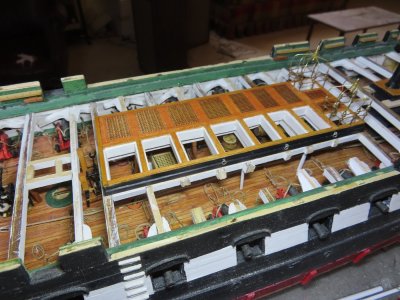
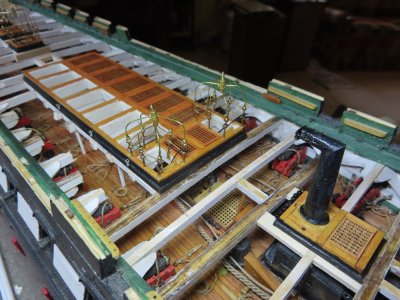
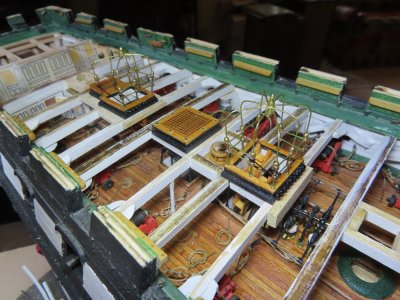
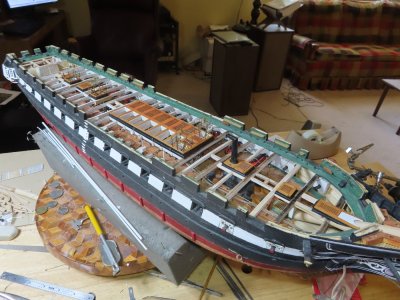
Finally, all the canopy frames (that I’m going to make) are completed. It only took me about four and a half months from figuring out how to fabricate these structures to actually creating them. They are done, not perfect, but done. The camera reveals all kinds of flaws, but after the rest of the model is done (in the near decade), those imperfections will blend in with everything else and most won’t notice them. The frameworks are only dry fit to the deck. I still need to install the ladders and rope handrails.

IMG_2831.JPG

IMG_2832.JPG

IMG_2834.JPG

IMG_2833.JPG
 
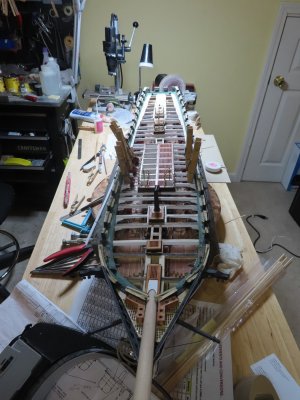
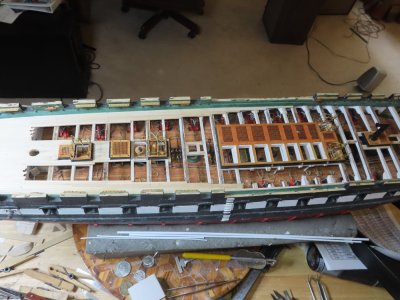
Right now, I'm adding the ladders and their rope railings that go through the hatchways that are covered by the brass frameworks. It turned out to be a little tricker than I thought it would be due to the tight tolerances between the openings and the ladders. Once those are completed, I've got the ship's wheels and binnacles to fabricate and install as well as the brass railing around the skylight. I'm going to try to leave off as much planking as I can so that the gun deck can be visible (more or less). My personal philosophy is to have viewers see more the longer they look. For instance, there is a lot of stuff I fabricated for the gun deck that is not clearly visible at first glance. If the viewers move around and spend a little time studying the model, hopefully they will discover new items they weren't initial aware of. I don't want them to become bored.

Although I am building my model in the style of the 2017 restoration, the carronades will all be 1812 style. Presently, the actual ship has only two (I believe) 1812 style guns. It has been discussed before that the carronades with the wedge (used for adjusting elevation) are incorrect for the 1812 period. These replica non-working guns were installed during the 1927 restoration. I decided to correct that error and to replace all of them with the 1812 versions (screw type adjusting elevation). I will discuss that process in more detail when I get to them.

Companionway Ladder Hand Ropes

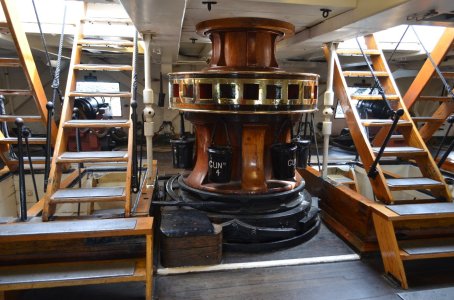
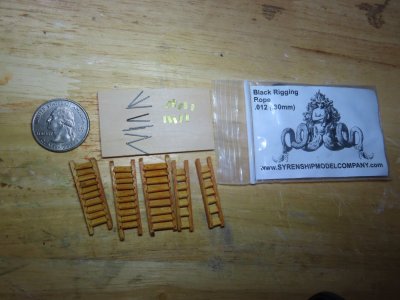
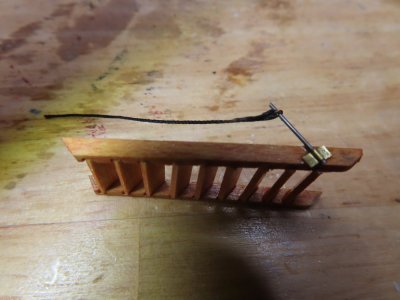
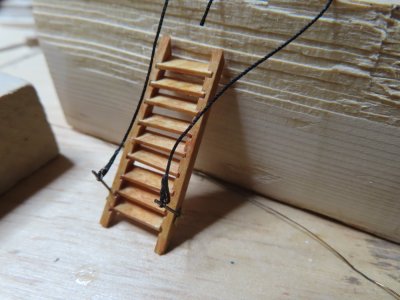
As I mentioned in my last post, I am adding the hand ropes to the companionway ladders going from the spar deck to the gun deck, which were made last year. At the base of the ladders, the stanchions anchor the hand ropes. Trying to maintain close to scale as possible (within reason) with the US Navy plans, I used 0.013” (0.33 mm) music wire cut to 3/8” lengths for the scale stanchions. Additionally, I deduced from the plans that the rope was about 1” diameter or 0.016” scale. Therefore, I used Syren Ship Model Company 0.012” (.30mm) black rope which I had on hand, for the hand rope.

dsc_0079.jpg

IMG_2835.JPG
 
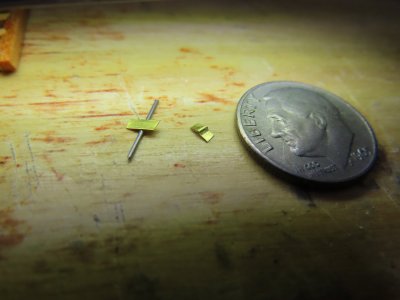
To secure the stanchion to the ladders’ sides, brass brackets were made out of .005” brass sheet cut into a strip and cut to length. These provided sufficient gluing surfaces to secure the stanchions.

IMG_2836.JPG

IMG_2837.JPG

IMG_2842.JPG
 
I ran into a problem with the ladders for the capstan hatchway. I made them snug to the hatchway walls such that I could not slide the ladder down the hatchway because the stanchions made the ladders too wide. Therefore, I modified the stanchion attachment method. I filed a grove in the ladders’ sides for the stanchions to recess into. In theory this should have been simple, but the execution was not. Just the slightest nudge, on the stanchion and it would pop off the ladder. It took numerous attempts, gnashing teeth, time, and vocabulary that would have gotten me divorced if I had ever been married. But eventually, it got done. The upper ends of the hand ropes were tied off on the brass framework.

IMG_2843.JPG

IMG_2844.JPG

IMG_2845.JPG
 
Captain Skylight Railing

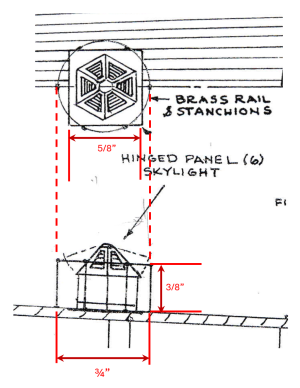
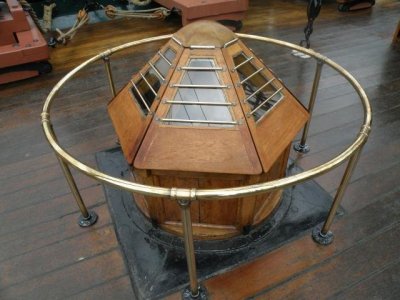
I could not find any US Navy plans for the hand railing surrounding the Captain’s Skylight, so I referred back to the MS kit plans. There, I measured the dimensions as follows: the railing is ¾” in diameter and 3/8” high off the deck (scale). The skylight sits on what the plans identifies as a square metal plate, imbedded flush with the deck. The composition of the plate material is hidden and therefore will not be fabricated but the area will be just painted black to get the flush effect. From the photos, it appears that the plate is coated with some sort of tar material, so I assume this was a form of a waterproofing seal for the skylight. BTW, the US Navy plans for the skylight do not show the plate.

Captain's Skylight Top View.png

Captain's Skylight Plan & Elevation.png

P5250065.jpg
 
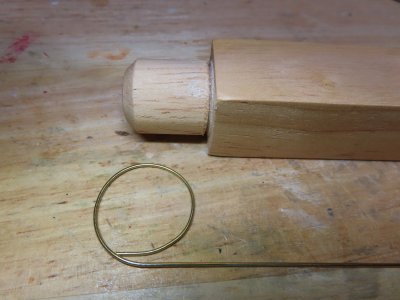
To be consistent with the companion ways, the rail and stanchions were made of 0.032” brass rod with the connecting joints and deck fasteners made from 1/16” brass tube. The brass rod was wrapped around my work bench peg insert which just happened to be ¾” diameter bending it to the initial shape of the circular railing.

IMG_2847.JPG
 
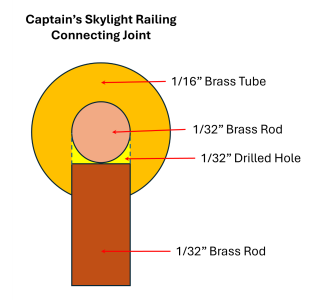
I wanted to create stanchion/connecting joints from brass rods and tubes. This meant confronting my old nemesis, drilling holes in brass. And this was especially difficult as I wanted to do this on a curved surface of a tube. The hard part was biting into the brass with the drill bit, so I skipped that part! Instead, I cut halfway through into the tube with my miter handsaw, just exposing the interior of the tube. Then with a fine drill, that cut was opened into a small round hole, and with a 1/32” drill bit, it was widened to accept the 1/32” rod. The ends were trimmed a bit to shorten and center the drilled hole into the tube (not shown in the picture below). Finally, 1/16” length pieces of the tube were cut off creating the deck fasteners.

Captain’s Skylight Railing Fabrication 2.png
 
Some very impressive and tricky work perhaps some hard wood components of that central hub could make things a bit easier than the styrene?

Rob
 
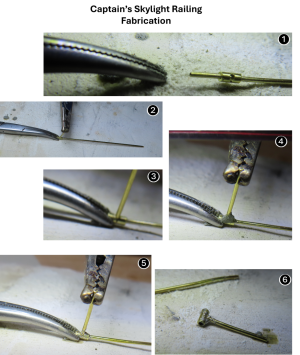
To assemble the parts, I had two choices, glue them or silver solder them. The best way to assemble them with strength was to solder. If I was inept enough in this endeavor, hopefully I could fall back and use either CA glue or epoxy.

Ideally in soldering, you want the joints to be mechanically strong on their own, and the solder just holds the pieces rigid. In this case that wasn’t possible. The solder had to do all the work. Just inserting the rod into the cut hole in the tube wouldn’t work. If the rod was inserted completely, it would prevent the joint from being threaded onto the railing. During the solder process a length of 1/32” rod was inserted into the tube to act as a “stop” for the 1/32” stanchion rod. Hopefully, it wouldn’t be soldered in place as it needed to be removed after the soldering process. As it turned out, of the first five attempts, two got soldered in place and had to be discarded. I found that if I used 1/32” brass rod as the “stop,” it was a 50-50 chance it would get stuck. However, when I switched to music wire for the “stop,” I had no problems.

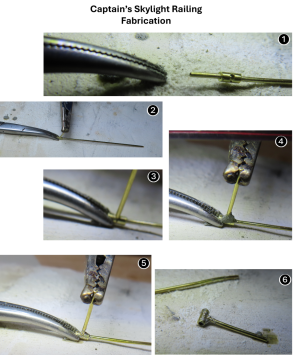
In the photos below:

1 – 1/32” brass rod inserted into tube to act as a “stop” (later music wire)
2 & 3 – Brass stanchion rod held in place for soldering
4 – Silver Solder paste applied to joint
5 – Soldered joint formed after heat with mini torch
6 – 1/32” brass rod “stop” removed. Competed soldered joint before cleaning the component up

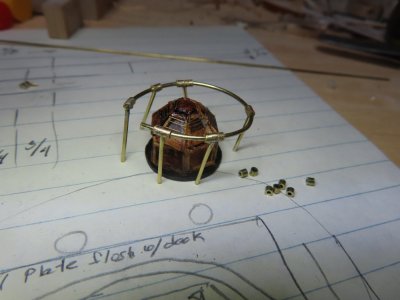
The last photo shows the joints strung onto the circular railing. The deck fasteners, rail closure, and final positioning of the stanchions will have to wait until the deck planking is installed.

Captain’s Skylight Railing Connecting Joint.png

Captain’s Skylight Railing Fabrication 2.png

IMG_2859.JPG
 
Some very impressive and tricky work perhaps some hard wood components of that central hub could make things a bit easier than the styrene?
Rob, I was trying everything. The smaller a piece of wood gets, the weaker it gets, so I used the strongest stuff I had...brass.

Jon
 
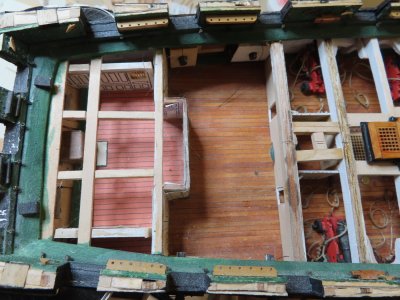
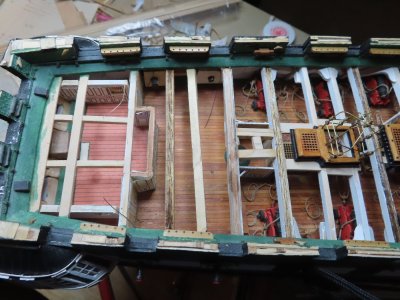
In order to install the captain’s skylight and its railing, requires that I start planking the aft section of the spar deck. It’s been a while since I last planked the gun deck, so I reviewed the practicum on deck planking. It reminded me that I had to stagger the planking joints about ¾” apart in the adjacent rows. And where the two planks butt up against each other requires that there be a support beam below the joint. It was then that I realized I had a big support gap above the dining room area. I originally left this area devoid of beams because it wouldn’t be seen as it was to be completely covered with planking. However, it turns out that I did need them to support the butt joints.

I don’t throw anything away while building a model. I still had the last two remaining support beams I originally cut off the bulkheads way back when. I needed these because they had the deck camber I needed. To use them, the vertical support was cut off and the width adjusted to fit under the spar deck waterway. I just had enough room to maneuver them into position and glued them into place with WellBond.

IMG_2860.JPG

IMG_2861.JPG

IMG_2862.JPG
 
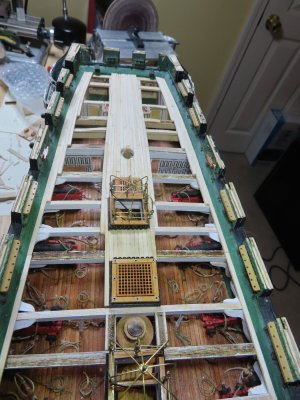
The MS plans show the planks tapering towards the stern on the spar deck, with the planks from 3/32” wide to the transom at 1/16” wide. The model’s far aft area of the stern is to be fully planked. I started the taper of the planks per the practicum, from the most aft hatchway.

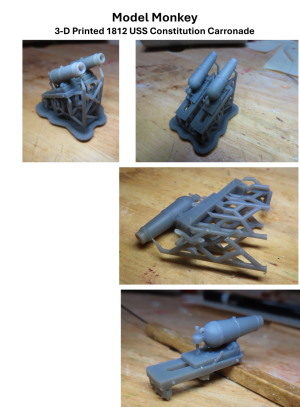
Unlike the gun deck, the spar deck does not have a plywood sub-surface for planks to rest and adhered to. If I had not opted to create the gun deck, it would have. Still, the planking is relatively easy to do although I had to make minor adjustments as the support beams were not always at the proper height as I thought they should be. Also, in order to provide as much viewing space to the gun deck below as possible, I wanted to plank the minimum number of strakes to support the carronades. To determine that, I finally took out one set of 3-D printed 1812 styled USS Constitution carronades I bought from Model Monkey a number of years ago to use as a measuring stick. These are the vertical angle, screw adjustment, type. Just to reiterate, because the 1927 restoration version (with the wedge adjustment) on the actual ship are known to be historically incorrect, all the carronades on my model are to be of the more accurate 1812 style.

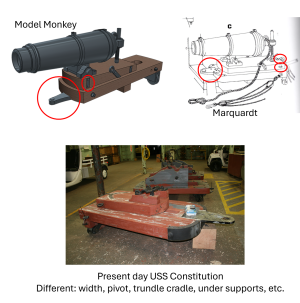
After I removed the excess spruce from the raw 3-D printed carronade, something didn’t look right. Looking at the available US Navy plans for the 1812 carronade and carriage which matched the few 1812 style carronades on the actual ship, there were some glaring differences to the Model Monkey versions. The sled (the part that slides back and forth on the skid) was perfect. The skid, however, was much narrower. Also, the pivot base on the nose of the skid was fastened to the bottom of the skid. According to Karl Heinz Marquardt’s book “The 44-Gun Frigate USS Constitution ‘Old Ironsides,” their diagram matched the Model Monkey’s version with one exception. The pivot plate was fastened to the top of the skid, to rest on the sill of the gun port (which the actual ship’s carronades do). No way was this lower pivot plate going to work on my model. So, there are three separate versions of what is supposed to be the 1812 carronade:
  • 1812 version carronades installed on the actual ship now,
  • Marquardt’s, diagram
  • Model Monkey 3-D printed version
and this doesn’t include the carronades installed during the 1927 restoration. Is everything clear as mud!!?? So, the conclusion is: NOBODY knows for certain what the carronades looked like in 1812! Therefore, as Captain of this mighty ship, I’m going to make the Command Decision to use the carronades I purchased from Model Monkey and modified the pivoting base…unless I change my mind. Now back to planking.
Carronade Differences - 1812.png

Model Monkey Carronades.png

IMG_2875.JPG
 
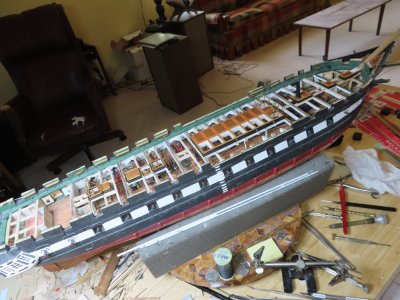
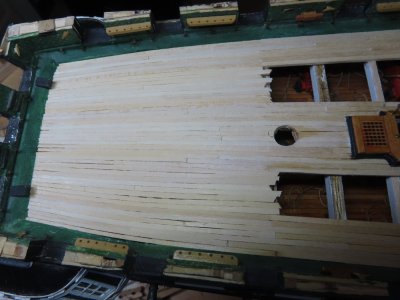
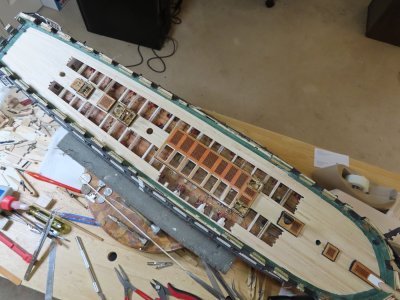
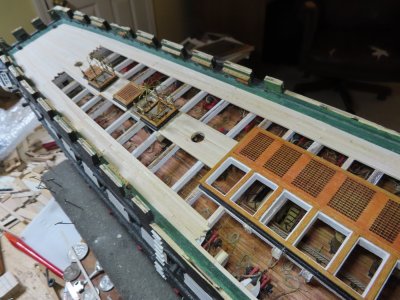
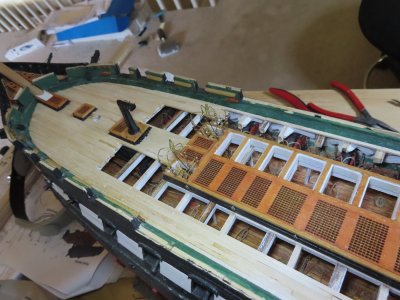
I started planking the center of the spar deck, starting from the capstan opening and working my way back to the stern until it filled in to the width of the hatchways. Then I applied the planks against the waterways, starting from the stern and working forward. The stern was fully planked to just forward of the captain’s dining area, then the plank voids will allow the gun deck to be visible. The forward areas are yet to be planked.
IMG_2870.JPG

IMG_2871.JPG

IMG_2872.JPG

IMG_2873.JPG

IMG_2874.JPG
 
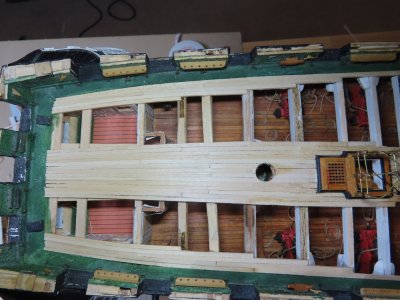
Unlike the stern, the 3/32” x 1/32” planks are not tapered as they approach the bow. The planks remain straight and those bordering the waterways were customed fitted into the curving bow. I planked the bow in the same manner as I did the stern, from the waterways inward and from the center outward. It did not surprise me, as the planking approached each other and as open space narrowed, I had to taper the widths a bit of some of the planks to ensure a proper fit when they merged.

IMG_2879.JPG

IMG_2880.JPG

IMG_2881.JPG
 
Back
Top