• SUBSCRIBE TO SHIPS IN SCALE TODAY!

    The beloved Ships in Scale Magazine is back and charting a new course for 2026!
    Discover new skills, new techniques, and new inspirations in every issue.

    NOTE THAT OUR NEXT ISSUE WILL BE MARCH/APRIL 2026
  • Win a Free Custom Engraved Brass Coin!!!
    As a way to introduce our brass coins to the community, we will raffle off a free coin during the month of August. Follow link ABOVE for instructions for entering.

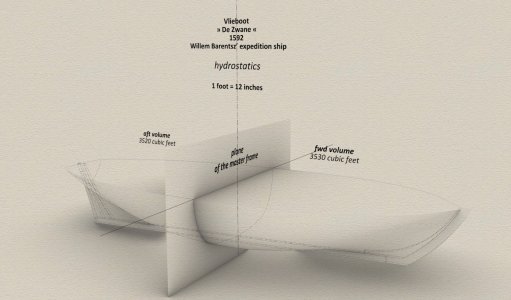
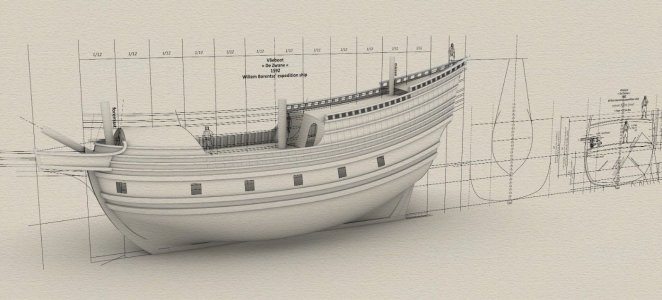
Vlieboot »De Zwane« 1592 — Barents discovers the Arctic

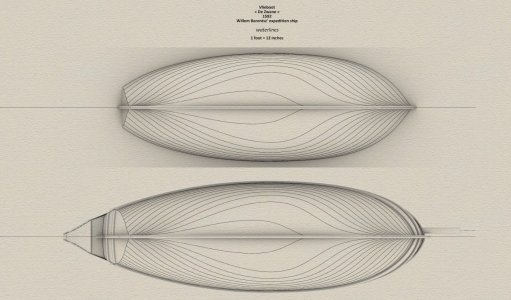
Nevertheless, I decided to make the hull slightly less sharp than in the initial design, and the degree of this sharpness was retained only to the extent necessary for the ship to move independently and in a controlled manner under its sails without excessive leeward drift, and without the need for constant use of the on-board diesel engine or towing with carefully furled sails in any weather other than ideal, as is necessary in the case of some modern replicas of historic ships.
ROTF ROTF ROTF

Aquila muscas non capit!
 
.​

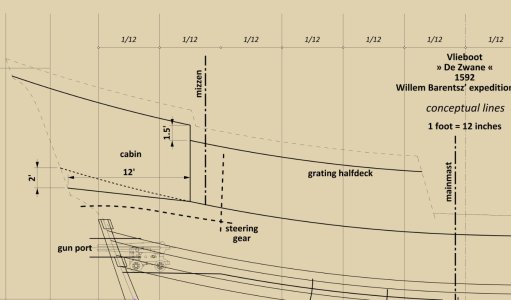
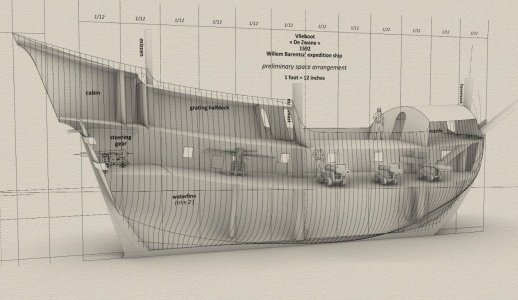
Thank you, Heinrich, for your comment. Another suggestion for how to interpret the cabin dimensions taken from the contract, and the general arrangement in this area, may be as depicted below, and I think I’ll stick with that. We’ll see… That said, fortunately, it happens that this particular detail can easily be tailored individually without compromising the reconstruction as a whole.

011.jpg
.​
 
Waldemar, I concur 100%. That is also how I would interpret it. The mizzen and helmsman position which are switched around, has two advantages the way I see it.

1. The mizzen can be moved slightly further aft which has a positive influence on the sailing characteristics of the ship, and
2. The helmsman's view is unobstructed by the mizzen.
 
.​

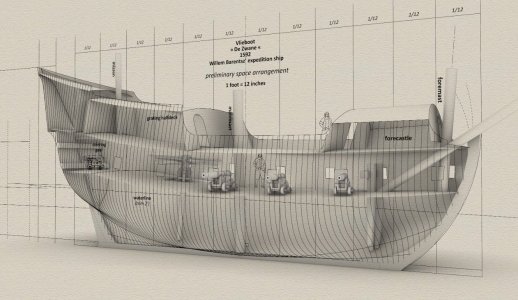
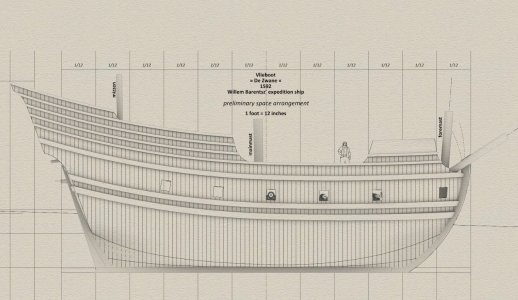
As I'm moving forward, however, I am constantly making some minor adjustments to elements that have already been defined and shown previously, or at least still considering slightly different variations or combinations.


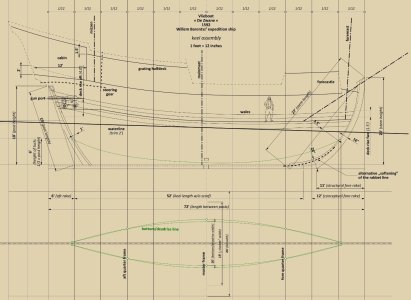
012.jpg


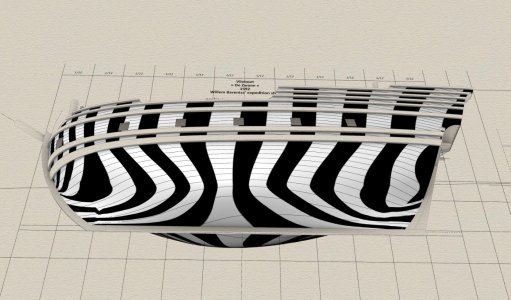
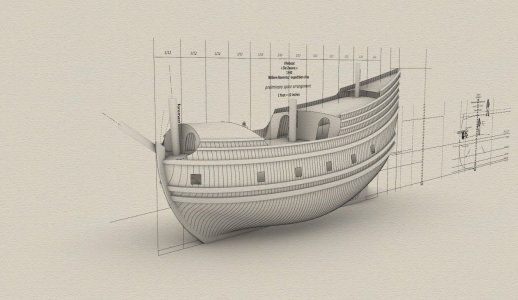
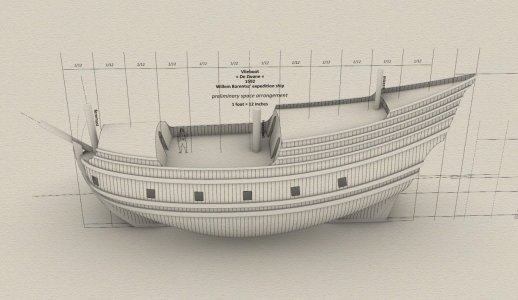
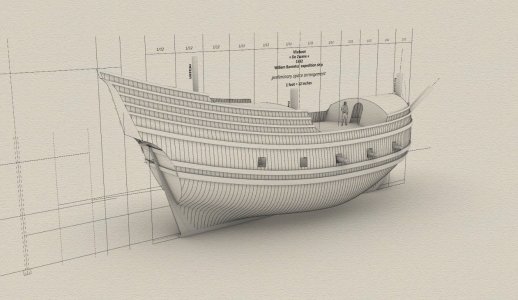
The above applies to details such as, for example, the width of the bottom line (which may be finally increased from 10 to 11 feet; both shown in the diagram as a ‘double’ green line on the top view), and such an adjustment would make the hull slightly fuller in the midship region, or more precisely between the quarter frames, whilst, conversely, gently sharpening the lines at both its extremities.

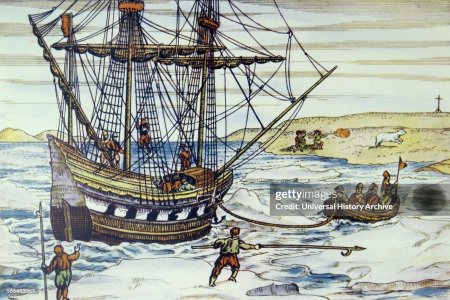
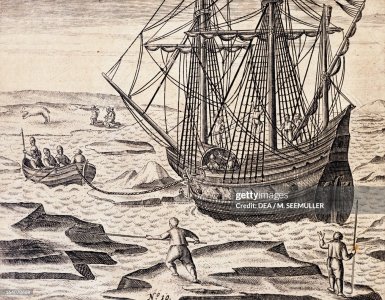
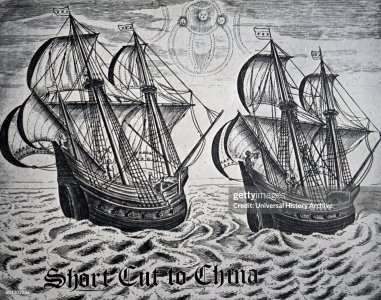
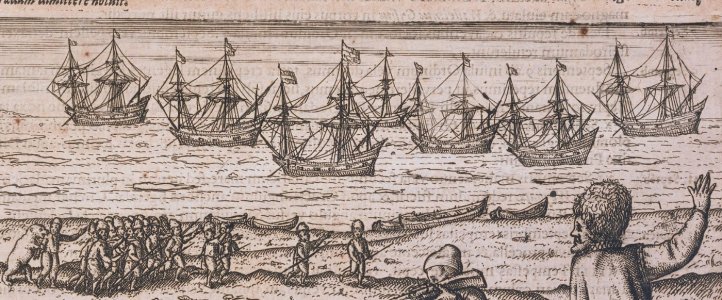
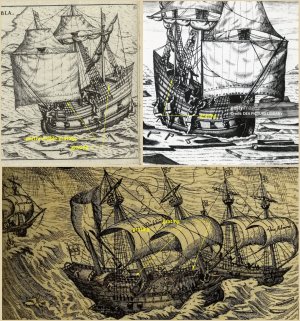
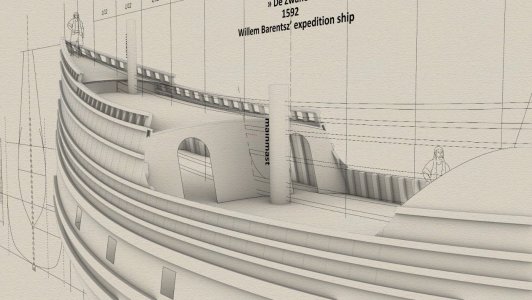
In order to lower the hull’s above-water profile, I am also adjusting the deck heights as well, as this specific information is not included in the contracts. In particular, the forecastle deck has been significantly lowered to a level well below human height, which in this specific part of the hull is highly beneficial from the perspective of the ship’s sailing characteristics, and this distinctly lower forecastle height relative to the half-deck can be observed, if not in all, then at least in many depictions of ships from Barentsz’ expedition, as well as in others from that period. This reduced (on the hull's side) height of the forecastle deck is intended, as it were, to be compensated for by the greater-than-standard camber of the deck beams, in turn producing the desired visual effect — which also appears consistent with the iconography — in the form of a pleasing, rather striking arch of the aft bulkhead of the forecastle, as shown in the reproductions below.


001.jpg

014.jpg

011a.jpg


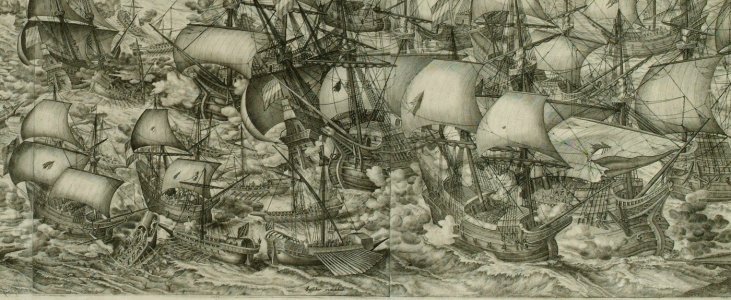
The deck itself should probably be of a grating construction, as is quite consistently rendered in the 1603 engraving depicting ships at the Battle of Bantam in 1601 (incidentally, a battle of profound strategic and economic consequences), and in other contemporary depictions as well; however, this is no longer strictly a conceptual matter, but rather a structural one, albeit more or less linked to the former.


Bantam 1601 - 1603.jpg


At this stage, that is, after determining the height of the decks, the initial height of the stem could now be adjusted too to the correct level, and the current interpretative variant is also shown in the attached diagram.

The angles of the masts have been provisionally adopted, although it must be said that for this early period, one is practically reduced to following the iconography more or less closely, and in this case, in particular, the woodcuts from Barentsz’s expedition.

.​
 
Hi Waldemar. Your work rate never ceases to amaze me; each day I am alerted to an update - it's far better than Christmas.

Seriously though, the line rendering in profile is looking more and more "integrated "(for lack of a better word), with each refinement you introduce. Just by introducing the wales, the hull has immediately assumed a more defined shape which makes a marked difference. Lowering the forecastle's height and thereby lowering the center of gravity of the ship, is a functional aspect of the design of which I know too little to make any meaningful contribution. On the renderings that I have at my disposal, I have measured the above upper-deck height of the forecastle and compared that to the height of the half deck. In most instances these two measurements were approximately the same.

As far as lowering the height of the deck at the forecastle to below human height goes, that is all in line with other interpretations as well.
"Given the size of the ship, it seems unlikely that this deck had standing height for an average person. Comfort will not have been the main motive of the builders here. More important was to keep the center of gravity of the tall ship as low as possible while at the same time providing the cannons with a covered space."

You mention that the upper deck should probably be of a grated construction, as depicted at the Battle of Bantam in 1601. This is a very interesting point and points to the dual role of the vlieboot - that of a fast merchantman or vlieboot-oorlogsjacht as deployed by the Watergeuzen (Sea Beggars) against the Spanish invaders. Whist there is nothing that I would have loved more than to have De Zwane equipped with a grated deck, I think it is highly unlikely (as in no way) that they would have undertaken a polar expedition with such a configuration. You will recall that De Zwane had new decks fitted as part of its refurbishing in anticipation of the 1594 and 1595 expeditions. It is not unlikely that during this period, the grated decks were replaced by solidly planked ones culminating in a closed construction. By the same token, I have now also realised the folly of my ways (after following the so-called authorities) of equipping my WB's forecastles with a bovennet. It just makes no sense - on De Zwane I vote for a fully closed forecastle with walls and doors!

As to the final width of the bottom line (10 feet or 11 feet, I bow to your superior knowledge. You will know best.

Kindest greetings
H
 
.​

Thank you very much, Heinrich. Well, I have no choice but to engage, but surely that’s actually beneficial for the further proceedings. :)

Just by introducing the wales, the hull has immediately assumed a more defined shape which makes a marked difference.

It could be said that, as a general rule, this was still a period when the design lines, deck lines and run of the wales ran parallel to one another, which, fortunately, makes it somewhat easier to reconstruct ships from this early period :).


"Given the size of the ship, it seems unlikely that this deck had standing height for an average person. Comfort will not have been the main motive of the builders here. More important was to keep the center of gravity of the tall ship as low as possible while at the same time providing the cannons with a covered space."

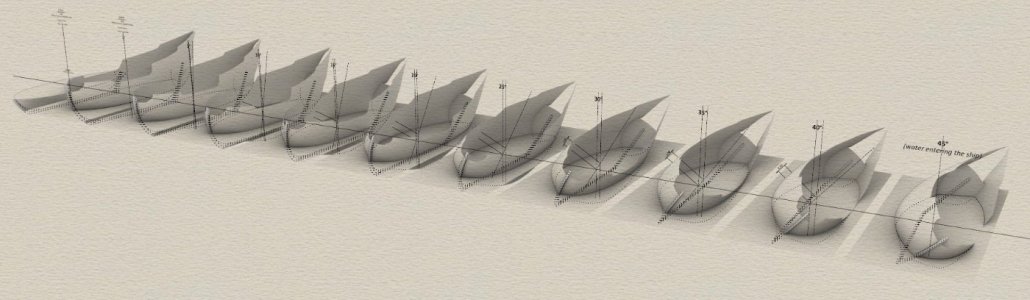
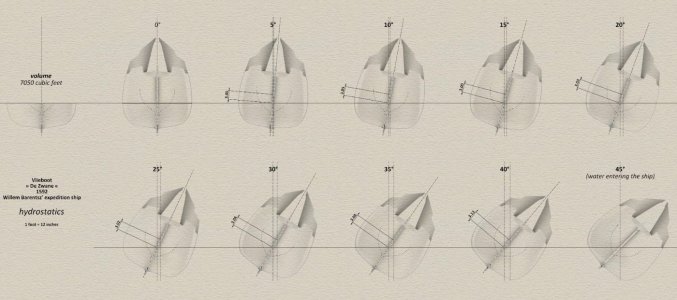
Indeed, the end result is the same, but my motivation in the specific case of the forecastle deck was quite different from the reasoning cited above. In this design, transverse stability does not appear to be compromised (though this can still be verified by calculations, yet at the very end of the process), and the guns were not housed inside the forecastle. In fact, all the guns, perhaps with the exception of the two lightest chambered (hailshot) guns, were placed one level lower, that is, on the main deck.

My concern is rather the effect of the wind. In short, whilst a high stern might even have been considered advantageous and desirable because it ‘automatically’ oriented the ship’s bow in the wind’s direction even without sails, an excessively high forecastle would have negated this effect. And in certain circumstances, particularly emergencies, this ability to orient the ship with its bow into the wind could even save it from disaster (during a hurricane, a ship positioned with its side to the wind and waves is a doomed ship).


On the renderings that I have at my disposal, I have measured the above upper-deck height of the forecastle and compared that to the height of the half deck. In most instances these two measurements were approximately the same.

Here is a fairly good example, among some others, where one can see the difference in height between the forecastle and the height of the hull's side for the half-deck that I am referring to. I intend to recreate that feature in this reconstruction.

014.jpg


I think it is highly unlikely (as in no way) that they would have undertaken a polar expedition with such a configuration. You will recall that De Zwane had new decks fitted as part of its refurbishing in anticipation of the 1594 and 1595 expeditions. It is not unlikely that during this period, the grated decks were replaced by solidly planked ones culminating in a closed construction. By the same token, I have now also realised the folly of my ways (after following the so-called authorities) of equipping my WB's forecastles with a bovennet. It just makes no sense - on De Zwane I vote for a fully closed forecastle with walls and doors!

You may be right that for the Arctic expedition, the decks, which might have been ‘typically’ constructed as grating decks, were replaced with decks of solid planks. Except that exactly the same problem would also apply to a grating half-deck, and this is where things get complicated, because in at least three depictions of ships from the expedition, the half-deck has a grating construction (partly or entirely), and two of these depictions even seem to show a (partially) grating deck on the forecastle.

Nevertheless, at this stage of the project, attempting to resolve this specific issue may be getting ahead of ourselves; besides, fortunately, it can always be easily modified according to individual preferences with virtually no disruption to the overall design. Right now, for example, the height of the decks is more important, as it affects the reconstruction as a whole.

And of course, the forecastle will have both its bulkheads in this reconstruction.

013.jpg

* * *​

It may also be added that it is not entirely clear whether, and which, of the depictions of ships from Barents’s expedition are reliable, but certain features of the reconstruction must necessarily be based on them, as there are simply no other options...

.​
 
Back
Top