.
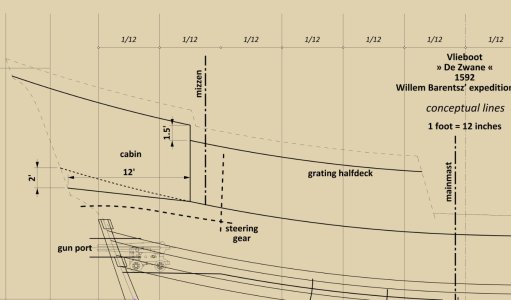
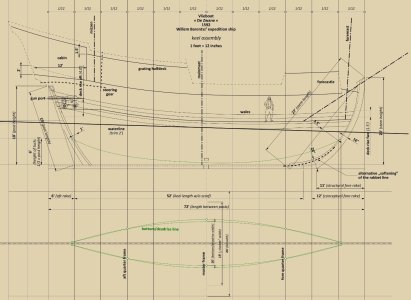
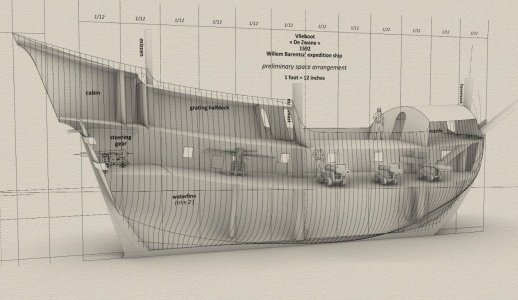
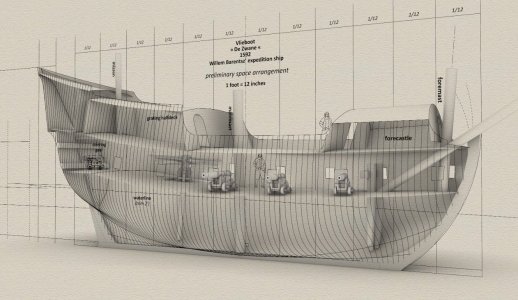
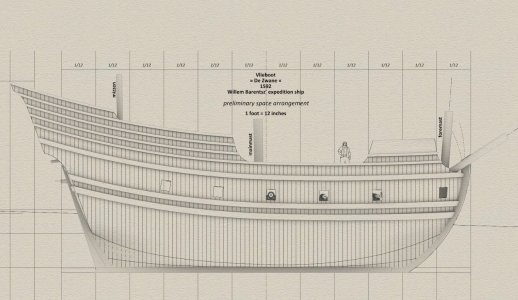
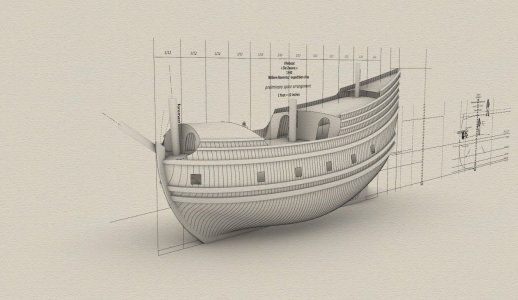
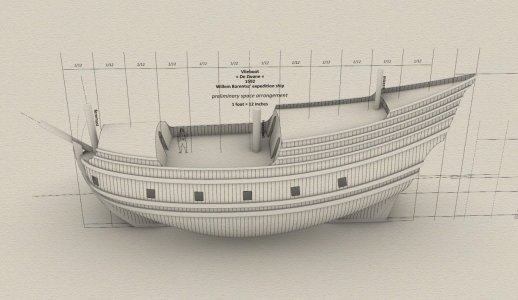
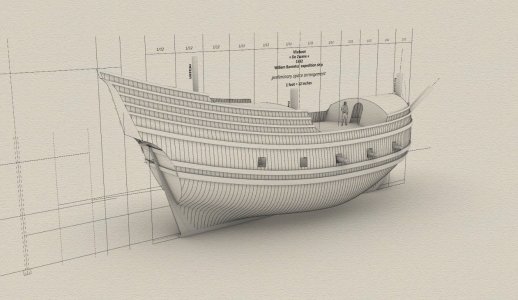
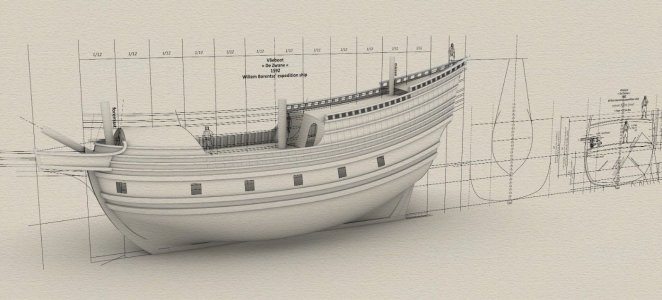
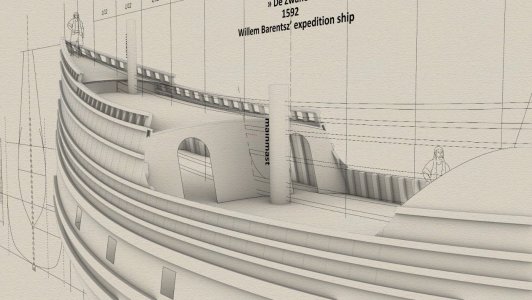
At this stage of the reconstruction, now that the hull shapes are complete, it is both possible and desirable to carry out a few basic tests, even if some of them only with a ‘rough’ level of accuracy.
* * *
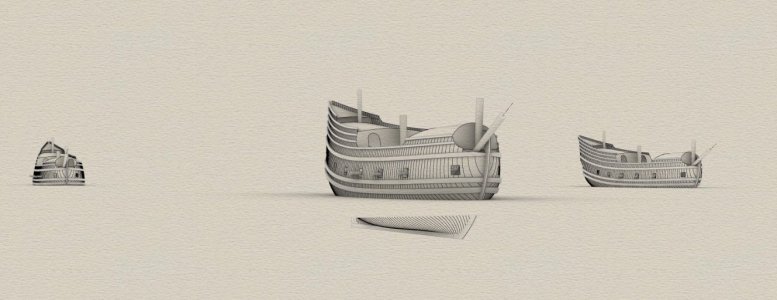
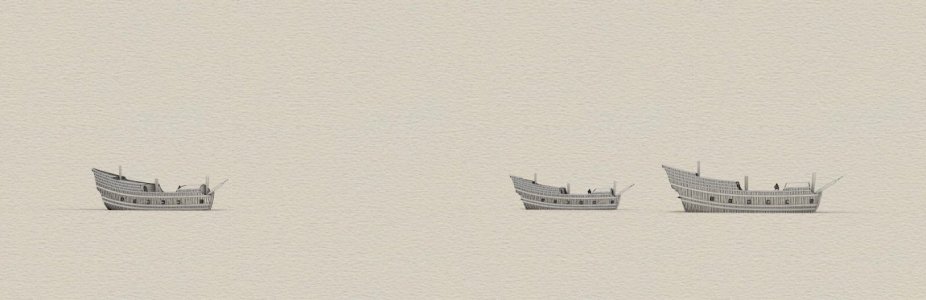
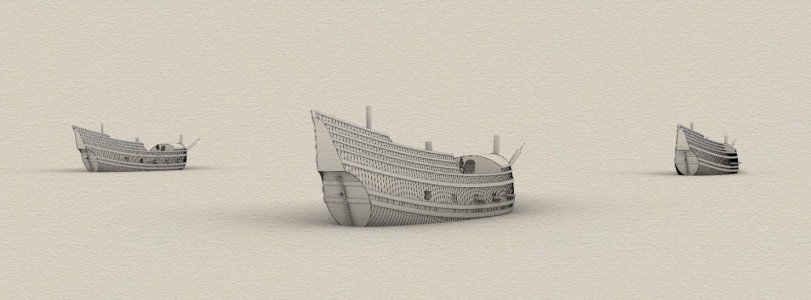
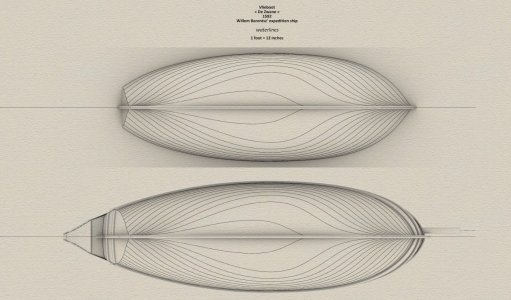
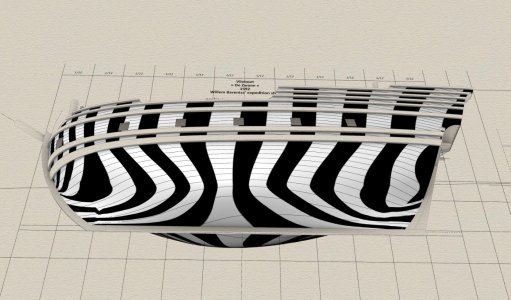
Firstly, this could be a visual verification of the lines’ fairness using the generated waterlines or by applying the even more rigorous, unforgiving so-called Zebra test. In the latter, shapes that are correct in terms of smoothness are indicated by a continuous and smooth flow of the test stripes, as can be seen in the graphic below. In this case, the visible lack of continuity in the test stripes near the stern is naturally a result of the sharp break in the surface in the immediate vicinity of the tuck, as the fashion piece joins the stern post in a sharp manner rather than with a gentle curve.
Waterlines test:
Zebra test:
* * *
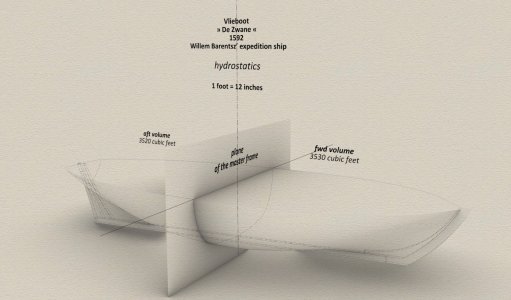
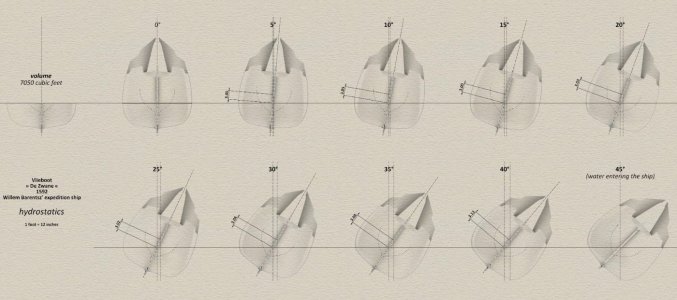
In addition, I have also carried out a rough (as this is, in fact, the only feasible approach) verification of the load capacity of the vlieboot
De Zwane as reconstructed, which, according to source data, provided by Menno Leenstra, was 44 last (sometimes given as 40 last).
And so, the volume of the submerged part of the hull for the reconstructed shape of the vlieboot (or more precisely — the volume below the design waterline previously determined, including the keel and both posts) is 7,050 cubic feet, which in metric units amounts to approximately 193 tonnes. Allocating half of this value to the weight of the ship itself, including all its equipment (on this assumption, see in particular G. Fournier,
Hydrographie, 1643, pp. 601–614), and assuming, very roughly, that 1 last of cargo equals 2 metric tonnes, yields a result of approximately 48 lasts, which may be considered quite close to the value given in the source records.
Incidentally, it is also worth noting that, in those days, the ship’s carrying capacity stated in documents was often — if not almost always — not based on precise calculations at all, but was the result of estimates based on the vessel’s overall size.
* * *
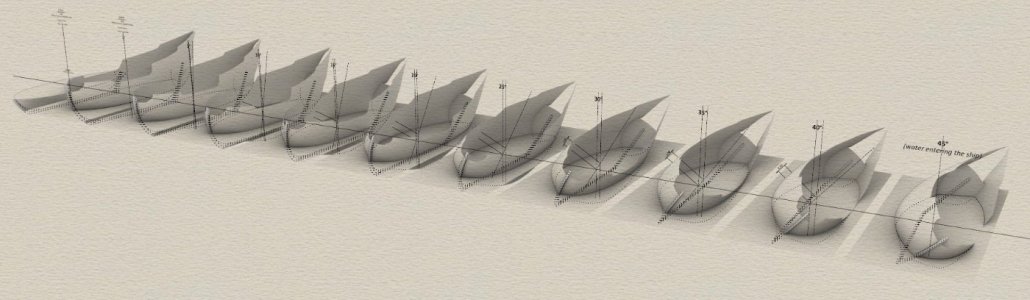
The height of the metacentric point above the design waterline was determined as well, which for this vessel’s shape and dimensions is 3 feet, i.e. a few inches below the lower edge of gun ports. This means, firstly, that the ship will remain right-side-up and will not capsize as long as the centre of gravity remains below this point, or does not shift as a result of heeling.
Secondly, given the cargo-carrying nature of the vessel with its effectively low centre of gravity, it can be estimated that
De Zwane, as reconstructed, was a vessel that was fairly rigid transversely (with stores that were still full), i.e. not prone to heeling, while sporting short, rather violent rolling of small amplitude, which could be unpleasant for crew members unaccustomed to it, and at the same time more demanding in terms of the ship’s structural strength compared to cases involving gentle, deeper rolling. However, during the voyage, as supplies were used up, these characteristics could change — and indeed had to change.
* * *
Overall, I consider the results obtained to be good, and even excellent in every respect (compliance with the construction contract, the specific characteristics of the shapes resulting from the design method of the time, shape fairness, hydrostatic properties), although this set could still be supplemented by hydrodynamic tests, but these would necessarily have to be carried out in a test tank, so I am cleverly obliging Heinrich to carry them out once the model has been built. After all, he will have as many as two oceans at his disposal, and even including the Antarctic zone, i.e. conditions that quite realistically simulate the northern polar waters

.
.