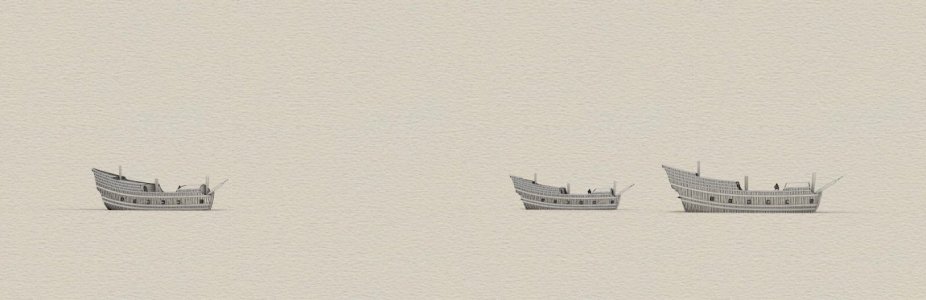
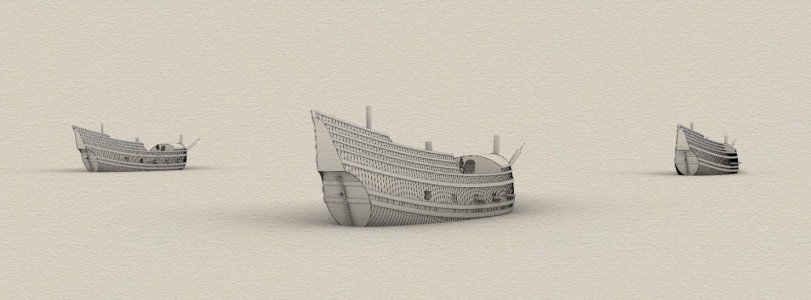
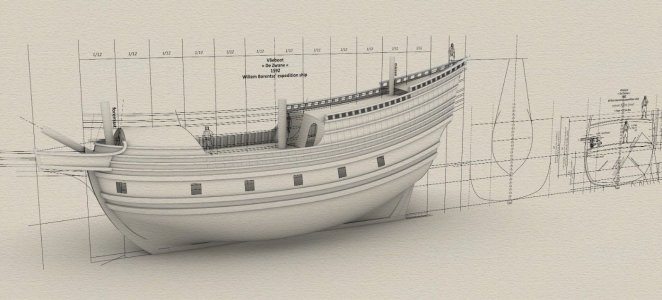
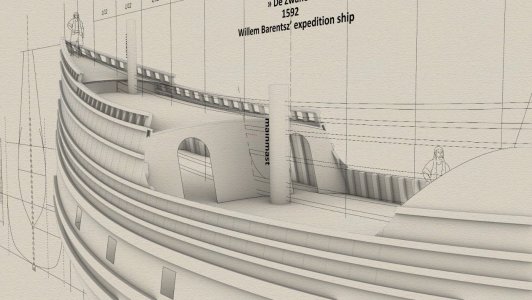
Vlieboot »De Zwane« 1592 — Barents discovers the Arctic

Nevertheless, I decided to make the hull slightly less sharp than in the initial design, and the degree of this sharpness was retained only to the extent necessary for the ship to move independently and in a controlled manner under its sails without excessive leeward drift, and without the need for constant use of the on-board diesel engine or towing with carefully furled sails in any weather other than ideal, as is necessary in the case of some modern replicas of historic ships.
ROTF ROTF ROTF

Aquila muscas non capit!
 
.​

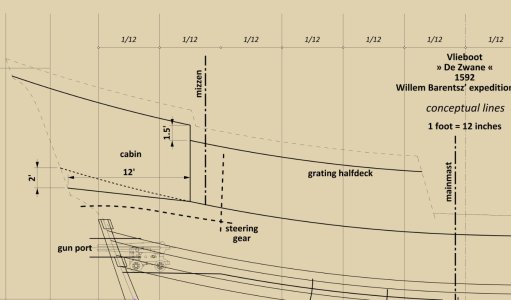
Thank you, Heinrich, for your comment. Another suggestion for how to interpret the cabin dimensions taken from the contract, and the general arrangement in this area, may be as depicted below, and I think I’ll stick with that. We’ll see… That said, fortunately, it happens that this particular detail can easily be tailored individually without compromising the reconstruction as a whole.

011.jpg
.​
 
Waldemar, I concur 100%. That is also how I would interpret it. The mizzen and helmsman position which are switched around, has two advantages the way I see it.

1. The mizzen can be moved slightly further aft which has a positive influence on the sailing characteristics of the ship, and
2. The helmsman's view is unobstructed by the mizzen.
 
.​

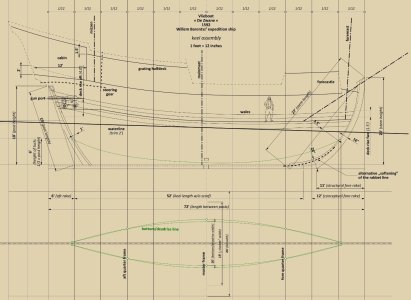
As I'm moving forward, however, I am constantly making some minor adjustments to elements that have already been defined and shown previously, or at least still considering slightly different variations or combinations.


012.jpg


The above applies to details such as, for example, the width of the bottom line (which may be finally increased from 10 to 11 feet; both shown in the diagram as a ‘double’ green line on the top view), and such an adjustment would make the hull slightly fuller in the midship region, or more precisely between the quarter frames, whilst, conversely, gently sharpening the lines at both its extremities.

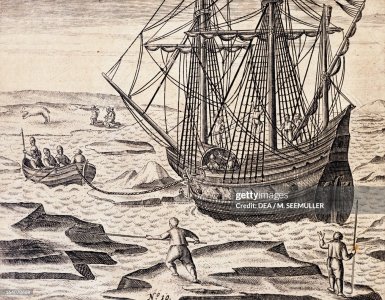
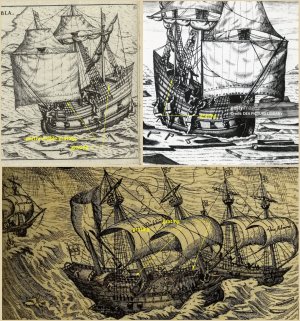
In order to lower the hull’s above-water profile, I am also adjusting the deck heights as well, as this specific information is not included in the contracts. In particular, the forecastle deck has been significantly lowered to a level well below human height, which in this specific part of the hull is highly beneficial from the perspective of the ship’s sailing characteristics, and this distinctly lower forecastle height relative to the half-deck can be observed, if not in all, then at least in many depictions of ships from Barentsz’ expedition, as well as in others from that period. This reduced (on the hull's side) height of the forecastle deck is intended, as it were, to be compensated for by the greater-than-standard camber of the deck beams, in turn producing the desired visual effect — which also appears consistent with the iconography — in the form of a pleasing, rather striking arch of the aft bulkhead of the forecastle, as shown in the reproductions below.


001.jpg

014.jpg

011a.jpg


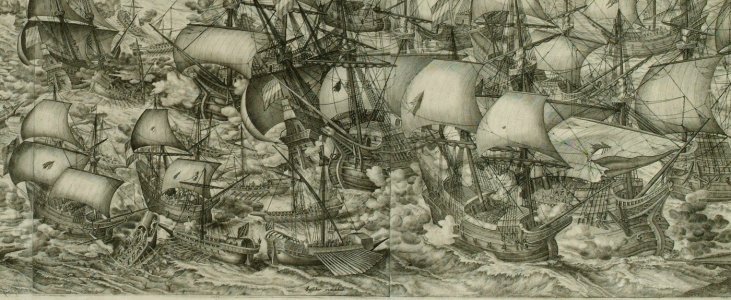
The deck itself should probably be of a grating construction, as is quite consistently rendered in the 1603 engraving depicting ships at the Battle of Bantam in 1601 (incidentally, a battle of profound strategic and economic consequences), and in other contemporary depictions as well; however, this is no longer strictly a conceptual matter, but rather a structural one, albeit more or less linked to the former.


Bantam 1601 - 1603.jpg


At this stage, that is, after determining the height of the decks, the initial height of the stem could now be adjusted too to the correct level, and the current interpretative variant is also shown in the attached diagram.

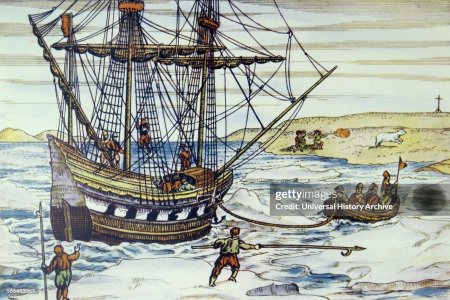
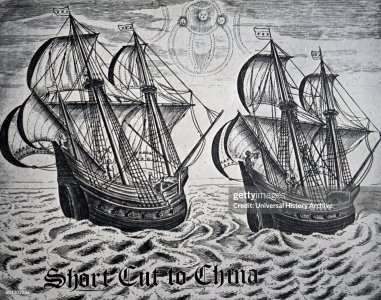
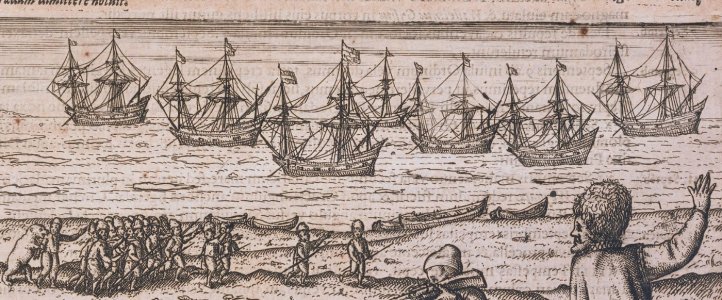
The angles of the masts have been provisionally adopted, although it must be said that for this early period, one is practically reduced to following the iconography more or less closely, and in this case, in particular, the woodcuts from Barentsz’s expedition.

.​
 
Hi Waldemar. Your work rate never ceases to amaze me; each day I am alerted to an update - it's far better than Christmas.

Seriously though, the line rendering in profile is looking more and more "integrated "(for lack of a better word), with each refinement you introduce. Just by introducing the wales, the hull has immediately assumed a more defined shape which makes a marked difference. Lowering the forecastle's height and thereby lowering the center of gravity of the ship, is a functional aspect of the design of which I know too little to make any meaningful contribution. On the renderings that I have at my disposal, I have measured the above upper-deck height of the forecastle and compared that to the height of the half deck. In most instances these two measurements were approximately the same.

As far as lowering the height of the deck at the forecastle to below human height goes, that is all in line with other interpretations as well.
"Given the size of the ship, it seems unlikely that this deck had standing height for an average person. Comfort will not have been the main motive of the builders here. More important was to keep the center of gravity of the tall ship as low as possible while at the same time providing the cannons with a covered space."

You mention that the upper deck should probably be of a grated construction, as depicted at the Battle of Bantam in 1601. This is a very interesting point and points to the dual role of the vlieboot - that of a fast merchantman or vlieboot-oorlogsjacht as deployed by the Watergeuzen (Sea Beggars) against the Spanish invaders. Whist there is nothing that I would have loved more than to have De Zwane equipped with a grated deck, I think it is highly unlikely (as in no way) that they would have undertaken a polar expedition with such a configuration. You will recall that De Zwane had new decks fitted as part of its refurbishing in anticipation of the 1594 and 1595 expeditions. It is not unlikely that during this period, the grated decks were replaced by solidly planked ones culminating in a closed construction. By the same token, I have now also realised the folly of my ways (after following the so-called authorities) of equipping my WB's forecastles with a bovennet. It just makes no sense - on De Zwane I vote for a fully closed forecastle with walls and doors!

As to the final width of the bottom line (10 feet or 11 feet, I bow to your superior knowledge. You will know best.

Kindest greetings
H
 
.​

Thank you very much, Heinrich. Well, I have no choice but to engage, but surely that’s actually beneficial for the further proceedings. :)

Just by introducing the wales, the hull has immediately assumed a more defined shape which makes a marked difference.

It could be said that, as a general rule, this was still a period when the design lines, deck lines and run of the wales ran parallel to one another, which, fortunately, makes it somewhat easier to reconstruct ships from this early period :).


"Given the size of the ship, it seems unlikely that this deck had standing height for an average person. Comfort will not have been the main motive of the builders here. More important was to keep the center of gravity of the tall ship as low as possible while at the same time providing the cannons with a covered space."

Indeed, the end result is the same, but my motivation in the specific case of the forecastle deck was quite different from the reasoning cited above. In this design, transverse stability does not appear to be compromised (though this can still be verified by calculations, yet at the very end of the process), and the guns were not housed inside the forecastle. In fact, all the guns, perhaps with the exception of the two lightest chambered (hailshot) guns, were placed one level lower, that is, on the main deck.

My concern is rather the effect of the wind. In short, whilst a high stern might even have been considered advantageous and desirable because it ‘automatically’ oriented the ship’s bow in the wind’s direction even without sails, an excessively high forecastle would have negated this effect. And in certain circumstances, particularly emergencies, this ability to orient the ship with its bow into the wind could even save it from disaster (during a hurricane, a ship oriented with its side to the wind and waves is a doomed ship).


On the renderings that I have at my disposal, I have measured the above upper-deck height of the forecastle and compared that to the height of the half deck. In most instances these two measurements were approximately the same.

Here is a fairly good example, among some others, where one can see the difference in height between the forecastle and the height of the hull's side for the half-deck that I am referring to. I intend to recreate that feature in this reconstruction.

014.jpg


I think it is highly unlikely (as in no way) that they would have undertaken a polar expedition with such a configuration. You will recall that De Zwane had new decks fitted as part of its refurbishing in anticipation of the 1594 and 1595 expeditions. It is not unlikely that during this period, the grated decks were replaced by solidly planked ones culminating in a closed construction. By the same token, I have now also realised the folly of my ways (after following the so-called authorities) of equipping my WB's forecastles with a bovennet. It just makes no sense - on De Zwane I vote for a fully closed forecastle with walls and doors!

You may be right that for the Arctic expedition, the decks, which might have been ‘typically’ constructed as grating decks, were replaced with decks of solid planks. Except that exactly the same problem would also apply to a grating half-deck, and this is where things get complicated, because in at least three depictions of ships from the expedition, the half-deck has a grating construction (partly or entirely), and two of these depictions even seem to show a (partially) grating deck on the forecastle.

Nevertheless, at this stage of the project, attempting to resolve this specific issue may be getting ahead of ourselves; besides, fortunately, it can always be easily modified according to individual preferences with virtually no disruption to the overall design. Right now, for example, the height of the decks is more important, as it affects the reconstruction as a whole.

And of course, the forecastle will have both its bulkheads in this reconstruction.

013.jpg

* * *​

It may also be added that it is not entirely clear whether, and which, of the depictions of ships from Barents’s expedition are reliable, but certain features of the reconstruction must necessarily be based on them, as there are simply no other options...

.​
 
.​

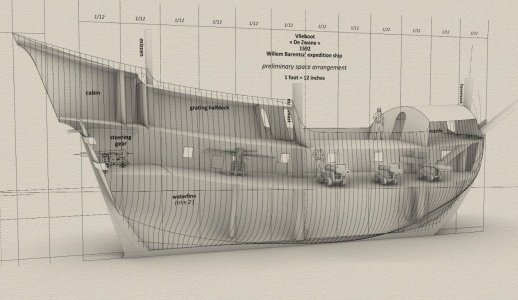
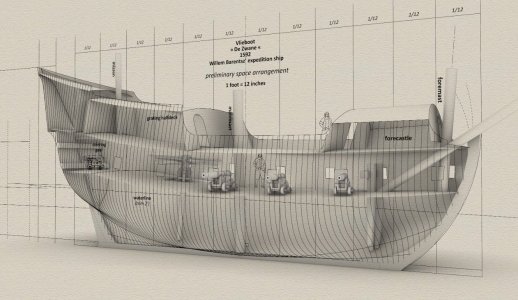
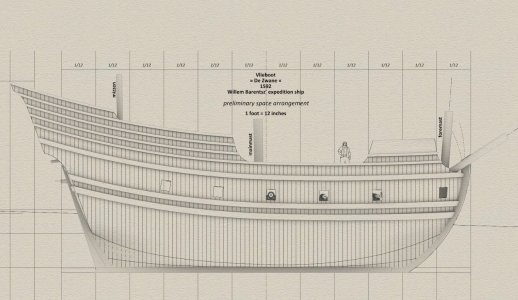
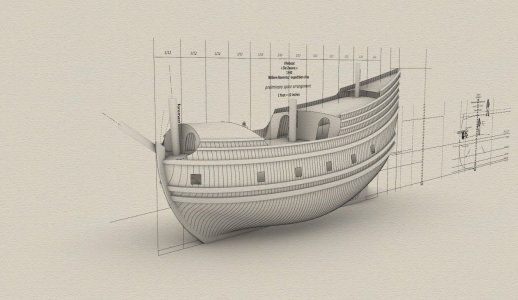
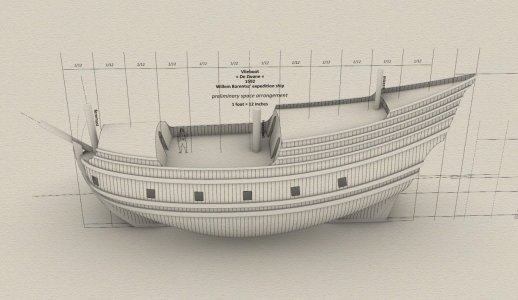
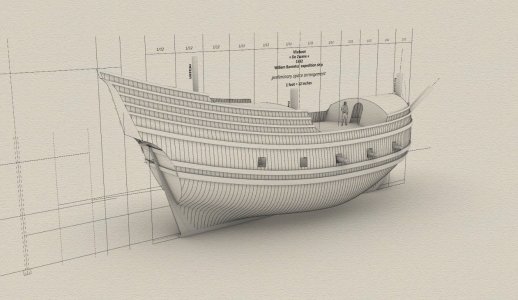
Below are a few renderings of the current stage of the reconstruction, i.e. the preliminary layout of the vessel’s both most important and visually prominent on-board equipment. Although this may not yet be their final arrangement, my main aim here was to show Heinrich the ship’s general silhouette, and from various angles, so he can offer any comments or suggestions.

As a reminder, the density of the hull’s cross-sectional lines is 9 inches, i.e. the sided dimensions of the floor timbers. Furthermore, a (symmetrical) half of all six guns from the lower deck is visible, namely one 6-pounder and two 3-pounders (as indicated by their weight listed in the inventory), all cast-iron.

Another possible variant of the cabin is shown, which here has again sacrificed 3 feet of its 12-foot length for the dedicated helmsman’s station. In my opinion, this is quite reasonable and, moreover, consistent with many iconographic examples, but for (my) final choice I still need to check the geometry of the steering arrangement for the various variants.

* * *​

Normally, in my conceptual reconstructions, I do not go any further than this; however, before continuing, it would be a great help to know the model-building method (POB, POF) so that I can do what is necessary and avoid doing what is not :).


016.jpg

017.jpg

018.jpg

019.jpg

020.jpg

021.jpg

022.jpg

023.jpg

024.jpg
.​
 
Dear @Waldemar. I probably sat for half an hour (at least) this morning, just staring at these renderings in disbelief. How anyone can turn a few pages of old-Dutch script into these visually magnificent renderings is beyond of me. The various design elements are so well integrated that it is hard to imagine that the ship could have looked any different from these renderings. To the uninitiated (and I do not mean this in any derogatory way - it simply refers to those who have not studied and analyzed this type of ship and the build contract), this rendering may not look all that different from other interpretations out there. However, nothing could be further from the truth. The hull shape is vastly different and takes pride of place - exactly like it should. It is much wider and fuller than other interpretations and what is more, it is based on factual information derived from the build contract and interpreted by someone who is a master at what he is doing. Added to that,(and I know I am repeating myself); the other structural elements are so well integrated into the overall design and makes for such a compelling visual argument that it would be hard to argue against any individual aspect of the rendering.

The helmsman's station is a case in point. I have always advocated for the station to be in front of the mizzen, but that is not what is described in the build contract - it is categorically mentioned that it was part of the cabin - exactly like you have it here. And that is what is important - It is not for me to question the rationale or the logic behind the build contract. As designers and builders, it is our responsibility to portray it as accurately as possible as it is described in the bestekken - verbatim. Which is precisely what you have done.

The forecastle has turned out very well and now looks dimensionally proper and in scale with the rest of the ship; not like it was a constructed as an afterthought.

As to the question about which construction will be followed, my automatic answer would have been POB, but after looking at the superb renderings, I almost started doubting myself. However, I will stick to POB for a variety of reasons; most important of which is that this hull needs to be planked fully in order to maximise its visual effect. The hull shape is one of the key differentiators between this interpretation and others and as such it has to be accentuated. A fully planked hull would negate the rationale behind a Plank-on-Frame construction method.

By the way, I just love the capstan which you have incorporated as well (it's a pity that it won't be visible, but it is what it is). There were long debates in my previous two builds as to the exact position of the windlass on Barentsz's ship - now it turns out that De Zwane had a capstan!

In summary @Waldemar, I am very happy and excited with the renderings and see no need to change anything. I know that you will continue to do checks and balances to verify everything and that whatever you decide, will be the most accurate and practically feasible option.

Congratulations on a fine job, so far, Sir!
 
.​

At this stage of the reconstruction, now that the hull shapes are complete, it is both possible and desirable to carry out a few basic tests, even if some of them only with a ‘rough’ level of accuracy.

* * *​

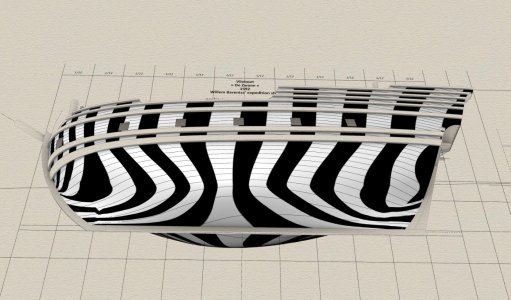
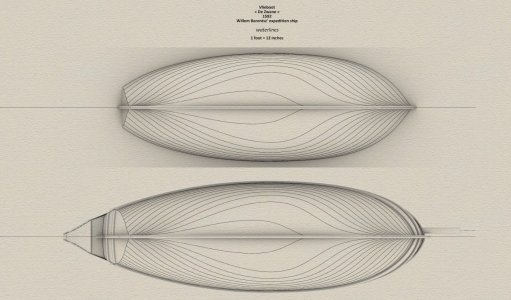
Firstly, this could be a visual verification of the lines’ fairness using the generated waterlines or by applying the even more rigorous, unforgiving so-called Zebra test. In the latter, shapes that are correct in terms of smoothness are indicated by a continuous and smooth flow of the test stripes, as can be seen in the graphic below. In this case, the visible lack of continuity in the test stripes near the stern is naturally a result of the sharp break in the surface in the immediate vicinity of the tuck, as the fashion piece joins the stern post in a sharp manner rather than with a gentle curve.


Waterlines test:
025.jpg


Zebra test:

026.jpg


* * *​

In addition, I have also carried out a rough (as this is, in fact, the only feasible approach) verification of the load capacity of the vlieboot De Zwane as reconstructed, which, according to source data, provided by Menno Leenstra, was 44 last (sometimes given as 40 last).

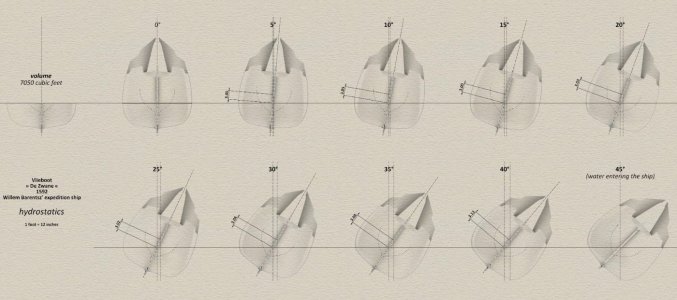
And so, the volume of the submerged part of the hull for the reconstructed shape of the vlieboot (or more precisely — the volume below the design waterline previously determined, including the keel and both posts) is 7,050 cubic feet, which in metric units amounts to approximately 193 tonnes. Allocating half of this value to the weight of the ship itself, including all its equipment, and assuming, very roughly, that 1 last of cargo equals 2 metric tonnes, yields a result of approximately 48 lasts, which may be considered quite close to the value given in the source records.

Incidentally, it is also worth noting that, in those days, the ship’s carrying capacity stated in documents was often — if not almost always — not based on precise calculations at all, but was the result of estimates based on the vessel’s overall size.

* * *​

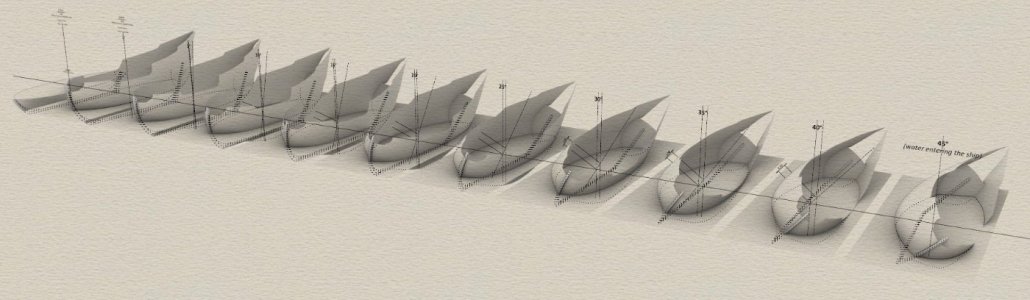
The height of the metacentric point above the design waterline was determined as well, which for this vessel’s shape and dimensions is 3 feet, i.e. a few inches below the lower edge of gun ports. This means, firstly, that the ship will remain right-side-up and will not capsize as long as the centre of gravity remains below this point, or does not shift as a result of heeling.

Secondly, given the cargo-carrying nature of the vessel with its effectively low centre of gravity, it can be estimated that De Zwane, as reconstructed, was a vessel that was fairly rigid transversely (with stores that were still full), i.e. not prone to heeling, while sporting short, rather violent rolling of small amplitude, which could be unpleasant for crew members unaccustomed to it, and at the same time more demanding in terms of the ship’s structural strength compared to cases involving gentle, deeper rolling. However, during the voyage, as supplies were used up, these characteristics could change — and indeed had to change.
027.jpg

028.jpg


* * *​

Overall, I consider the results obtained to be good, and even excellent in every respect (compliance with the construction contract, the specific characteristics of the shapes resulting from the design method of the time, shape fairness, hydrostatic properties), although this set could still be supplemented by hydrodynamic tests, but these would necessarily have to be carried out in a test tank, so I am cleverly obliging Heinrich to carry them out once the model has been built. After all, he will have as many as two oceans at his disposal, and even including the Antarctic zone, i.e. conditions that quite realistically simulate the northern polar waters :).

.​
 
Last edited:
Dear @Waldemar, it is very gratifying to see that De Zwane passed the waterlines and Zebra test. I am completely unfamiliar with the latter and am in the process of reading up on it! Your explanation of how to interpret the lines though, makes complete sense.

I find your comments about the metacentric point of De Zwane very interesting. You mention that the ship exhibited a particular set of characteristics at the start of a journey (when the stores were full) and a different set as of characteristics as supplies were used up. This is perfectly in line with what we read in De Veerr's journal as well as in the notes on De Zwane as she was prepared for her expeditionary journeys. Apparently, these small ships were quite sensitive to ballast. In his book, Ab Hoving mentions that even the consumption of drinking water was taken into account when calculating the amount of ballast, a ship had to carry. In his journal, De Veer writes that they needed to take on ballast relatively early into the 1596 expedition.

04.jpg
Drawing by Arnold de Lange.

In the notes of the Zeeuws Archives, we read that as De Zwane was prepared for the 1594 expedition, the ballast had to be removed, in order to calphate the ship from below. Later, the ballast was put back again, without any information about the quantity and nature of the ballast being used for this trip. However, it is mentioned that underneath the ballast some 11 "mats” were laid out.

As ballast for the 1595 expedition, both ships (De Zwane and the Griffioen) received 240 "wagon loads" of Scottish coal as ballast.

In his calculations of the lasten of our reconstruction, Waldemar arrived at a number of 48 last which may - to the uninitiated - seem out of kilter with the previously mentioned 40 or 44 lasten. This is not so. Bear in mind that the size of ships around the year 1600 was indicated in lasts (cargo capacity). This makes it confusing because a last is not only considered a weight measure (400 Amsterdam pounds = 1975 kilograms), but also a volume measure. What makes it even more confusing is that, for example, timber lasts are larger than grain lasts and a rye last is different from a wheat last. Thus, it can happen that the same ship is recorded with a different number of lasts on two different voyages, because of the different nature of the respective cargoes.

However, there was also a more rudimentary method of calculating lasten - a method which I think was more likely to be employed by the shipwrights of the time. Before 1630, it was common to determine the tonnage of a ship by multiplying its length, width, and holte in feet and dividing the result by a factor, which differed per type of ship: 250 for large warships and VOC ships, 242 for timber haulers, and around 200 for fluyt ships. The factor was highest in the case of an “oorlogsjacht / vlieboot”, where the number was approximately 400. That was logical: due to its small dimensions, the ratio of buoyancy to cargo capacity was already unfavorable.

In the case of De Zwane, when applying the above formula, the equation would look as follows:

Length (72 feet) x Width (24 feet) x Holte (9.5 feet) = 16 416

Divided by a factor of 400

Equals ... wait for it ...

41,04 last

This is simply uncanny and is an incredibly strong testimony to the accuracy of Waldemar's reconstruction. This also shows that he has read and interpreted the build contract to perfection. I have no doubt that this is the most accurate rendering (based on an actual build contract) of any Dutch vlieboot/jacht to date.

PS: I am still dumbfounded by that last calculation. This is like buying an ordinary rifle off the shelf and shooting sub-MOA's with it!
 
.​

Thank you very much, Heinrich. Your contribution allows me to focus better on my main task, and also serves as a welcome form of feedback on my proceedings to date. I even try to keep my own comments as brief as possible, limiting them to what is strictly necessary, without attempting to explain or justify ‘everything’. That’s a great help.

Everything you’ve written is fine by me; I just wanted to add that the use of different factors for estimating the tonnage of various ship types must have been primarily related to the sharpness of their hull shapes (or the reverse), or to put it more technically — the so-called block coefficient.

* * *​

It is quite possible that a value of 10 feet was introduced as the depth in the formula you presented above. The thing is that in the contract, a value of 9.5 feet is specified to the upper edge of the beam shelf, but the deck beam itself was not recessed into the beam shelf to its full height (1 foot is specified for deck beams directly adjacent to the mast and forming its bracing), but only by a few inches. Hence, I conclude that the depth as understood in the conventional meaning — that is, measured from the keel to the deck level (without planking) — was precisely 10 feet.

In that case, according to this formula, the estimated carrying capacity of the vessel would be just over 43 last.

Or perhaps even better, in various instances and by different people, values were taken for these cargo capacity calculations using both of these approaches, hence the discrepancies in the reported carrying capacities of the vessel.

.​
 
Last edited:
the use of different factors for estimating the tonnage of various ship types must have been primarily related to the sharpness of their hull shapes (or the reverse), or to put it more technically — the so-called block coefficient.
Correct - that was the very reason.

And at 43 last, we are still in the "sweet spot" range of 40-44 lasten! Unbelievable! o_O
 
.​

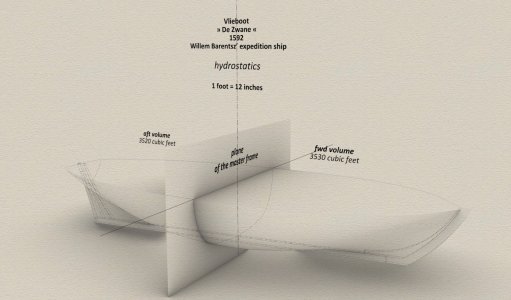
I almost forgot to mention another basic characteristic that is quite important for the ship’s proper behaviour on the water. This is the vessel’s so-called longitudinal balance, expressed as the ratio of the volumes of the forward and aft sections of the hull — in this case, the sections forward and aft of the master frame, which is placed in the middle of the hull’s length. In this design, as reconstructed, the ratio is perfect, standing at 3530 : 3520 for the forward and aft halves of the hull respectively.

In those times, longitudinal balance was ensured at the design stage by taking care that both quarter frames, correctly set lengthwise, had as much as possible the similar surface area.


029.jpg
.​
 
Last edited:
Back
Top