


• SUBSCRIBE TO SHIPS IN SCALE TODAY!

    The beloved Ships in Scale Magazine is back and charting a new course for 2026!
    Discover new skills, new techniques, and new inspirations in every issue.

    NOTE THAT OUR NEXT ISSUE WILL BE MARCH/APRIL 2026
  • Win a Free Custom Engraved Brass Coin!!!
    As a way to introduce our brass coins to the community, we will raffle off a free coin during the month of August. Follow link ABOVE for instructions for entering.

Vlieboot »De Zwane« 1592 — Barents discovers the Arctic

Hi Waldemar

The openwork railings on the half-and poop deck, is such a nice touch and rounds-off the appearance beautifully. I have always wanted to do this on my builds and yet, I have always omitted them. Even though it means more work for the builder, this is something that I will not leave out again.

There is no need to include items such as the gratings, belaying racks and knechten - I have a very good idea where those should go, what they looked like and how they were constructed. Luckily, items such as the windlass and the mooring bitts - which have always been a bone of contention in my previous builds - have now been negated by the fact that De Zwane had a capstan!

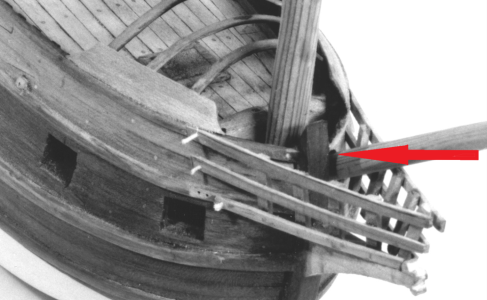
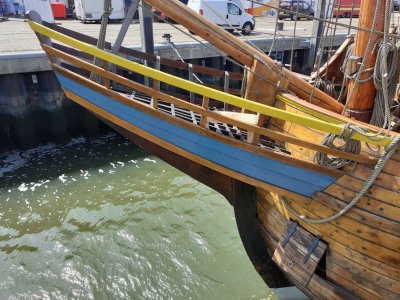
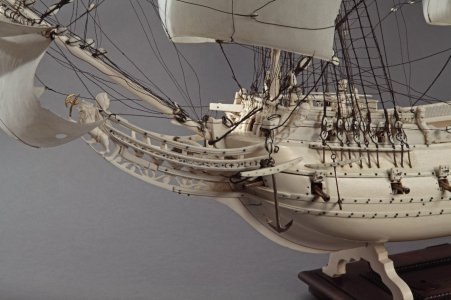
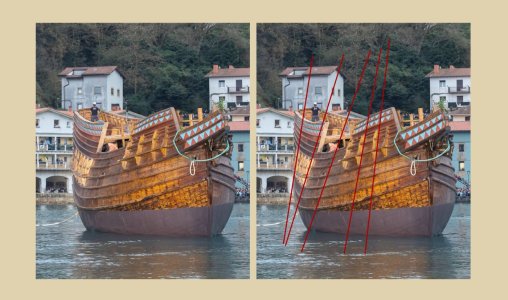
The beakhead is an interesting one. I want to point out here @-Waldemar- rationale behind the beakhead as he explained it to me:

Over the last few days, I’ve been looking through dozens and hundreds of different period illustrations in search of technical details and the specific shapes of beakheads from that era. On top of that, the challenge lies in elegantly synchronising the lines of the beakhead with the hull’s shapes and its wales. This is a very eye-catching feature of the ship, and I want its design not only to convincingly reflect what is seen in the iconography, but also to look sufficiently attractive given its visually prominent position. I don’t want to settle for the oversimplified, rather makeshift solutions found in previous reconstructions.

This is actually the one item which in position and configuration is displayed fairly consistently in the iconography i.e. the top railing of the beakhead follows the line of the ship's "potdeksel"(upper railing)

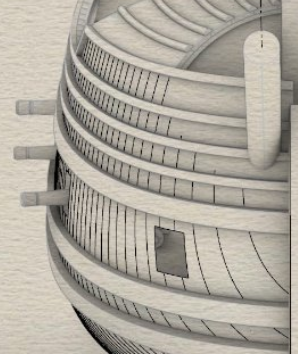
The color-enhanced picture below may be of some help.
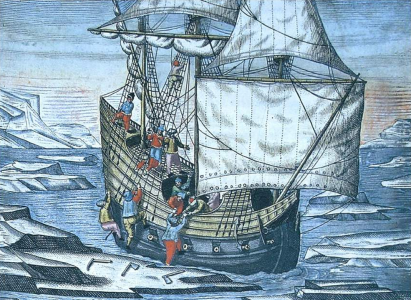
BHEAD.png

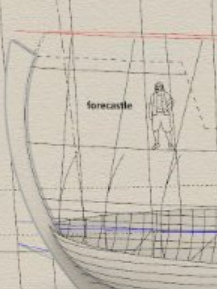
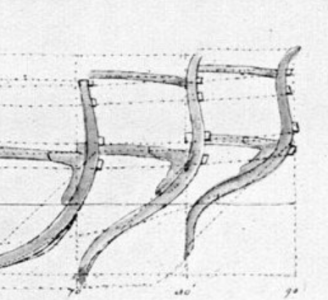
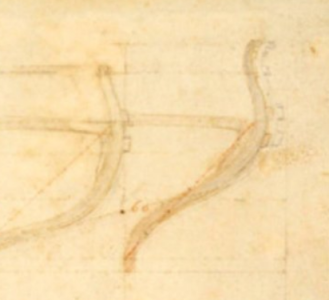
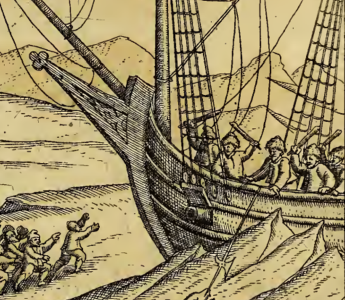
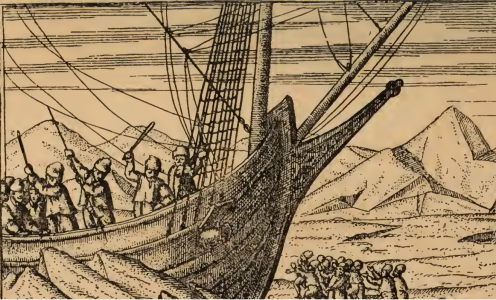
Also, the next two etchings which show the ship after deconstruction of the forecastle and beakhead (these materials were used to construct Het Behouden Huys), may offer some assistance with regards to the exact position and angle of the beakhead.
BHEAD@.png

Mast Position.png

The caveat, of course, is that these illustrations refer to Barentsz's ship and not to De Zwane.

What I do know though is that the final result that Waldemar comes up with will be convincing on all fronts. (No pressure! :) )
 
.​

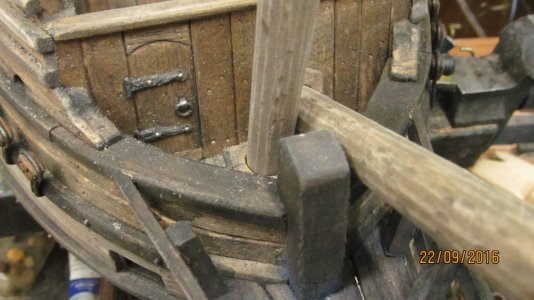
Thanks, Heinrich, especially for pointing out these particular reproductions depicting remains of the beakhead, which I had indeed almost overlooked until now. Apart from the evidence and styling themselves, when reconstructing the beakhead and its surroundings, one has to take into account several quite serious structural issues. For example, the solution where the bowsprit pierces the hull side does not sit well with me, and to be honest, I am still searching for the right overall arrangement in that area.


What I do know though is that the final result that Waldemar comes up with will be convincing on all fronts.

I would comment on this by saying that previous reconstructors may not have been fortunate enough to have a helpful, albeit anonymous, assistant who would have warned them in time that ‘current-day US feet and inches’ should not be used, and perhaps that is precisely why so many things have gone wrong in past achievements :).

.​
 
For example, the solution where the bowsprit pierces the hull side does not sit well with me,
Waldemar, upon reading this, I concur fully and I have to admit (to the detriment of my own interpretation) that this is the layout which I followed as well. Sometimes, it might be difficult for modelers of bigger models to appreciate just how little space there is to work with on this ship - and to make matters worse - you still have to contend with that pesky foremast and belaying rack which both have to be fitted in the "luizenplecht" area - the area between the forecastle and stem of the ship.

无标题.png
This is what Waldemar means when he says that the bowsprit "pierces" the hull of the ship. I have to plead guilty for doing the same on my two previous builds.

Mees Ippel 18.jpg
To his credit, De Weerdt has avoided this pitfall. Here the bowsprit almost appears to lie in a "cradle" of sorts on top of the stem - an interpretation of which I have no idea about its historical accuracy or feasibility.

My Russian friend, Vladimir Zhdan has followed a different approach for the bowsprit to clear the hull. The bowsprit is mounted further back (actually underneath the roof of the forecastle) which allowed the bowsprit to clear the railing without having too steep a rake. Again, as to its historical accuracy or feasibility I cannot comment.

1781345395099.jpeg
 
.​
I have to plead guilty for doing the same on my two previous builds.

You definitely shouldn’t :), because it’s not an entirely unheard-of solution. It’s just poor engineering, which is why it’s so rare among better designs.

For example, as shown below on a Danish warship Norske Løve from 1634 (model built in 1654). Although in this case, indeed, it is not actually the side of the ship above the deck that is pierced, and the bowsprit can be secured from below and even from above by breast hooks.


318aa.tiff.jpg

318b.tiff.jpg
.​
 
.​

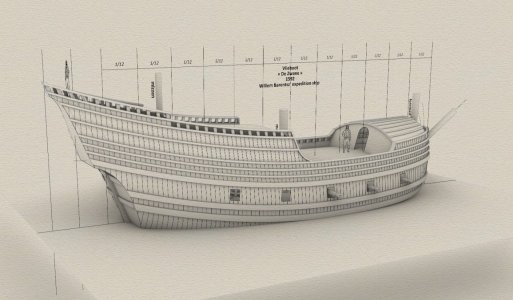
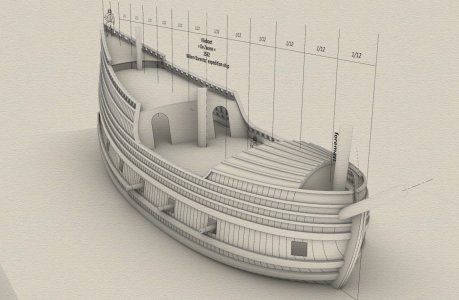
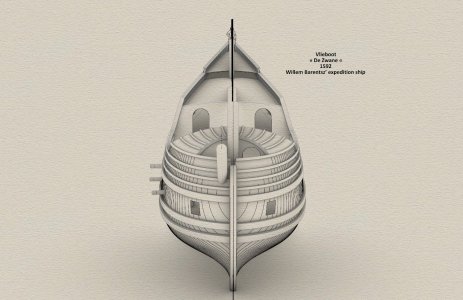
I’ve tidied up the railings, but above all I wanted to show you my interpretation of the forecastle. Ultimately, solid planks, sealed at the joints with additional half-round strips. I think I’ve seen this solution on one of the models before, but for forecastle without bulkheads.

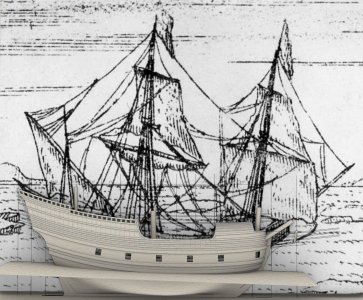
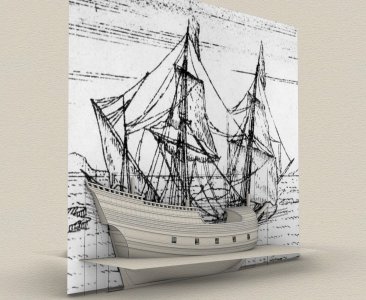
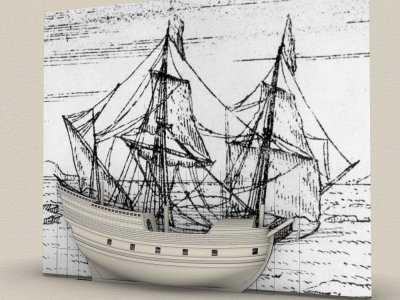
Apart from that, a simulation of how the reconstructed ship would look under sail (though still without a beakhead) :).


036.jpg

037.jpg

033.jpg

034.jpg

035.jpg
.​
 
.​

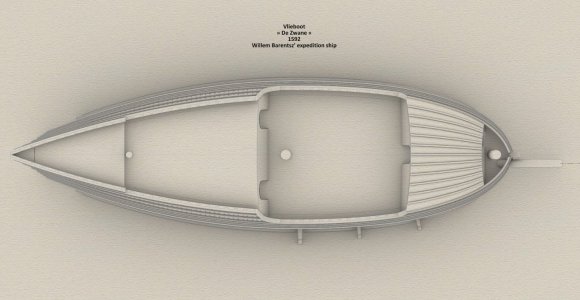
And here’s a view of the duck from above. The extremely bulbous proportions of this vessel are particularly striking in this projection.

Oh, and the keel and stem are now tapered, in line with the contract scantlings. Unfortunately, this will make building the model a bit trickier, unless you choose to ignore it, as in practice the differences are barely noticeable...


038.jpg
.​
 
Wow @-Waldemar- ! I have officially run out of superlatives! The forecastle looks incredible. It is by far the best integrated iteration of the forecastle I have ever seen - and that includes all the various versions depicted in the iconographies. I am very happy that you have gone for a completely closed construction with solid roofing instead of the grating. Seeing that the bovennet (grating) was expressly specified for the halfdeck construction in the build contract, but not for the forecastle, I think we can rightly assume that the forecastle did not have a bovennet. The half-round strips look brilliant and just adds the perfect final touch.

Your simulation of the reconstructed ship overlayed over the original iconographies is incredibly accurate - in fact, the resemblance(s) are uncanny. To think that you could create these from the build contracts is beyond me, and to be perfectly honest, probably beyond all but the most gifted.

As to the top view, the pijlstaart duck-shape is blatantly obvious and proportionally sound.

I am at a loss for words!
 
.​

Thanks, Heinrich. The reconstructed vessel may seem simple at first glance to the general public, yet, in reality, a realistic and consistent reconstruction of the hull shapes of this particular vessel, in accordance with hydrostatic and hydrodynamic requirements and the design paradigms of the time, was by no means straightforward for this exceptionally short (and wide) hull. One need only look at previous attempts to reconstruct the ships of Barentsz or Tasman, which are, sadly, either unsuitable for open-sea navigation, or fail to meet so-called formal requirements, such as having two full decks, or both. On the other hand, I am aware that for many this may not matter much, given that the ships can also be seen rather as floating decorations, along with something else :).


039.jpg
.​
 
Very true @-Waldemar-. This project stirs up many feelings and emotions for me - for sure, this is not a subject that will ever become a popular one.

The modeling world has for so long been fed a consistent diet of British, French and Spanish modeling subjects, that anything that falls out of this realm, is simply not considered as prospective builds. This is particularly sad for the Dutch maritime history and a country which had for so long been shipbuilding pioneers and whose ships had ruled the oceans during the 17th Century in particular. Added to that, De Zwane did not have 120 guns, four or more decks and massive amounts of flashy and ornate embellishments.

No, this ship is an acquired taste where nothing is obvious at a first glance. This ship needs to be studied, understood and experienced to understand fully its intricacies and the inherent challenges associated with an accurate rendition of her. This you have accomplished beautifully.
 
.​

Thanks. I would particularly like to point out that it was only the very recent discovery of the design methods used in the Netherlands at the time (yes, by me, I’ll say without false modesty) that allowed for a rational and consistent interpretation of the dimensions specified in shipbuilding contracts.

Until now, data concerning hull height in particular had been an insurmountable obstacle, with researchers and experts simply not knowing what to make of it, resulting in entirely unsatisfactory solutions and explanations. It is rather amusing that, in previous interpretations, not even the freedom allowed by the (erroneous) hypothesis of building ships ‘by eye’ helped to achieve at least roughly acceptable results.

That is precisely why this is actually a very important case, despite the absence of 120 guns and tonnes of decoration... :)

.​
 
Back
Top