
- Joined
- Oct 9, 2020
- Messages
- 2,351
- Points
- 488

Furthermore I get more interest in the kit boxes than the actual completed models. The kits I can sell, easily, the models, not so much.

 |
The beloved Ships in Scale Magazine is back and charting a new course for 2026! Discover new skills, new techniques, and new inspirations in every issue. NOTE THAT OUR NEXT ISSUE WILL BE MARCH/APRIL 2026 |
|
 |
As a way to introduce our brass coins to the community, we will raffle off a free coin during the month of August. Follow link ABOVE for instructions for entering. |
|


Could it be that our true intent is to reject the universal application of standards to every ship model built on this (or another) forum. Some models are built for the joy of engagement. When that is the case "good job" or "try this next time" reads the room in its proper context.
Actually, the point several of us are trying to make is that it does not bind us. Surely you can see that everyone does not intend (or desire) to be a master model builder? There is nothing wrong with elevated standards, but they cannot be used as a bludgeon. Some modelers just want to have fun.


Bob, may I ask, respectfully, that we try to stay closer to the original topic of the thread? The discussion keeps circling back to the broader “standards” debate, and while it is a subject in its own right, it tends to pull us away from the specific question being discussed here.Could it be that our true intent is to reject the universal application of standards to every ship model built on this (or another) forum?" Ah! Yes, I see. Well, that certainly does change things, doesn't it?
How do we identify these modelers who "just want to have fun," but avowedly aren't interested in having the quality of their models measured against some standard? " Might their posts be displayed in a differently colored font so the serious modelers won't waste their time reading them? Perhaps the "just for fun" modelers should be segregated from the "fine arts" modelers like they do public swimming pools with certain areas and/or times dedicated to "open" or "fun swim" use and other times reserved for "lap" swimming, water aerobics, and team training activities.
There really are differences between the different types of ship modelers that make their undifferentiated participation in a forum problematic. If a person who's modeling for fun posts a question, they may get overwhelmed, discouraged or, God forbid, offended, by an answer from a "fine arts" ship modeler when the latter might have not bothered to respond to the post at all, or counseled, "If you are just modeling for fun, don't worry about it." had the former's intentions been made known. Consider as an example the different types of responses the below linked post might engender from different types of ship modelers!
Bob, may I ask, respectfully, that we try to stay closer to the original topic of the thread? The discussion keeps circling back to the broader “standards” debate, and while it is a subject in its own right, it tends to pull us away from the specific question being discussed here.
Perhaps it would be more productive to open a dedicated thread (as I've recommended in arlier post) for that larger conversation, rather than revisiting it in every related discussion.
Thank you.
Bob,Hey, I've got no dog in that fight. I'm just responding to what comes my way. It's not my thread and I have no idea what it takes to break up an existing thread even if I felt it was my place to do so. It appears you have all the necessary faculties as a staff member, administrator, and moderator, so, as far as I'm concerned, go ahead and break it out into a new thread. If I were you, however, I'd ask the guy who started the thread in the first place before I did so because it's his thread. Don't go by me alone.


Bob,
The issue isn’t about who has the technical ability to split a thread. The issue is focus.
In Post 81 (link), I explicitly asked that we stay on topic. When a discussion repeatedly circles back to the same broader argument, regardless of intent, it shifts the thread away from its original purpose. That’s what I’m trying to prevent as the moderator. You may feel you’re “just responding to what comes your way,” but steering the conversation back to the same recurring theme is still a choice. It affects the tone and direction of the discussion.
I am not trying to silence you or “break up” anything unnecessarily. I’m simply asking, again, that we respect the scope of the thread and allow it to develop without redirecting it into familiar territory. Let’s keep it focused on the topic at hand.
P.S. Perhaps it would be more productive to open a dedicated thread (as I've recommended in post 81). I even provided suggested topics for discussions for that larger conversation, rather than revisiting it in every related discussion.
Thank you.
Paul's original question: What is it about a model that makes it valuable to the collector community?

The "investment grade" fine art high-quality scale ship model collecting community is very small group of connoisseurs who may, as Brad illustrated well with his buffalo nickel example, dictate prices beyond the market value of a given model based on their own personal collecting tastes, desires, or requirements.
 . I think I can confirm this also from the perspective of my personal experience. Thank you.
A substantive post, Brad.Paul's original question: What is it about a model that makes it valuable to the collector community?
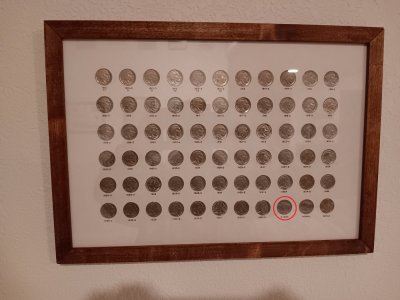
I collect coins (specifically US Buffalo Nickles).
Coins, like models, have characteristics the "collector community" values:
Coins (Ship Models)
1) Condition (Condition/taken care of/preserved)
2) Rarity (Uniqueness and/or a special/renowned modeler (not a kit?))
3) Sharpness of details (Quality, attention to details, accuracy)
4) Mint Luster (Overall aesthetic appeal)
Six pages have been dancing around these intuitive "things/criteria".
HOWEVER, what makes something valuable to "An Individual Collector" isn't so obvious.
1. I wouldn't bid on any coin that was NOT a Buffalo Nickle. Others pay outrageous prices for coins that don't interest me.
a. Similarly, an individual may value:
1) a type of ship. (Think Battleships vs 21st century America's Cup Yachts)
2) a period. (think 16th vs 19th century)
3) a country. (French vs Dutch)
4) material (paper vs wood vs metal vs plastic vs etc.)
b. A single collector may also value things that are not obvious:
1) Maybe dimensions are the single most important criteria (the fireplace mantel is only so big!)
2) Maybe a relative served or died on a specific ship (none other are of any value)
3) Maybe the family worked in a specific shipyard (only ships from that yard hold any interest/value)
4) POW2 bone models (stunning to some and ugly to others)
BOTTOM LINES:
1. Beauty/value is in the eye of the beholder/buyer/individual.
2. If criteria/judges/collector community are involved (think miss universe or ship modeler judges), you get very similar, beautiful curves, adornments, decorations, that may not appeal to every individual.
PS: Example of beauty in the eyes of the beholder:
I paid over $500 for the final nickel in my collection. I doubt many of you would have paid $5 for the same coin...right or wrong??
View attachment 579468
Just my "5 cents"!


My money is on: before expending the effort -the only way to know is to ask the OP to define his ultimate ambition as a modeler.How do we identify these modelers who "just want to have fun," but avowedly aren't interested in having the quality of their models measured against some standard?
You can find some cool stuff using CoPilot.In 1975, living in the small town of Marietta, Ohio I was amazed to read that an organization that I had never heard of would be meeting there; the Nautical ResearchGuild. I attended and met the “Rock Stars” that Dave writes about. Like him and probably others, I was introduced to a standard of work that I could only then aspire to. Unfortunately, unlike Dave, once the meeting was over, these guys were out of my reach. But I did join the Guild and their Journal continued to encourage and educate me.
The Journal, sadly “ain’t what it used to be.” The editor only can publish the articles that he receives, but some of the ship model building articles that get printed would not have been accepted for publication back in the day. Ship model builders wanting to improve their art will have to look for forums like SOS for help.
Roger
You can find some cool stuff using CoPilot.


Paul,I was asked by a visitor to my home how much a particular model was worth. I gently explained that nothing was for sale - - for the reason you just shared, Graham. But as a rule, when people visit, no one even mentions my prominently displayed ship models. They just don't care about them...
 we here, arguably spend half a decade creating these model ships, and yes barely a glance from our mostly uninterested home visitor guests. Even when our ships, within their cases, are arguably hard not to see.
I just use CoPilot as a search engine because it is better than doing a regular search on Edge. Either way, it is just a tool.I, along with a lot of other people, believe artificial intelligence is a tremendous force in our world today and will continue to evolve to become as significant a technological development as the telephone or the internet. It is, however, only now in its infancy. All AI is, really, is a data storage and retrieval system like any other "computer," but "on steroids." This exponentially increased power permits software applications that can so much faster storage and sorting functions that it is said computers can thereby "think like people." That's true, as far as it goes, but the problem is exactly that AI enables computers to "think" like the people who program them. And just like flesh and blood people, AI's "thinking" is only so good as the underlying information with which it has to work. We "think" using "what we know." Consequently, even the most powerful computers, just like people, can only "thing" with "what they know."
"Thinking computers" using the present AI software rely strongly upon the internet, which has accurately been called "the world's largest refrigerator door." Anything can be posted on the internet and then become part of the "information base" that AI programs use to "think." Ship modeling is an interesting example of this. There's a lot of information about ship modeling online these days, much of it posted by people who are hardly conversant in the broad spectrum of trivia required to model ships. The sheer weight of data posted by "ship modelers" who really know little, if anything, about the subject other than how to assemble ship model kits designed by others, has created a number of inaccurate impressions about ship modeling which are reflected in the AI generated information we are now seeing online. For this reason, AI generated information related to ship modeling should be "taken with a grain of salt." Today's immature AI technology can be a good place to start researching, but it is a long, long way from a definitive source. The better AI software will provide linked citations to the information upon which the AI generated response is based, but when those sources are reviewed, it's surprising how often they are hardly authoritative at all. It is not at all unusual that AI query responses are based upon social media posts which are at best only rank opinions, which, the more they are repeated online, increase is "credibility" as far as the AI algorithms are concerned.
To illustrate this point, I asked the Microsoft Bing AI search engine the question at hand:
What is it about a model that makes it valuable to the collector community?
and got the following AI generated response:
"Precision, authenticity, and visual appeal
The value of a ship model to the collector community lies in its precision, authenticity, and visual appeal. These models are not just replicas; they are works of art that tell a story and reflect the craftsmanship and historical accuracy of the original vessel. Collectors seek models that are grounded in meticulous research, showcasing technical knowledge and honoring the vessel's legacy. The craftsmanship of the model, from the intricate details to the construction methods, sets it apart from mass-produced alternatives. Additionally, the emotional connection these models inspire, whether it's a love for naval history or a respect for handcrafted beauty, adds to their value. Collectors appreciate these models as historical documentation and tangible pieces of naval history, making them valuable assets for both personal and educational purposes."
This AI search engine cited Ships of Scale as the authority upon which it based its answer.
(See: https://www.bing.com/search?q=What is it about a ship model that makes it valuable to the collector community?&qs=n&form=QBRE&sp=-1&lq=0&pq=what is it about a ship model that makes it valuable to the collector community?&sc=0-80&sk=&cvid=4531584196654CA99081C2D1DC10FD10 )
When I clicked on the link, to see where the information came from, it was this very thread in this forum! So, in this case, at least, AI has us chasing our tails!
Here's the above-mentioned Copilot AI response to the same question:
"A ship model’s value to collectors comes from its craftsmanship, historical accuracy, uniqueness, and the reputation of its builder, making it both a work of art and a tangible piece of maritime history.
Craftsmanship
Collectors highly value models that demonstrate exceptional skill and attention to detail. This includes precise rigging, realistic deck planking, accurate paint schemes, and the use of traditional materials like hardwoods, brass fittings, and cotton threads. Models that are meticulously constructed, whether scratch-built or custom-made, are considered superior to mass-produced kits because they reflect the artisan’s dedication and technical expertise, elevating the model from a decorative item to a collectible work of art. Ships of Scale+1
Historical
A model’s authenticity and adherence to historical records significantly enhance its value. Builders often research ship blueprints, period paintings, and maritime records to ensure every element—from sail layout to hull design—is faithful to the original vessel. This accuracy transforms the model into a miniature archive of naval history, allowing collectors to engage with maritime heritage in a tangible way. alexcordo.com+1
Uniqueness
Unique or bespoke models are particularly prized. Custom ship models, commissioned to replicate famous vessels or personal yachts, are one-of-a-kind pieces that cannot be replicated easily. Their scarcity, combined with the ability to customize scale, materials, and intricate details, makes them highly sought after in the collector market. Mass-produced models generally hold less value because they lack individuality and artistic distinction. modelworksdirect.com+2
Builder
The reputation of the modeler can greatly influence value. Models created by well-known or historically significant builders often command higher prices, similar to fine art. Collectors may pay a premium for models by artisans whose work is recognized in museums or publications.
Ships of Scale+1
Emotional
Beyond technical and historical factors, ship models carry emotional significance. They can commemorate personal experiences, celebrate maritime history, or serve as heirlooms passed through generations. High Quality models made from premium materials can also appreciate in value over time, making them both a passion project and a potential investment. Modelworksdirect.com+1
Museum-Quality
Models that meet museum-quality standards are distinguished by their longevity, durability, and educational value. They are constructed to last generations, often using historically accurate materials and methods, and serve as miniature representations of seafaring technology and naval architecture. jagerhobby.com
In summary, a ship model’s value to collectors is a combination of artistry, historical fidelity, uniqueness, and provenance, along with the emotional and financial significance it carries. These factors together make certain models highly prized, collectible, and enduring symbols of maritime heritage.
Here again, one of the main "authorities" cited by Copilot was this very same thread in Ships of Scale! So, how does it feel to have your posts cited as authority for the AI answers to the question, "What is it about a model that makes it valuable to the collector community?" If anybody ever challenges your knowledge of model ship building, you can say you'v'e been cited as an authority by Copilot!
Another link generated in response to my asking the question above was to an article posted by a commercial model-making company called Modelworks entitled The Growing Value of Bespoke Ship Models. (See: https://modelworksdirect.com/bespoke-ship-models-value/) This article is obviously a "fluff piece" written for advertising purposes and published under the guise of "news." It is, to my practiced eye, at least, classic AI generated garbage: a few very general facts stretched out with a lot of "padding" to sound like the reader is being informed of something new.
All of this is the sad result of the tremendous amount of "garbage" (a computer scientist's term for "bad information" often uses in the phrase, "Garbage in - garbage out.") that is posted on social media and by advertisers of products sold to the ship modeling consumer. Anybody who has "surfed" the ship modeling subject will find their social media feeds bombarded with advertising for ship model kits of varying quality, many often rather substandard, with slick close-up video content that reveals an utterly unremarkable model passed off as exceptional workmanship. This "information pollution" creates erroneous impressions of the ship model subject for the general public and novices ship modelers.
I think any evaluation of what makes a ship model valuable to the ship model collector community must, in the first instance, take as a given that the collectable ship model must be of the highest quality all around. I think that's the threshold qualification for the collector community. It's what I and some others refer to as "investment quality." I also believe that the collector community is keenly aware of what an "investment quality" ship model looks like and that is something quite different from what's represented online in social media posts and ship model kit advertisements as such.
As a Supreme Court Justice once wrote about pornography, I say about high-quality scale ship models: "I shall not today attempt further to define the kinds of material I understand to be embraced within that shorthand description ["high-quality scale ship models"], and perhaps I could never succeed in intelligibly doing so. But I know it when I see it."

