

Ah! Well, that explains it. Try a sampling of major maritime museums instead of contests that are, in the main, usually full of recently assembled ship model kits. I expect you'll come away with quite a different impression.All I will say is that I don't think I have ever seen a contest-winning sailing ship model that did not have simulated treenails.
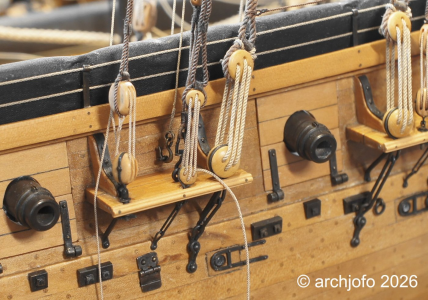
For the sake of thoroughness, though, it should be acknowledged that there is a certain artistic ship model presentation style that doe reveal real functioning treenails properly placed as they would occur on the prototype. This is because these models are presented without opaque finishing (e.g., paint) in order to depict that actual construction details of the prototype vessel. Contrasting colors, such as they may be, are depicted by the use of differently appearing wood species, all of the highest quality. This "clear finished" presentation may show actual treenails as slightly darker than the planking species because locust, the preferred species for treenails, was slightly darker than the planking species. In this instance, this is an accurate portrayal of the prototype vessel and does not detract from such models' effectiveness. When encountered, the color contrast will be seen as rather subtle.
There are currently some modelers, notably in Belgium and France, who particularly favor this sort of presentation and have given it a bit of a renaissance. Properly done, the style can be very attractive. It absolutely requires total fidelity to historical accuracy and only the very highest level of craft skills. At present, I would expect no more than a half-dozen of such models are produced each year. I know of no kits available for building such "as built" models. It is truly "modeling without a net" because it is a style that demands the highest level of quality of its builder and is ruthlessly unforgiving. See: https://shipsofscale.com/sosforums/...-by-archjofo-scale-1-48-french-corvette.7643/