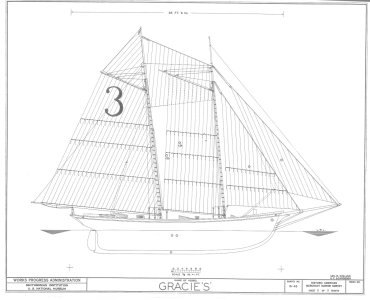
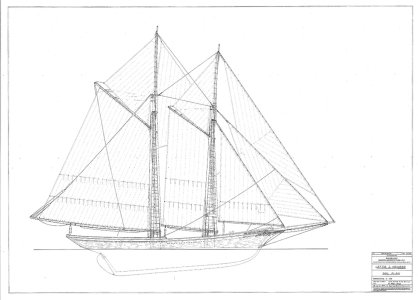
Addendum:
One (last) Howard I. Chapelle document:
HOWARD I. CHAPELLE
General Preliminary Building Specifications
Division of Marine Transportation Smithsonian Institution, Washington, D.C.
(Revised 3-31-1961)
THE INTENT OF THE PLANS AND DETAIL SPECIFICATIONS IS TO PRODUCE AN ACCURATE SCALE MODEL OF MUSEUM-GRADE WORKMANSHIP AND FINISH. THIS SPECIFICATION IS GENERAL AND PRELIMINARY, AND FORMS PART OF A CONTRACT OR PURCHASE AGREEMENT.
The model is to be as complete, in exterior detail, as is agreed in the contract detail specifications or as indicated or shown in the plans.
Models are to be built to a selected scale. It is intended that models in a certain category shall be all the same scale so that, in exhibition, they give a sense of relative size. Small craft models will be made to 1-1/2, 1, 3/4 or 1/2 inch to the foot scale, as directed. Fishing and coasting vessels shall be built to 1/4, 3/8 or 1/2 inch to the foot scale as directed. Large sailing vessels and steamers will be built to 1/8, 3/16 or 1/4 inch to the foot scale as directed. Unless otherwise agreed, models are to be built to the scale of the plans furnished to the builder and are subject to measurement and templating upon delivery, prior to final acceptance.
HULL –
The hull form is to be shaped (using the "lift" construction method, planked, or planked over moulds or as otherwise agreed) with great precision using accurate templates for level lines, buttocks and sections; and the model hull will be checked by the curator or his aid prior to finishing to be certain the hull agrees with the lines drawing. 2 The margin for tolerance is 2 inches to scale in all models built on scales between 1/8 and 1/4 inch; 1 inch to scale on models built on scales between 3/8 and 3/4 inch; 1/2 inch on models built on scales between 3/4 and 1-1/2 inch to the foot. Models built on 1/8 inch scale to be within 4 inches by scale tolerance. The hull will be fair and smooth in all respects and fully templated in building to insure accuracy and shall be fitted with head rails, trailboards, knees, quarter galleries, ports, scuppers, chesstrees, sheathing, stern windows, deadlights, and moudlings in correct scale as shown in the plans or as otherwise directed. Parts may be made of brass if strength requires. The deck plank may be marked or the deck laid, as agreed upon in the contract or purchase agreement, without showing butts or too wide a seam. 3 Deck machinery or fittings to be as shown in the plans or as otherwise indicated. Hull and fittings to be properly painted or finished as directed in the detail specifications.
RIGGING -
To be to scale and of good and lasting material or proper appearance and color, so far as is possible. Rigging to be done to agree with instructions, as to source reference and methods, contained in detail specifications. Mast metal work to be to correct scale and properly proportioned, "faked" only where it cannot be made to scale or where it does not show when model is rigged. The workmanship to be of museum quality throughout. Linen, wire, brass chain or other approved materials to be employed, as suitable.
MATERIALS –
The model hulls, deck furniture and spar work to be of well dried lumber, preferably white pine or poplar and the glue employed is to be damp resistant or "water proof". 5 Metal work to be of brass, copper or other approved material, as work requires. The use of white or "pot" metal is restricted to those portions of the metal work agreed upon in the contract or purchase agreement. Castings to be of copper or brass. 6 Rigging to be of brass chain, soft iron wire, 7 linen twine or other approved material, properly coated or painted as work requires. Lead or plastic are not acceptable for hull or spar fittings. Spars under 3/16" diameter to be of brass, not wood.
PAINTING –
To be of approved colors and flat, no gloss or egg-shell finish paint to be employed unless specified in plans or detail specifications. To be of high grade material and properly mixed for metal work.
HALF-MODELS –
These are to be made on the lift principle with great precision to the tolerance stated earlier in this general specification. The hull is to be carefully templated for sections, buttocks and level lines and is to be deck level. The outboard of the hull and deck furniture to be fitted with mouldings, carvings, lights, etc., as shown in plans. Stub masts are to be shown in correct position in rake, in half-section. Usually full length bowsprit and main or mizzen boom, in half-section, will be mounted with the model on the backboard, along with cutwater, keel, rudder, screw, stack, etc. as plans require. The whole are to be painted and finished as in original vessel or boat, as shown in plans and detail specifications. If model is to be planked, seams are to be laid off as in the full-size vessel or boat, complete with butts and stealers, wales, mouldings and cove or stripe lines, coppered if required. Backboard is to be painted or polished wood.
CARVINGS –
To be artistically formed and neatly made, fitted as shown in plans, with great precision, and correct scale to size.
FIGURES –
If human figures are required, they are to be of proper scale and proportion and dressed in contemporary fashion to the boat or vessel, as of her date of construction. Material and fastening or disposal on deck to be as agreed in contract.
SAILS –
Will be made of lasting and suitable textile such as linen or as directed in the contract, detail specifications. If not set, sails to be furled on the spars, but if set the sails must be sewn or marked to represent cloths and patches, reef and reef bands and be complete as to appearance.
MECHANICAL MODELS –
Where model is required to show machinery, the latter is to be built of metal or plastic, and is to be of accurate scale and proportion and properly assembled in working, or apparent working order, as the detail specification and plans require.
MOUNTING –
Ship models are to be mounted on keel blocks and bolted to base board, or set in a proper cradle. All mounting chocks, blocks and base board to be of dry lumber: mahogany, white pine or other approved lumber, smooth and well sanded and painted or varnished as required.
AMENDMENTS:
(1) SCALE - the same application should be applied towards the use of the metric system.
(2) HULL - Plank or Frame vs. Plank on Bulkhead: due to the wide spacing of bulkheads on the normal kit model, flats normally appear even in the best of model construction, especially in areas requiring large or complicated bends. Completely framed models are much better in this regard, and allow for portions of the hull to be left unplanked without undue distraction.
(3) DECK PLANKING - on small scales only (3/32, 1/16, etc.), all others should show butts. Over emphasis on small scale deck work should not distract from remainder of model.
(4) SAILS - Preferably none, though suitable linen cloths can be employed for scales 1 /4'' or greater. If employed, all details must be shown, reefs, reef bands, etc.
(5) MATERIALS - deck furniture should be made from close grained hardwoods (pear, etc.).
(6) CASTINGS - can also be made of other approved metals.
(7) IRON WIRE - this may rust. One should use anodized tin wire instead.
(8) BRASS YARDS - optional, use of close grain hardwood o.k.
(9) GLOSS PAINT - Paint finish should not be a high gloss: flat, egg-shell, semi-gloss, and satin or their combinations are preferred.











 . It's probably much easier to provide an on-boarding method with a single model (or a small subset to be chosen from).