• Win a Free Custom Engraved Brass Coin!!!
    As a way to introduce our brass coins to the community, we will raffle off a free coin during the month of August. Follow link ABOVE for instructions for entering.
  • PRE-ORDER SHIPS IN SCALE TODAY!

    The beloved Ships in Scale Magazine is back and charting a new course for 2026!
    Discover new skills, new techniques, and new inspirations in every issue.

    NOTE THAT OUR FIRST ISSUE WILL BE JAN/FEB 2026

To Build or Not to Build According to Howard I. Chapelle

A link to the Smithsonian and their "nigh-impenetrable without prior knowledge" search functions isn't really providing plans, either.
There are several "catalogs" for many of the plans at The S.I. Every illustration in all of Chapelle's books except The Baltimore Clipper is available as a 1/4" scale plan. a few exceptions on scale.


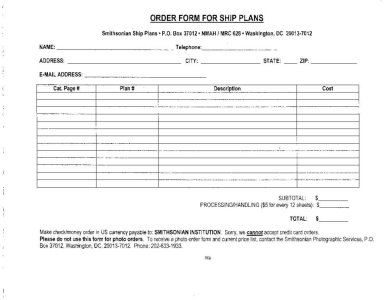
SmithsinianOrderForm-1.jpg

The The necessary data requires the catalog - at least in the position to get it to you if you do not wish to have your own copy. Another large group is the HAMMS plans,


Once upon a time I could find a lot of last 100 years small craft plans at Mystic. If I have the link, I have hidden it well. A visit to the museum website was non-productive.

There are monographs for French vessels at the AAMM boutique - They are drawn for carved hull and are modelers plans:


The ANCRE monographs are not the place to go if doing unique is a goal.
Both ANCRE and AOTS can be bad news for a scratch build beginner. They started a dominant and pervasive fad. The fad is mostly a complete disaster for scratch builders who are not Silver Backs.
The fad is building the hidden guts of a vessel as well as the outside. It increases the time and amount of a build by 2-10 times, to no good purpose that I can see. To me it is a showoff ego trip with no good purpose. If done once by one person that is sufficient. Otherwise it is: "OK, now I have seen your dump. Now, where is your village." My interest is the swimming body. The flow of the lines. In a decided minority am I.

Dean
 
As someone who would like to get into scratch-building, I would recommend providing high-quality, freely-available plans and links to places to purchase materials, and tools needed. Also a selection of plans that aren't just the average ship of the line or simple dory; a variety is would be good.

actually, all that information is scattered all over the forum you just have to look for it. Maybe a future "shop class" can be created here in the school

A link to the Smithsonian and their "nigh-impenetrable without prior knowledge" search functions isn't really providing plans, either. Part of the scratch-building process is going to require an accumulation of knowledge, so easing that accumulation of knowledge, both in model-building as well as maritime vocabulary and understanding, will be crucial to the newbie. (E: A series of links to specific plans would work!)

There are 2 main types of plans (1) is the original plans you will find in the Smithsonian and Admiralty collection, HAMMS collection (2) these are modeling plans redrawn from the original. The modeling plans are drawn for plank on frame, plank on bulkhead and solid hull construction.
 
As someone who would like to get into scratch-building, I would recommend providing high-quality, freely-available plans and links to places to purchase materials, and tools needed. Also a selection of plans that aren't just the average ship of the line or simple dory; a variety is would be good.

A link to the Smithsonian and their "nigh-impenetrable without prior knowledge" search functions isn't really providing plans, either. Part of the scratch-building process is going to require an accumulation of knowledge, so easing that accumulation of knowledge, both in model-building as well as maritime vocabulary and understanding, will be crucial to the newbie. (E: A series of links to specific plans would work!)

E: Should also mention this has been a pretty fascinating conversation to read, lots to think about for anyone serious about model ship-building.

Would you be willing to share a bit in terms of what type(s) of ships / projects come to mind as you consider giving scratch building a try? Have you thought about what type of hull construction you would like to work with - solid hull, plank on bulkhead, frame? Knowing this, it may be easier to start to address your comments.
 
Maybe a future "shop class" can be created here in the school
I think this would be invaluable - while so much info is in the SoS (and MSW) forums, it is really a challenge to track it down with limited organization available. Just a guess, but I am thinking a good number of prospective scratch builders don't get into the woodshop because they are overwhelmed in the gather the starting material phase.

Again, I don't understand why the Smithsonian catalogs are not online - and even if they were, a list of ships is hard to make a choice from. They need to digitize more like the Ship plans of the Royal Museums Greenwich (https://commons.wikimedia.org/wiki/Category:Ship_plans_of_the_Royal_Museums_Greenwich)


I feel / hope that as the School develops, more projects - from gathering plans / background info to completing the build - will be presented that can be copied directly by other modelers and / or used as guides for modeling similar ships. Some projects do need to be given out, like what would happen in a high-school shop class!
 
the school does have a facility of sorts and there are discussions that are ongoing about different projects and how to structure classes. The facility is made up of very knowledgeable and skilled model shipwrights. In the short time since the school has started there are over 31,000 views so we know there is an interest. As we develop the school curriculum all types of building will be covered in some way or another from out of the box kit building to scratch building.

in Greg's classroom he is presenting an overview of the hobby/art of the model shipwright the foundation the 101 where it starts
 
Would you be willing to share a bit in terms of what type(s) of ships / projects come to mind as you consider giving scratch building a try? Have you thought about what type of hull construction you would like to work with - solid hull, plank on bulkhead, frame? Knowing this, it may be easier to start to address your comments.

My interest in model ship building is in utility craft and west coast US history, generally the smaller ships (two-masted schooners and brigs especially).

HOWEVER...

My intention for commenting here wasn't really to ask for help directly in the thread, it was more to answer the earlier question given.

Example: I have Model Shipway's 1/48 18th Century Longboat kit sitting next to my desk and will be starting the build fairly soon. I notice that the instruction manual not only shows how to construct the model but also introduces the builder to common ship vocabulary: transom, keelson, thwarts, gaff, chainplates... For an absolute newbie to the hobby and general maritime history this is valuable stuff, it's a good on-boarding point. The kit also came with tools, clamps, glue, paint, and can probably be built using only what's in the box. Obviously a forum can't be providing such a service but as far as on-boarding a minimum set of tools list is also valuable (and also likely varies by scale involved!) Similarly, a bill of materials for a particular project and good places to order such materials from

If you want new people in the hobby and you want to see them approach it in the best manner for the continuance of the hobby (or a certain method of the hobby), providing people with a relatively easy on-boarding point is crucial. That means gathering easily digestible information into a central place (maybe that's what's going on here and I'm just some newbie explaining the already in-place plan?) and having a presentation that is approachable for the aspiring modeller. That's mainly what I was trying to say and please pardon me if all this is completely obvious, I approached this thread trying to be helpful.

My comment about a variety of projects was... just me being me and can be safely ignored, although I guess in-line with Chappelle's criticism of fad :D. It's probably much easier to provide an on-boarding method with a single model (or a small subset to be chosen from).
 
For those interesting in building models “That should be built:

Begin by hitting the “Forums” button in the above tool bar here on SOS.

Scroll down. There are three relevant different topics: Books, Plans and Plansets, and Research. I would be surprised if you don’t find something of interest.

I believe that most scratch builders also build a library. It can fill an entire room like mine or be limited to the few books relevant to the topic of interest. As books can be expensive, I personally find well illustrated maritime history books to be “keepers” over the long haul vs how to build ship model books.

And last but not least: Even Chapelle “missed the boat” to an extent by largely ignoring the fascinating ships and boats built for sailing on America’s Rivers and Great Lakes.

Roger
 
My interest in model ship building is in utility craft and west coast US history, generally the smaller ships (two-masted schooners and brigs especially).

here is a peek at what the facility is hashing over in historical content, a study of the plans, research and how to approach a model build in different styles.

A pilot boat is a specialized vessel used to transport maritime pilots between land and larger ships at sea or near port entrances. These boats are designed for speed and reliability, ensuring the safe passage of vessels in congested or challenging waters. Pilot boats play a crucial role in maritime navigation, providing essential guidance and expertise to navigate through narrow channels and avoid hazards.

once this class is completed you as a builder should be able to build most anything from start to finish. a model does not have to be big with all kinds of guns sticking out and incrusted with carvings. A skillfully and well-crafted scale ship model is a thing of beauty and can be anything from a canoe to anything you want.

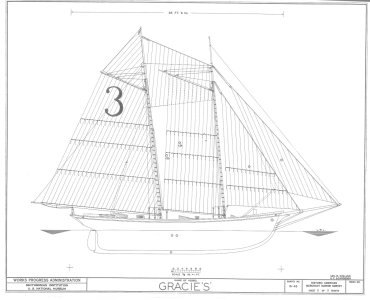
west coast

_0007.jpg

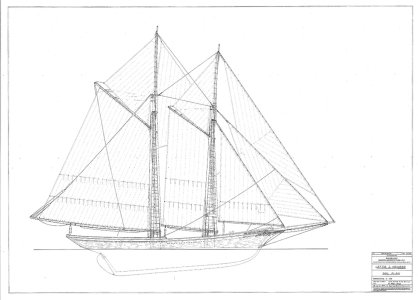
on the east coast

19 LGH_SailPlan copy.jpg
 
If you want new people in the hobby and you want to see them approach it in the best manner for the continuance of the hobby (or a certain method of the hobby), providing people with a relatively easy on-boarding point is crucial. That means gathering easily digestible information into a central place (maybe that's what's going on here and I'm just some newbie explaining the already in-place plan?) and having a presentation that is approachable for the aspiring modeller. That's mainly what I was trying to say and please pardon me if all this is completely obvious, I approached this thread trying to be helpful.
You are being helpful!

I am relatively self-taught when it comes to modeling and as such a good deal of learning has come in a randomized way - not like the structured learning that I had learning to be a mathematician nor how I was then able to teach within a mathematics curriculum where there are prerequisites (assumptions) as to what the students would know at any given point. In the modeling realm builders arrive with a much more diverse background and with a wide variety of goals. Comments like yours help remind me of questions and pitfalls that I have dealt with; even more important they serve as a reminder as to the parts of the hobby that I sometimes take for granted but are worthy of being noted.

So thank you for participating in the discussion and I hope remain engaged!

Greg
 
Topic 3 – part 2

Now that a feel for what models Chapelle thought would be good to model, I thought it would be a good time to look at his 1964 publication:

The article focuses on the construction of a model of Robert Fulton’s “Steam Battery”. This was a catamaran-type blockship built during the War of 1812. Chapelle notes that ‘the identity of the first steam man-of-war has been known for many years, … Until recently, the only available drawing of the ship has been a patent drawing made for Robert Fulton. … The lack of plans has heretofore made it impossible to illustrate the vessel with any degree of precision, or to build a scale model.’

He goes on to talk about an important discovery:

“The discovery in 1960 of some plans of this historic ship in the Danish Royal Archives at Copenhagen now makes possible a reasonably accurate reconstruction of the vessel and also clarifies some of the incomplete and often confusing descriptions by contemporary writers.”

The article continues with a history of the difficulties in obtaining funding for the project and the eventual building of the vessel. Unfortunately, Fulton died 24 February 1815, months before the Steam Battery’s first trial run on 10 June 1815. The vessel was never commissioned and was placed into ordinary. In 1921, guns and machinery were removed, and the ship was becoming rotten. Until 1829 she was used as a receiving ship. The Steam Battery met its tragic fate, exploding on 4 June 1829 – at 2:30 p.m. 25 individuals lost their lives and an additional 19 were injured. The explosion had been caused by 2 -1/2 barrels of condemned gunpowder.

Fulton’s “Steam Battery” never was given an official name.


The discovery of the plans had been unexpected. Chapelle had requested inspection of a folio of American ship plans held in the Dansh Royal Archives in order to find information on Civil War river monitors. These plans were not there, but three plans for the Fulton Steam Battery were! The plans had been copied in 1817 and showed lines, inboard profile and arrangement, as well as a sail and rigging plan. This became the basis for a reconstruction and a model. The Steam Battery was over 150 feet long, with a paddle wheel mounted centrally between the two hulls, and had a lateen rig. It was symmetric fore to aft and could be sailed in either direction. It was proposed that the vessel would be manned by a crew of 500 men.

The last portion of the article is concerned with reconstructing the plans. Again, Chapelle notes the important aspects:
  • It was necessary to reconstruct the deck arrangements without enough contemporary description
  • The outboard appearance and hull form, rig, and arrangement of armament require no reconstruction, for all that is of importance is shown in the lines and rig drawings, or in the inboard profile
Chapelle also provides rationale for the choices made in the deck arrangement reconstruction.


Similar to Savannah, I was not aware of Fulton’s “Steam Battery”, nor this interesting article written by Chapelle. Clearly, he endorses this model; and for me, this is an example of a ‘Ship Model that Ought to be Built’.


Thoughts / comments?
 
Topic 4 The Wrap-up

To me, model ship building according to Howard I. Chapelle boils down to just a few simple themes:

  • No accurate knowledge of vessels lines – don’t build a model

  • Accurate lines available – perhaps build a model; but only to your source material
  • Source of lines ranked best to worst
    • take-off
    • builder’s plans
    • original design
  • Model must not be misleading to all who ever see the model

  • Accurate plans are not always easily found
  • However, there are a huge number of plans in existence
  • Build models of lesser known / modeled ships

While pondering these themes, I find it interesting to note that while his guidance nearly requires the modeler to scratch build, Chapelle does not spend time discussing model construction. He does not say a model is better or worse because it is solid hull, fully planked, or framed. Based on what he wrote in Grimwood’s book, I tend to believe that Chapelle does not believe a good model needs to take a long time to build.

Perhaps, I’m reading too much into his philosophy, but I imagine that he would have liked to have seen more people building models of vessels much simpler in nature than the popular ‘man-of-warship’ to help create a more solid historical maritime record. I personally find this a meritorious endeavor!

This will likely be the last ‘topic’ in this Chapelle class, but I hope that more comments / discussion continues to occur, as it is most welcomed.


Thank you for taking the time to follow this thread,

Greg
 
At the time that Chapelle wrote this the Nautical Research Journal where it was covered did not publish articles about kits.

Roger
 
At the time that Chapelle wrote this the Nautical Research Journal where it was covered did not publish articles about kits.

Roger
That is really interesting! Were there multiple articles in NRG related to building models of the very same ship? (You can see from my question that I haven’t purchased the thumb drives with all the back issues!)
 
Source of lines ranked best to worst
  • take-off
  • builder’s plans
  • original design
It is my preference to essay "as designed".
I find take-off or in my case captures, to be irritating. The officer taking off the data and producing the draught was/were lazy bastard(s). The precise location of the deadflat was arbitrary. The stations at 10' intervals (not in any way related to R&S) until the increase in curvature required a shorter station interval. These were also easy to measure 5' then 3' and/or 2'. To frame such a vessel requires a frame thickness does not match establishment scantlings. Most often only 12" width will fit.

If a ship had any kind of lifespan it took on a different appearance as it aged and minor or major repairs were done. A new captain may get a wild hare up his butt and make changes, too.
 
At the time that Chapelle wrote this the Nautical Research Journal where it was covered did not publish articles about kits.
Roger


it was the late 1960s when i got involved in model ship building and the early 1970s when i met Bob Bruckshaw and Harold Hahn and became aware of the NRG. Back then kits were not even talked about. Chapelle's philosophy set the stage for the art of model ship building and what it should be.

While pondering these themes, I find it interesting to note that while his guidance nearly requires the modeler to scratch build, Chapelle does not spend time discussing model construction. He does not say a model is better or worse because it is solid hull, fully planked, or framed. Based on what he wrote in Grimwood’s book,

Construction methods were of no concern as Charley McDonald later to become editor of the NRG journal built solid hull models and salvaged old ivory piano keys to plank the hulls. Dave Lawler built whaleback models as solid hulls for the museum. So, it was not how a model was built it was about the accuracy and craftsmanship. Back then ship kits were not even considered a part of model ship building. Even to this day there are the small inner core in any group be it ship modeling or model railroading, RC planes etc that are the scratch builders and would not be caught building a kit.
 
I started in 1971 with the Scientific solid hull decorator model of Sea Witch. Scientific had other vessels - I do not remember seeing a catalog. The kits were simple. The product was more like an actual ship than the Starving Artist type souvenir shop Impressionistic offerings. They were not something that was at all serious. There were at least three US kit mfg.
Model Shipways NJ Their's (his) was a solid hull Basswood or Sugar Pine solid carved hull and a few wood squares, Britannia metal castings, and basic rigging stuff. I am guessing that the pattern following lathe that was the company's core was surplus WWII rifle stock carving machine. The plans were fairly detailed and included details not in the kit - for the ambitious. The directions and instructions were Campbell's - Jackstay. I think most if not all of the vessels were from HIC and in one of his books.
Bluejacket CT also solid hull - maybe also HIC plus maybe HAMMS, and Mystic plans library?
A.J.Fisher MI The original provider of kits? I think also carved solid hull.

European kits had not gained a foothold. The quality was somewhere between the cartoon souvenir shop objects and the Scientific very basic kinda close.

Plans were in archives and libraries - direct copies of original plans would have to be an actual photograph mostly unaffordable.
There were a limited number of redrawn and printed plans.

There would be little need to have articles about a kit build. The needed information was either on the plans that came with the kit, or in one of the HowTo books. Kits were pretty much all the same as far as the How To Do It part.

The Nautical Research Journal was attempting to be just that. Publishing research, resurrecting lost and obscure original data, demonstrating advanced skills - all without having a staff of well paid academic professionals. Time, copier tech, a large enough market for support reprints of ancient texts
In its present morph setting the only thing that the NRJ now has in common with original NRJ content and objectives is that it is still "nautical". In place of academic research there is fantasy, fiction, pandering.
"Guild" and kits are pretty much mutually exclusive.
 
This will likely be the last ‘topic’ in this Chapelle class, but I hope that more comments / discussion continues to occur, as it is most welcomed.
Thank you for taking the time to follow this thread,
Greg


Beyond Chapelle and the evolution of model ship building

i would assume it was to Howard Chapelle's delight to see the formation of a formal guild of model shipwrights and he stepped up to lay the foundations of what it should be. Back in the early 1970s scratch builders outnumbered kit builders by a large margin i suspect because there were few kits available other than simple solid hull kits. The first introduction to kits other than the available solid hulls came from Milt Roth and his business the Dromedary and P.C. Coker who began to offer what was then advertised as plank on frame museum quality model ship kits. The reality was plank on bulkhead and far from museum quality. I remember the rise against kits because they were made up ships, based on shotty research, poor quality materials, out of scale, bad quality fittings and in general not as advertised. They were considered the bane of model ship building. In the early times of the Lumber yard for model shipwrights i spent endless hours milling wood for kit builders who tossed out the poor-quality wood and replacing it hoping for a better model. The birth of kit bashing and semi scratch building became the trend. The trend began to fade when builders realized paying for the kit then tossing out the supplied wood and the cost to replace it, then having to either remake the fittings or buy a better quality. A realization you are now scratch building on a bad designed plank on bulkhead structure. Then came Harold Hahn who offered true plank on frame plans and a building system that made it possible for a first-time scratch builder to actually build a model ship, once again kits were kicked to the curb as cheap, easy hobby level toys and not considered in the arena of real model ship building. The industry of wooden ship kits saw the writing on the wall and to survive the on slot of bad reviews had to improve or die. Unfortunately ship model kits were still in the catagory of hobby/toys and governed by that industry and how much they could improve and maintain a reasonable price range. You do not go into Hobby Lobby and expect to see a model ship kit with a price tag of $1,300.00. It is unacceptable for the people that go to places like a hobby/craft store. That is like building a 2-million-dollar home in a neighborhood of homes in the 50K range it is just out of place.

Where it stands now and where is it going you tell me
 
Where it stands now and where is it going you tell me

Where it is going is hard to figure out, but then again, what is the point to even try to figure it out and why would we even actually care...

It is obvious that people keep buying that stuff, no matter what at this point, but eventually the reaction to the price tag will become more vocal and these people, if they keep buying, will keep complaining that the price is going up without the expected improvements. Once people cannot afford a “decent” kit at a decent price, the people dedicated to the Ship Modeling Building Hobby will turn the clock back, for the most dedicated builders, and the rest will just find a cheaper hobby to partake in. Which brings me to a point I have made somewhere in an earlier conversation about this; it is a first world problem related to disposable income and free time to fill.

That is how far dedication goes for most kit builders, as it seems to be based on affordability, ease of access and quick results.
As for the scratch builder, dedication seems to be a more serious attribute.

This said, I would think that a lot of people dedicated to kit building seem to have unconsciously resolved the problem by having amassed numerous boxes through a life time of planning their next quick build.
Might seem a bit harsh but...
Do not my word for it, it is just one guy's opinion.
G.
 
Last edited:
Where it is going is hard to figure out, but then again, what is the point to even try to figure it out and why would we even actually care...

it is a big so what

what goes around comes around

it began as scratch builders outnumbered the kits by a large margin then it turned and it will turn again.

the kit industry is finite there are only so many kits available and many of them are repeats just another manufactures version of the same subjects because it is a big financial risk and time is money in development, so best stick with proven sales. Kits are limited to what the market will bare in price and that governs the quality. On the flip side scratch building is open ended and the subject material is vast to say the least, material choice and quality is in the hands of the builder and not in the hands of a money-making mass produced product.

BUT and there is a big but

So your thinking about scratch building, running with the big dogs, playing with the big boys, turning you hobby into a fine art, joining the 1% club. I will be straight up and honest with you it is not that easy. First off just because you built a few kits does not qualify you to jump into scratch building, kit building and scratch building are worlds apart. Kit building does not teach you the needed skills in woodworking nor does it teach you how ships are built. You need to have the mind set your starting in square 1 and the perseverance to follow through. A belief, which you may have heard comments on the big investment in tools that are needed is just a myth. i know for a fact Harold Hahn started scratch building with nothing more than a coping saw and hand tools. I started scratch building with hand tools, over a period of time i added a 4 inch disk sander, a Jarmac cheap table saw and a Dermel tool. I bought my sheet stock from Model Expo, mid West products and Warner Woods West and began building from there Later i began to mill my own material. You can start with modeling plans or start with the original drawing of the ship. Starting from original plans you need to know basic drafting and how ships were built and an understanding of the original plans, once again your faced with a steep learning curve.

Kit manufactures may indeed improve their kits with state-of-the-art tooling like CNC or laser cutting 3d printing all the fittings and so on even going as far as precutting the hull planking to shape. A sign of the times and indeed a realization that what you're doing is actually just assembly, there is very little skill left for the builder. With all these hi-tech tools and provided parts model ship kits are becoming the Legos of model ship building, a child could build the kit, no skill or knowledge of the subject is required.

the glaring truth about scratch building is it’s not for everyone because it demands skill and experience, that is why scratch building is the 1% club. it requires dedication to the art, developing a number of skills over time, and knowledge of the subject that is far beyond kit instructions.

so you're thinking about scratch building give it some deep thought it is a long hard road. but in the end the personal satisfaction can never ever be matched from building a predesigned, premade box of parts that you assemble as a mock "model of a ship"

just last week i went to visit a friend selling a pile of Walnut lumber. He invited me in to show me the table he built saying "i got to show you this because i am proud of it" told me how he designed the beautiful legs he created from scratch. Now that is the pride and passion of woodworking and a model of a wooden ship is "woodworking" at its finest level.
for me that is what it is all about and why this school is here to pay it forward so take it or leave it.

What do you expect from this? what do you want to know?

first and foremost is to ask yourself am i up to the challenge.
 
Last edited:
Addendum:

One (last) Howard I. Chapelle document:

HOWARD I. CHAPELLE
General Preliminary Building Specifications
Division of Marine Transportation Smithsonian Institution, Washington, D.C.
(Revised 3-31-1961)


THE INTENT OF THE PLANS AND DETAIL SPECIFICATIONS IS TO PRODUCE AN ACCURATE SCALE MODEL OF MUSEUM-GRADE WORKMANSHIP AND FINISH. THIS SPECIFICATION IS GENERAL AND PRELIMINARY, AND FORMS PART OF A CONTRACT OR PURCHASE AGREEMENT.


The model is to be as complete, in exterior detail, as is agreed in the contract detail specifications or as indicated or shown in the plans.

Models are to be built to a selected scale. It is intended that models in a certain category shall be all the same scale so that, in exhibition, they give a sense of relative size. Small craft models will be made to 1-1/2, 1, 3/4 or 1/2 inch to the foot scale, as directed. Fishing and coasting vessels shall be built to 1/4, 3/8 or 1/2 inch to the foot scale as directed. Large sailing vessels and steamers will be built to 1/8, 3/16 or 1/4 inch to the foot scale as directed. Unless otherwise agreed, models are to be built to the scale of the plans furnished to the builder and are subject to measurement and templating upon delivery, prior to final acceptance.

HULL

The hull form is to be shaped (using the "lift" construction method, planked, or planked over moulds or as otherwise agreed) with great precision using accurate templates for level lines, buttocks and sections; and the model hull will be checked by the curator or his aid prior to finishing to be certain the hull agrees with the lines drawing. 2 The margin for tolerance is 2 inches to scale in all models built on scales between 1/8 and 1/4 inch; 1 inch to scale on models built on scales between 3/8 and 3/4 inch; 1/2 inch on models built on scales between 3/4 and 1-1/2 inch to the foot. Models built on 1/8 inch scale to be within 4 inches by scale tolerance. The hull will be fair and smooth in all respects and fully templated in building to insure accuracy and shall be fitted with head rails, trailboards, knees, quarter galleries, ports, scuppers, chesstrees, sheathing, stern windows, deadlights, and moudlings in correct scale as shown in the plans or as otherwise directed. Parts may be made of brass if strength requires. The deck plank may be marked or the deck laid, as agreed upon in the contract or purchase agreement, without showing butts or too wide a seam. 3 Deck machinery or fittings to be as shown in the plans or as otherwise indicated. Hull and fittings to be properly painted or finished as directed in the detail specifications.

RIGGING -

To be to scale and of good and lasting material or proper appearance and color, so far as is possible. Rigging to be done to agree with instructions, as to source reference and methods, contained in detail specifications. Mast metal work to be to correct scale and properly proportioned, "faked" only where it cannot be made to scale or where it does not show when model is rigged. The workmanship to be of museum quality throughout. Linen, wire, brass chain or other approved materials to be employed, as suitable.

MATERIALS

The model hulls, deck furniture and spar work to be of well dried lumber, preferably white pine or poplar and the glue employed is to be damp resistant or "water proof". 5 Metal work to be of brass, copper or other approved material, as work requires. The use of white or "pot" metal is restricted to those portions of the metal work agreed upon in the contract or purchase agreement. Castings to be of copper or brass. 6 Rigging to be of brass chain, soft iron wire, 7 linen twine or other approved material, properly coated or painted as work requires. Lead or plastic are not acceptable for hull or spar fittings. Spars under 3/16" diameter to be of brass, not wood.

PAINTING

To be of approved colors and flat, no gloss or egg-shell finish paint to be employed unless specified in plans or detail specifications. To be of high grade material and properly mixed for metal work.

HALF-MODELS

These are to be made on the lift principle with great precision to the tolerance stated earlier in this general specification. The hull is to be carefully templated for sections, buttocks and level lines and is to be deck level. The outboard of the hull and deck furniture to be fitted with mouldings, carvings, lights, etc., as shown in plans. Stub masts are to be shown in correct position in rake, in half-section. Usually full length bowsprit and main or mizzen boom, in half-section, will be mounted with the model on the backboard, along with cutwater, keel, rudder, screw, stack, etc. as plans require. The whole are to be painted and finished as in original vessel or boat, as shown in plans and detail specifications. If model is to be planked, seams are to be laid off as in the full-size vessel or boat, complete with butts and stealers, wales, mouldings and cove or stripe lines, coppered if required. Backboard is to be painted or polished wood.

CARVINGS

To be artistically formed and neatly made, fitted as shown in plans, with great precision, and correct scale to size.

FIGURES

If human figures are required, they are to be of proper scale and proportion and dressed in contemporary fashion to the boat or vessel, as of her date of construction. Material and fastening or disposal on deck to be as agreed in contract.

SAILS

Will be made of lasting and suitable textile such as linen or as directed in the contract, detail specifications. If not set, sails to be furled on the spars, but if set the sails must be sewn or marked to represent cloths and patches, reef and reef bands and be complete as to appearance.

MECHANICAL MODELS

Where model is required to show machinery, the latter is to be built of metal or plastic, and is to be of accurate scale and proportion and properly assembled in working, or apparent working order, as the detail specification and plans require.

MOUNTING

Ship models are to be mounted on keel blocks and bolted to base board, or set in a proper cradle. All mounting chocks, blocks and base board to be of dry lumber: mahogany, white pine or other approved lumber, smooth and well sanded and painted or varnished as required.


AMENDMENTS:

(1) SCALE
- the same application should be applied towards the use of the metric system. (2) HULL - Plank or Frame vs. Plank on Bulkhead: due to the wide spacing of bulkheads on the normal kit model, flats normally appear even in the best of model construction, especially in areas requiring large or complicated bends. Completely framed models are much better in this regard, and allow for portions of the hull to be left unplanked without undue distraction.

(3) DECK PLANKING - on small scales only (3/32, 1/16, etc.), all others should show butts. Over emphasis on small scale deck work should not distract from remainder of model.

(4) SAILS - Preferably none, though suitable linen cloths can be employed for scales 1 /4'' or greater. If employed, all details must be shown, reefs, reef bands, etc.

(5) MATERIALS - deck furniture should be made from close grained hardwoods (pear, etc.). (6) CASTINGS - can also be made of other approved metals.

(7) IRON WIRE - this may rust. One should use anodized tin wire instead.

(8) BRASS YARDS - optional, use of close grain hardwood o.k.

(9) GLOSS PAINT - Paint finish should not be a high gloss: flat, egg-shell, semi-gloss, and satin or their combinations are preferred.

 
Back
Top