• Win a Free Custom Engraved Brass Coin!!!
    As a way to introduce our brass coins to the community, we will raffle off a free coin during the month of August. Follow link ABOVE for instructions for entering.

The Donald David, a Maine Lobster Boat, launched 1956

I am ready to mount the rudder controller into the Donald David. but the supplier did not include any connecting rod for it. I have some excellent metal wire that I plan to use but I don't know the proper connection for the rod (or rods). Any recommendations would be greatly appreciated.
Happy Modeling
Steven

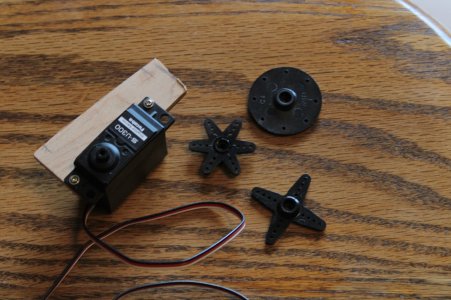
Servo, S-U300 (2).JPG
 
Hi Steven,
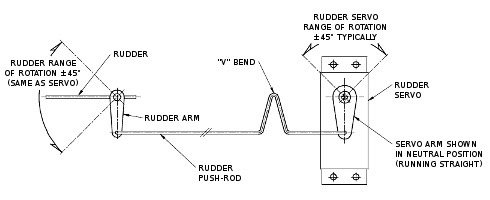
Bent stiff wire is adequate, it is usually a good idea to have a dog leg bent into one end with the other end bent at right angels.

The only problem with the bent wire is a lack of fine adjustment, you might be alright because you haven't installed your servo yet.

With the bent wire idea I am assuming that you have complete access to the rudder arm once the model is finished. If that is not the case I would tend to go for an aircraft type of linkage these have the added benefit of adjustability.

I hope this helps.

Cheers,
Stephen.
 
Thanks for the info, Stephen. My current thought is to place the servo close to the hull on one side or the other. I think that will be the best angle available to me for the existing location of the rudder. I like your suggestion about bending of the rudder. I appreciate your help.
Happy modeling.
Steven

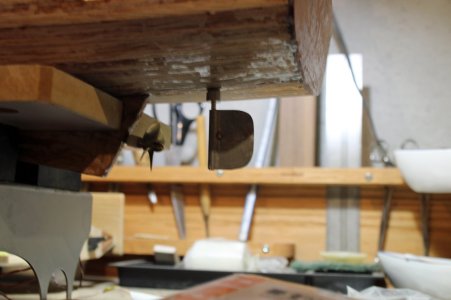
I Just got your image of the rudder assembly. It is excellent and greatly appreciated.
 
The best way for the linkage is to use a metal aircraft clevis and a threaded push rod. You can use a bent end on one end and the thread clevis on the other which will give you adjustability.
A quick search on Amazon for metal aircraft clevis will result in lots of option for the RC aircraft hobby. Even better if you have a local hobby shop that carries RC aircraft should have anything you need.
 
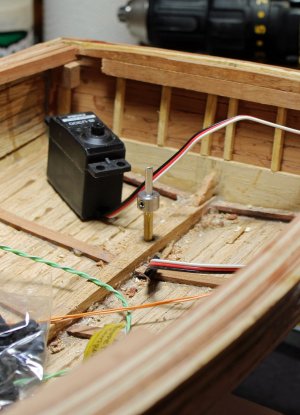
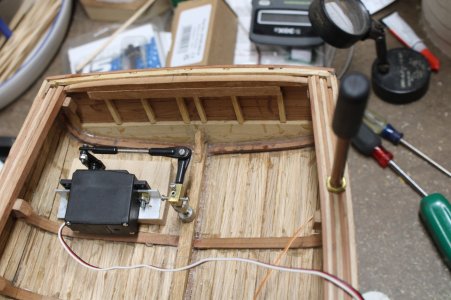
I finally got the the rudder control set up. I tinkered with a number of options and finally settled on the one in this photo. Now I can move on to connecting all the wires to their spots in the control system. And, I can build/attach the foredeck, in a way that I can remove it to take care of all the wires, motors & lights etc. Painting the hull and installing floor boards for the cabin are essentially all that remains, plus making a display stand.

IMG_7782EC.jpg
 
Now that I have gotten through a few weeks of interruptions, I'm back to work on the rudder control. it doing absolutely nothing for me. I have opened the case of the rudder control and it appears be totally damaged. The wires are intact and the power is getting from the power supply to the terminals in the the servo box but not functioning in any way; I believe it is totally dead. Not sure if I want to get it from Hobby Models' the place where I got the damaged one.
 
Now that I have gotten through a few weeks of interruptions, I'm back to work on the rudder control. it doing absolutely nothing for me. I have opened the case of the rudder control and it appears be totally damaged. The wires are intact and the power is getting from the power supply to the terminals in the the servo box but not functioning in any way; I believe it is totally dead. Not sure if I want to get it from Hobby Models' the place where I got the damaged one.
Hi Steve,

That's not good.
Just for clarification are you saying that the servo never worked?
What brand of servo do you have?
Do you have any spare servos you can try in the receiver?

Cheers,
Stephen.
 
It was never tried until now. It is a Futaba, Digital Servo, Model U300. I do have an OLD servo; I'll have to find where I put it. I chose to order the new one only because I don't know how old older one is and I wanted to start out with a new one just to be sure I was doing the best thing for my boat.
 
That is odd that the servo doesn't work. Futaba is generally very reliable, I've been using them for years in my RC ships. I would suggest hooking the servo lead into another Chanel position in your receiver before discarding it. I'm not saying that these servos never fail as they only have plastic gears inside them and sometimes a tooth will break off and jam it, but that would not likely be the case for a brand new one.
 
I did test the three wires of the cable before connecting any power to the servo itself. The cables are fine. Then I connected the colored cables to the servo and to an adjustable power supply that was set to zero volts. No activity on any of wires, up through 3 volts. I didn't try to go any higher voltage because the instructions advised against high voltage on any of the wires. The internal circuit did not look good, but I have no idea if it is good or bad. I an seriously considering just buying a new servo, and requesting a advise from from the company.

 
I did test the three wires of the cable before connecting any power to the servo itself. The cables are fine. Then I connected the colored cables to the servo and to an adjustable power supply that was set to zero volts. No activity on any of wires, up through 3 volts. I didn't try to go any higher voltage because the instructions advised against high voltage on any of the wires. The internal circuit did not look good, but I have no idea if it is good or bad. I an seriously considering just buying a new servo, and requesting a advise from from the company.

I am a bit confused with the statement (I did test the three wires of the cable before connecting any power to the servo itself.) in my experience it is not necessary to do such a thing they are pretty much plug and play.
Did you try operating the servo using radio control through the receiver?

I would suggest that a Digital servo is not really needed an Analogue servo would be sufficient in fact Digital servos can use more power to hold a position.
 
As for the "testing" of the cable, I had connected the cable to a low voltage power supply along with my digital meter and small resistors so that I could check the the cables to see if there were any resistors and/or interconnections involved the set up. They proved to be independent, low resistance cables, as I hoped they would. Kind of an unnecessary task, but I don't like to take chances on things I haven't played with before. Kind of helps prevent me from unknowingly causing a problem on something new.
 
Back
Top