

• Win a Free Custom Engraved Brass Coin!!!
    As a way to introduce our brass coins to the community, we will raffle off a free coin during the month of August. Follow link ABOVE for instructions for entering.

Bluenose I - YuanQuin 1:72 - Loracs (in progress)

@dockattner, thank you for that! I really like this kit so far. The precision of the supplied parts is outstanding... It became a matter of careful execution. There is no struggling with misfitted parts or trying correct loose fit. Very impress by the manufacturer. First time with Pearwood too. Will be hard to work with something else in the future. I guess this and boxwood are moving on top of my list as requirement for a kit.

@RDN1954, crossing my fingers... but "sneak peek" no problem so far. Taken a glue hardening break every 30-45 min or so. One set of frames, set, glue and wait, rinse and repeat.
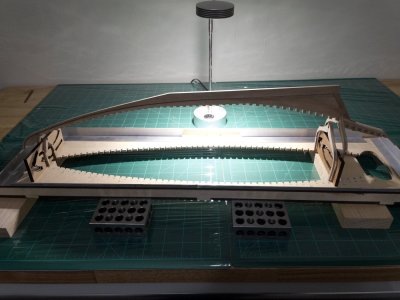
 
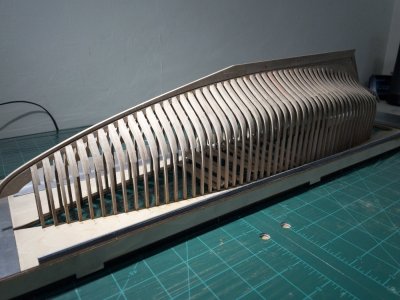
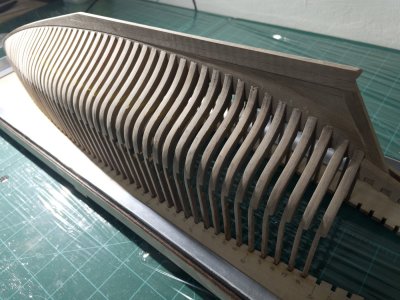
Frames on Keel: Results of the session... I still did not throw the model out of the window. This is good.

As customary with this kit, tolerance is exceptional. It is still a very tight fit... so I go slowly. First credit, on the approach already posted in prior posts on how to deal with the assembly. It was quite useful.

Method 1: sideways, @Peter Voogt posted in #182 of his build log.
Method 2: Front/back, @Daniel20 posted in #166 of his build log.

I use Method 2 so far because there is plenty of room front/back... but that will change as I progress and will change to #1. Other aspects I keep a close watch on as I glue are that the frames a) sit fully on the keel, b) sit flush at the bottom of the jig and c) I monitor the fit of the last back frames (indicative that something is not sitting right).

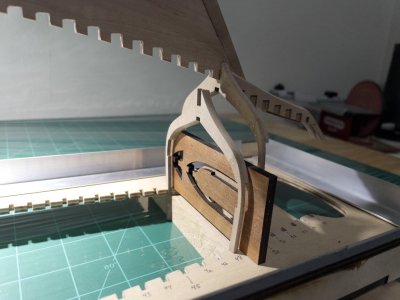
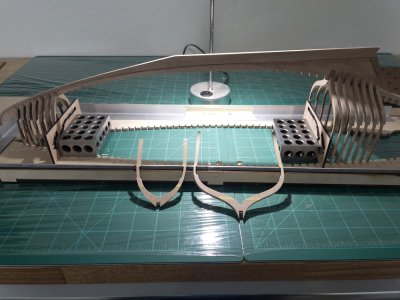
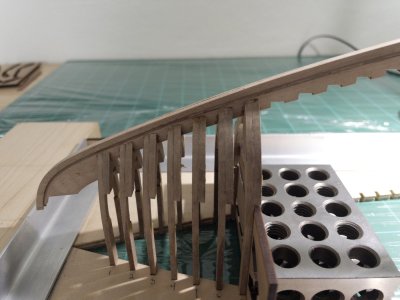
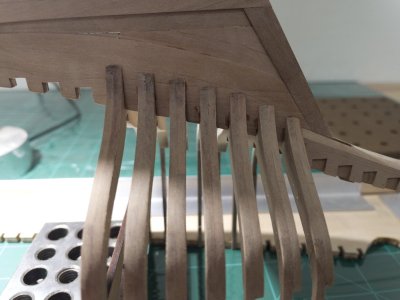
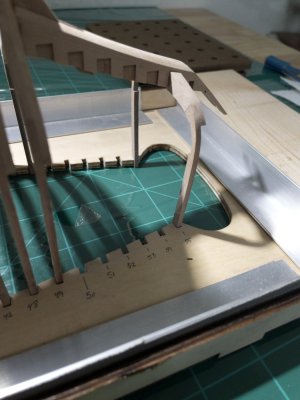
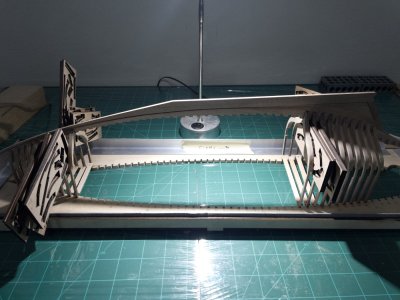
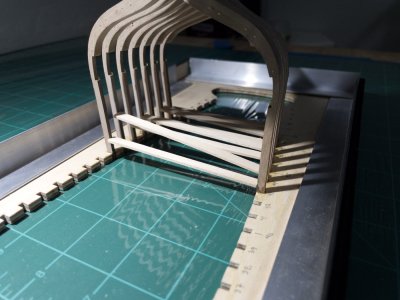
I'm still using Hide glue, so I need to be patient and allow time for the glue to do its work, roughly 1 hr for each pair back and front. Will wait to clean up a little at the end of the assembly. Here are some pictures of the progress.

IMG_3678.jpegIMG_3679.jpegIMG_3684.jpegIMG_3687.jpegIMG_3688.jpegIMG_3689.jpegIMG_3692.jpeg
 
Hello Loracs, I just came across your build here. As a former BN builder your build brings back a lot of memories. I love your airbrush sandblasting technique and am really curious to see how well the Titebond Hide Glue holds up. You have a great looking build and will be delighted to check in on you from time to time.
 
Frames on Keel: Results of the session... I still did not throw the model out of the window. This is good.

As customary with this kit, tolerance is exceptional. It is still a very tight fit... so I go slowly. First credit, on the approach already posted in prior posts on how to deal with the assembly. It was quite useful.

Method 1: sideways, @Peter Voogt posted in #182 of his build log.
Method 2: Front/back, @Daniel20 posted in #166 of his build log.

I use Method 2 so far because there is plenty of room front/back... but that will change as I progress and will change to #1. Other aspects I keep a close watch on as I glue are that the frames a) sit fully on the keel, b) sit flush at the bottom of the jig and c) I monitor the fit of the last back frames (indicative that something is not sitting right).

I'm still using Hide glue, so I need to be patient and allow time for the glue to do its work, roughly 1 hr for each pair back and front. Will wait to clean up a little at the end of the assembly. Here are some pictures of the progress.

View attachment 564658View attachment 564659View attachment 564660View attachment 564661View attachment 564662View attachment 564663View attachment 564664
It’s looking good so far. Nice spiderleg pictures.
Regards, Peter
 
@Daniel20, thank you. So far, I still like the hide glue a lot. In another wood project, I used to glue 5x5mm board together. I had to redo it after it cure (>48 hrs.). Believe me it holds very tightly. It took several rounds of prying/wetting under hot steam to get it apart. However, it came off very cleanly, no damage whatsoever. Another advantage is that hide glue can be reapplied to itself... so no real cleaning necessary beside moist cloth. You can see that I'm a convert. Hehe ;_)

@Peter Voogt, a thousand thanks... I must say that it is reassuring to have peoples with experience with the bluenose keeping an eye on the work. This would likely minimize costly mistakes. Thanks for that.
 
@Daniel20, forgot to mention, sand blasting is quite cool and I prefer to alternatives. Just no risk of changing the parts and it can get everywhere regardless of shape. It is still a pain to do when you have multiple parts. I'm using Badger aluminum oxide now and I don't recycle anymore. After a first use, you round the aluminum oxide, so it gets less effective (take longer). The real pain though, is that you have to reload the brush very frequently. Overall, I still like it... but you have to know what you are getting into.
 
Sandblasting is probably something I will not attempt but I do apricate its novelty and effectiveness. But who knows, I still have a LOT of char removal ahead on my current build and just received my latest model The Oseberg a Viking ship which has a considerable amount of laser cut wood as well.
 
Bracing and spacing of the frames: There is very little play of the frames to the keel but they may still sit at an angle rather than 90 degrees. I'm checking as I go using two of the old plates. Gluing to the jig requires some bracing to hold things in place until the glue sets.

Thanks Peter for mentioning that in your log. Forgot to take pictures yesterday... so here it is.

IMG_3694.jpegIMG_3693.jpeg
 
Last edited:
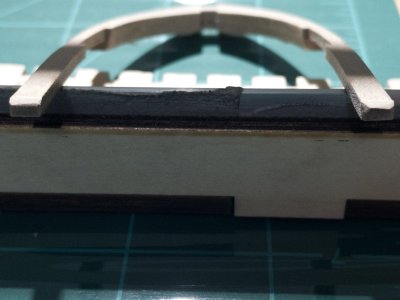
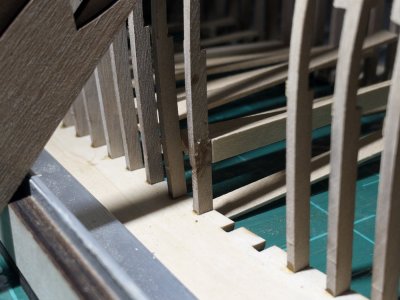
I noticed the char removal on the notches of the jig and the placement of strips to press the frame ends fully into the notches.
The fit of the frames in the notches was somewhat cumbersome; too tight and one risks frame breakage and too loose requires some additional attention...
Your build made me look through my own build log again and made me remember the feeling of accomplishment having all frames on the keel and the beauty of the cathedral view.
Your build log sure enough is going through memory lane for me.
Thumbsup
 
@RDN1954, Char removal on the jig: this is where the sandblaster excels. It literally took less than 15min with no risk of widening. NOTE: does not worth the expense just for that, but if you already have a compressor... the blaster + oxide can be got cheap.
 
I have a general question for all our bluenose fan. I'm debating about the color schema for the outside hull. I love wood color and would rather finish with natural; I'm considering the following:

Accurate reproduction
a) reproduce the final color schema of the bluenose, i.e. Upper black and lower oxide red. Would be staining using keda dyes.

Wood Finish - artistic (edging here)
b) no dye, Upper part in pear wood as provided with the kit (finish with lindseed oil/wax) - a relatively dark color. MY QUESTION: what should I use for the lower portion? pearwood (kit supplied) OR the much lighter boxwood?
 
I have a general question for all our bluenose fan. I'm debating about the color schema for the outside hull. I love wood color and would rather finish with natural; I'm considering the following:

Accurate reproduction
a) reproduce the final color schema of the bluenose, i.e. Upper black and lower oxide red. Would be staining using keda dyes.

Wood Finish - artistic (edging here)
b) no dye, Upper part in pear wood as provided with the kit (finish with lindseed oil/wax) - a relatively dark color. MY QUESTION: what should I use for the lower portion? pearwood (kit supplied) OR the much lighter boxwood?
My solution was applying a very dark, midnight blue and oxide red finish on the fully planked port side and a cherry-colored dy on the "open" side. There are several variations to this theme.
By the way, I applied five full pear wood planks on the open side and left the rest open in order to be able to show the frames.
 
I have a general question for all our bluenose fan. I'm debating about the color schema for the outside hull. I love wood color and would rather finish with natural; I'm considering the following:

Accurate reproduction
a) reproduce the final color schema of the bluenose, i.e. Upper black and lower oxide red. Would be staining using keda dyes.

Wood Finish - artistic (edging here)
b) no dye, Upper part in pear wood as provided with the kit (finish with lindseed oil/wax) - a relatively dark color. MY QUESTION: what should I use for the lower portion? pearwood (kit supplied) OR the much lighter boxwood?
I used Vallejo Night Blue Game Color 72.019 from the bottom of the main rail base to the bottom of the drain scuppers. I left the pear on the port side natural with just a mat-poly finish, the pear came out so beautiful I decided not to paint the hull with the transparent red. Some natural darkening has occurred over time which just adds to the patina. Of course, this is all purely personal preference. I do not have any experience with boxwood but would like to in the future. Follow the link in my signature section for the outcome.
 
Emergency repairs: I thought I was pretty much out of the woods so close to the end... then the dreaded - that we learn to hate - CRACK. Yep, one of the frame legs snapped along the grain (after it was glued to the keel - could not easily remove). Crazy glue to the rescue and hold with fingers.

The only consolation is that it is below the final cut point. If it last until re-enforced with planking, it should not show.

IMG_3697.jpeg
 
Back
Top