
-

SUBSCRIBE TO SHIPS IN SCALE TODAY!
The beloved Ships in Scale Magazine is back and charting a new course for 2026!
Discover new skills, new techniques, and new inspirations in every issue.
NOTE THAT OUR NEXT ISSUE WILL BE July/August 2026 -

Win a Free Custom Engraved Brass Coin!!!
As a way to introduce our brass coins to the community, we will raffle off a free coin during the month of August. Follow link ABOVE for instructions for entering.


- Home
- Forums
- Ships of Scale Group Builds and Projects
- Bluenose PoF Group Build
- Bluenose Group Build Logs
You are using an out of date browser. It may not display this or other websites correctly.
You should upgrade or use an alternative browser.
You should upgrade or use an alternative browser.
Bluenose I - YuanQuin 1:72 - Loracs (in progress)

Hi Loracs.@Peter Voogt, greeting. I have a quick question: what width planks are you using for the bottom ceiling?
I figured that the lower and upper decks are with planks of 3mm width x 1 mm thick (simply looking at what is provided in the kit). Is the ceiling planks 4mm x 1mm like the outside (supplied by the kit) or the same than the decks?
For the interior trim, I was primarily inspired by Jenson's "Saga," which you mentioned on your first page. Specifically, this drawing on page 42:
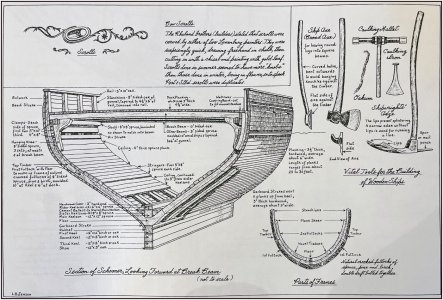
The dimensions for most of the planks and beams are listed there. The "Saga" was, of course, written for the BN-II, but was inspired by the original.
Then there are the drawings on pages 44 through 50 for further inspiration.
Next, I simply looked at my remaining wood stock and made my choices based on that. This is what we in the 'BN Group Build quickly began to call AL-FI: "Artistic License" and "Free Interpretation.".
Hopefully this will give you a satisfactory answer?
Regards, Peter

- Joined
- Jul 11, 2023
- Messages
- 483
- Points
- 278

@Peter Voogt, a thousand thanks... I was (am) a little confused because of the discrepancy between the dimension in the Saga and the one provided by the kit. I keep asking myself, am I missing something?
For example: the Saga mentioned outside planking at 6-inch average (2.1mm at 1:72) while the kit planks are average 4.2mm. OR deck plancking at 4.75-inch, which translate to 1.67mm at 1:72, while the kit deck is 3mm.
I'm assuming if I keep the same overall proportion all is fine. I'm ok to take some liberty here, I would rather prefer working with larger boards.
For example: the Saga mentioned outside planking at 6-inch average (2.1mm at 1:72) while the kit planks are average 4.2mm. OR deck plancking at 4.75-inch, which translate to 1.67mm at 1:72, while the kit deck is 3mm.
I'm assuming if I keep the same overall proportion all is fine. I'm ok to take some liberty here, I would rather prefer working with larger boards.
Last edited:
Working in this 1:72 scale requires compromises. It also depends on your skills, tools, and materials. The dimensions for all the parts ultimately fell within these 3 variables.@Peter Voogt, a thousand thanks... I was (am) a little confused because of the discrepancy between the dimension in the Saga and the one provided by the kit. I keep asking myself, am I missing something?
For example: the Saga mentioned outside planking at 6-inch average (2.1mm at 1:72) while the kit planks are average 4.2mm. OR deck plancking at 4.75-inch, which translate to 1.67mm at 1:72, while the kit deck is 3mm.
I'm assuming if I keep the same overall proportion all is fine. I'm ok to take some liberty here, I would rather prefer working with larger boards.
It's also a balancing act between ratio and reason. Often, it was a compromise between the kit's material and the 'Saga'. The Proxxon saw table became my friend.
Regards, Peter
Last edited:

- Joined
- Jul 11, 2023
- Messages
- 483
- Points
- 278
Bolts on the frames: The work is now completed. However, I came across a small issue that I would like to resolve in the future. I drilled holes with a 0.6mm HSS steel bits all the way thru (5mm thick pearwood), using the same bit until it broke. What I noticed thought is that, at time, it is not quite vertical but slightly angle. This makes inserting the brass wire a pain. I'm wondering the reason.
1. Was it the Foredom alignment? I'm using a digital angle finder to align it on both axes carefully. Many holes are straight in a set... others are not though.
2. HSS bit just too flexible, thus creating a potential issue? especially when getting warmer after multiple drilling.
3. Is it because the bit is getting dull over time? thus has more likelihood to follow a path of less resistance in the wood.
4 Does drilling speed matter (Foredom is variable speed)? too slow or too fast? currently, it is very slightly burning the wood.
Would using carbide steel be better overall even if more likely to snap? Your experience all is much welcome.
1. Was it the Foredom alignment? I'm using a digital angle finder to align it on both axes carefully. Many holes are straight in a set... others are not though.
2. HSS bit just too flexible, thus creating a potential issue? especially when getting warmer after multiple drilling.
3. Is it because the bit is getting dull over time? thus has more likelihood to follow a path of less resistance in the wood.
4 Does drilling speed matter (Foredom is variable speed)? too slow or too fast? currently, it is very slightly burning the wood.
Would using carbide steel be better overall even if more likely to snap? Your experience all is much welcome.

- Joined
- Sep 3, 2021
- Messages
- 5,227
- Points
- 738

0,6 Dia drills are a nightmare. They are (too) flexible and once dull, the issue worsens. If you observe burning marks, chances are you applied too much pressure on the drill. Drilling 0,6 mm holes I use a hand drill and try to avoid applying to much pressure. Having said that, breaking 0,6mm drills remains a frequent occurrence.Bolts on the frames: The work is now completed. However, I came across a small issue that I would like to resolve in the future. I drilled holes with a 0.6mm HSS steel bits all the way thru (5mm thick pearwood), using the same bit until it broke. What I noticed thought is that, at time, it is not quite vertical but slightly angle. This makes inserting the brass wire a pain. I'm wondering the reason.
1. Was it the Foredom alignment? I'm using a digital angle finder to align it on both axes carefully. Many holes are straight in a set... others are not though.
2. HSS bit just too flexible, thus creating a potential issue? especially when getting warmer after multiple drilling.
3. Is it because the bit is getting dull over time? thus has more likelihood to follow a path of less resistance in the wood.
4 Does drilling speed matter (Foredom is variable speed)? too slow or too fast? currently, it is very slightly burning the wood.
Would using carbide steel be better overall even if more likely to snap? Your experience all is much welcome.

I'm a bit jealous, on frame 24 and getting sandpaper rash. Haven't decided yet if I want to fit bolt heads.Thank you for the tips... all the frames are now done but there more drilling to come. ;-)
- Joined
- Jul 11, 2023
- Messages
- 483
- Points
- 278
@Pat D, Sanding is getting easier as you progress thru the frames. We are not in any rush... just enjoy! One of my eyes is acting up lately, which force me to slow down a little... for now. :_)
I like the addition of bolt heads, but frankly bluenose builders are likely to be the only one noticing. Regardless, this is my first venture into bolts and treenails... I had to do it on at least one build.
I like the addition of bolt heads, but frankly bluenose builders are likely to be the only one noticing. Regardless, this is my first venture into bolts and treenails... I had to do it on at least one build.
- Joined
- Jul 11, 2023
- Messages
- 483
- Points
- 278
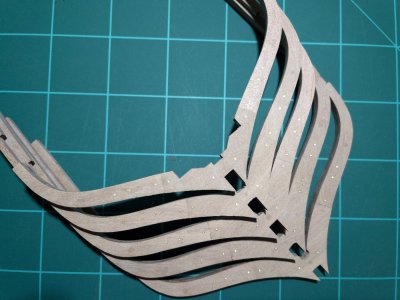
Semi-final fairing: For each frame, I decided to get a lot closer to the final fairing line. That means a lot of careful, manual sanding. Next, I transferred from the plan, the cut lines and the position of the bearing beam.
Lastly, a new addition to the shipyard: a height-adjustable table. It is very sturdy, high quality and built like a tank. Those of you in the US will recognize the brand.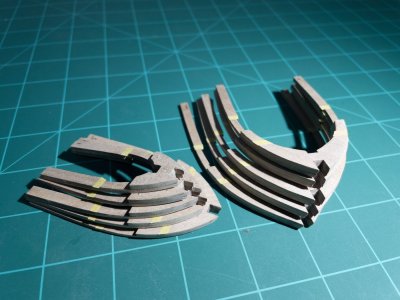
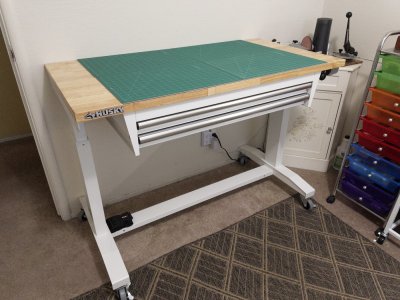
Lastly, a new addition to the shipyard: a height-adjustable table. It is very sturdy, high quality and built like a tank. Those of you in the US will recognize the brand.
- Joined
- Sep 3, 2021
- Messages
- 5,227
- Points
- 738
Bolts definitely look great at frame level, but once completed, there's little to no visibility of the huge effort one has put into installing the boltsI'm a bit jealous, on frame 24 and getting sandpaper rash. Haven't decided yet if I want to fit bolt heads.
I certainly am enjoying this build, it's a high quality kit. I'm also enjoying your log, I've read some good ones but for the first time I understand everything. Regarding marking the lines it looks like you've used tape but won't it need removing to finish sanding and straining if you intend to do so. I scored the lines with a blade, just a thought. Hope your eye clears soon. Pat
- Joined
- Jul 11, 2023
- Messages
- 483
- Points
- 278
Greeting, In fact I'm hoping that it should be easy to remove the tape with forceps once done. I place the tape only to one inner side of the frame and it does not appear to interfere with sanding later. Tamiya tape is quite nice, robust and easy to remove without leaving glue residue.
- Joined
- Jul 11, 2023
- Messages
- 483
- Points
- 278
Evaluating Wood Finish: I was planning on trying linseed oil but read that it will yellow over time... which I would prefer not (unpredictable). So I tried Shellac application. I used 4 varieties I had on hand. There is not a huge difference on Pear. The only concern I have is that the carbon stain seems to be more apparent than with poly only.
What do you think? Shellac or poly?
Middle area: polyurethane matte
a) Platina
b) Orange
c) Ruby
d) Garnet
What do you think? Shellac or poly?
Middle area: polyurethane matte
a) Platina
b) Orange
c) Ruby
d) Garnet
My BN has been coated with (boiled) linseed oil for over three years now and there's no trace of a yellow cast.I was planning on trying linseed oil but read that it will yellow over time...
You shouldn't apply it as a coat with a brush. It's too thick and is the possible cause of discoloration. Use it on a damp piece of cloth and rub it as a smooth even thin layer. With more thin layer you can build up the coloring.
Perhaps it is clear what my choice would be......

Regards, Peter
- Joined
- Jul 11, 2023
- Messages
- 483
- Points
- 278
@Peter Voogt , thanks for sharing your experience. I was convinced after seen your, the "possible" yellowing was the only deterrent. I have my eye on this, a little pricy but would last forever.

- Joined
- Jul 11, 2023
- Messages
- 483
- Points
- 278
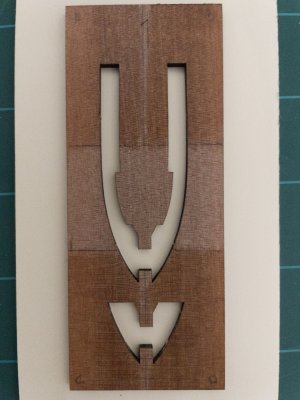
Pear Wood with Linseed Oil: Testing finishes is a never ending story. @Peter Voogt convinced me to try Linseed Oil. I finally got some "Tried and True" Original wood finish. It is a mix of Linseed Oil and beeswax. Expensive but received praise for the quality of their products. So I took the jump...
I'm very glad I did. It applies easily and the wood color is... so nice. The sheen is perfect for me. Semi-Matte: in between matte and semi-gloss. Overall, I'm sold. Here's an example. The middle area is aged wood, while the edge is more fresh. This is how the plate is. The tone variation is warm. Not sure if the picture will reflect the results... but that's all I got.
Note: the bottom third was not treated.

I'm very glad I did. It applies easily and the wood color is... so nice. The sheen is perfect for me. Semi-Matte: in between matte and semi-gloss. Overall, I'm sold. Here's an example. The middle area is aged wood, while the edge is more fresh. This is how the plate is. The tone variation is warm. Not sure if the picture will reflect the results... but that's all I got.
Note: the bottom third was not treated.